Business
Amazon fined nearly $6 million for violations at Inland Empire warehouses

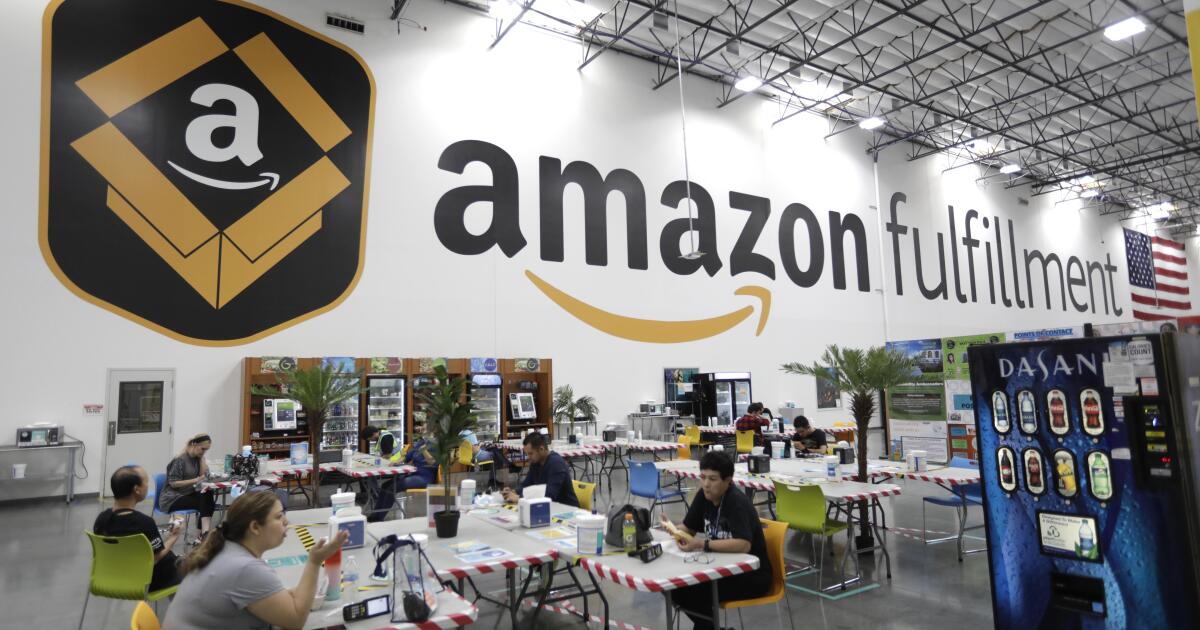
California has fined Amazon nearly $6 million for violating a law meant to protect warehouse workers from misuse of production quotas, state officials announced Tuesday.
The $5.9 million in penalties, which were issued last month, stem from demands that the behemoth e-commerce company placed on thousands of workers at two of its Inland Empire fulfillment centers. The California Labor Commissioner’s Office found that managers at the facilities failed to provide employees with adequate explanations of quotas that they were expected to meet as they prepared orders for shipment.
Mindy Acevedo, staff attorney with the Warehouse Worker Resource Center, an advocacy group, said in a statement released Tuesday that “these citations show Amazon failed to follow fundamental parts of the law.”
The law, AB 701, went into effect at the beginning of 2022 and requires that companies explain in writing the speed at which warehouse workers are expected to complete a certain amount of work as well as the discipline the company may impose for failure to meet the quotas. Under the law, an employee cannot be required to meet a quota that prevents them from taking meal or bathroom breaks and rest periods.
Amazon spokesperson Maureen Lynch Vogel said in an email that the company plans to defend itself against the citations.
“We disagree with the allegations made in the citations and have appealed. The truth is, we don’t have fixed quotas. At Amazon, individual performance is evaluated over a long period of time, in relation to how the entire site’s team is performing,” Vogel said. “Employees can — and are encouraged to — review their performance whenever they wish. They can always talk to a manager if they’re having trouble finding the information.”
The citations include penalties of more than $1.2 million at a warehouse in Redlands and nearly $4.7 million at one in Moreno Valley.
The fines imposed on Amazon are among the first issued by the Labor Commissioner’s Office for failing to provide written quota descriptions to its workers. Since September 2023, the office has handed down $7.8 million in penalties — a total that includes the Amazon fines, according to the Warehouse Worker Resource Center.
The enforcement comes after years of scrutiny over working conditions inside Amazon’s warehouses, including investigations by state and federal agencies into the company’s safety practices. They also come as California has come under fire for failing to enforce labor laws around wage theft and other violations.
Lilia Garcia-Brower, the California Labor Commissioner, said Tuesday at a news conference in Ontario that Amazon had not been singled out for enforcement. Her office, she said, sent out hundreds of letters notifying companies of possible violations and followed up with inspections on companies that failed to respond or comply.
“We are not playing the game of gotcha here,” Garcia-Brower said.
Garcia-Bower said her office will defend the Amazon citation at an appeal hearing. She encouraged workers to reach out to worker centers and other community organizations for help.
“It is so important for workers to come together, understand it is the bad-faith employer who wants you to feel isolated and alone and unfamiliar with your rights.”
At the news conference, Veronica Kern, who has worked at Amazon for seven years, and currently sorts products and loads them onto conveyor belts at the Moreno Valley warehouse, said it “can be a stressful and intense place,” with managers publicly chastising workers when they decide they aren’t working fast enough.
She described her manager telling her she needed to work faster and that she was performing in the bottom 5% of workers. He would stand outside the bathroom and get workers to hurry back to work, she said.
“They started treating us like a number rather than humans,” Kern said.
Kern recalled how managers would show workers real-time productivity data that they said showed them falling short of production targets, but often would not tell workers what those targets were, she said.


WASHINGTON — In congressional races across the country, a new crop of super PACs is taking to the air with millions of dollars worth of advertisements to sway voters.
“President Trump said it best, ‘Celeste Maloy will never let you down,’” says one advertisement supporting the Utah Republican representative in her upcoming primary election.
“Standing up to big pharma, fighting for local jobs, Val Hoyle doesn’t back down,” says an ad backing the Oregon Democratic representative ahead of her primary victory last month.
The super PACs have nondescript names — such as Jobs and Democracy PAC and American Mission — and the text is so generic that it almost seems to have been created by artificial intelligence.
That isn’t so far off the mark. The AI industry has funded the ads.
One network of super PACs is linked to Anthropic, maker of the popular AI tool Claude, and the other to Open AI, maker of ChatGPT.
They have been among the most prolific political spenders so far in the 2026 midterm elections, splashing out more than $37 million to date to influence races across the country and making the groups among the biggest outside spenders so far in congressional races. That number could grow exponentially as campaign season heats up closer to the November election — and as the Silicon Valley giants prepare initial pubic offerings that are poised to raise billions of dollars for the companies and their executives.
The AI political spending boom comes as emerging technology companies have become increasingly “comfortable with using their power to achieve a political goal,” said Adam Kovacevich, a former Google public policy executive and founder of Chamber of Progress, a technology trade group with a progressive orientation.
The leading AI companies have a history.
Anthropic was formed by former OpenAI employees who were concerned that the company was less focused on its original mission to safely harness the power of AI.
The companies are now the leading drivers of the burgeoning AI industry, and their competing views about how the technology should be regulated are playing out in a wide-ranging political ad spending war that has targeted congressional races in big cities and rural areas alike.
OpenAI thinks AI should be regulated solely at the federal level.
Anthropic calls for more stringent regulation and supports efforts by states such as New York and California that have passed more aggressive AI laws.
The groups spending in these races are super PACs, which are able to raise and spend unlimited amounts of money in federal races thanks to the 2010 Citizens United Supreme Court decision.
In some races, the AI-backed political groups have spent more than the candidates they are backing.
“There was no way as a grassroots person that I could compete with that kind of money,” said Al Olszewski, whose opponent in a Montana Republican congressional primary beat him by 30 points after getting a boost from $877,000 in ads from a super PAC backed by OpenAI’s co-founder. “I got crushed.”
The AI behemoths have emphasized that they are independent from the political groups.
One group counts $25 million in support from OpenAI co-founder Greg Brockman and his wife, Anna, alongside $100 million tied to one of Silicon Valley’s biggest venture capital firms, which holds a large stake in OpenAI. The global policy chief for OpenAI was reportedly involved in conceiving the group.
The other side has gotten $20 million from Anthropic and millions more from donors whose identities are not public.
This anonymous political cash is commonly known as dark money, and its prevalence is growing.

(Los Angeles Times photo illustration; source photos courtesy of the Tech Oversight Project)
“This has become very normalized now,” said Brendan Glavin, director of insights at OpenSecrets, which tracks campaign spending. “In 2024, we tracked over $1 billion in dark money.”
That total was $350 million higher than the previous presidential election.
The crypto playbook
The political activity of these AI companies and executives reflects a dramatic shift from how emerging technology companies have historically engaged with politics.
Google, for example, didn’t hire its first in-house Washington lobbyist until after the company had gone public in 2005.
“I think that for a long time, the tech industry lobbying strategy was just ‘leave us alone,’” Kovacevich said.
He sees the spending by these AI-linked super PACs as following the recent playbook developed by the cryptocurrency industry, which has funded the only network of political groups that has spent more on congressional races this year than those linked to OpenAI.
“I think what the crypto industry realized was that there’s no substitute for building up political power,” Kovacevich said.
The political stakes for these technology companies are significant.
“AI policy is far from settled,” said Asad Ramzanali, the former deputy director for strategy in the White House Office of Science and Technology Policy during the Biden administration and the director of artificial intelligence and technology policy at the Vanderbilt Policy Accelerator.
Earlier this month, the Trump administration banned foreign nationals from using the most powerful AI model developed by Anthropic — and even banned the company’s own employees from it — which forced the company to restrict access for all users.
Manhattan matchup
The two super PAC networks have largely shied away from producing ads that mention AI and have mostly chosen to avoid competing against each other in the same races.
There’s one big exception.
In the marquee Manhattan Democratic congressional primary to replace retiring Rep. Jerry Nadler (D-N.Y.), each side has spent millions of dollars.
While the field includes Kennedy scion and social media star Jake Schlossberg and former Republican turned Trump critic George Conway, the target of all the AI-backed spending has been Alex Bores, a former Palantir data scientist who now serves in the New York state Assembly.

New York congressional candidate sponsored a state measure Bores requiring major AI companies to be transparent about their safety protocols and promptly report safety incidents.
(Yuki Iwamura / Associated Press)
That’s because Bores sponsored a state bill, known as the RAISE Act, that requires major AI companies to be transparent about their safety protocols and promptly report safety incidents. The bill was signed into law in December 2025.
The ads sponsored by the group tied to OpenAI, which has spent more than $7.5 million in the race, paint Bores as someone who can’t be trusted.

They cite his support from other tech billionaires, including former crypto mogul and convicted financial fraudster Sam Bankman-Fried, whose super PAC spent $100,000 to support Bores in 2022 when he first ran for New York Assembly.
“Is that really who should be shaping AI safety for our kids?” one ad asks.
An ad sponsored by the Anthropic-backed network, which has also spent more than $7.5 million supporting Bores, makes the case that the bill he sponsored is exactly why he should be elected.
“As a computer engineer, Alex Bores saw how dangerous unregulated AI could be and he wrote New York’s RAISE Act to put real safeguards on A.I. and hold big tech accountable,” the ad says.
The AI ad barrage in New York has even included what might be considered a kumbaya moment in the ad wars — another super PAC created to support Bores is most heavily backed by both an employee of Anthropic and an employee of OpenAI, who both focus on AI safety.
The group, Dream NYC, has spent more than $1.7 million supporting Bores.
Bores and fellow New York State Assemblymember Micah Lasher have been atop the most recent polls in the race ahead of the June 23 primary.

A general view of businesses in St. George, Utah, on Wednesday.
(Ian Maule / For The Times)
Rural Republicans
For voters in many parts of the country, the debate over AI policy has played out locally as a debate over the massive data centers required to power the technology.
In Utah, a proposed data center in Box Elder County, backed by “Shark Tank” television personality Kevin O’Leary, has generated controversy because of questions about its impact on resources in the drought-prone state and its environmental effect on the nearby Great Salt Lake.
In the state’s most competitive Republican congressional primary — the vast, newly drawn 3rd Congressional District — both candidates expressed concerns about how the project has been developed and called for greater transparency in this plan and for future data centers in the state.

Utah congressional candidates Phil Lyman and Celeste Maloy in a debate on June 1. A super PAC backed by Anthropic has spent more than $920,000 to support Maloy.
(Rick Egan / Pool / The Salt Lake Tribune Via Associated Press)
Despite their similar position on the project, a super PAC backed by Anthropic has spent more than $950,000 to support Maloy, who is running in the new district after the boundaries of her old district changed.
“It’s a lot of money to throw at a race,” said her opponent, Phil Lyman, a former conservative Republican state Representative who ran to the right of Utah Republican Gov. Spencer Cox in an unsuccessful primary challenge in 2024.
Lyman insists he is no AI skeptic.
“I’m not anti data centers, I’m pro-transparency,” he said. “I think the future is bright with AI.”
The group said it is backing Maloy because it sees her as “someone who’s worked the issue” of AI regulation and who “has demonstrated leadership” with Republicans in Congress.
Maloy’s campaign didn’t respond to request for comment.
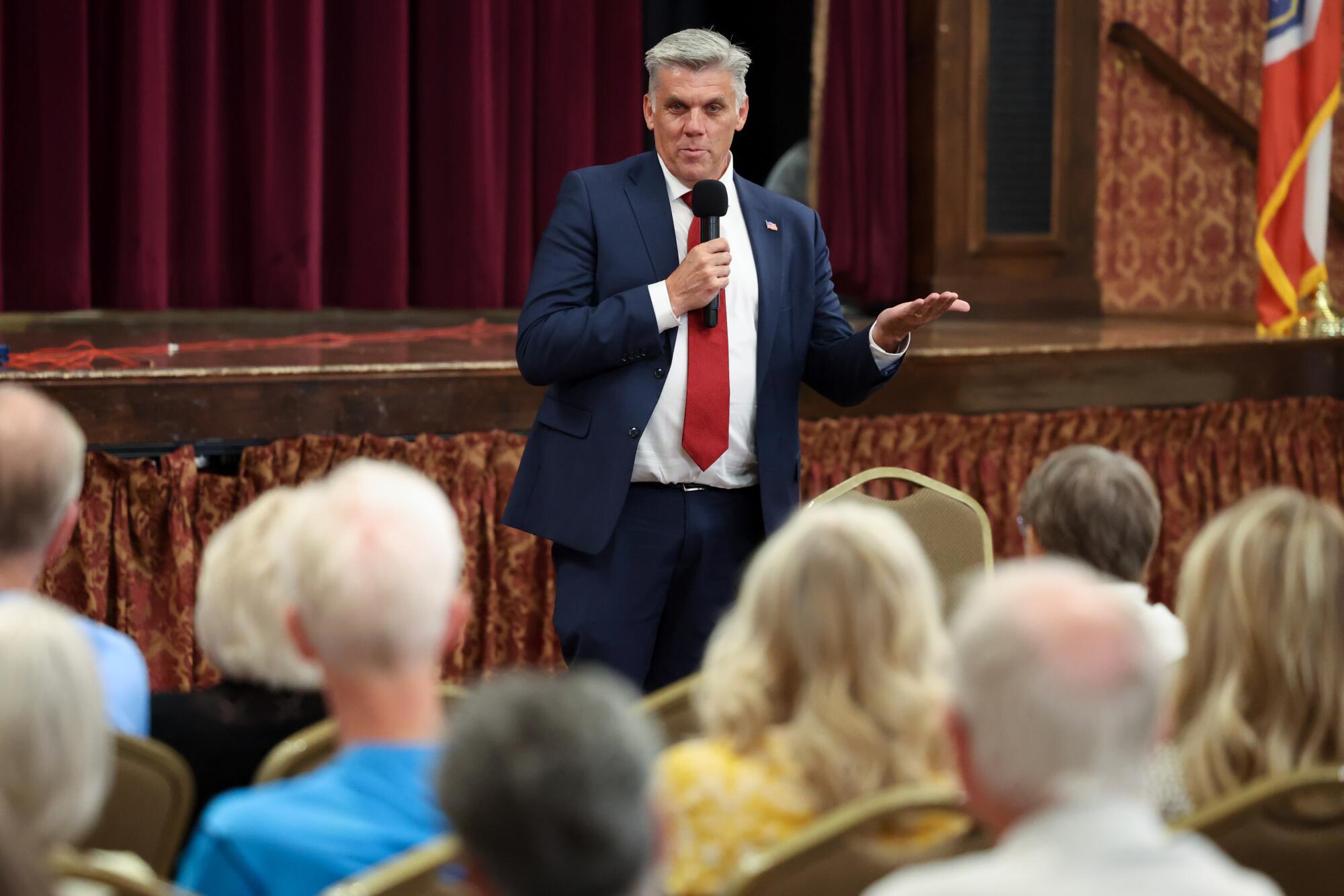
Utah congressional candidate Phil Lyman speaks during a Cottage Meeting at the SunRiver Community Center Ballroom in St. George, Utah, on Wednesday.
(Ian Maule / For The Times)
But Lyman suspects the group’s support for Maloy ahead of their June 23 primary has more to do with old-fashioned politics than any emerging technology.
One of the two co-founders of the political group is Chris Stewart, Maloy’s predecessor in Congress.
“Everything that they’re doing feels very coordinated,” Lyman said. “It makes you wonder if he’s still really controlling that seat.”

A big rig crossed the center divider on the 210 Freeway in Irwindale on Saturday morning, killing one and injuring 30, authorities said.
The mass accident took place before 9 a.m. west of Irwindale Avenue, where emergency personnel arrived to find the truck had collided with several vehicles, the Los Angeles County Fire Department said in a social media post.
One person was pronounced dead at the scene and two were critically injured. Eight minors were taken to the hospital and 22 other crash victims declined treatment, the department said.
The California Highway Patrol temporarily shut down all westbound lanes of the freeway, diverting traffic onto Irwindale Avenue, before opening up one lane.
The CHP issued a SigAlert warning of traffic delays on the westbound lanes, with two lanes on the eastbound side of the freeway also temporarily closed.
The cause of the crash is under investigation.

Ford Motor Co. is suing a prominent Los Angeles lemon law firm for allegedly inflating their fees by as much as 7,000%, the company’s latest attempt to crack down on California attorneys who it says are exploiting the state’s unique law to protect consumers from defective cars.
Quill & Arrow, a personal injury firm that represents drivers suing over so-called “lemons” — vehicles with significant, unfixable manufacturing flaws — has long been a thorn in the side of Ford. Since 2021, Ford said its has paid them more than $100 million, roughly half in attorney fees.
That profit, Ford alleges in a federal lawsuit filed Thursday, came from billing records that were “utter fabrications.”
Quill & Arrow used an overseas “army” of low-paid, non-lawyers to help file thousands of lemon lawsuits and then pretended the work was done by California attorneys, who billed as much as $950 per hour, Ford alleged in its complaint.
Ford claims that the bulk of the work was actually done by non-lawyers in countries such as Mexico and the Philippines, who got paid as little as $13 per hour.
Quill & Arrow was founded in 2019 by attorneys Kevin Jacobson and Jonathan Shirian, according to the firm’s website, which touts recovering $500 million in lemon law payouts. The partners called Ford’s lawsuit “nothing more than an attempt to silence firms who would dare to hold them responsible and seek justice for consumers.”
“It grossly mischaracterizes the facts and the claim that Quill & Arrow created fabricated attorney billing records is absurd,” the firm said in a statement.
California’s lemon law, considered one of the strongest consumer protections in the nation, allows drivers to get a refund or replacement of a broken car if the manufacturer can’t fix it. If the driver is not satisfied, they can sue.
If the driver wins, the law allows attorneys to collect their fees from the car maker — rather than take a percentage of the client’s winnings, as is common in personal injury cases. This fee structure, Ford argues, has turned the law into a bonanza for plaintiff attorneys. The longer the case drags on, the company argues, the more the law firm can reap in profit.
Ford alleges the firm intentionally slowed down its clients’ cases to drive up their billable hours, instructing drivers not to communicate with Ford and pushing them toward filing a lawsuit.
“California’s Lemon Laws are in need of reform and the courts need to exercise more oversight, given the fraud we continue to expose,” said Doug Lampe, counsel at Ford, in a statement. The law is “being blatantly abused by the lemon law plaintiffs lawyers, the bar is not policing its own and the courts need to monitor fee awards with far more skepticism and scrutiny.”
The cases, he said, “have become about the lawyers for the lawyers.”
Lemon law cases have exploded in California in the last decade from about 4,500 cases in 2015 to roughly 30,000 in 2024, according to an analysis from the Assembly Judiciary. These cases, officials warned, “are poised to cripple the entirety of California’s civil justice system.”
In 2024, the legislature tightened the state’s lemon law, requiring additional steps before a driver could sue. The bill seems to have put little dent in the caseload: Lemon lawsuits surged to record levels the following year.
Ford’s lawsuit marks the second attempt by one of America’s largest car manufacturers to go on the offense against lemon law attorneys in Southern California.
Ford sued a cohort of local lemon law firms in May 2025, accusing attorneys of collecting at least $100 million in “phantom legal fees” by billing for hours they never worked. The case, which was brought under the Racketeer Influenced and Corrupt Organizations Act, or RICO, alleged lawyers worked together to file a flurry of fraudulent cases with billable hours that defied logic.
A partner at Knight Law Group, an L.A.-based lemon law firm, once billed an “ostensibly heroic but physically impossible” 57.5-hour workday, Ford alleged.
Knight Law Group denied inflating their billing, calling the suit a “thinly veiled attempt to silence firms who would dare to hold them responsible and seek justice for consumers.”
A judge threw out the suit in March on the grounds that lawyers were protected under the 1st Amendment from being sued for the content of their lawsuits unless the case was proved fraudulent. Ford says it plans to appeal.
After Quill found about the Knight Law Group case, Ford alleged, Quill dedicated a team to “scrubbing” their own timesheets of “impossible time entries.”
-

 Technology18 seconds ago
Sony’s Xperia 1 VIII is still a phone for the fans
-

 World7 minutes ago
Trump-backed ‘El Tigre’ looks to crush cartels, end Colombia’s socialist era in pivotal election
-

 Politics10 minutes ago
Obama Center visitors say project symbolic of ‘Black excellence,’ claim scandal-free legacy while Trump ripped
-

 Health15 minutes ago
Poison centers link growing Benadryl abuse among teens to dangerous social media trends
-

 Sports22 minutes ago
Bryce Harper hits for cycle, Kyle Schwarber blasts three homers in Phillies blowout win over Mets
-

 Technology25 minutes ago
Meta offers paid training for AI data center jobs
-
Business30 minutes ago
‘I got crushed’: AI giants are funding ad wars in races across the country
-
 Entertainment37 minutes ago
A fake mountain and real magic transform Paris’ oldest bridge

