Lifestyle
Françoise Hardy, French pop star and fashion icon, dies at 80

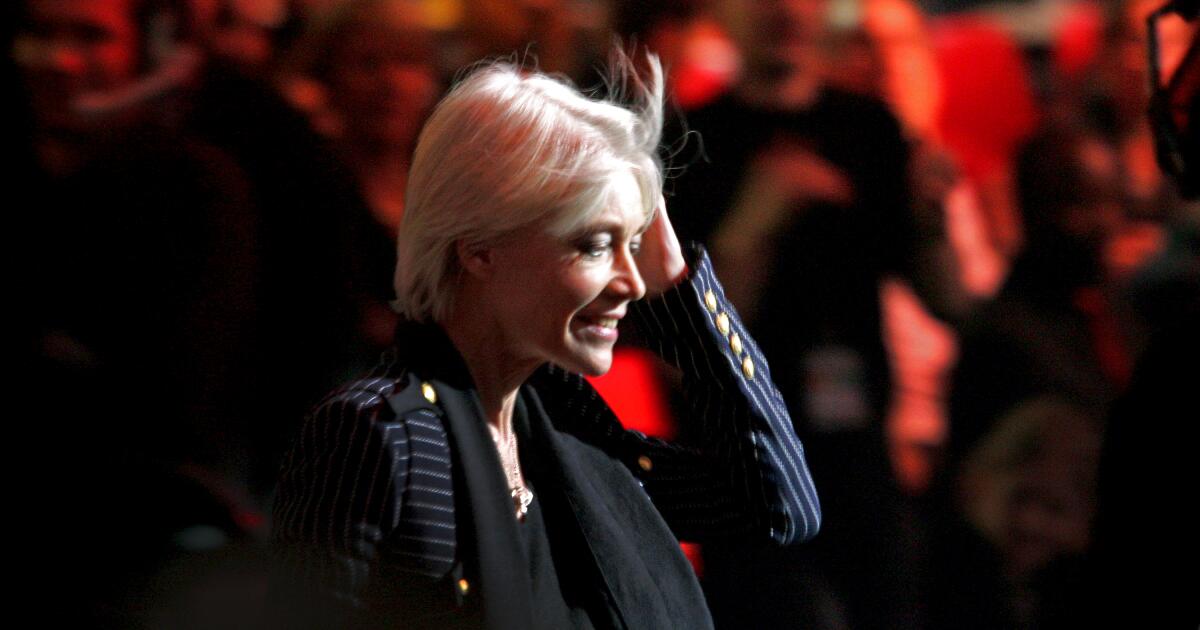
Françoise Hardy, the French chanson singer, songwriter, fashion “It Girl” and darling of the 1960s “yé-yé” French pop movement, has died. She was 80.
Her death was announced Tuesday on Instagram by her son, Thomas Dutronc, who wrote, “Maman est partie” — “Mom is gone” in French — without specifying when or where she died. Hardy said in 2004 that she’d been diagnosed with lymphoma.
A superstar in Paris by the time she turned 20, Hardy released her debut single, “Tous les Garçons et les Filles” (“All the Boys and Girls”), in 1962. Across the following decades, she issued more than 30 studio albums, a body of work that was briefly interrupted by a late 1980s retirement.
Though hardly a household name in America — she sang most of her hits in her native tongue — Hardy was a phenomenon in her homeland, regarded both for her minor-key lyricism and her delicate delivery. She followed her first hit with “Le Temps de L’amour” (“The Time of Love”), which featured spacious, echoed production that captured the spirit of Gene Pitney’s sessions with Phil Spector. Songs including “La Maison Où J’ai Grandi” (“The House Where I Grew Up”) and “Comment te Dire Adieu” (“How to Say Goodbye to You”) pondered the absence of love and, once present, the futility of keeping it.
Director Roger Vadim, left, and stars Françoise Hardy and Jean Claude Brialy attend the premiere of “Château en Suède” (“Castle in Sweden”) in Paris on Nov. 19, 1963.
(Max Micol / Associated Press)
“In music, I like above all the slow, sad melodies, that stir the knife in the wound. Not in a way that plunges, but in a way that uplifts,” Hardy said, according to Frédéric Quinonero’s 2017 biography. “I still aspire to find the heartbreaking melody that will bring tears to my eyes. A melody whose quality gives it a sacred dimension.”
Often dismissed as an artist at the time due to her gender and beauty — a 1967 Reuters article identified her as “France’s sexy long-haired, mini-skirted singing idol” — Hardy drew on her skills as a writer and interpreter to render moot such simplistic descriptions. Her looks and charisma, however, did draw the attention of musicians such as Bob Dylan, the Rolling Stones’ Brian Jones and the French singer Jacques Dutronc.
Many baby boomer music fans, in fact, learned of Hardy not through song but by reading a Dylan poem on the back of his 1964 album, “Another Side of Bob Dylan,” where the seemingly smitten Minnesota bard wrote (in lowercase), “for françoise hardy / at the seine’s edge / a giant shadow / of notre dame / seeks t’ grab my foot / sorbonne students / whirl by on thin bicycles…”

Hardy harnessed her early-1960s singing and songwriting success to become a renowned fashion icon, astrologer and published author. She also appeared in several films, including “Château en Suède” (1963), “What’s New Pussycat?” (1965) and “Grand Prix” (1966). As the decades progressed, her muse pushed her away from the commercially driven yé-yé sound toward pop-focused psychedelia, folk-rock and meditative adult pop.
“From when she was 18, she knew she was different,” producer Erick Benzi, who collaborated with Hardy for two decades, told Uncut in 2018. “She was capable of going in front of big artists like Charles Aznavour and saying, ‘Your song is crap, I don’t want to sing it.’ She never made compromises.”
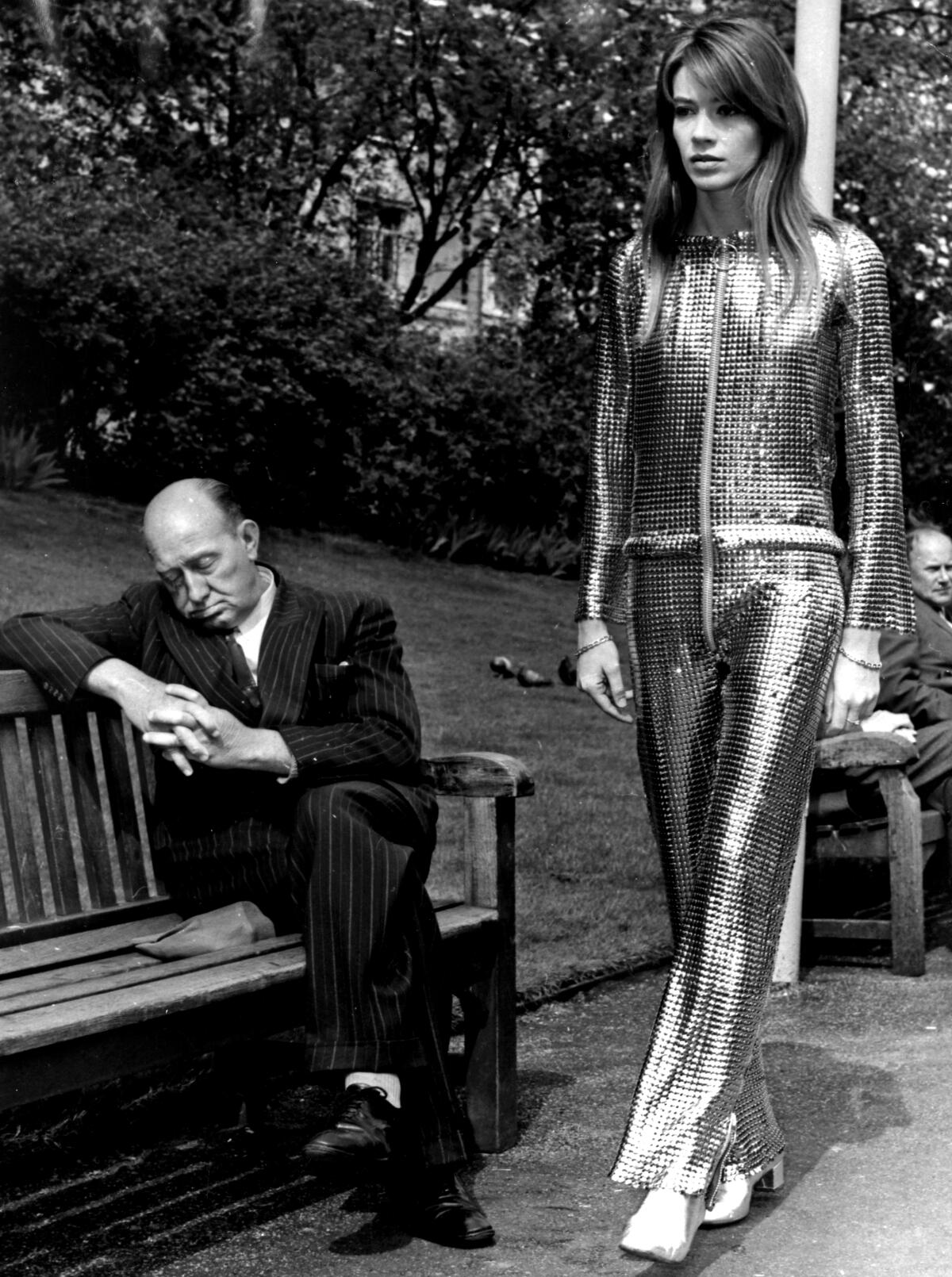
Françoise Hardy strolls through a garden in London in 1968.
(Harris / Associated Press)
Born Jan. 17, 1944, during an air raid amid the final months of Germany’s occupation of France during World War II, Hardy was conceived through an affair between her mother and a much older, well-to-do married man. Her only sibling, sister Michele, arrived a year later.
Despite excelling at school and having a father from a higher social status, Hardy faced an adulthood similar to those of her middle-class peers. At one point as a teen, she recalled in her 2008 memoir, “The Despair of Monkeys and Other Trifles” (published in the U.S. in 2018), “my mother and I conjured up all the realistic careers open to me: executive secretary, medical secretary, nurse, pharmacist.” She added: “In secret I was nurturing the ambition of finding an activity with some connections to the musical style I had recently fallen for.”
When she was a teenager, as a reward for academic success, Hardy’s mother and father offered her a gift of her own choosing. She wavered between a radio and a guitar before going with the latter. “I will never know why I chose a guitar because a transistor radio was all I ever wanted,” she told the Guardian. “My future life would flow out of this crucial choice because, once I had this precious instrument in my hands, I started scratching out three chords over which I sang snatches of my own melodies.”
Alongside peers including Jane Birkin, Brigitte Bardot, France Gall and Sylvie Vartan, Hardy ascended to become a yé-yé hitmaker in her native Paris, drawing the attention of jet-setting pop stars, tastemakers and fashionistas from London, New York and Tokyo. As with other yé-yé singers, Hardy’s music blended mid-1960s bubblegum pop, groovy guitar lines and France’s romantic chanson tradition to create sticky-sweet love songs.
Hardy first visited Los Angeles in 1968 to record her English-language album “En Anglais” (“In English”) — although she had appeared onscreen at the Cinerama Dome two years earlier in John Frankenheimer’s race car movie “Grand Prix” — but never seemed too concerned with stateside success. It didn’t help that she suffered from stage fright.
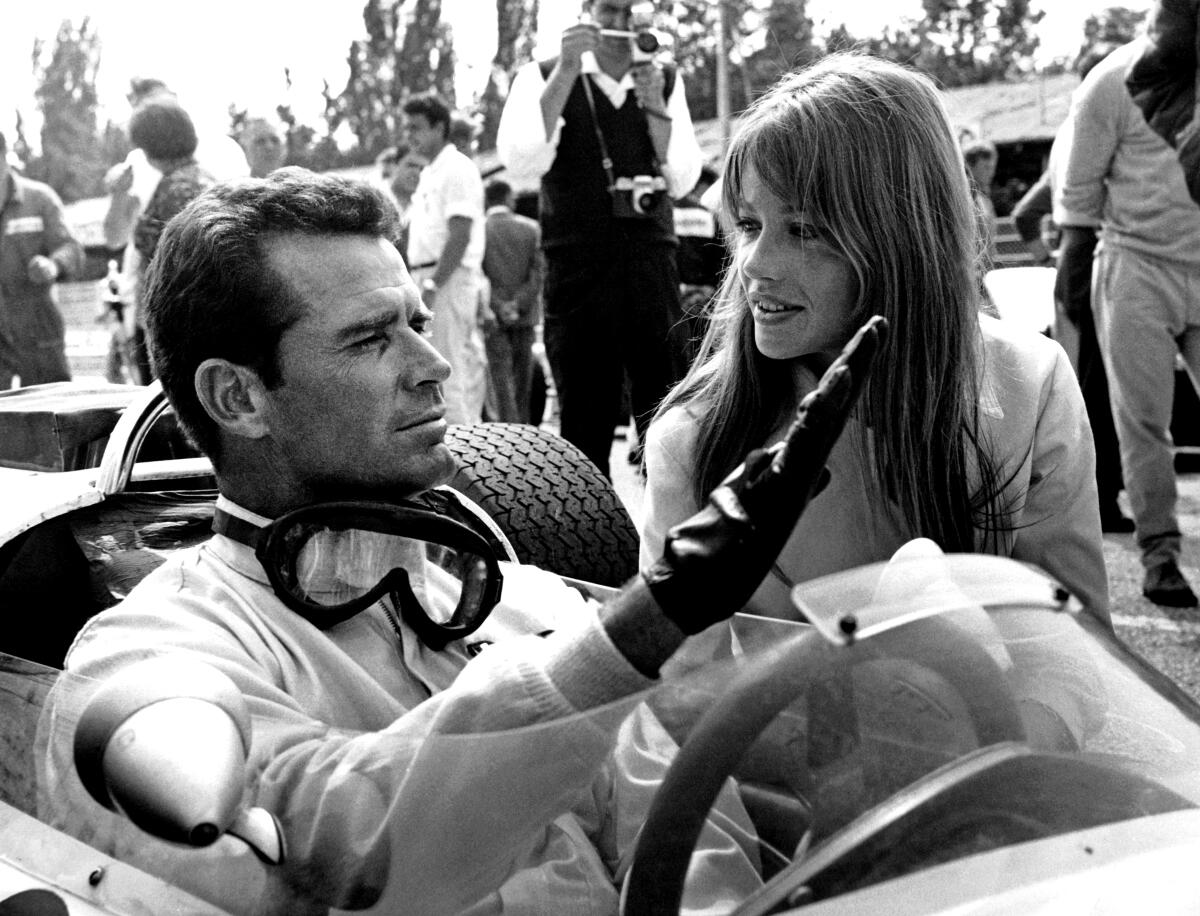
James Garner and Françoise Hardy chat on the set of “Grand Prix” in 1966.
(Keystone-France / Gamma-Keystone / Getty Images)
Her commanding presence drew the attention of the Paris fashion scene and she became a muse to designers such as André Courrèges, Emmanuelle Khanh and Yves Saint Laurent. Current Louis Vuitton creative director Nicolas Ghesquière called Hardy “the very essence of French style,” a trait apparent in the cover photos of Hardy’s first four albums, which were shot by fashion photographer (and then-boyfriend) Jean-Marie Périer.
“My songs had little interest compared to the Anglo-Saxon production. So I took it to heart to dress well every time I went to London or New York,” she told Vanity Fair in 2018, calling herself “above all a fashion ambassador.”
In the late 1960s, Hardy and Jacques Dutronc began a relationship that would last the rest of their lives. Their son, Thomas Dutronc, now a successful French singer, was born in 1973, and Hardy raised him as she continued to release some of her most expansive albums. The title track to ’73’s “Message Personnel” (“Personal Message”) is a gentle exploration of unrequited love and unspoken emotions lush with orchestral arrangements.
Hardy and Dutronc married in 1981 — purely for fiscal reasons, both stressed — but separated in 1988. Despite entering into other relationships, they never divorced and remained close. Her extended family life had its share of tragedy. According to Hardy’s memoir, in 1981 her father, with whom she had had little contact, was killed in his home by a male prostitute. As she also conveyed in her memoir, in the mid-2000s, her sister, who had long struggled with mental illness, died. Though the police investigation never officially confirmed the cause, Hardy believed her sister died by suicide.
Commercial success afforded Hardy the opportunity and time to fully explore her creativity; one main avenue was astrology. Introduced to the belief system in the 1960s, she immersed herself in the various schools of thought, ultimately studying with French writer Jean-Pierre Nicola. Using her fame to advocate for his methods, she eventually became the daily horoscope reader on Radio Monte Carlo. She released her astrology book “Les Rythmes du Zodiaque” (“Rhythms of the Zodiac”) in 2003.
Hardy published her first work of fiction, “L’Amour Fou” (“Crazy Love”) in 2012. Written as a companion to an album of the same name, its success kept her writing. Two books of essays followed in 2015 and 2016.
Hardy’s statements on politics drew ire from French liberals in 2012 when she stated that if Socialist Party candidate François Hollande were able to initiate his proposed 75% tax on millionaires, Hardy would “have to sell my apartment,” adding, “I’ll be on the street.”
Hardy lived long enough to see her recordings rediscovered by a new generation of listeners. She sang on a remix of the Britpop band Blur’s 1994 song “To the End,” and continued to release albums and collaborate with others for the rest of her life. In 2015, the respected archival label Light in the Attic reissued her first four albums. in 2021, Hardy and the French house group Bon Entendeur released an updated version of her early hit “Le Temps de L’amour.”
“No one can sing like Françoise,” Iggy Pop said in 1997 as he and Hardy were promoting their version of “I’ll Be Seeing You.” “Her emotional and musical accuracy combined with her sense of reserve and mystique make an indelible and very French impact on the listener. There’s no one else as good around.”
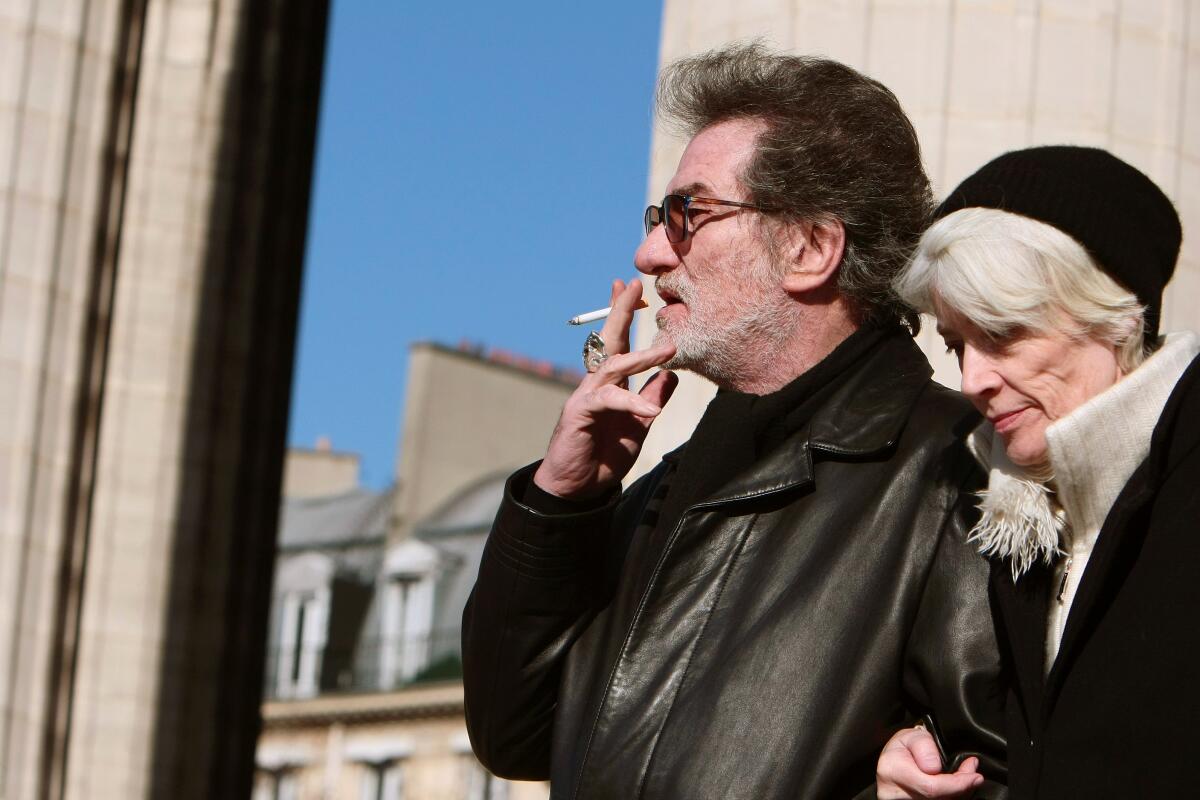
Singer Eddy Mitchell and Françoise Hardy appear together in Paris in 2008.
(Michael Sawyer / Associated Press)
“It has always been a big surprise to me that people, even very good musicians, were moved by my voice,” Hardy told the Guardian. “I know its limitations, I always have. But I have chosen carefully. What a person sings is an expression of what they are. Luckily for me, the most beautiful songs are not happy songs. The songs we remember are the sad, romantic songs.”
Hardy, who survived lymphatic cancer in the mid-2000s, was diagnosed with a malignant tumor in her ear in 2018. Later that year, she explained her situation in an email to the French magazine Femme Actuelle: “My physical suffering has already been so terrible that I am afraid that death will force me to go through even more physical suffering.”
Arguing on behalf of her right to die, she wrote: “It is not for the doctors to accede to each request, but to shorten the unnecessary suffering of an incurable disease from the moment it becomes unbearable.”
For an artist long drawn to the ways in which people cope with grief and sadness, her plight seemed aligned with the themes of her music.
“I sing about death in a very symbolic and even positive way. There is an acceptance there, too,” she told the Guardian. “At my age, I can really only sing about that one very special train that will take me out of this world. But, of course, I am also hoping that it will send me to the stars and help me discover the mystery of the cosmos.”
Hardy is survived by her husband and their son.


A tarp covers the facade of the John F. Kennedy Memorial Center for the Performing Arts in Washington, D.C., on June 13. A federal judge has asked the arts complex’s leadership to explain the purpose of the tarp and the surrounding scaffolding.
Alex Wroblewski/AFP via Getty Images
hide caption
toggle caption
Alex Wroblewski/AFP via Getty Images
On Wednesday, the federal judge overseeing the Kennedy Center lawsuit ordered the center to give him a status report on the center’s operation and programming within the next few weeks. Judge Christopher R. Cooper also said that the Kennedy Center must explain the purpose and status of the tarp and scaffolding that have been placed over the front of the arts complex, where until recently both President Trump and President John F. Kennedy’s names were both displayed.
In a directive issued last Tuesday, Judge Cooper had given Kennedy Center administrators three days to update him on the arts complex’s immediate plans regarding construction, programming and public access. Trump, who now serves as the center’s chairman, had announced July 5 as the date the venue would close for major renovations.

Last Friday, on Cooper’s due date, lawyers for the Kennedy Center filed a request asking for an extension. In that filing, Matt Floca, who was promoted as the center’s president and CEO in March, said that the Kennedy Center’s current management intends to present its board with “an array of options” for trustees to vote on at their next meeting on an unspecified date in mid-July.
According to Floca, the options are a complete closure for extensive renovations; a partial closure “enabling some continued public access and limited programming” while some renovations are undertaken; and “a highly limited series of phased closures to address only the center’s most serious infrastructure needs while scheduling and maintaining a full slate of programming.”
In his newest order, Cooper denied Floca’s request for an extension. And he mandated that the center file a status report within seven days of the center’s July board meeting or by July 31, whichever date is earliest. He also ruled that the report must “indicate the purpose for and status of the tarp and scaffolding,” which were erected by workers over the center’s front signage in the early morning hours of June 13.
When asked for comment Wednesday, the Kennedy Center pointed back to the documents its legal team submitted to the court.
The tarp and scaffolding on the center’s front portico went up after the Kennedy Center’s administration slow-walked the court-mandated removal of President Trump’s name from the front of the center and from all digital materials, which was supposed to happen no later than June 12. Workers removed the lettering overnight into the following morning, hours after the federal court’s original deadline, and covered the center’s sign with a tarpaulin.
As of Monday, the sign remains hidden from the public.

Trump’s name was scrubbed from all of the Kennedy Center’s digital content on June 4, the same day an email order to do so was issued by the complex’s legal team; NPR obtained this memo the day it was sent out to Kennedy Center staff.
These court orders are part of the ongoing lawsuit filed by Rep. Joyce Beatty, D-Ohio, against President Trump and the board of the Kennedy Center. Earlier this year, Cooper ruled that Beatty, an ex-officio member of the Kennedy Center board, must be allowed to participate in board meetings. NPR has asked Beatty if she plans to vote at the July board meeting, but did not receive an immediate response.
It would be very difficult for the Kennedy Center to revive a thriving programming lineup for the months ahead. Over the past year, many prominent artists canceled their planned appearances, citing the politicization of the venue. Most of the center’s programming staff have departed, either via layoffs or resignations. Unlike top administrators at other major performing arts venues around the country, Matt Floca has no experience in artistic direction, fundraising or arts administration; formerly, he was the center’s head of facilities, and he holds a bachelor’s degree in construction management.
Established artists who typically perform at the Kennedy Center generally have their touring schedules set at least a year in advance, if not multiple years ahead. In years past, the center has publicly announced its upcoming season in mid-spring for performances beginning in September and running through the following summer.

Currently, only a handful of outdoor free movie screenings of nostalgic favorites like The Princess Diaries and Clue appear on the center’s calendar of events, along with some participatory workshops for kids. In the past, the Kennedy Center presented over 2,000 arts and education events each year.
The center also recently became ensnarled in litigation with one of its longtime tenants and artistic partners. On June 12, the Washington National Opera, a company formerly in residence at the Kennedy Center, sued the complex for $17 million. It claims that the Kennedy Center had withheld “years’ worth of donor gifts, bequests and endowment funds” that had been intended specifically for the WNO.

Denis Novikov/Getty Images
I tend to romanticize summer. The movies and TV shows I grew up with made me think that the season was about adventure and big-time transformation.
I imagined myself building a tight-knit friend group and getting out of a pickle together, like in The Sandlot or Camp Nowhere. Or traveling across the world, say, to Greece, like Lena Kaligaris, a character in The Sisterhood of the Traveling Pants, having a whirlwind summer romance and returning an entirely different person.
I’ve never actually had a summer like that.
Even when your expectations are more modest than mine, “so often, the summer just flies by, and we haven’t taken the picnics or gone for the day trip or whatever it was that we thought we were gonna do,” says happiness expert Gretchen Rubin.
Rubin, author of The Happiness Project and host of the podcast Happier With Gretchen Rubin, has been sharing ideas on social media about how to make the season more memorable and satisfying.
She walks through four exercises to help you get what you want — and more — out of the season. Print out our worksheet here, fill it out and stick it on your fridge to keep you accountable. Or take a screenshot and post it to Instagram (don’t forget to tag @NPRLifeKit!).
🍑 Give your summer a theme
Pick a single word or phrase that you want to embrace this season — something that captures the feeling you want to have over the next few months.
“My theme for the summer is ‘ketchup,’” Rubin says. “It has a kind of a summer feeling, because you think of putting ketchup on your burger.”
“It’s a metaphor,” she says. It means to look for “whatever I could add [this season] to make something elevated and more fun.”
Meanwhile, my theme word this summer is “juice.” I no longer think that I need to travel far or completely transform to have a delicious summer. I just need to take advantage of the abundance that the season offers: ripe peaches and tomatoes, juicy softball pitches and the opportunity to feel juicy in my body when I wear a bathing suit.

Print out our worksheet here, fill it out and stick it on your fridge to keep you accountable. Or take a screenshot and post it to Instagram (don’t forget to tag @NPRLifeKit!).
Malaka Gharib/NPR
hide caption
toggle caption
Malaka Gharib/NPR
🪣 Create a summer bucket list
What do you want to do this summer? On my bucket list: ride the Ferris wheel at a summer fair, have more barbecues at my parents’ house and see the sunrise at least once.
There might even be something you don’t necessarily want to do but have been trying to accomplish for a long time — like cleaning out the garage or learning how to swim.
“Some people love a long list with a lot of easy things to cross off,” Rubin says. “I’m a fan of that approach myself.”
But some people like a list with fewer goals that are more ambitious. If you take this path, just make those items realistic, she says. “It’s easy to get discouraged if you set the bar too high.”
🏁 Set a fun challenge
It could be fun to gamify a few of the items on your bucket list — or to come up with an entirely different kind of dare for yourself.
You might try 10 new taco joints this summer or read five romance novels. Or you might come up with a theme, like “Freaky Flavor Friday,” Rubin says. Every Friday, you go to a different ice cream shop and try a new and ambitious flavor.
A good challenge can make your summer feel more memorable, she says. “If you did ‘Freaky Flavor Friday’ all summer long, that would stand out in your mind. Years later, you’d be like, ‘That’s the summer I discovered creamed corn ice cream.’”
Two challenges I’m considering: taking a swim class and rewatching all the best Pixar movies.
🖼️ Take a “five-senses portrait”
Experience the summer through your five senses — then reflect on each one. What does summer look like, smell like, taste like, sound like and feel like?
“It’s one thing to look at photographs, but that’s very flat,” Rubin says. “A ‘five-senses portrait’ puts you back into that experience. It’s a creative, fun way to look back on summer and capture the memories that you’ve created.”
Do this exercise either for your whole summer or for a specific summer adventure, she says. Do it with yourself or with a group. You can journal about it, make a collage, draw a picture or simply have a conversation.
When I think of summer, here’s what comes to mind: the smell of smoke from a crackling outdoor fire and the taste of toasted marshmallows on a stick.
More summer-worthy goals from Life Kit
Learn how to swim. Knowing how to swim can help you have fun at the pool or beach this summer. But it could also save your life. Here are some tips to start swimming at any age.
Focus on rest and relaxation. In Dr. Saundra Dalton-Smith’s book Sacred Rest, she outlines different kinds of rest you may be craving. From the mental to the physical, Dalton-Smith shares how to identify what kind of respite you need and how to embrace rest.
Get into running. Ready to kick-start a new running habit? Coach Martinus Evans breaks down a common misconception to get you into the mindset and offers quick tips on pace, form and more.
Declutter your home. Got piles of stuff you just can’t seem to get rid of? Professional organizer Star Hansen explains how to let go of unnecessary items and keep your home neat and tidy.
This episode was produced by Clare Marie Schneider. The story was edited by Meghan Keane. The visual editor is CJ Riculan. We’d love to hear from you. Leave us a voicemail at 202-216-9823, or email us at LifeKit@npr.org.
Listen to Life Kit on Apple Podcasts and Spotify, and sign up for our newsletter. Follow us on Instagram: @nprlifekit.

Night is falling in Altadena as bats circle, peacocks wail and photographer Kevin Cooley tries to capture what’s left of a tree.
Using strobes and a long exposure time to allow the maximum amount of available light to hit his lens, Cooley snags about 50 shots of the 20-foot-tall tree, which stands vigil over a street where nearly all the homes burned. The tree’s limbs were lopped off in the wake of January 2025’s Eaton fire, which ravaged Altadena and part of Pasadena, but all these months after the fire, there’s new growth on the tree.
Photographer Kevin Cooley sets up a camera to take photos for his series.
(Jason Armond / Los Angeles Times)
Little tufts of green leaves have emerged from the raw cuts where the burned branches once were, proving the tree to be more resilient than its otherwise relatively stark exterior might suggest.
A fine art and news photographer for decades, Cooley, 51, is using pictures like the one he snapped of the tree as part of his new project, “In the Gardens of Eaton.” A collection of 6,000 photos and counting that Cooley has taken around Altadena on wild lots where homes once stood, “In the Gardens of Eaton” aims to capture bits of natural beauty that have endured despite the ravages of the fire and its aftermath.
Cooley has lived in Altadena since 2000 and he knew his neighbors well. He started working on the photo project several months after losing his home in the fire. He’d enlisted a group called Samaritan’s Purse to come up to his lot, where he’d found a metal flat file he’d used to store his photographic prints. Cooley was hopeful some had survived, but when the group popped it open, he says it quickly became clear that the burning metal had acted somewhat like an oven, burning almost everything inside to a charred crisp.

A ponytail palm on Athens Street photographed for Kevin Cooley’s “In the Gardens of Eaton.”
(Kevin Cooley)
One piece Cooley could identify, though, was a 2020 copy of Wired magazine for which he’d shot the cover. It featured a swirling plume of smoke, accompanying the story “The West’s Infernos Are Melting Our Sense of How Fire Works,” and the irony wasn’t lost on him.
“You could still kind of make out the word Wired across the top of the masthead and something about that just blew me away,” Cooley says. “It’s as if the whole thing had come full circle. I immediately wanted to photograph it in the same way I had originally photographed the smoke, which was in a studio with lighting, and I guess that made something click for me. I started feeling like there was a way to make something positive after the fire, and that’s when I started spending more time back in Altadena.”
Driving around town, looking at the lots and the wreckage, Cooley says he started to notice the bits of nature that were trying to persevere. He spotted a begonia poking through a burned fence on his neighbor’s property and snapped a photo, and soon he was accumulating more and more similar images. Cooley says if you’d told him before the fire he’d be taking so many pictures of flowers, he’d have scoffed, but now images like one he captured recently of a group of blooming roses in front of a cluster of dead vines remind him that perseverance is possible no matter the odds.

Cooley stands in front of some of his photos on display in a gallery in Culver City.
(Jason Armond / Los Angeles Times)
“It’s inspiring what nature is doing up there,” Cooley says. “We live in this environment where fire is very much part of the ecology, but people’s gardens are also pushing through. Nonnative species and native species are both there. And people are planting more wildflowers, and it feels cathartic. It’s making me excited to rebuild too, because I really can’t wait to get back.”
Letizia Ragusa, an Altadena resident who lost her home, says Cooley shot her flower-filled lot without her even knowing it. Before the fire, her yard was a wonderland of 16 fruit trees, a koi pond and both a vegetable and an herb garden. All of that was lost in the blaze. As a method of coping and of shoring up the land, Ragusa enlisted a Sierra Madre company called Hardy Californians to plant a remediation seed mix across her lot.

El Molino geraniums captured for Cooley’s “In the Gardens of Eaton.”
(Kevin Cooley)
Seeing the native plants and flowers begin to pop up on her lot was important, Ragusa says. She’s been living in a rental with her family since the fire, and there’s no yard or room for a garden.
“It’s just really comforting to me to have some sense of control when everything else feels so out of control right now,” Ragusa says. “At least I have this little piece of land that I can plant things on and I know it’s what’s going to happen. It’s very predictable, and I also think it makes other people happy. I see people driving and walking by that stop to look at it. And our neighbors have all commented on it too, so that’s nice.”
The pictures Cooley took on Ragusa’s property were of rows of pink and purple native flowers and sunflowers set amid city lights and a dreamy sunset. Ragusa says they’re surreal and beautiful.
“It’s outdoor photography, but with a studio element,” she says, noting that she’s especially open to Cooley’s process because she’s an artist herself, previously producing ceramics and sculpture from a home studio that she also lost.

Cooley works sets up lights for a recent photo shoot.
(Jason Armond / Los Angeles Times)
While the initial photos Cooley took of her yard were from the street and her driveway, she’s since given him permission to go deeper into her lot. It’s something Cooley says is important to him because he knows firsthand that a lot of people’s lots are what he calls “hallowed ground.”
Most of the pictures Cooley has taken so far have been from a distance, though he has set up his equipment near the end of people’s driveways to get a good photo. As word of Cooley’s project has gotten around Altadena — with one resident posting a photo of him on their lot captured via trail cam to a local Facebook group, looking for more information — more and more people have expressed an openness to having him come shoot their gardens.

Honeysuckle on Via Maderas captured for “In the Gardens of Eaton.”
(Kevin Cooley)
Cooley has created a Google Form for interested residents to use and he keeps a spreadsheet of the responses in a clipboard on his car’s dashboard. When he’s at a loss for what to shoot next, he’ll glance at it, mentally mapping out addresses in his mind and looking at resident-submitted descriptions of their lots, which include phrases like “We don’t have much left, but we saved our banana plant” and “[Our house] made me into the gardener I am and I adorned her in plants.”
Cooley says he intends to shoot photos for all the owners who have responded to his Google Form, hoping to gift them prints when the project is complete. Starting in July, he’s headed to Portugal for a six-month art fellowship, but says he plans to continue the photo project later. Cooley would also like to produce an art book of his favorite photos from the project.
He’s also aware that, in some respects, he’s up against a time limit in terms of what he can shoot. He says he spent the beginning part of the project “rushing against the Army Corps” as they were clearing lots, and now he’s trying to photograph rough-and-tumble lots full of nature before their owners level them and start to rebuild.

Calaveras roses photographed for “In the Gardens of Eaton.”
(Kevin Cooley)
Sometimes, Cooley says, he had to shoot on lots where he hadn’t known the owner. When he started the project, he made an effort to track down who lived on the property before he set up his camera, but the process was surprisingly arduous and he’d often lose his intended shot as flowers or plants died or changed shape.
“It wasn’t practical,” Cooley says. “It’s not that I didn’t want to, but I just couldn’t figure it out. I will eventually, though, and then I’ll be able to present people with a photograph when they’re back in their new homes.
“I just think Altadena is a special place,” he says on a spring day. “Six months ago, it was so depressing to come up here, but now it’s not. It’s still emotional, of course, but seeing all the rebuilding, it’s clear that people see value in being here, even now. When all this is done, if Altadena is even 50% or 75% as special as it was before, it’ll still be great.”
-

 Iowa2 minutes ago
Iowa one of nine states that won’t have to match portion of federal SNAP benefits
-

 Kansas5 minutes ago
Body believed to be Kansas City highway shooting suspect found in burned home’s basement by family: police
-

 Kentucky10 minutes ago
Kentucky’s Otega Oweh headed to Thunder in 2026 NBA Draft trade
-

 Louisiana17 minutes ago
GOP candidates trade attacks, differ on carbon capture in Louisiana Senate race
-

 Maine20 minutes ago
Hearts of Pine halt 4-game skid with emphatic win
-

 Maryland25 minutes ago
Republican candidates ask judge to block Maryland primary certification
-

 Michigan32 minutes ago
Michigan heatwave on way. See day likely to set a record high
-

 Massachusetts35 minutes ago
Massachusetts man accused of wanting sex with girl busted in World Cup trafficking operation

