Politics
Israel and Hamas at odds over cease-fire pact details as international pressure builds

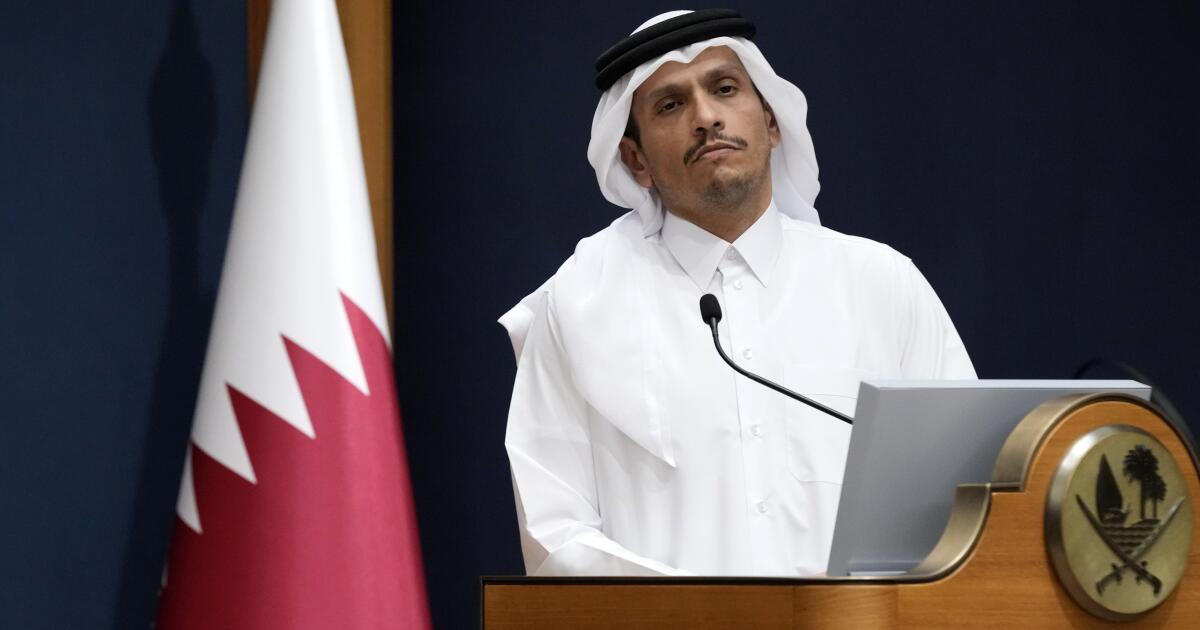
The United Nations Security Council’s unanimous endorsement of a U.S. cease-fire proposal in Gaza has buoyed hopes that the devastating, eight-month-old war might come to an end.
On Tuesday, the militant group Hamas issued its long-awaited, formal response, presenting several amendments to Qatari and Egyptian mediators.
But despite intense urging from the U.S. and other world powers, both Israel and Hamas still seem at odds over what they are willing to agree to — differences that could doom the deal.
The plan — which is similar to one submitted by Hamas weeks ago and was presented by President Biden on May 31 as an Israeli proposal — comprises three phases.
The first phase includes a six-week cease-fire and the release of 33 Israeli hostages, including women, men over age 50 or those who are ill or wounded. For every hostage, Israel would release 30 to 50 Palestinian detainees.
Israeli troops would also withdraw from populated parts of the Gaza Strip, according to the U.N. Security Council resolution, and allow displaced civilians to return home, including to northern Gaza. Humanitarian aid, including food and medicine for Palestinians, would increase significantly.
While the first phase is being implemented, negotiations would continue for the second phase. That would see the full withdrawal of Israel’s military, including from the Rafah crossing and the Philadelphi Corridor between Gaza and Egypt. More hostages and detainees would be exchanged. It would also lead to a permanent cease-fire.
In the third phase, the bodies of hostages who died in Gaza would be returned. A multiyear reconstruction plan for the enclave would commence.
The U.N. resolution rejects any demographic or territorial change in Gaza, “including any actions that reduce” the Palestinian territory. That has been the U.S. position as well. The language differs from a previous draft, which said that any buffer zones created in Gaza would be considered territorial change.
An important detail is that the cease-fire would remain in place between Phase 1 and Phase 2 while negotiations continue, even after the six weeks envisioned in the first phase are over.
Hamas said its proposed amendments were aimed at guaranteeing the complete withdrawal of Israeli forces from all of Gaza. It also sought a firmer timeline for the cease-fire, including a permanent end to the fighting, which according to the U.S. plan is supposed to be implemented during Phase 2, after more negotiations.
Nevertheless, Hamas insisted both it and Islamic Jihad, another militant group operating in Gaza, “voiced willingness to deal positively” with the negotiations “in order to reach an agreement.”
Hamas leaders remain suspicious that Israel will use an initial acceptance of the proposal to free Israeli hostages being held by the militants — a stipulation in the first phase of the deal — and then renege on the rest of the deal and resume its military campaign.
Despite U.S. assurances to the contrary, it remains unclear whether Israel has accepted the deal.
Israeli Prime Minister Benjamin Netanyahu has not publicly endorsed it, repeatedly ruling out a permanent cease-fire or a withdrawal from Gaza until Israel’s goals — the destruction of Hamas, both militarily and as a governing entity — are fulfilled. Full withdrawal is a step that is supposed to be part of negotiations.
Netanyahu is also facing dissent within his government that could jeopardize the chances of a deal. His political fortunes became more tenuous this week after the Israeli centrist politician Benny Gantz left the government in protest over Netanyahu’s conduct of the war and refusal to publicly endorse the cease-fire plan.
The departure of Gantz, a former defense minister and one of the few members of Netanyahu’s government widely respected by the Biden administration, leaves the Israeli prime minister even more beholden to the most radical right-wing elements in his coalition: National Security Minister Itamar Ben-Gvir and Bezalel Smotrich, the finance minister.
The two have outsized sway over control of the Israeli occupation of the West Bank. Both favor annexation of land claimed by Palestinians, including Gaza, and the forced removal of some Palestinians. Gantz’s presence kept some of those moves at bay.
On Wednesday, U.S. Secretary of State Antony J. Blinken criticized Hamas, saying that it took too long to respond and that some of the group’s “numerous changes” were “workable,” while others were not.
“Hamas could have answered with a single word: yes,” Blinken said in a news conference in the Qatari capital, Doha, with Qatari Prime Minister Sheikh Mohammed bin Abdulrahman al Thani. “Instead, Hamas waited nearly two weeks and requested numerous changes.”
“The time for decision is now,” Blinken said. “The longer this goes on, the more people will suffer.”
Blinken is making his eighth trip to the region since the war began, shuttling to capitals to push for the release of hostages, more humanitarian aid and a cease-fire, and in a largely unsuccessful attempt to urge Israel to minimize civilian casualties in its bombardments of Gaza.
More than 36,000 Gazans have been killed in the war, according to Palestinian figures. About 1,200 Israelis were killed during the Oct. 7 Hamas attack in southern Israel.
Mohammed, the Qatari prime minister, said that pressure would have to be exerted on both Hamas and Israel to accept the proposal.
“It is frustrating, lots of times. We have seen the behavior from both parties on different occasions being counterproductive to the efforts,” he said, emphasizing that the primary aim was for a permanent solution, including the establishment of an independent Palestinian state alongside Israel.
“What we are aiming for is one specific goal is to end the war, to end the suffering of the people, to get the hostages back. And then we will think about the day after.”
Bulos reported from Amman and Wilkinson from Washington.


Habitual marijuana users cannot be barred from owning guns, Supreme Court rules
Fox News host Sean Hannity reports the Supreme Court unanimously limits a federal gun law, ruling habitual marijuana users cannot be banned from owning guns. Legal Analyst Gregg Jarrett explains the 9-0 decision, distinguishing between recreational use and serious addiction, contrasting it with Hunter Biden’s crack cocaine and gun charges.
NEWYou can now listen to Fox News articles!
FIRST ON FOX: A powerful House committee is escalating its probe into the Biden administration for alleged collusion with gun control activists.
House Oversight Chairman James Comer, R-Ky., is demanding that the Bureau of Alcohol, Tobacco, Firearms and Explosives (ATF), the federal agency responsible for enforcing gun laws, hand over documents detailing Biden aides’ communications with Everytown for Gun Safety, an influential gun control group founded by billionaire Michael Bloomberg.
Comer’s panel has argued that a now-defunct Biden office may have collaborated with Everytown to help facilitate its lawsuit with the city of Chicago against the gunmaker Glock Inc.
“These records will inform the Committee as to whether the Biden Administration and Everytown colluded to attack private gun manufacturing companies through lawfare to circumvent Second Amendment rights,” Comer wrote in a letter Wednesday to the ATF that was reviewed by Fox News Digital.
Rep. James Comer arrives at the U.S. Capitol in Washington, D.C., on June 10, 2026. (Tom Brenner/Getty Images)
CITY OF CHICAGO SUES GLOCK INC. OVER ‘FACILITATING’ ILLEGAL GUN CONVERSIONS
Chicago’s lawsuit, listing Everytown’s legal arm as the plaintiff’s counsel, was filed in March 2024 and alleges Glock sold pistols that the firearms manufacturer knew could be easily modified to fire like machine guns.
“Glock knows that it takes little effort to convert its pistols into illegal machine guns and that criminals frequently do so,” the lawsuit alleged. “Glock also knows it could fix the problem, but has chosen not to, putting profits over public safety and violating the law.”
In the letter, Comer cited a 2023 meeting between the White House Office of Gun Violence Prevention (WHOGVP) and representatives from Glock, during which Biden officials pressed the gun manufacturer to modify its pistol designs.
When Chicago sued Glock three months later, John Feinblatt, president of Everytown, wrote on X, “Federal officials recently contacted Glock to discuss implementing new ways to modify Glock pistols to make it harder for Glock switches to be installed. Rather than help, Glock has falsely insisted there is nothing they can do.”
Comer argues Feinblatt “appears to have had insider information regarding the WHOGVP’s private meeting with Glock, which raises questions about whether the Biden Administration colluded with Everytown to initiate their lawsuit against Glock,” according to the letter.
The lawsuit is still moving through the court system, with a Cook County judge denying Glock’s motion to dismiss the case in September 2025.
Members of Everytown for Gun Safety rally outside the U.S. Capitol in Washington, D.C., on May 26, 2022. (Chip Somodevilla/Getty Images)
STATES’ TOP COPS GANG UP ON LETITIA JAMES IN CRUSADE WITH POTENTIAL NATIONWIDE CONSEQUENCES
The Kentucky lawmaker has also highlighted close ties between the Biden White House and Everytown. The letter notes that Biden aide Rob Wilcox worked at Everytown for eight years prior to his employment with the WHOGVP.
Biden also headlined Everytown action fund’s annual training conference, known as Gun Sense University, in June 2024, during which he reiterated his support for a nationwide ban on so-called assault weapons.
Wednesday’s letter comes after the GOP-led panel asked the National Archives and Records Administration (NARA) in April for communications between the Biden White House and Everytown.
House Oversight Republicans previously subpoenaed the Biden ATF and Everytown for all communications related to their “potential collaboration efforts,” but neither party complied with the request.
President Joe Biden speaks about gun safety at Everytown’s Gun Sense University at the Washington Hilton in Washington, D.C., on June 11, 2024. (Saul Loeb/AFP)
CLICK HERE TO DOWNLOAD THE FOX NEWS APP
Comer has also argued that the committee’s probe will help lawmakers evaluate whether new legislation is needed to combat officials violating recordkeeping requirements or using their roles to leak private information to politically aligned third parties.
A spokesperson for the ATF did not immediately respond to a request for comment.

The June 16 appearance by Vance gave the program its most-watched episode since November 2024.
The first appearance by Vice President JD Vance on ABC’s “The View” delivered the most-watched edition of the talk show since November 2024.
The June 16 program averaged 3.3 million viewers, according to Nielsen data. The figure was well above the average of 2.6 million viewers for “The View” in the 2025-26 season.
Vance appeared on the liberal-leaning program to promote his new book on his decision to become a Catholic. While the co-hosts mostly questioned him on the Trump administration’s policies on immigration and race, the discussion was cordial.
The panel of co-hosts — Whoopi Goldberg, Joy Behar, Ana Navarro, Sunny Hostin and Alyssa Farah Griffin — did not ask Vance to address the program’s ongoing tension with the Federal Communications Commission.
FCC Chairman Brendan Carr has questioned whether “The View” should have the status of news programs, which are exempt from giving equal time to the opponents of political candidates who appear as guests.
ABC has asked the FCC to rule on the status of “The View,” which received an exemption from the rarely enforced equal time provision in 2002. ABC has maintained that “The View” books politicians based on newsworthiness and not partisanship.
The FCC is currently taking comments from the public on the matter. ABC is running on-air spots urging viewers to support the program.
“‘The View’ has welcomed your favorite guests and covered the issues you care about for nearly 30 years,” the spot says. “Now the FCC wants to control who is allowed to appear on the show.”
The National Republican Senatorial Committee and the National Republican Congressional Committee submitted comments Monday, asserting that “The View” takes advantage of its exemption and favors Democratic candidates and permits “only rare appearances by Republican-aligned figures.”
ABC has told the FCC that “The View” has invited politicians from both sides of the aisle to appear on “The View,” including Health Secretary Robert F. Kennedy Jr., Secretary of State Marco Rubio and entrepreneur Elon Musk. They have declined the invitation as did Vance before his appearance last week.
The letter from the GOP committees also cited the ideological leanings of the co-hosts, saying they are “not selected for their journalistic talent or excellence in commentary, but for their partisan tilt.”
Over the last two decades, “The View” has used five liberal hosts and filled one seat designated for a conservative voice. The right-leaning co-host role has had the most turnover.
“The View” has been the most-watched daytime program for the last nine years. As a live, topical program, it has remained an important media platform while the rest of the talk show genre has largely faded due to diminishing audiences.
Carr’s targeting of “The View” is part of his ongoing criticism of broadcast platforms that annoy President Trump, who has urged that TV station licenses be pulled when he’s been unhappy with coverage.
Politics
Trump to kick off Great American State Fair as 250th anniversary celebrations take over National Mall

Washington DC to host Great American State Fair for America250
Ambassador Monica Crowley discusses the Great American State Fair, set to transform the National Mall in Washington D.C. from June 25 to July 10. Celebrating America’s 250th anniversary, the 16-day event will feature pavilions from all 50 states and six territories, a 110-foot Ferris wheel, traditional games, and rodeo competitions, aiming to unite the country.
NEWYou can now listen to Fox News articles!
President Donald Trump will kick off the Great American State Fair Wednesday evening as part of celebrations surrounding the nation’s 250th anniversary.
“President Trump promised the greatest 250th birthday celebration in American history, and Freedom 250 is proud to help deliver it for the American people,” Freedom 250 CEO Keith Kranch told Fox News Digital.
“This celebration is about what makes America exceptional—our freedom, our faith, our optimism, and our people. We are honored to welcome President Trump as he helps kick off these historic festivities tomorrow and begin a nationwide celebration of our Nation’s 250th birthday,” Krach added.
The fair brings together all 50 states and six U.S. territories for a national celebration stretching from the Capitol to the Washington Monument featuring military flyovers, musical performances and civic programming. Trump announced he will deliver remarks after a handful of musical artists pulled out of their musical performances, turning the bash into a “Make America Great Again Rally.”
TRUMP FLOATS REPLACING 250TH ANNIVERSARY CONCERT WITH MASSIVE MAGA RALLY AFTER ARTISTS PULL OUT
Organizers describe the Great American State Fair as a modern-day World’s Fair celebrating America’s 250th anniversary. (Aaron Schwartz/Bloomberg via Getty Images)
The event is scheduled to run from June 25 through July 10, 2026, celebrating patriotism to bring together the nation for a celebration of unity.
TRUMP’S DC BEAUTIFICATION PUSH WINS RARE DEM PRAISE AS PRESIDENT SNAPS LANDMARKS BACK TO LIFE
U.S. President Donald J. Trump watches the UFC lightweight championship fight during the UFC Freedom 250 event on the South Lawn at the White House on June 14, 2026 in Washington, DC (Jeff Bottari/Zuffa LLC)
Trump’s anticipated remarks follow his signature last week on a Memorandum of Understanding with Iran, launching a 60-day negotiating period aimed at preventing Tehran from ever obtaining nuclear weapons capability.
The world’s fair-scale event will have pavilions touching on five national themes: Made in America, American Heartland, American Innovates, The American Canvas, and Faith & Family.
There will also be a 110-foot Ferris wheel and the refurbished Smithsonian carousel for families to enjoy.
Rending of 110-foot ferris wheel coming to National Mall for “Great American State Fair.” (Freedom250)
The U.S. has hosted over two dozen variations of the world’s fair since first hosted in Philadelphia in 1876, according to the State Department.
CLICK HERE TO DOWNLOAD THE FOX NEWS APP
Freedom250, the nonpartisan group helping coordinate the broader America250 effort, said the fair will feature food, games, exhibits and themed attractions designed to showcase the country’s culture, history and innovation.
-

 Iowa59 seconds ago
Iowa one of nine states that won’t have to match portion of federal SNAP benefits
-

 Kansas4 minutes ago
Body believed to be Kansas City highway shooting suspect found in burned home’s basement by family: police
-

 Kentucky9 minutes ago
Kentucky’s Otega Oweh headed to Thunder in 2026 NBA Draft trade
-

 Louisiana16 minutes ago
GOP candidates trade attacks, differ on carbon capture in Louisiana Senate race
-

 Maine19 minutes ago
Hearts of Pine halt 4-game skid with emphatic win
-

 Maryland24 minutes ago
Republican candidates ask judge to block Maryland primary certification
-

 Michigan31 minutes ago
Michigan heatwave on way. See day likely to set a record high
-

 Massachusetts34 minutes ago
Massachusetts man accused of wanting sex with girl busted in World Cup trafficking operation

