Lifestyle
15 best native plants to grow in your yard if you also want fragrant bouquets

Attention, anyone who thinks native blooms are brilliant in the wild — or our yards — but don’t work in bouquets.
Boy, are we wrong.
This isn’t an invitation to trample wildflower fields to pick bouquets — our precious wildflowers need to stay unpicked so their seeds will produce blooms in the future — but it is notice that native plant gardeners don’t have to rely on grocery-store bouquets to grace our tables.
With the right preparation and care, you can grow and assemble stunning, long-lasting bouquets for your home while building habitat in your yard or patio, said Linda Prendergast, crew chief and lead designer for the California Botanic Garden’s floral volunteer group known as Native Designs.
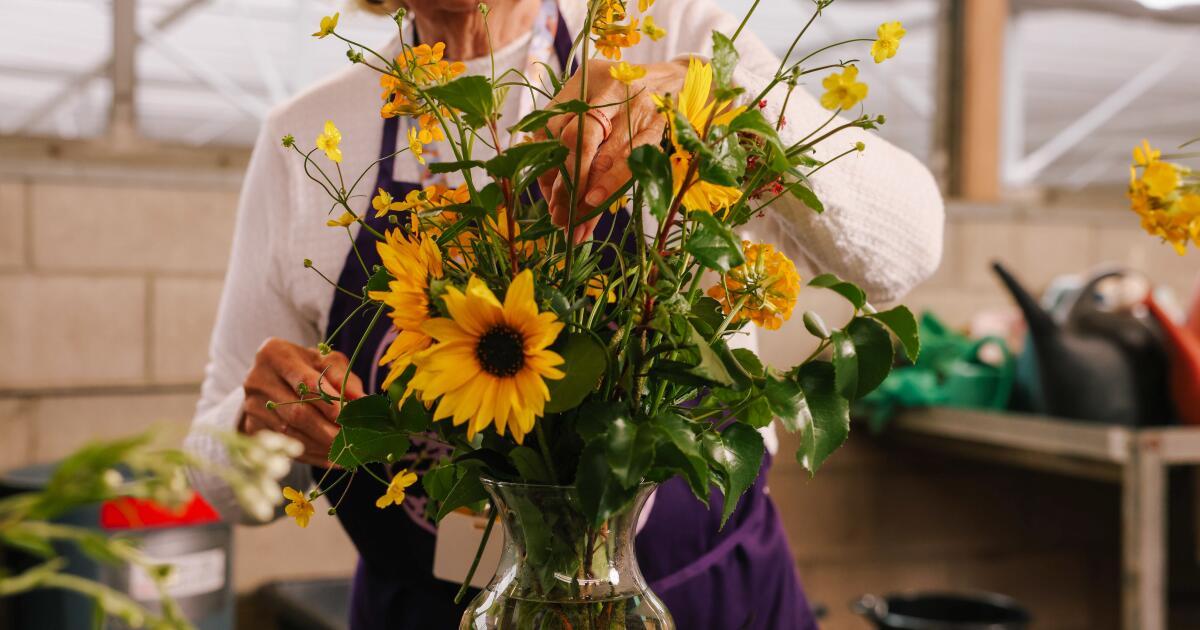
Susan Spradley is surrounded with containers of hydrating yellow blooms for her sunny native plant bouquet.
(Dania Maxwell / Los Angeles Times)
Prendergast had a career working in flower shops and then wholesale nurseries when she was younger, and she still appreciates traditional ornamental bouquets, but over the years her environmental awareness has cooled her delight in traditional ornamentals.
Grocery store bouquets “are lovely and I buy them. But they have also been grown with lots of fertilizer and imported from South America. They’re flown in using lots of jet fuel that’s bad for our air,” she wrote in a text message.
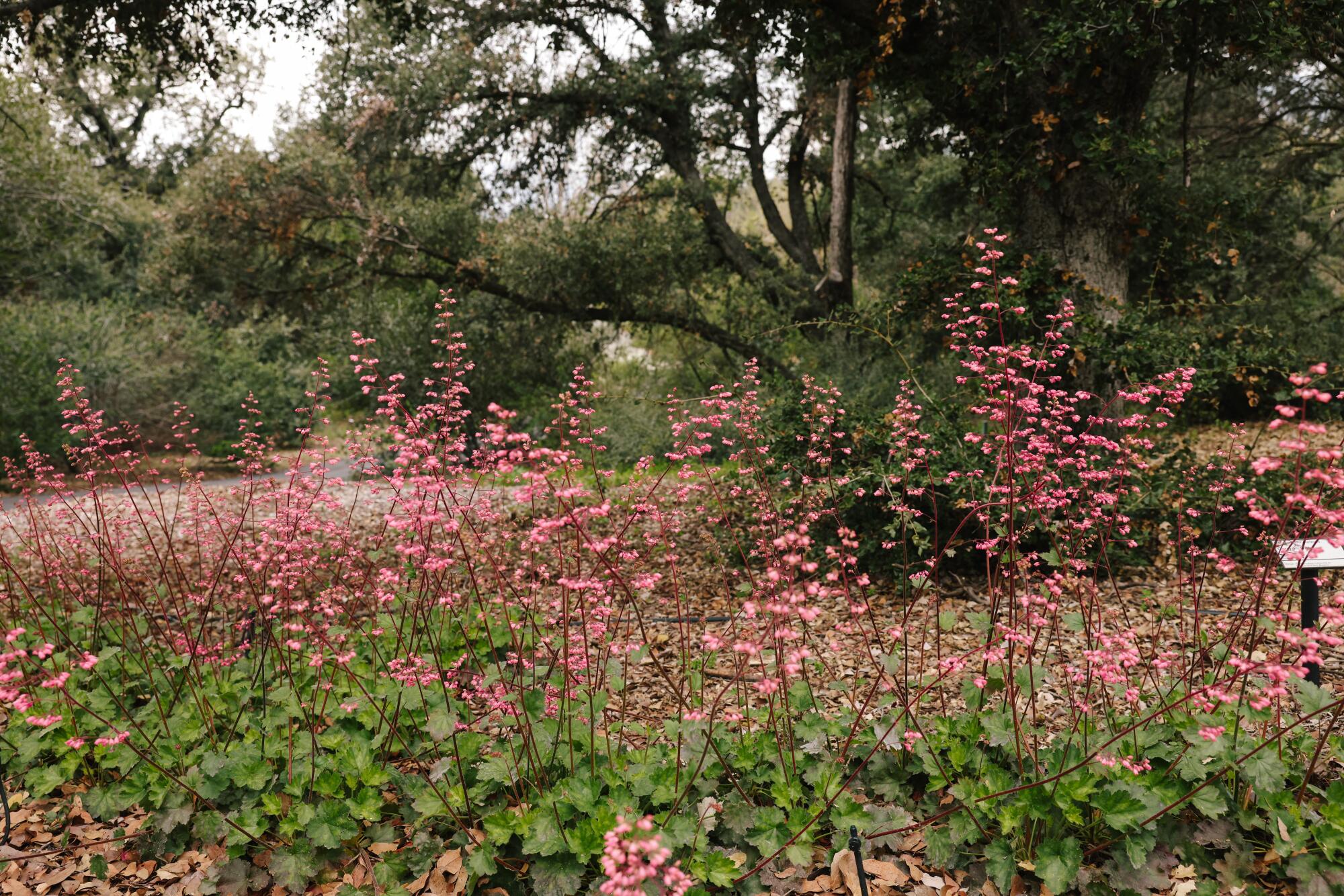
The pink airy flowers of coral bells rise like clouds above the native plant’s bright green foliage. They thrive under oak trees and in other shady areas.
(Dania Maxwell / Los Angeles Times)
“By contrast, native flowers are lovely in your garden or flower beds; they generally use less water than other varieties and most importantly, they are food sources for pollinators. Our precious bees and butterflies rely on natives as a food source.”
So these days, Prendergast and her group of about 32 merry volunteers put their floral design skills to work arranging flowers cut from and for events at California Botanic Garden, the state’s largest botanic garden devoted to native plants.
After an afternoon watching Prendergast, Susan Spradley and Carol Petty create cheerfully gorgeous arrangements, I can personally vouch for the variety and beauty of their bouquets, as well as their longevity. Petty’s graceful arrangement of coral bells (Heuchera sanguinea ‘Coral Bells’), white sage (Salvia apiana), fragrant pitcher sage (Lepechinia fragrans), hollyleaf cherry (Prunus ilicifolia) and sugar bush (Rhus ovata) still looked fresh and lovely on my dining room table a week after it was made.
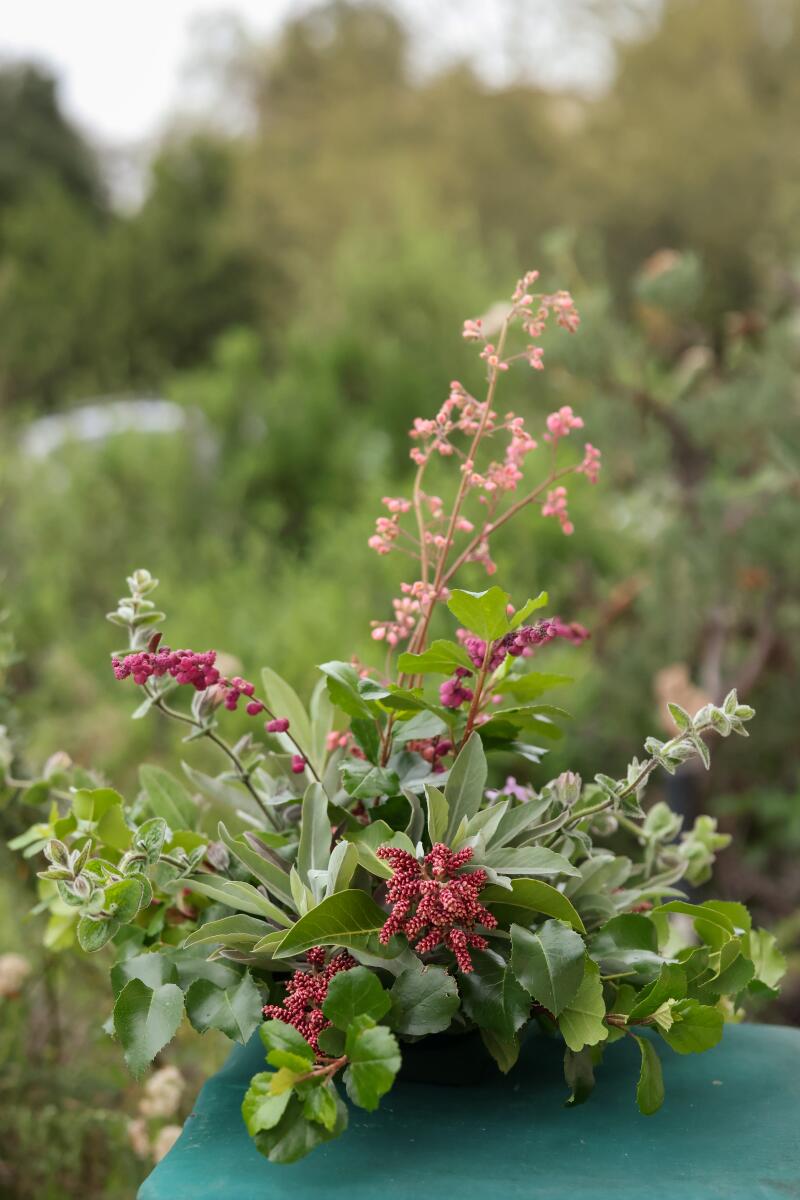
A bouquet by Carol Petty of white sage, coral bells, Catalina currant, sugar bush, hollyleaf cherry and fragrant pitcher sage. (Dania Maxwell/Los Angeles Times)
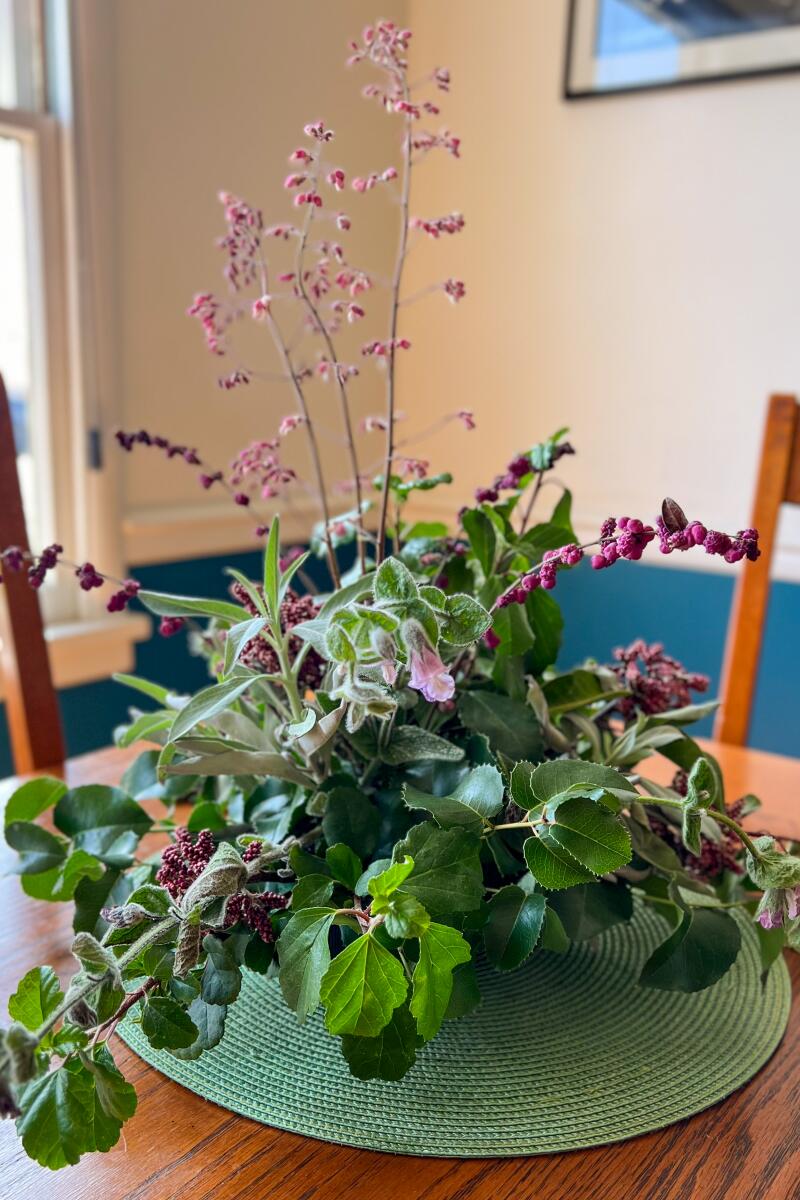
Petty’s native plant arrangement, still looking fresh a week later. (Jeannette Marantos/Los Angeles Times)
There are a few important tricks for creating native bouquets, Prendergast said.
- Cut your flowers and foliage early in the day, and immediately plunge the cuttings into warm — not hot — water.
- Look for interesting branches and berries as well as flowers to add color and fullness to your display.
- Don’t snip helter skelter. Make sure you cut your branches near the base of the plant to maintain its shape and integrity.
- Leave the cut flowers and foliage in warm water mixed with a floral food (Prendergast uses a product called FloraLife Crystal Clear available in packets or bulk) for at least 12 to 24 hours.
- If you use white sage foliage, hydrate it in a separate bucket since the plant gives off an oil that is unpleasant for the other flowers.
- Most native plants are heavy drinkers once they’re cut, so they’ll do better in a vase instead of floral foam. And some, like California poppies, don’t have stems hard enough to push into foam and get the hydration they need, she said.
- If you must use a shallow container to arrange your flowers, try using a crumpled ball of chicken wire to hold the stems instead of foam blocks. Those foam blocks grow fungus so they shouldn’t get reused and they can’t be recycled, Prendergast said, so they just add to landfill waste. Chicken wire, however, can be washed and reused. Just be sure your foliage covers the base so it doesn’t show.
- Prendergast also recommends using waterproof floral tape in green or clear to create a grid over the top of your container to further support your flowers and foliage and ensure your design stays in place.
- Snip the ends of your stems as you add them to your container to improve water absorption.
- Some branches are heavy, so make sure you have enough weight in your container, like pebbles or glass rocks, to keep it from tipping over.
- Start with the largest or showiest flowers first and add from there. Keep turning the container to make sure you’re filling in gaps.
- Change the water in your display daily to keep the flowers fresh.
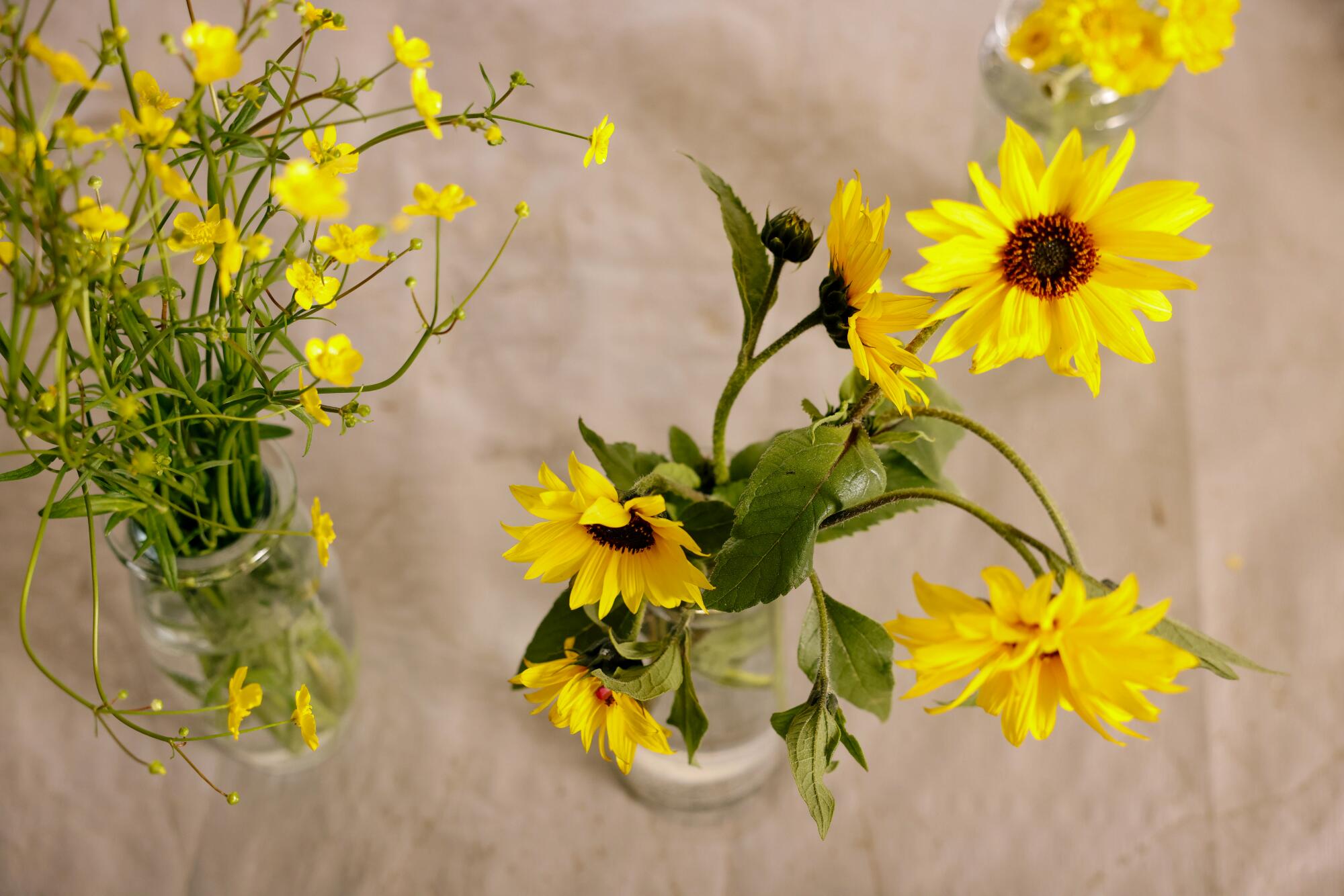
Pick your native flowers early in the morning and immediately put them in warm water with floral food to let them hydrate for 12 to 24 hours before making your bouquet.
(Dania Maxwell / Los Angeles Times)
Not all native flowers and foliage are great in bouquets, Prendergast said. The silvery green foliage of white sage makes for great accents in bouquets during cooler winter months, but come spring, when the plant is starting to bloom, the leaves tend to soften up and go limp, she said, making them sad choices for arrangements.
Ceanothus blooms also don’t last much longer than a day once they’re cut, and manzanitas, large shrubs with reddish limbs and dainty bell-shaped flowers, “are just too precious” to potentially damage by cutting, she said. The slow-growing trees are increasingly hard to find in the wild because of development, and at least two varieties have been listed as endangered in California, presidio manzanita (Arctostaphylos montana ssp. ravenii) and pallid manzanita (Arctostaphylos pallida).
But there are lots of other choices for flowers, foliage, berries and sculptural stems in a huge number of colors and shapes. Here are some of Prendergast’s top picks for native plants that work in home gardens and bouquets:
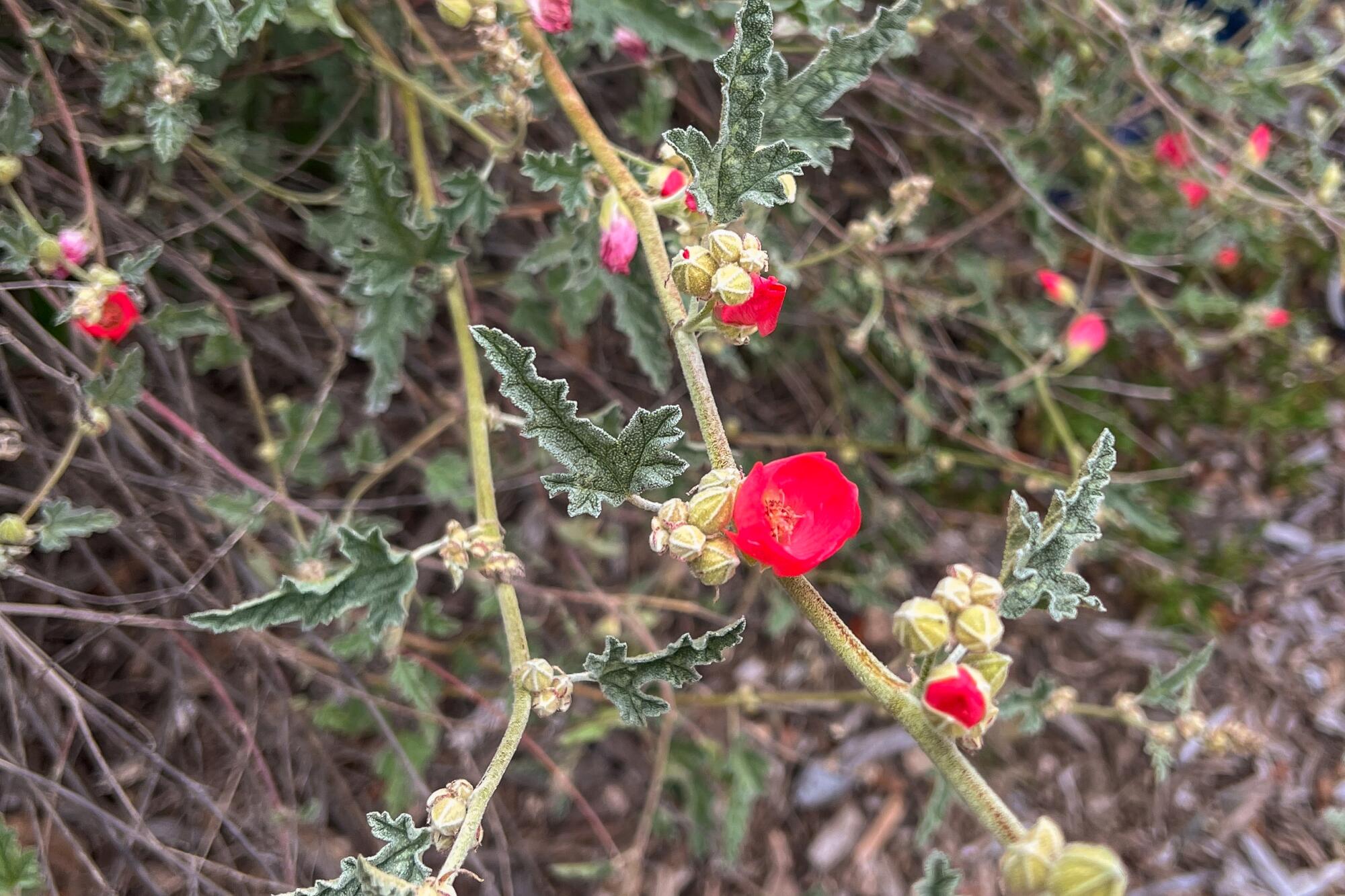
Apricot mallow.
(Jeannette Marantos / Los Angeles Times)
Apricot mallow (Sphaeralcea ambigua var. rugosa) and its cultivars have pink- to apricot-colored bowl-shaped flowers on tall stalks that contrast nicely with the silvery green foliage.
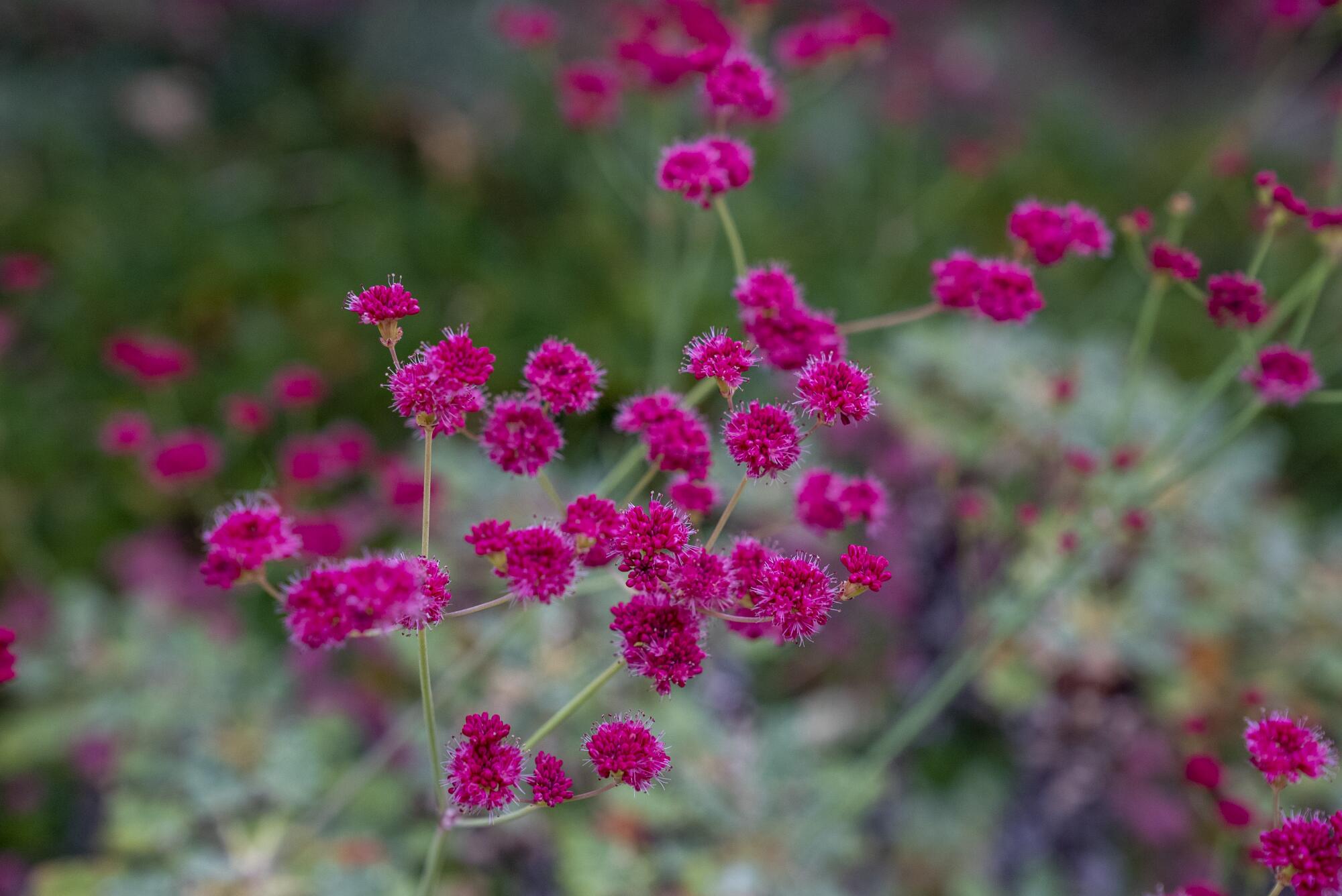
Red-flowered buckwheat.
(Marie Astrid Gonzalez)
Buckwheats (Eriogonums) are varied in color and shape, but Prendergast says her favorites are St. Catherine’s lace (Eriogonum giganteum) with bouquet-like sprays of white to pinkish-white flowers (a favorite with pollinators too, but it can get very big, up to 9 feet tall), red-flowered buckwheat (Eriogonum grande var. rubescens), a low-growing plant with red pom-pom type blooms on tall stems, and sulphur buckwheat (Eriogonum umbellatum) with tall, pom-pom blooms in yellow or white.
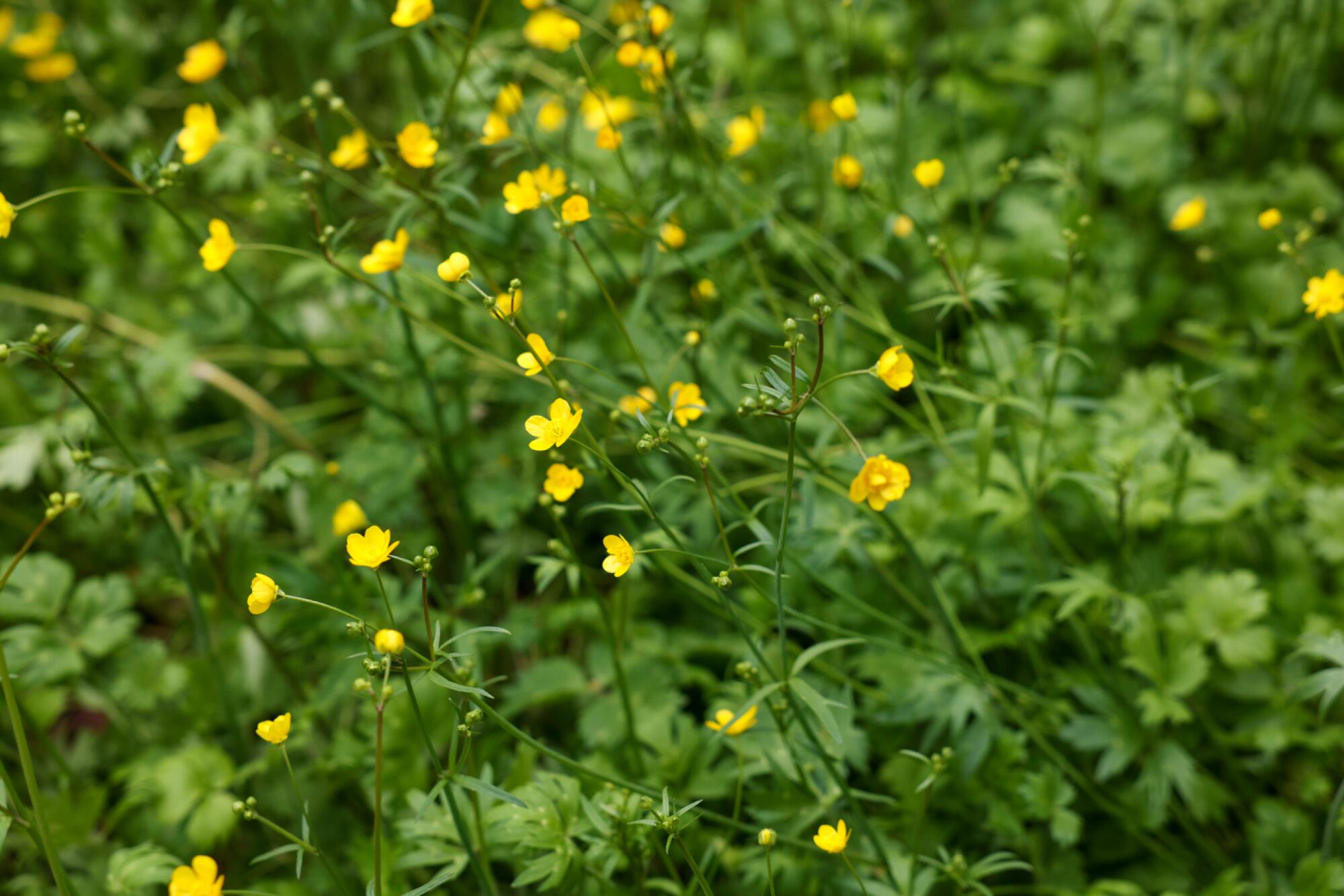
California buttercups.
(Dania Maxwell / Los Angeles Times)
California buttercup (Ranunculus californicus) is a cheerful, reseeding addition to any garden with brilliant yellow flowers and bright green foliage.
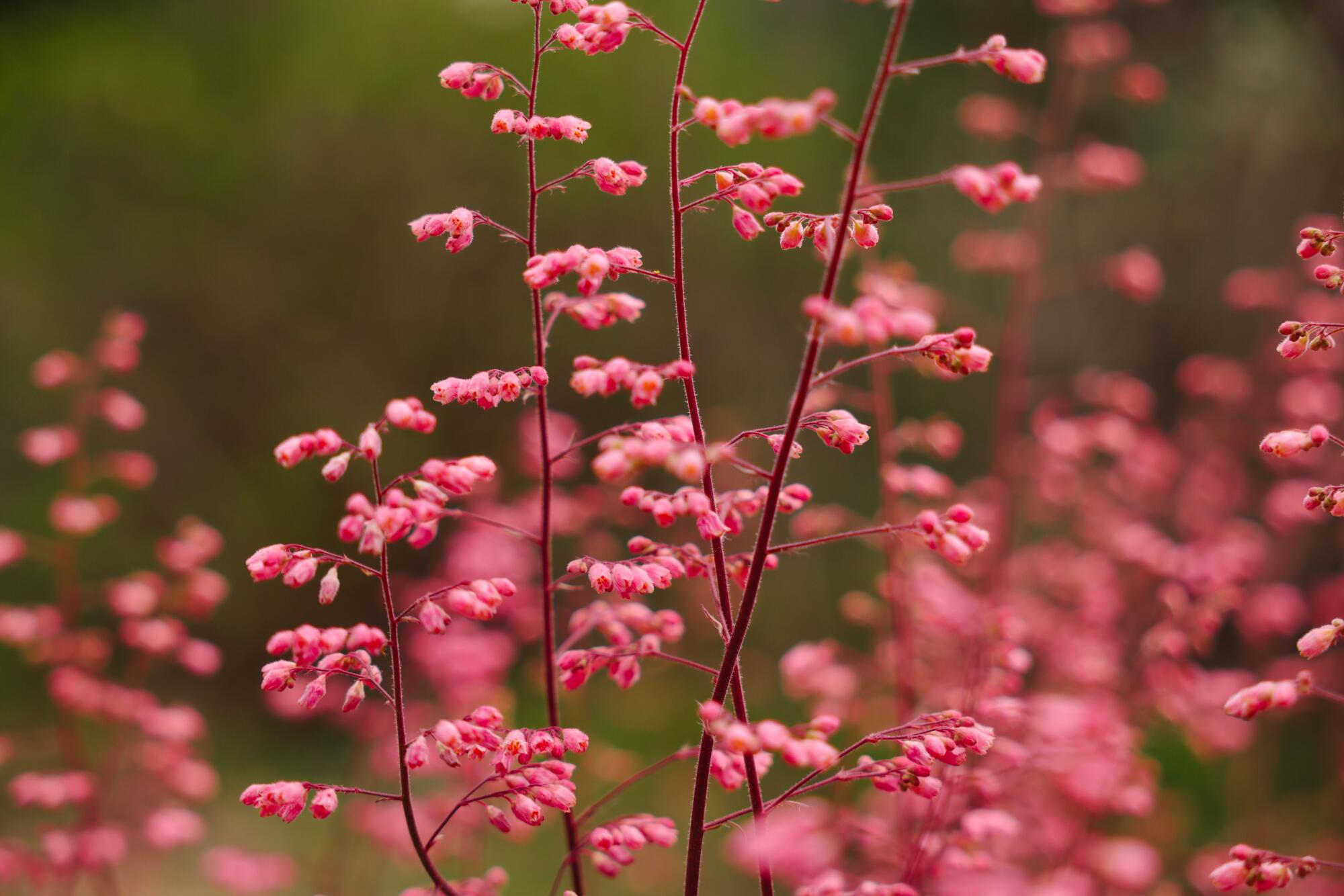
Coral bells (Heuchera sanguinea ‘Coral Bells’).
(Dania Maxwell / Los Angeles Times)
Coral bells (Heuchera sanguinea ‘Coral Bells’) has spring blooms that look like tiny clouds of exquisite pink fairy flowers, a perfect centerpiece flower against dark green foliage. These are great plants to add to shady areas in your yard.
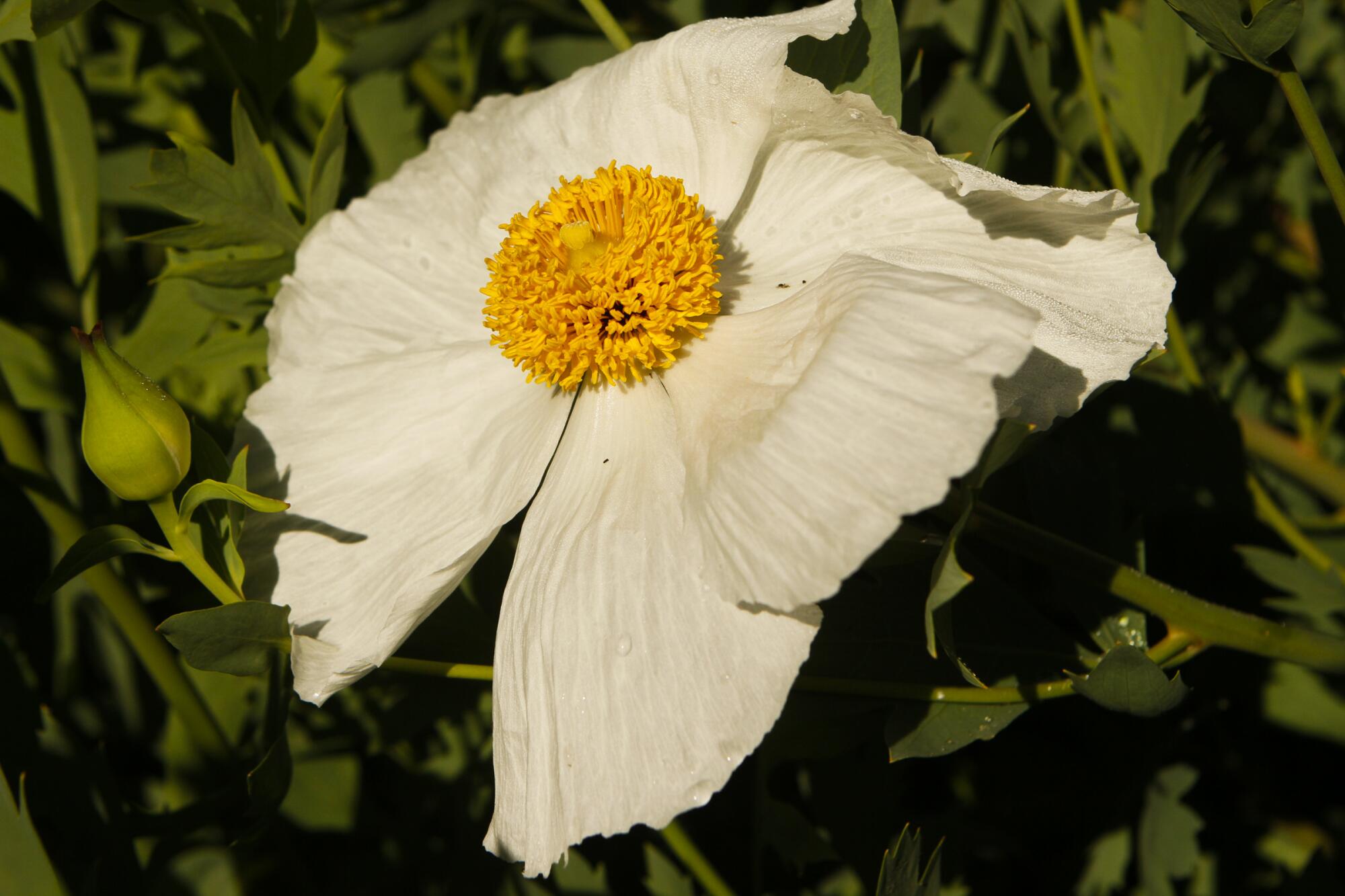
Coulter’s matilija poppy.
(Anne Cusack / Los Angeles Times)
Coulter’s matilija poppy (Romneya coulteri) is sometimes known as the “fried egg plant” for its huge white crepe-papery petals and yolk-yellow center. It makes an excellent cut flower, Prendergast says, but this is another native plant that doesn’t always play well with others. Once established it can take over a garden space. This is a great plant for slopes, because it grows exuberantly tall and wide, with lots of showstopping blooms.
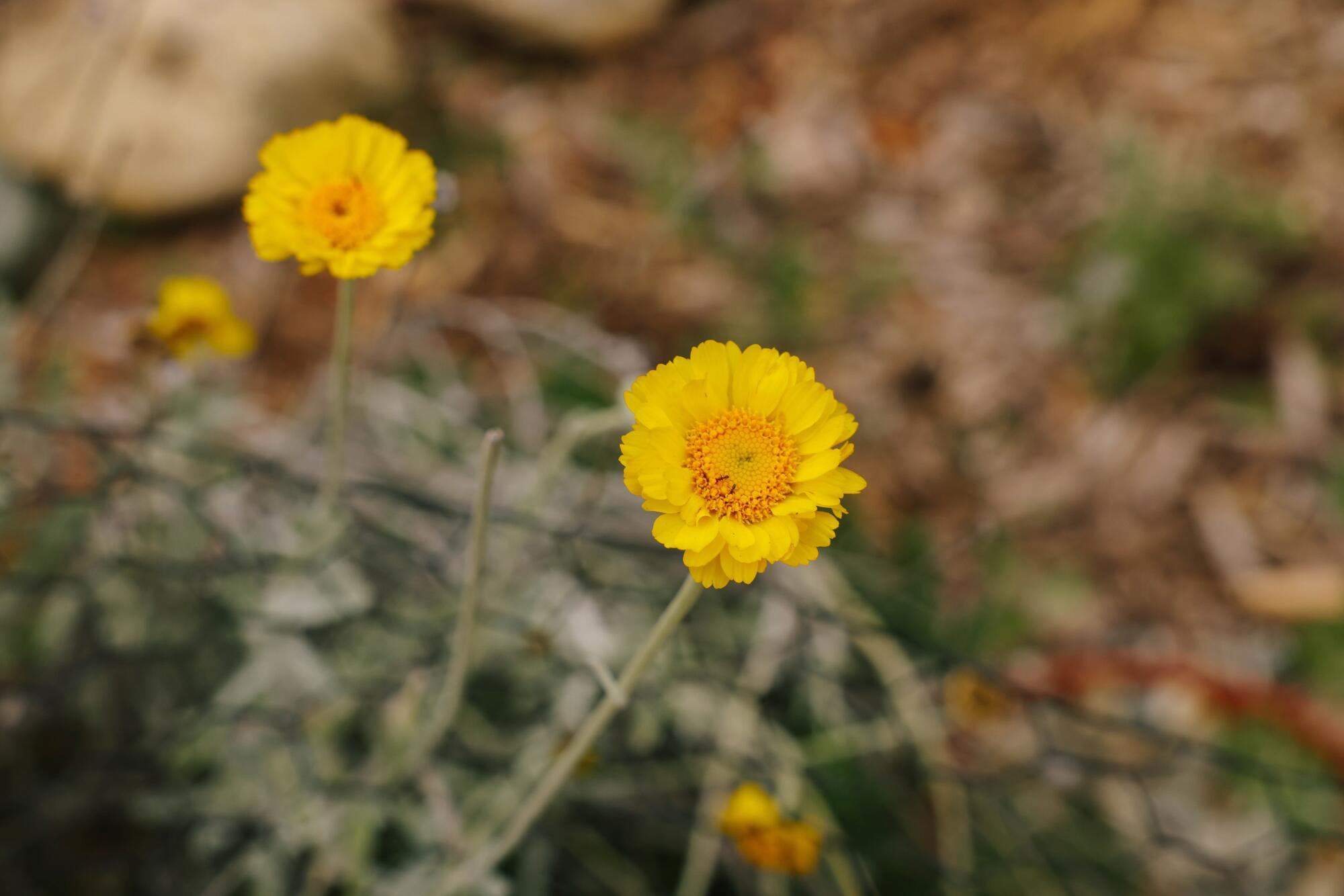
Desert marigold.
(Dania Maxwell / Los Angeles Times)
Desert marigold, a.k.a. wild marigold (Baileya multiradiata), are golden-yellow open-faced wildflowers with bare stems that just beg to be picked. These also reseed in sunny, well-drained garden spots.
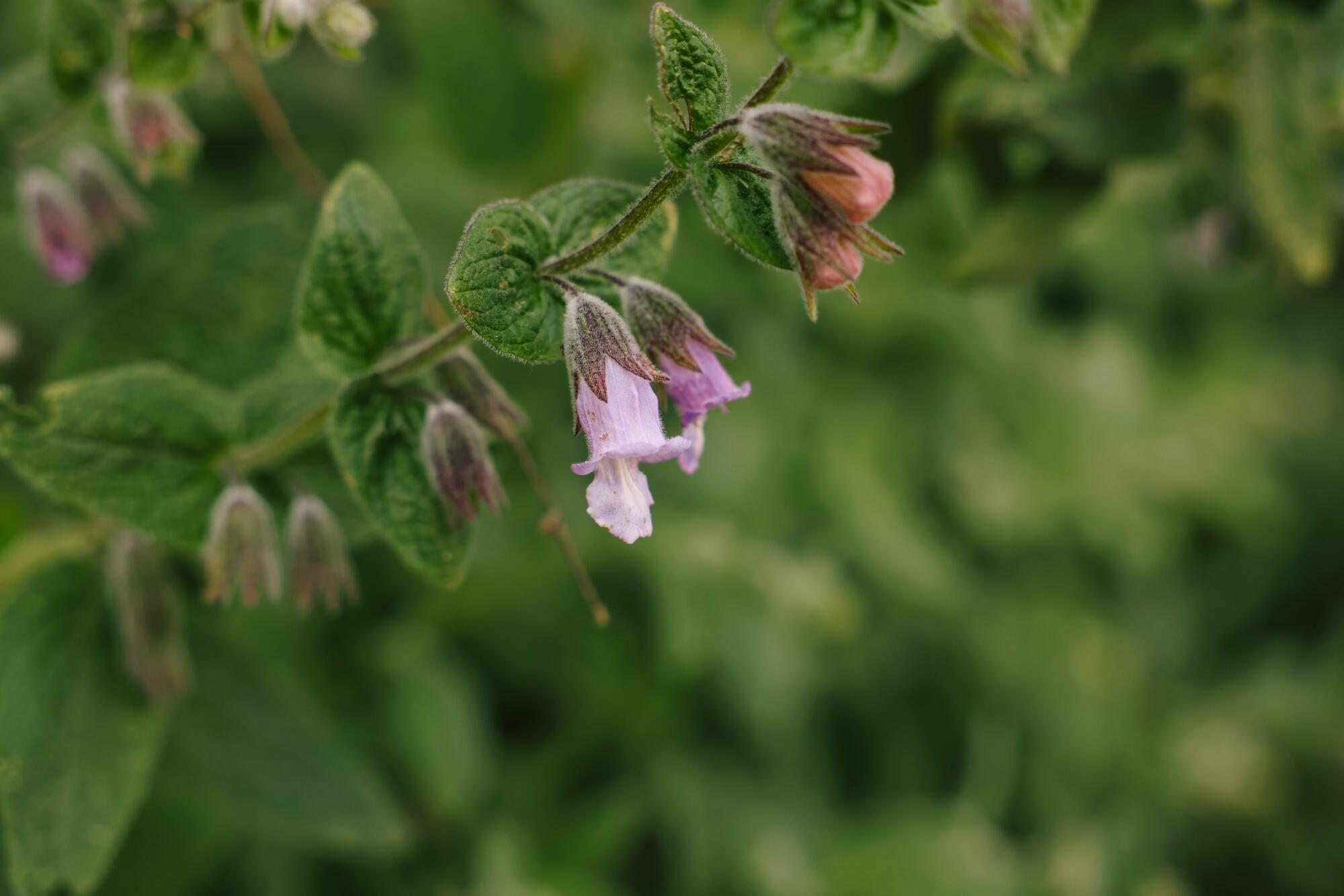
Fragrant pitcher sage.
(Dania Maxwell / Los Angeles Times)
Fragrant pitcher sage (Lepechinia fragrans) definitely lives up to its name, with soft gray-green foliage, twisty stems and tubular pale violet flowers that actually look more blue than purple.
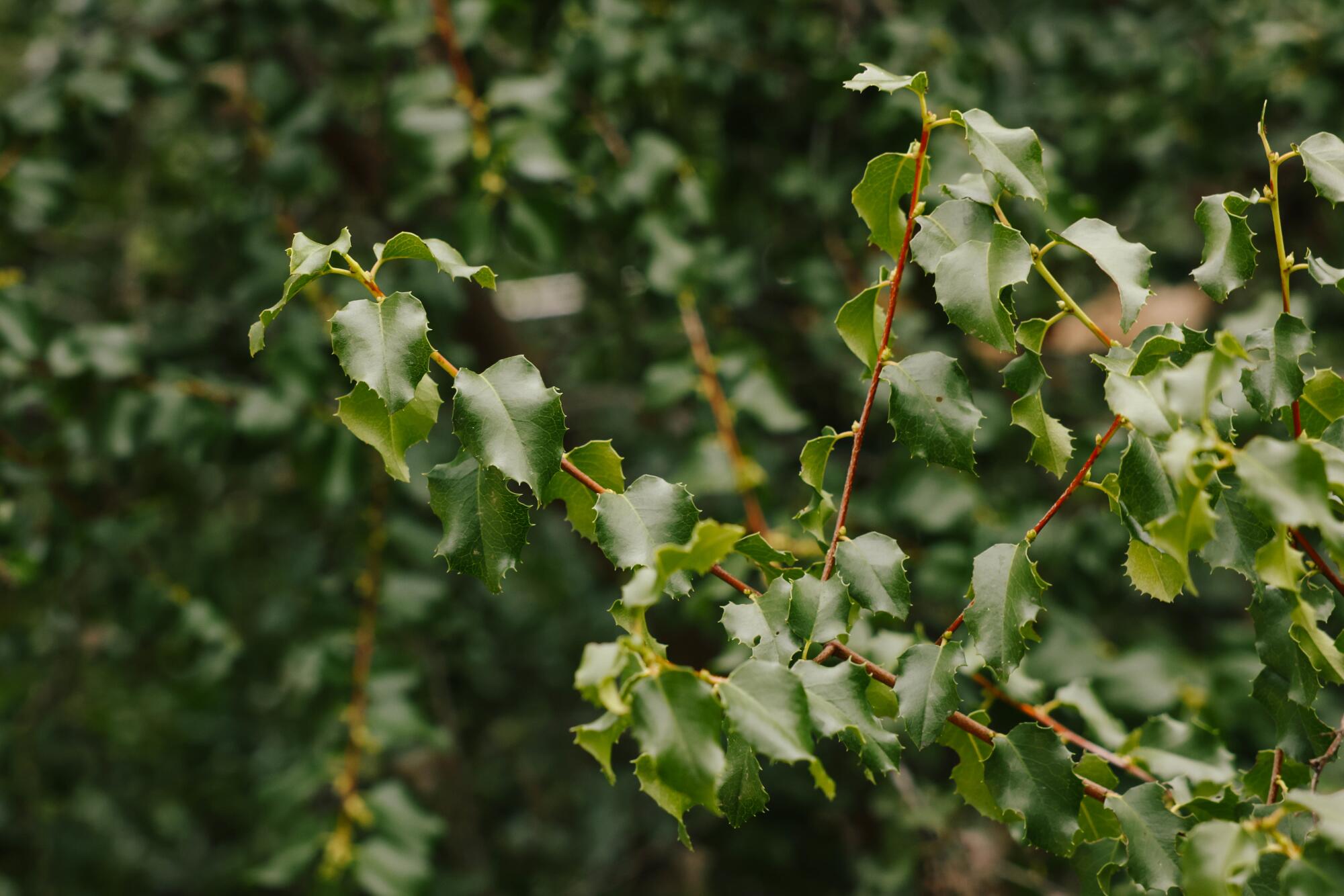
Hollyleaf cherry’s glossy green, serrated leaves add interest to native plant bouquets.
(Dania Maxwell / Los Angeles Times)
Hollyleaf cherry (Prunus ilicifolia) has underwhelming sprays of white flowers; it’s the deep green, serrated foliage that you’re after, a dramatic filler against the lighter-colored greens of so many other native plants.
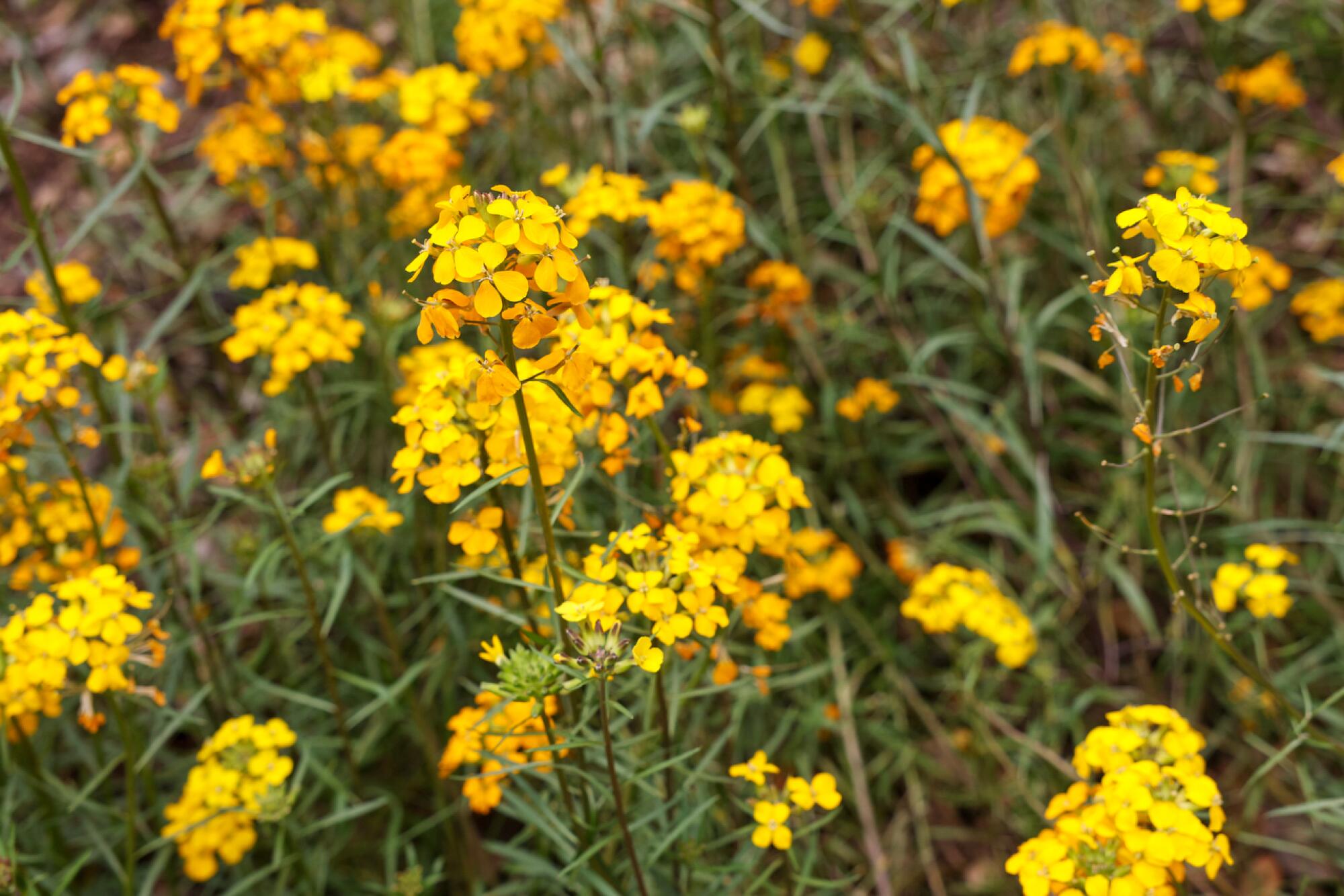
Sanddune wallflowers.
(Dania Maxwell / Los Angeles Times)
Sanddune wallflower (Erysimum capitatum) grows in clusters of sunny yellow or tangerine-colored flowers that look like small bouquets on straight stalks about a foot tall. Some wallflowers also have red, white or purple blooms, and the plants will reseed to grow back in the spring.
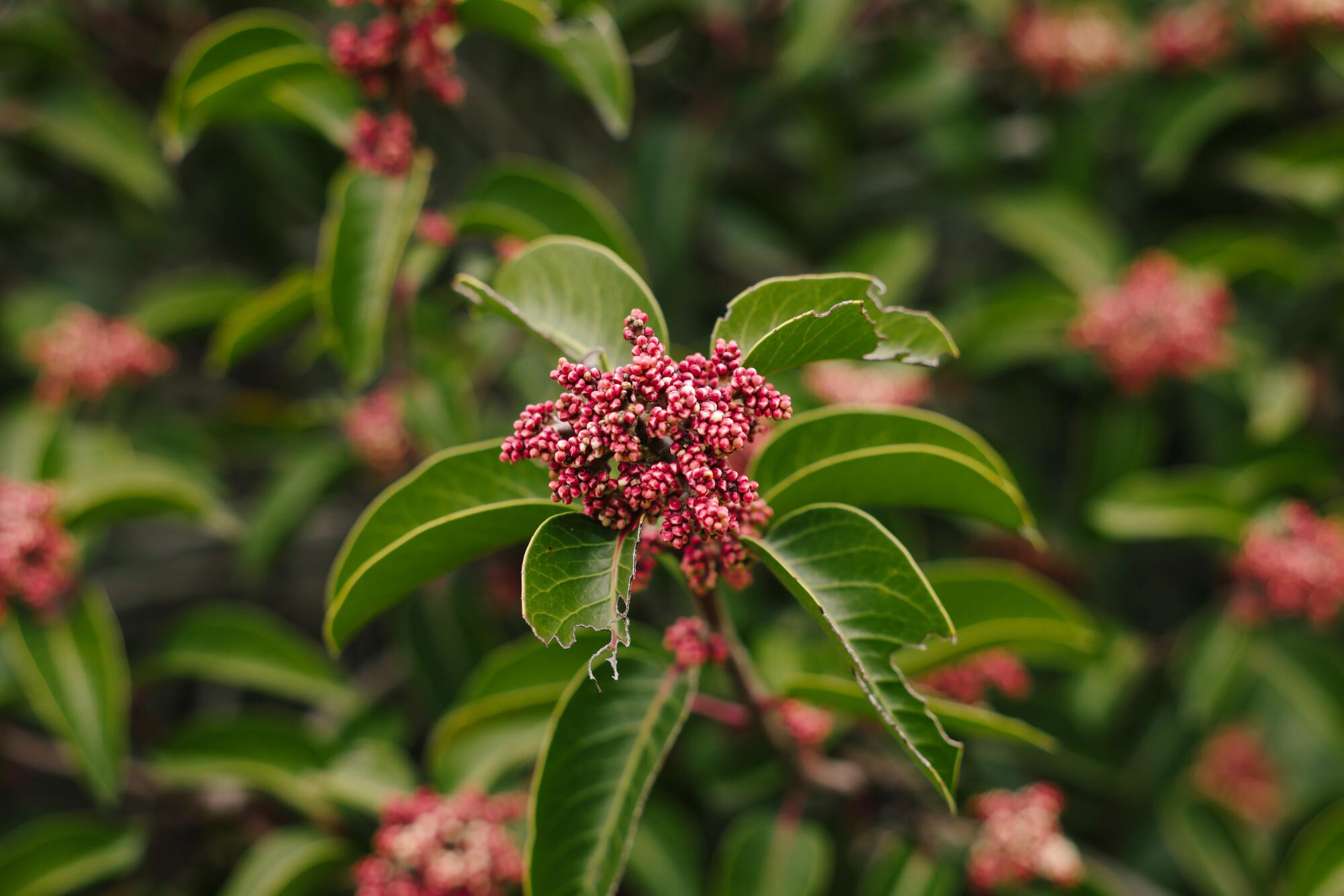
Sugar bush
(Dania Maxwell / Los Angeles Times)
Sugar bush (Rhus ovata) comes with a proviso: It is a dramatic, fast-growing evergreen shrub/small tree with glossy green leaves, showy red blooms and berries that birds love. But this plant gets big, over 10 feet wide and tall, so be sure you put it in a spot where it won’t crowd out other plants. Calscape notes: “Sugar Bush hybridizes often with Lemonade Berry (Rhus integrifolia). A good rule of thumb for landscaping applications is: Within 5-10 miles of the coast, Lemonade Berry is a better choice. More inland, Sugar Bush does better.”
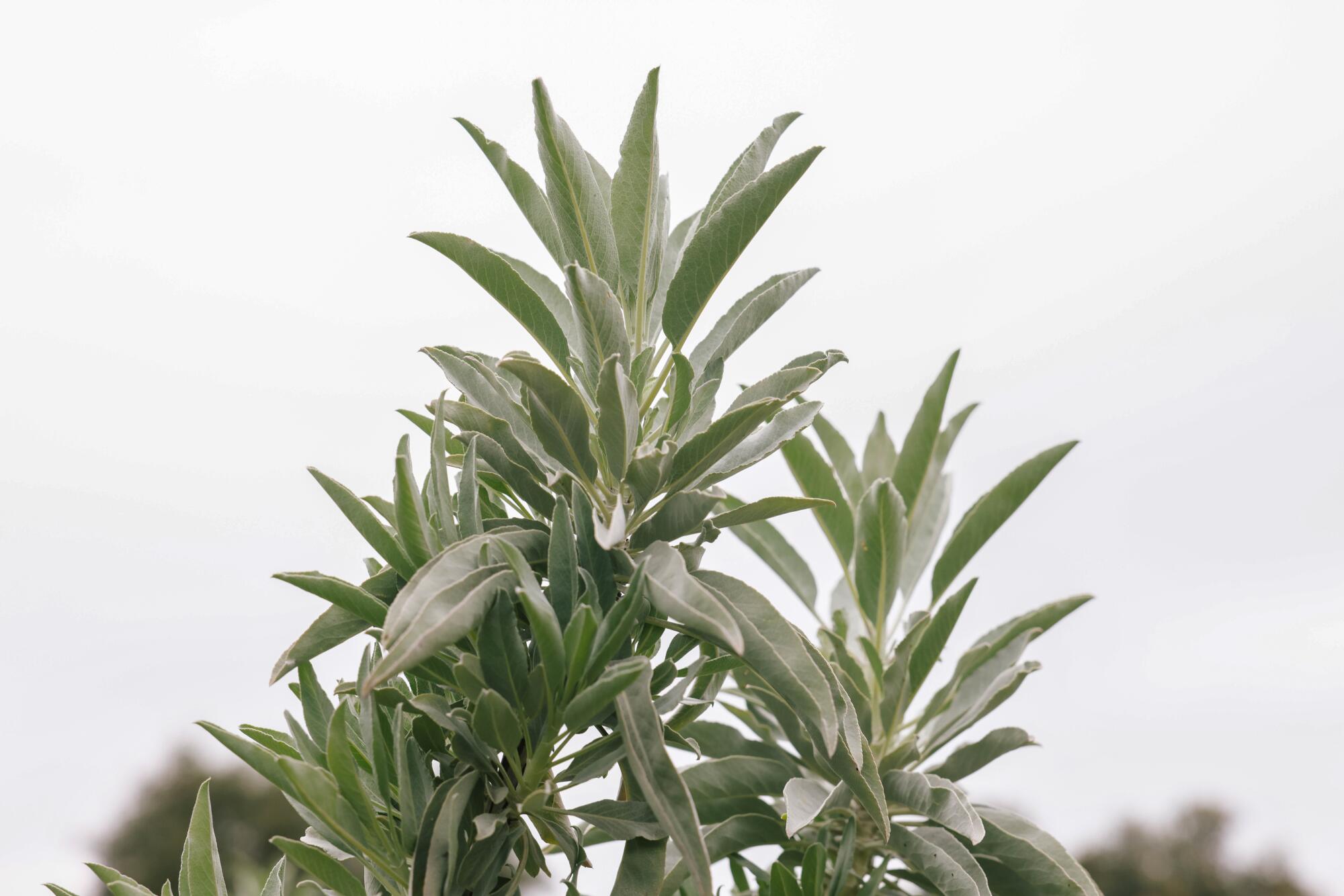
White sage.
(Dania Maxwell / Los Angeles Times)
White sage (Salvia apiana) foliage (only in cooler months when the leaves stay firm). White sage flowers are tall and dramatic, so be sure you have a container large enough to hold them.
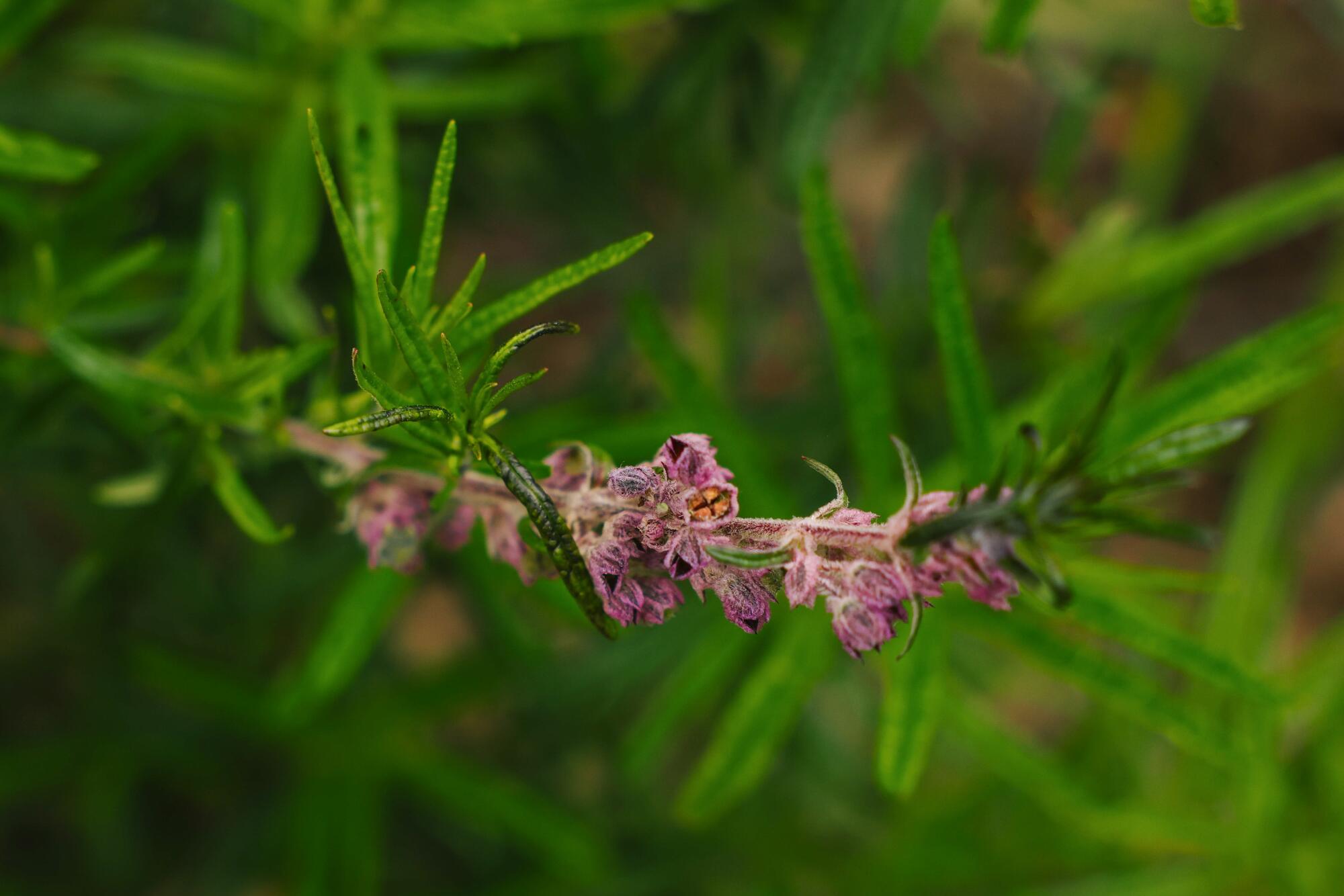
Woolly bluecurls.
(Dania Maxwell / Los Angeles Times)
Woolly bluecurls (Trichostema lanatum) is a finicky native plant that needs regular water to get established and then none to stay alive, but it pays off beautifully with deep purple stalks of flowers and a swoon-worthy sweet fragrance beloved by pollinators and every person I’ve ever known. Definitely worth the effort.
There are plenty more choices, and you can get a good idea of the diversity in the beautiful book of native floral arrangements that Prendergast helped create, “California in a Vase,” available on Amazon for $50 or at the California Botanic Garden poppy shop window in the admissions kiosk for $30 (but only if purchased in person).
If you want more tips, California Botanic Garden is offering a Wildflower Floral Design class on April 21 from 1 to 3 p.m. that includes all materials for $70 ($60 for members) taught by garden horticulturist Jennifer Chebahtah. And you can apply to become a member of the Native Designs group by applying to become a garden volunteer.



Milly Alcock in Supergirl.
Warner Bros. Pictures
hide caption
toggle caption
Warner Bros. Pictures
Hollywood’s newest Supergirl is kind of a dirtbag — in the good way. Fearless and grumpy, Supergirl (Milly Alcock) sets out on a quest to support a new pal’s revenge journey and to make a point that should be clear by now: Never mess with a lady’s dog. Also featuring David Corenswet and Jason Momoa, is Supergirl a worthy follow up to Superman?
If you want more DC superhero action, check out these episodes:
‘Superman’ takes off and nails the landing
‘The Batman’ puts the emo in emote
Connect with Pop Culture Happy Hour:
Letterboxd / Facebook
Our weekly newsletter
Support Pop Culture Happy Hour+
Lifestyle
L.A. Affairs: After decades of near-misses, I finally told him: ‘I’m not leaving here without you’

It didn’t take endless quarantining with my spouse during the COVID-19 pandemic to end my marriage of over two decades. By the summer of 2019, menopause — and the extra-added “bonus” of frontal fibrosing alopecia that it awakened — was pummeling me physically and mentally to the extent that I no longer had the capacity to function inside the dysfunction of my life.
The relief that came with the decision to finally let go was completely dwarfed by the immense pain of severing a family in two. I cried as I packed. I cried as I unpacked. I was rolling endlessly in a dark wave that would not stop; my feet could not tell sand from sky. Once I managed to break the surface, I reached out.
I called Tish, Diane and Michelle, three smart, strong, nurturing women who’d been through and survived divorce. I also called my brother, Dan, and my friends Doug and Steve, three kind, creative, funny men who always “got” me.
As for Steve, we met in the spring of 1984 when he auditioned to be the drummer for the Secrets, the band Dan, Doug and I had started the year before. In our small-town high school of fewer than 400 students, he had flown completely under my radar, as he was two years younger, and he joined marching band the year after I’d ditched my baritone horn for a microphone and Pat Benatar tights. Steve aced the audition, and the four of us clicked immediately over our shared love of the Pretenders and all things Monty Python. By mid-June, the Secrets were playing local bars and biker parties in the middle of nowhere, and I was head over heels in love with the drummer.
It wasn’t supposed to happen like that. I wasn’t supposed to fall in love with a boy from my hometown.
I had spent my whole life dying to get out of Middlebourne, W.Va., and had been champing at the bit to leave for college, but by late August, that no longer meant freedom; it meant that I’d have to leave Steve behind. I told myself we’d defy the odds and make it work. He was my soul mate. But we were just kids, and there was no internet, no cellphones with unlimited text and calling. By February 1985, the divide was too great. In a moment of loneliness, I cheated on him. It was over, and I was firmly told to take my place in the friend zone.
I spent the following year flailing and failing in college before making the bold, half-baked decision to drop out of the West Virginia University theater program and move to Los Angeles, a place I’d never been, to pursue a singing career. When Steve found out that I was moving across the country, he softened his friend-zone stance and told me he loved me. On July 13, 1986, he went with my parents to Pittsburgh International Airport to see me off.
For the next 33 years, we would come together and drift apart — sometimes as lovers but mostly as friends. During a visit to my Hollywood apartment in 1988, when he was still in college and the timing was still wrong, I told him, “Who knows. Maybe in 30 years, I’ll come back and get you.”
In November 2019, Steve came to visit me for a long weekend.
I picked him up at Los Angeles International Airport and took him straight to Zuma Beach for a picnic, where we watched dolphins jumping in the waves while the seagulls stole our potato chips. The following day, we cozied up for an afternoon of wine and cheese at Cornell Wine Co. in Old Agoura, then made our way over Topanga Canyon for dinner at Canyon Bistro & Wine Bar.
The night before he flew home, we watched the sun set from our table by the lake at Zin Bistro Americana in Westlake Village. I felt giddy, excited, seen, understood and appreciated in a way I hadn’t felt in a very long time. While it was tempting to jump right in with both feet, we decided to date long distance and take things slowly.
On March 26, 2020, while Steve was still recovering from being profoundly ill with COVID, I arrived at his doorstep at 6 a.m. and proclaimed, “I’m not leaving here without you.”
Two weeks later, after packing most of his belongings into U-Haul shipping crates, we left Parkersburg, W.Va., in Steve’s red Volkswagen Golf with two suitcases, one Treeing Walker Coonhound and one Aussie/Chow mix. I-40 West was practically empty; just us and the occasional car or Amazon truck.
We arrived in California on Easter Sunday and joined the rest of the world in quarantine, not knowing how it would affect our work and financial future. We took a lot of long walks to help deal with the stress of the not knowing, but the magic panacea for me came the day Steve’s Harley-Davidson arrived in one of the crates.
We cruised up and down PCH, and roared our way up and over Mulholland Highway, Stunt Road, Malibu Canyon and Decker Canyon, stopping along the way to stretch our legs, feel the sea spray on our faces and take in views from the valleys to the coastline. We were surrounded by so much beauty; it was almost impossible to let trepidation win.
On one particularly memorable ride on Mulholland Highway between Kanan Road and SR 23 near Saddle Rock, we came around a bend and — bam! — right in front of me was the greenest mountain range I’d ever seen in California, gleaming spectacularly in the sunlight. As I inhaled its gorgeousness and exhaled my stress, I thought, “I can’t believe I get to see this. I can’t believe I get to do this. I can’t believe I get to be with Steve.”
In September 2024, I got to marry Steve.
As my brother, Dan, said at the reception, “What a long, strange trip it’s been.”
The author lives in the suburbs of Los Angeles with her husband, Steve, and their dogs, Coco Puff and Kira.
L.A. Affairs chronicles the search for romantic love in all its glorious expressions in the L.A. area, and we want to hear your true story. We pay $400 for a published essay. Email LAAffairs@latimes.com. You can find submission guidelines here. You can find past columns here.
-

 Technology4 minutes ago
Prime Day’s final hours bring rare discounts on Philips Hue smart lights
-

 World7 minutes ago
Video shows gaping hole after small plane crashes into towering skyscraper
-

 Politics12 minutes ago
Warren tells Trump to ‘sign the damn bill’ as bipartisan housing package remains stalled in Washington
-

 Health19 minutes ago
Common food preservatives may raise blood pressure and heart risks, study suggests
-

 Sports22 minutes ago
Who is Alyssa Thomas? WNBA star suspended for punching Caitlin Clark in the throat
-

 Technology27 minutes ago
Fox News AI Newsletter: Waymo’s robotaxi recall
-
Business34 minutes ago
Cisco to lay off more than 400 workers in California
-
 Entertainment37 minutes ago
Tom Sandoval’s girlfriend Victoria Robinson arrested after patio fire pit altercation


