Business
SpaceX Starship blasts off on fourth test flight

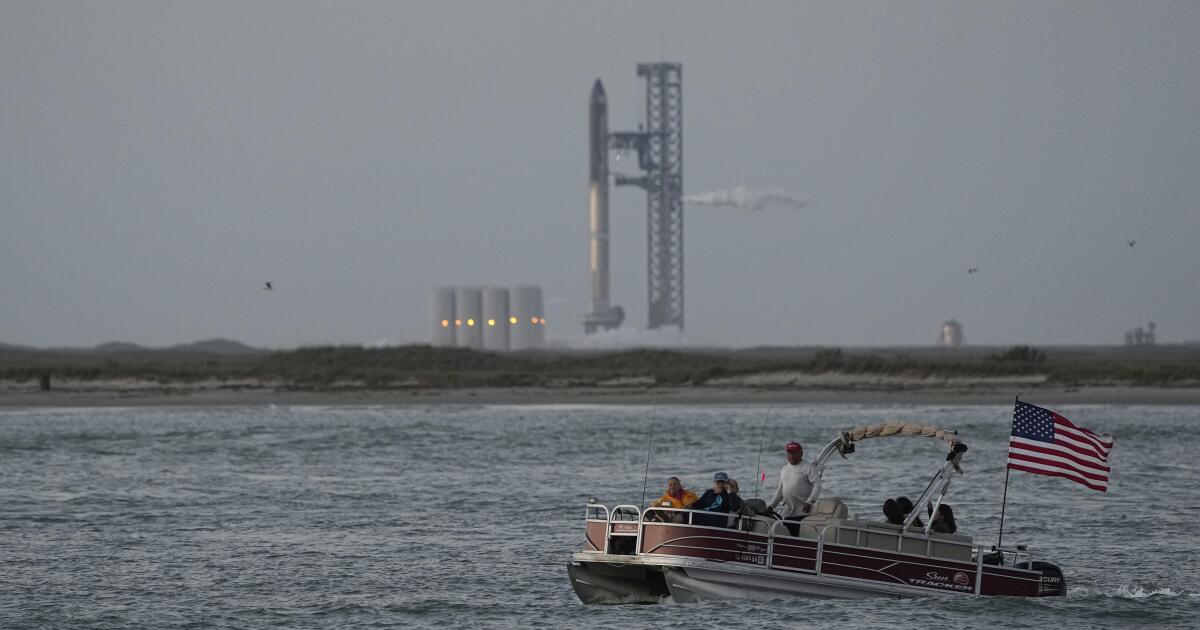
SpaceX launched its Starship spacecraft into orbit Thursday in a fourth test flight intended to assess its ability to control the craft’s descent.
Stacked on a Super Heavy rocket, the Starship capsule blasted off at 5:50 a.m. Pacific time from the company’s Boca Chica, Texas, launchpad. The rocket, the most powerful ever built, is designed to eventually send astronauts to the moon and to Mars.
The goal of Thursday’s uncrewed test flight of Starship is to have the spacecraft and its rocket return to Earth in controlled descents — the capsule in the Indian Ocean and the rocket in the Gulf of Mexico — but there were no plans to recover the stages.
In future flights, Elon Musk’s Hawthorne-based company is expected to attempt landings on pads so the spacecraft and rocket can be reused, an essential technology to making space flight cheaper.
The space-launch system, at 397 feet, is taller and has about twice the thrust of the Saturn 5 and Apollo capsule that carried men to the moon. It is collectively referred to as Starship.
This was the second major launch this week and came after Boeing on Wednesday finally launched its Starliner spacecraft with a crew aboard to the International Space Station. Starliner, which has had its launches repeatedly delayed, is competing to service the station with SpaceX, which already has sent more than half a dozen crews to the orbiting lab. Starliner is expected to dock with the station at 9:15 a.m. Thursday.
Thursday’s flight came about four months after a March 14 test flight when Starship reached several milestones. However, the capsule burned up in the atmosphere on descent while the rocket failed to achieve a controlled reentry to earth.
Starship did reach orbit, though, opened and closed its payload doors and transferred fuel from one tank to another, a critical function for flights into space. The test flight also was the longest yet of the spacecraft.
The craft’s first flight in April 2023 lasted only a few minutes before the booster lost power and exploded on ascent. A second launch in November was more successful, with the rocket separating from the capsule before both were lost.
SpaceX, formally known as Space Exploration Technologies Corp., views flight failures as part of its development process, an approach that differs from traditional aerospace companies that have long preferred to perfect their technology on the ground.
Starship is part of NASA’s Artemis program to return humans to the moon, with the goal of establishing a permanent base to facilitate missions to Mars. The program includes a second spacecraft called Orion, manufactured by NASA, Northrop Grumman and Airbus, and a Space Launch System rocket built by Boeing, Northrop Grumman and other companies.
Orion circled the moon in a successful 25-day mission that blasted off in November 2022 without a crew. A mission carrying astronauts is scheduled for no earlier than September 2025.
Starship also has a commercial component. It would allow the privately held company to launch more and larger Starlink broadband satellites than the company’s existing lineup of Falcon 9 rockets.
Last week, Japanese e-commerce billionaire Yusaku Maezawa tweeted that he had pulled out of a contract signed in 2018 to fly in Starship around the moon due to delays in the spacecraft’s development. Maezawa, who wanted to fly with a half dozen artists, said he had expected the private space trip to take place in 2023.


Tired of the same old dating apps like Bumble and Hinge, Marie Lansley tried talking to an artificial intelligence matchmaker.
For roughly 15 minutes, she chatted with an AI voice on the dating app Known, answering questions about her upbringing, personality, education, lessons from past relationships and whether she’s looking for a serious relationship or something more casual.
“Divorced at 36. Yea, you’re not here to waste time. The way you build your days matter,” the AI voice told her after Lansley replied she was looking for a serious relationship.
Weeks later, the San Francisco resident got a match along with a written summary of why the pair could be compatible. But the stranger wasn’t her type and she wasn’t keen on paying $15 to meet up.
Startups like Known are roping in new users by hosting in-person dating events in San Francisco.
“I want to be able to use AI to improve efficiency in dating and to help navigate a pretty frustrating dating landscape. But there are just some things that are so deeply human that AI technology cannot capture,” said Lansley, who has posted about her dating experience on social media.
Singles like Lansley are dipping their toes into the wacky world of AI dating but they’re also skeptical if it will make it easier to find love. Online dating is ripe for disruption, and tech companies big and small are turning to AI as a potential solution to find people better matches more quickly and help them improve their chances of landing a date.
For years, people have been frustrated and exhausted by the seemingly endless amount of swiping and small talk that go nowhere on dating apps. They’re turning to in-person options such as running clubs, pickleball and speed dating but finding the right partner is still tough.
Online dating remains a popular way people search for a partner but some are dumping the platforms. Tinder’s monthly active users in March dropped 7% year-over-year, though its parent company Match Group noted that the rate of decline has been slowing as it revamps the app.
West Hollywood-based Tinder, which has roughly 50 million monthly users, has been experimenting with using AI to analyze a user’s camera roll and recommend better matches.

Known, an AI dating app, has its branding plastered on a storefront in the Marina District in San Francisco.
Its rival Bumble — an app that initially stood out for having women message their matches first — saw its paying users drop 21% to 3.2 million in the first quarter this year compared to 2025. The company has been working on AI matchmaking and plans to ditch swiping in the last three months of the year in select markets.
Even dating services that have grown users such as West Hollywood-based Grindr, an app for the LGBTQ+ community, and Facebook Dating, which is included in the main social network, are also leveraging AI more.
And new AI dating startups are popping up in California, New York and other states that could change the way people find a partner online. Former Hinge co-founder and Chief Executive Justin McLeod is working on an AI dating app called Overtone, stating on its website that “AI, if used correctly, can help us invent an entirely new way for people to find their partners that is far more personal, far more efficient, and far more effective.”
Some of those startups started in the San Francisco Bay area, where AI dating apps are hosting parties, speed dating, coffee meet-ups and other in-person events to rope people into using their new service.

Singles who downloaded the Known dating app mingle over drinks at Left Door, a cocktail lounge in San Francisco, on Thursday.
On one recent Thursday night, dating app startup Known hosted a dating event at a swanky San Francisco cocktail lounge for people who completed their matchmaking call on the app. The event’s description said attendees would be greeted with “champagne, caviar bumps, and a mysterious envelope” that reveals who the AI matchmaker paired them up with.
Known Chief Executive and co-founder Celeste Amadon, who dropped out of Stanford University to create the AI dating app, said Americans are spending more time alone at home as online services have made it more convenient to do everything from getting food delivered, online shop and date. Young people complain about traditional dating apps yet they’re also still on them.
“The more I understood today’s dating apps, the more clear it became that they have been for the better part of two decades now, designed, tweaked, redesigned, rebuilt, to not work,” she said.
1

2

3

1. A sign that reads, “I love my AI boyfriend” hangs in a San Francisco window. 2. Known, an AI-driven dating app, has their branding plastered on a store front in the Marina District in San Francisco. 3. Celeste Amadon, CEO of Known, poses for a portrait.
The company charges per date to ensure people show up but the startup also has a business incentive to find people a match they actually want to meet, she said. Known plans to expand to San Diego in July, she said. Amadon said she expects the AI matching technology to become more accurate over time.
Known hasn’t shared its user numbers or revenue figures. Founded in 2025, the startup launched the dating app in February and has raised roughly $10 million from investors such as Coelius Capital, Forerunner Ventures and NFX, according to PitchBook.
Grindr is learning more about how much users are willing to use and pay for AI features.
The company has been testing a subscription tier called “Edge” in Australia, New Zealand, the United States and Canada that includes AI tools that recap meaningful chats, display personalized profile recommendations and show users who they’re likely to match with.
Unlike other dating apps, Grindr users don’t swipe through profiles. The app displays a grid of people who are nearby that they’re able to chat with. Grindr has expanded beyond casual dating, allowing people to find friends, travel companions and others in the LGBTQ+ community.
Grindr’s Chief Product Officer AJ Balance said the company is still testing subscription pricing for Edge but some users are willing to pay $350 per month because they’re “seeing a lot of value” and saving time.
“We view AI and new paradigm shifts like it as opportunities to build great, new product experiences that haven’t been developed before,” he said. “Our approach is really to leverage AI, like we did with mobile, to facilitate better conversations, deeper connections, ultimately more success in dating in the real world.”
Other popular dating services aren’t charging for AI matchmaking features. On Facebook Dating, which has more than 21.5 million daily users worldwide, users can use AI to write their profile intro and chat with an dating assistant for free.

AI dating startups are popping up in California, New York and other states that could change the way people find a partner online.
The AI assistant can recommend people looking for a serious relationship, someone with common hobbies or even above a certain height or age. Roughly 1 million people use Facebook Dating’s AI assistant daily in the United States and Canada, Meta said.
Facebook Dating product manager Neha Kumar said AI can help combat “swipe fatigue” facing online dating users.
“You’re sifting through a bunch of profiles. It’s really hard to understand and find somebody that’s compatible for you based on your specific types of preferences,” she said. “We really wanted to think about leveraging AI to solve this growing pain point.”
Technology is also a double-edged sword. The rise of AI tools means people can use technology to easily manipulate photos and craft messages on dating apps that might make them seem much more attractive or charismatic than they are in person. Some people are even turning to AI chatbots for companionship.
“How do we maintain human authenticity and human connection through an AI world? I don’t have a perfect answer to that. I think we’re still figuring it out,” Kumar said.
Lansley, the online dating user, said apps do make dating more convenient but it’s much more interesting to meet people face-to-face. She worries people will rely too much on AI as a “crutch” to replace human intimacy or emotional judgment.
“Chemistry,” she said, “is always going to be analog.”

Los Angeles County saw job gains in May, likely driven in part by rebuilding after the January 2025 wildfires, which destroyed or damaged more than 18,000 structures.
Construction added 2,300 jobs since April, while postings for new jobs in the industry jumped 45% over a year ago —indicating rebuilding in Pacific Palisades, Altadena and nearby is helping boost the local economy, according to a report by the Los Angeles County Economic Development Corp.
“This is consistent with the possibility that wildfire rebuilding activity is increasing construction labor demand in the area,” Max Chomas, an economist at the LAEDC Institute for Applied Economics, said at a presentation this week based on California Employment Development Department and other data.
Motion picture and sound recordings also added 2,800 jobs during the month, despite a deep downturn in Hollywood caused by a reduction in streaming filming, runaway production and other factors. The industry lost 6,700 jobs compared with a year ago.
Still, the job growth since April in construction and Hollywood were among the highlights of a month that saw total county payroll jobs — excluding agriculture and certain other sectors — grow by 9,000 jobs, to 4,618,400. Employment was virtually flat from the same time a year ago.
“May was a relatively good month for employment growth,” Chomas said.
The biggest monthly job gainers were the hotel and restaurant industries, which added 3,700 jobs.
Manufacturing, which has been hit by job losses over recent years, added 400 jobs since April. It also saw a 15% increase in job postings compared with a year ago.
That could reflect the resurgence in Southern California’s aerospace and defense industries, which have seen a sharp rise in startups.
Postings for all new jobs were up 1,134, or 2.4%, since a year ago. Chomas noted that May was only one of five months over the last three years that saw year-over-year growth in job postings.
The gains helped stabilize the county’s unemployment rate at 5.2%, matching April’s rate and down from 5.4% in May 2025.
Still, that is higher than May’s 4.3% national unemployment rate, and it masked some weakness in the local economy.
The rate is calculated by a household survey to determine which members are working, looking for work or no longer seeking employment.
It found 18,000 workers had dropped out of the county labor force in May, artificially driving down the unemployment rate, according the California EDD.
Similarly, California recorded a 5.3% unemployment rate in May, on par with April, despite a drop in the labor force.
That rate is higher than every state other than Delaware. In May, California only added 3,100 non-farm jobs month-over-month — a job growth rate that lags behind the nation, according to an analysis by the Inland Empire Economic Partnership and the Lowe Institute of Political Economy at Claremont McKenna College.
The LAEDC’s report also examined the potential effects the growth in artificial intelligence has been having on L.A. County jobs “exposed” to AI, meaning they are vulnerable to AI replacement.
California has been hit hard by thousands of AI-related layoffs in Silicon Valley as the software has been integrated into the tech workplace — even though there is fierce competition for software engineers with skills and expertise in the field.
The report found that since July 2023, job listings in Los Angeles County for AI-exposed positions — such as clerical and translation positions — have lagged behind other jobs. However, it is unclear whether businesses have replaced or are waiting to replace those workers with AI.
It may be that employers overhired for those positions during the COVID-19 pandemic and are now shedding them, since there is a correlation between AI-exposed positions and those jobs that can be completed from home, Chomas said.
The report also examined macroeconomic trends and policy decisions affecting the national, state and Los Angeles County economies — which have been hit by tariffs, the crackdown on immigrant labor and high energy costs, among other factors.
Nevertheless, consumers continue to spend despite affordability strains, and employers continue to hire selectively amid higher interest rates to battle inflation, said institute economist Shannon Sedgwick.
“During the previous decade, we experienced extraordinarily low inflation, near zero interest rates, relatively stable globalization, and abundant capital. So those conditions may have conditioned us to think that environment was normal,” she said.
“But historically speaking, today’s world of higher rates, greater geopolitical uncertainty and tighter labor markets, they may actually be closer to that long-run average,” Sedgwick noted.

A proposal to build a truck parking lot near the Port of Los Angeles is facing backlash from nearby residents.
Port officials say the parking lot would provide much-needed designated space for cargo trucks waiting to pick up loads from the port, helping to ease congestion in the area.
But some neighborhood groups say the proposed staging area would only increase traffic and air pollution in Wilmington.
Gina Martinez, chair of the executive board of the Wilmington Neighborhood Council, said the land in question provides a vital buffer between port activity and residential communities.
“It’s been a bad deal from the beginning,” Martinez said in an interview. “We want open space because we’ve been promised for decades a clear separation from port activities.”
The Los Angeles Harbor Commission signed off on the project in a meeting on June 11, but it was vetoed by the Los Angeles City Council this week.
The veto does not permanently ban the project, but allows for more time to discuss the implications for stakeholders and the community.
Los Angeles City Councilmember Tim McOsker, who introduced a special motion to halt the truck plans, said he was acting on behalf of community residents. McOsker represents Harbor City, Harbor Gateway, San Pedro, Watts, and Wilmington.
“Generally, folks in the community would say, ‘we don’t want the port industrial properties to creep into neighborhoods. We want them to retract or hold the line,’” McOsker told The Times.
The John S. Gibson Truck & Chassis Parking Lot, which was originally proposed in 2023 by the Port of Los Angeles, would cover 18 acres of privately owned land and include 393 truck and chassis parking stalls.
The land is currently designated as open space, though it’s undeveloped and not available for any recreational use. The completion of the parking lot would require a Port of Los Angeles master plan amendment to switch the land’s designation from open space to maritime support.
Martinez said the land should have never been sold to private developers because it’s included in the California State Lands Commission’s tidelands trust, which says certain land near the ocean must be available for public enjoyment.
Building a truck and chassis waiting lot on that space would increase congestion on the freeways and in Wilmington neighborhoods, add particulate matter into the air and increase already-problematic noise pollution from the port, she said.
“Of all the things Wilmington needs, it is not another parking lot for trucks,” Martinez said at a Los Angeles Harbor Commission meeting earlier this month. “It is not the responsibility of our community to take on every single truck that runs through the port.”
At the same meeting, Noel Gould of the Coastal San Pedro Neighborhood Council said the council is supporting the project after working closely with the developers to reach compromises.
The parking lot would prevent port-bound trucks from idling near schools and parks, he said. The lot would also include landscaping with native coastal plants.
“We didn’t start out in a position of support, but we worked very closely with them to get to a place where we felt it was really something that would benefit the community,” Gould said at the meeting.
In an interview, McOsker said there is already space set aside for trucks to wait to access the port.
At the Los Angeles City Council meeting Wednesday, the council unanimously approved what’s known as a 245 motion, which gives the council authority to temporarily veto certain actions taken by city boards and commissions.
“The 245 gives us the opportunity to meet and confer and see if there are revisions or additions or mitigation that can better protect the full community,” McOsker said.
The motion sends the project proposal back to the Harbor Commission for further review.
Supporters of the parking lot say the land is currently uninhabited and requires consistent police presence to deter criminal activities.
The Port of Los Angeles also clashed with coastal communities last year over the possible raising of the Vincent Thomas Bridge. The bridge was already slated to be redecked by the California Department of Transportation, but Port of Los Angeles executive director Gene Seroka proposed raising the bridge height as well.
Raising the bridge would allow larger cargo ships to pass under its deck, helping create jobs and keep the port relevant, Seroka said at the time. Most painfully for local commuters and businesses, it would mean the bridge will be closed for around 28 months rather than the originally planned 16 months.
Last December, the California State Transportation agency rejected the proposal to raise the bridge.
-

 Los Angeles, Ca1 hour ago
Climbers rescued from Tahquitz Rock in San Bernardino National Forest
-

 Detroit, MI2 hours ago
Report: Pistons Targeting 7-Time All-Star Wing to Pair With Cade Cunningham
-

 San Francisco, CA2 hours ago
6/28 Gamethread: Giants vs. Braves
-

 Dallas, TX2 hours ago
Dallas community gathers donations for Venezuela
-

 Miami, FL2 hours ago
Miami Heat Could Reunite With Playoff Hero This Offseason
-

 Boston, MA2 hours ago
Red Sox lefty makes latest rehab start, close to forcing tough decision
-

 Denver, CO2 hours ago
Firefighters say car crash caused large fire north of Denver International Airport
-

 Seattle, WA2 hours ago
PHOTOS: Thousands gather in downtown Seattle for city’s iconic Pride Parade

