Lifestyle
Gay hamsters. A litigious elf. A cowgirl toilet. Welcome to Julio Torres’ ‘Fantasmas’


Julio Torres in Fantasmas, which he also wrote and directed.
Monica Lek/HBO
hide caption
toggle caption
Monica Lek/HBO
The Greek hero Jason famously sought the fabled Golden Fleece. His quest took him over land and sea, and forced him to confront six-armed giants, harpies, clashing rocks, a sleepless dragon, sirens, a huge bronze automaton and many other strange and thrilling perils.
Comedian Julio Torres, on the six-episode HBO series Fantasmas (which he also wrote and directed), embarks upon a similar quest. Only instead of seeking the pelt of a winged ram sired by Poseidon and the nymph Theophane which was said to bestow divine authority upon whomsoever possessed it, Torres goes looking for an earring he lost at a dance club.
Yet Torres’ quest is no less mythic; it takes him through a colorful, dreamlike version of New York City created entirely on a soundstage. And his tale is just as discursive as Jason’s, because he’s forever brushing up against other New Yorkers who hijack the story for a few minutes at a time. Think of these character-focused vignettes as the series of strange Greek islands Jason visits on his travels. But instead of sirens and harpies, Torres’ encounters, in no particular order: Gay cokehead hamsters, grasping social media influencers, a homewrecking alien puppet who in no way repeat in no way resembles ALF, a hilariously self-aware school bully, a toilet dressed up in cowgirl couture, the letter Q as an alt-comic who’s way too niche for mainstream audiences, an elf suing Santa over labor violations, and really, trust me, just … so much more.

Bowen Yang in Fantasmas.
Monica lLek/HBO
hide caption
toggle caption
Monica lLek/HBO
Sound like a lot? Too much? That’s kind of the point. Fantasmas is stuffed with outsized characters and absurd situations that have no business cohering — that would, on any other show, jostle selfishly for our attention, elbowing themselves to the front. But that’s not the case here, because every aspect of the series first passes through the filter of Torres’ comic sensibility. That sensibility turns out to be a bracingly offbeat and intensely idiosyncratic one; nobody else vibrates at his specific frequency. Over the course of the series’ six episodes, the resolutely weird tone proves flexible enough to admit welcome variations, but it never wavers.
The world Torres has created here is a hermetically sealed one, walled off from our mundane reality even as it critiques various features of it, from the institutional demand for official documentation (“Proof of Existence”) to white privilege to the gig economy.
And where Jason’s quest for the Golden Fleece featured lots of celebrity cameos — Medea, Heracles, Orpheus, Zeus, Aphrodite – Torres brings his own pantheon of famous pals into the mix, both onscreen (Bowen Yang, Paul Dano, Steve Buscemi, Aidy Bryant, Ziwe, Julia Fox, Kim Petras) and off (Cole Escola and John Early voice those bitchy gay hamsters, Tilda Swinton embodies toilet water, James Scully voices a wall poster of a demonic Pomeranian no yeah look I said it was weird what do you want from me?).
If you’ve devoured Torres’ work, as I have — he co-wrote the instantly and indelibly iconic SNL sketch “Wells for Boys,” co-created the series Los Espookys and wrote and directed last year’s Problemista – you know what to expect from Fantasmas to some extent, both in its approach and in many of its particulars.
That’s not a complaint; creators like Torres aren’t workmanlike jacks-of-all-trades that studios could happily attach to any project. They’re artists who tend to seize upon their personal obsessions, and as a result, themes recur.
Had Problemista been released back in August of 2023 as originally intended, we would have spent almost a full year away from Torres’ singular comedy mind. But the SAG-AFTRA strike delayed that film’s release; it finally arrived in theaters this past March.
So it’s only been a handful of months since we last visited Planet Torres, and walked among the verdant forests of his pet fixations: Uncaring institutions (banks, credit cards, hospitals), the hidden essences of objects, hypochondria, the monetization of art, a weirdly specific revulsion at filling out online forms, etc.
Now, me? I’m happy to revisit Torres’ world as often as possible. But it’s true that watching Fantasmas so hard on the heels of Problemista leaves you with a sense of having just left a charming, trippy, disorienting party, realizing you forgot your phone, and walking back into the same riot of color, sound and fascinating people that you haven’t been away from long enough to miss.
But still: It is a great party — fun, blithely strange, exultantly queer and packed with folks you love spending time with. Why not grab yourself another drink, while you’re here?

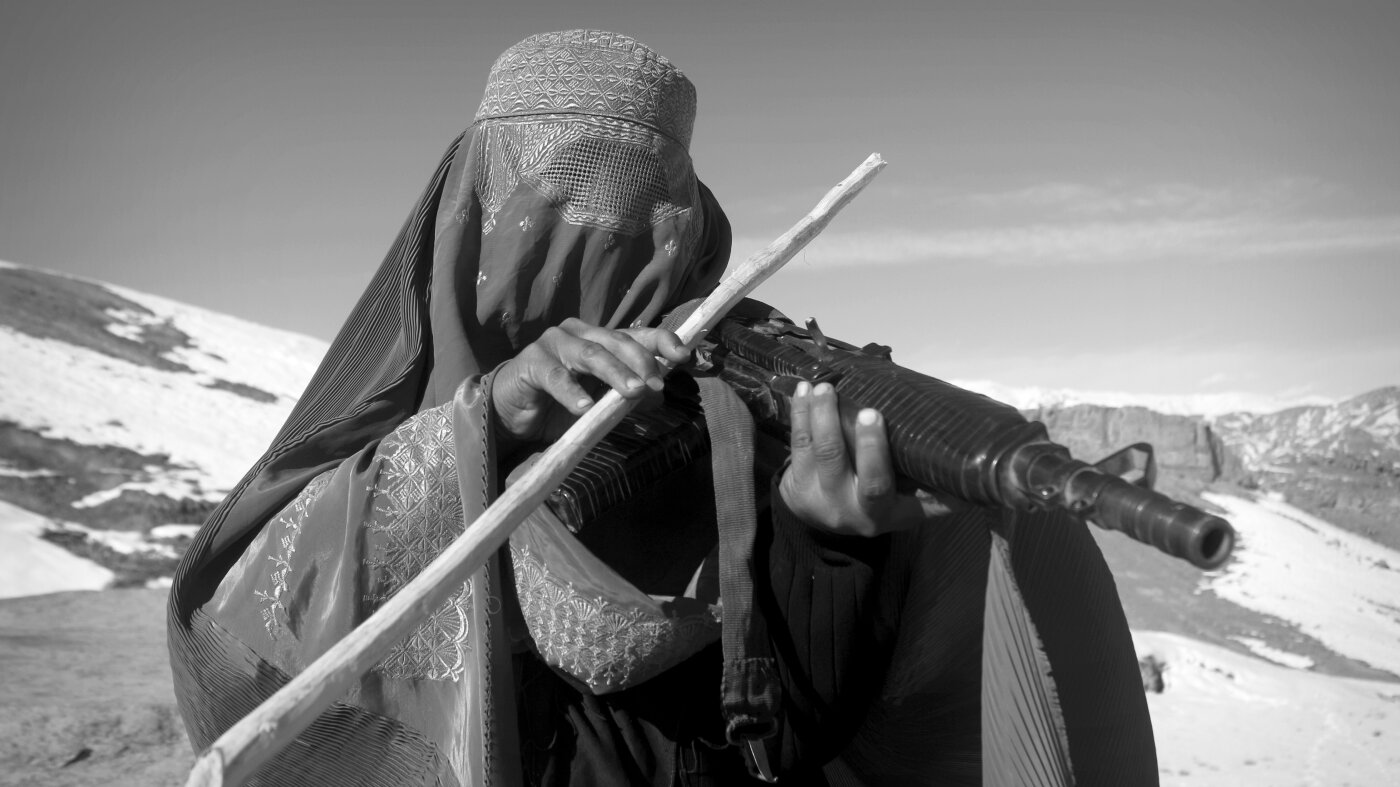
This photo, from a series of pictures by two anonymous cousins, is entitled “The Music of Poverty and Violence.” The subject is playing an automatic weapon as if it were a string instrument.
Mahnaz Ebrahimi|January 2026
hide caption
toggle caption
Mahnaz Ebrahimi|January 2026
Do these photos depict fiction or reality … or both?
A bicyclist whose dark, flowing burka enfolds her body from head to ankles sits with hands perched on the handlebar, seemingly undaunted by the meshed veil that covers her eyes and restricts her sight. Her determination is suggested by the photo’s title, “It will not stand in my way.”

This photo of a woman wearing a burka while riding a bicycle is titled “It will not stand in my way.”
Somayeh Ebrahimi/February 2025
hide caption
toggle caption
Somayeh Ebrahimi/February 2025
A similarly clad figure swirls so swiftly that the billowing fabric appears to lift her into the air like a bird in flight; scribbled in Farsi across the brick wall in front of her is the phrase, “I dreamed that my homeland was prosperous.”

“Courage means being afraid and trembling in the face of adversity, but with the courage, dance!” says photographer Somayeh Ebrahimi.
Somayeh Ebrahimi | February 2025
hide caption
toggle caption
Somayeh Ebrahimi | February 2025
A third burka-draped figure places an automatic rifle on her shoulder as she would a violin, “bowing” it with a long wooden stick as if to make music. The photo’s title is “The Music of Poverty and Violence.”
Two Afghan cousins who created these starkly evocative black-and-white photographs. They do not want their real names revealed because they fear Taliban retribution for their work. So they use the pseudonyms Mahnaz Ebrahimi (born in 2000) and Somayeh Ebrahimi (born in 2001). They live in a remote Afghan mountain farming village. They and their families, all members of the Hazara ethnic group and Shia Muslims, had previously worked as carpet weavers in Kabul. When the Taliban regained power in 2021, they left, seeking refuge from the repression and persecution permitted under the laws of the country’s ultra-conservative Sunni rulers.
Neither cousin had any training in photography when they started taking photos on their cellphones in 2022 or so, says Madrid-based curator and gallery director Edith Arance. She came across their work on Instagram and was struck by the skillful melding of their bleak surroundings with messages ranging from the poetic to the political.
“I know a little Farsi [the Persian language] so I could approach them,” she says. The cousins and Arance worked together via Instagram. In November 2024, Arance presented their work in Madrid, at her Galería Sura, which specializes in emerging photographers from Southwest Asia and Africa.
The photos, which document the sparse reality of the cousins’ lives today and their hopes for a less gloomy future, are on display through May 30 at the Photoville Festival in Brooklyn, New York. Arance uses the literary term auto-fiction to describe their work because, as in that genre, these photos also combine autobiography and fiction. While the images are set against the autobiographical backdrop of where they live, the poses struck by those photographed and their interactions with their physical and natural surroundings suggest interior dreams and fantasies, played out before the camera.
For Arance, the use of light and shadow, and the use of trees, leaves, plants and butterflies as symbols, are also akin to the literary style known as magic realism. The captions and poems accompanying were written by the cousins and translated by Arance.
In “Life Is Today” a young girl dances on a barren ridge overlooking snow-capped mountains. Arance comments: “There’s a sense of play, which should not be unusual. But this is Afghanistan, and this girl is not wearing a veil or a burka, she is just being free. Her shadow looks like an airplane flying away.”

This photo is titled “Life is today.” The photographers say the image is a call to live in the present as the future is uncertain.
Somayeh Ebrahimi/March 2024
hide caption
toggle caption
Somayeh Ebrahimi/March 2024
Other photos similarly question the highly constricted lives of women under Taliban rule.
“Liberation” shows a woman, her back turned to the camera showing the decorations in her hair (which are prohibited by the Taliban), as she throws her burka up and away into the sky. In its accompanying poem, Mahnaz Ebrahimi writes, “In the name of being a woman,/today I will free myself from oppression/and darkness to the breeze/to the height of the sky.”
“Girl by the Door” emphasizes contrasts in light and shadow, as a girl holding a tattered schoolbook stands with half her face hidden by a pale wooden door with multiple chains, the other half dimly lit against the dark background behind her.
The commentary by Mahnaz reads: “The image here is imbued with symbolism. For a time, after learning about the new law [prohibiting education for females after sixth grade], girls risked their lives by going to school. Attacks followed, intended to discourage families from allowing their daughters to attend classes throughout 2022. Light, knowledge, life resides outside. Darkness is the interior of the domestic space to which girls and women are relegated.”
The dichotomy between constriction and freedom is dramatized in the photo of a young girl wearing sunglasses and laughing with uproarious delight titled, “When Will We Laugh From the Bottom of Our Hearts Again”? But there is still the possibility of youthful delight, as shown in “Autumn Games,” in which three young girls throw leaves up into the sky.
Their photos pose questions about other restrictions imposed on girls and women. “Vestiges of the Present” captures a female figure in colorful garb, shown only from the shoulders down, holding a boombox that her still stance tells us is silent; “music, dancing and singing are prohibited for women [in public] in Afghanistan,” the caption reminds us.

This photo addresses the Taliban prohibition forbidding women to make music in public.
hide caption
toggle caption
In an outdoor scene, a young girl cowers as an unseen gunman points a rifle at her, but she holds on to a school notebook with a message in Farsi that reads, “There is no justice,” referring to the limits on girls attending school.
Taken as a whole, Arance says, the photos declare that “The Taliban may say that this is the destiny of women in Afghanistan, but I’m saying this is not my destiny.” As for that hoped-for future, aspirational glints appear in photos such as “From the Depths of Darkness,” which shows, against a black backdrop, a woman holding in her hand a mound of dirt and twigs from which a butterfly is emerging.
Similarly, “And the Glory of Growing Happens Within Us” captures, in profile, a burka-covered woman cradling in her hands a growing, blossoming plant, and perhaps finding inspiration in the ongoing life of its sprouts and buds.
Diane Cole writes for many publications, including The Wall Street Journal and The Washington Post. She is the author of the memoir After Great Pain: A New Life Emerges. Her website is DianeJoyceCole.com
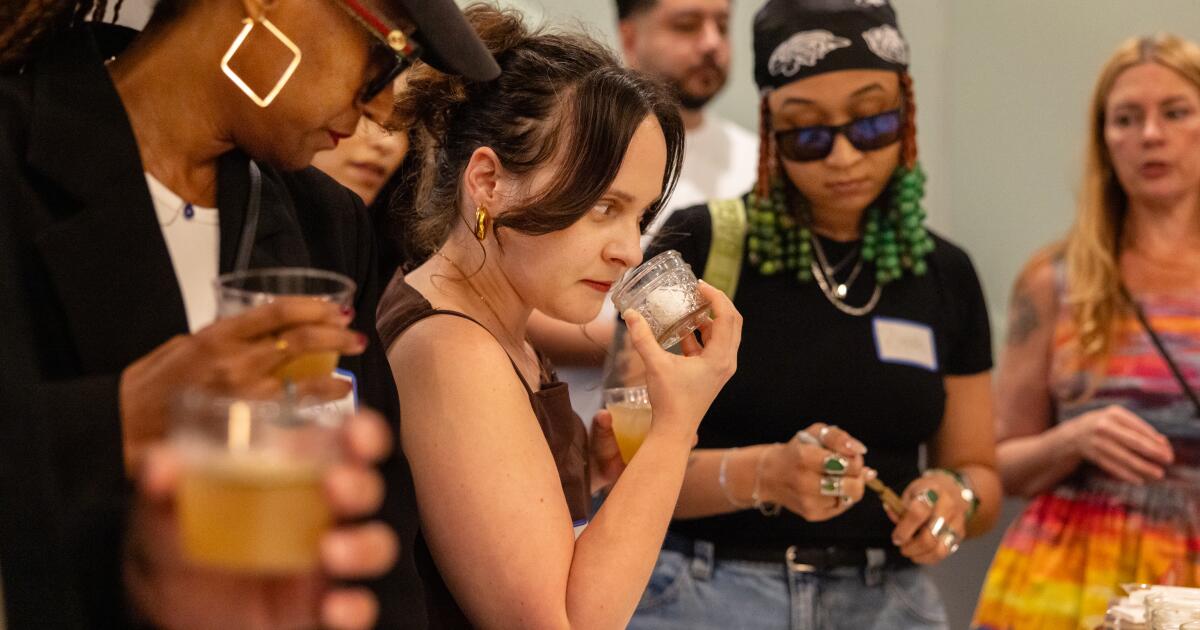
On a Thursday night in West Hollywood, a sleek, multi-level townhome is filled with stylish guests holding fragrance vials the way partygoers cling to cocktails. They raise scents to their noses as they mingle and float through the space.
In one nook, two well-known faces in the fragrance community, Tishni Weerasinghe (@thatbrownperfumegirl) and Chase Chapman (@thescentchase), host stations with their favorite home scents — pre-bedtime spritzes to everyday comforts for working from home — as a small group leans in, asking questions and noting which scents resonate. Inhaling the blend of white musk, floral notes and amber of Rouat Al Musk by Lattafa, a $16 fragrance from Weerasinghe’s collection, attendees oooh and nod in enthusiastic approval.
In another corner, guests try fragrance pairings, scents expertly paired with drinks, letting the aroma and flavors mingle through their senses. Outside on the rooftop, the crowd spills into smaller conversations over refreshments and city views.
Sarah Bowen, co-founder of the Smellers Club, sniffs a fragrance.
This is the Smellers Club. To an outsider, it might seem like a gathering centered around a niche fixation, but within this world, fragrance is much more expansive. Here, it’s a bridge between people, a tool for self-expression, a way to understand your own taste and increasingly, a reason to connect. The night’s gathering is taking place in the home of Daniel Scott and Ronn Richardson, the duo behind the fine home fragrance line Space.
Some guests are simply scent-curious, while others have deep roots in the world of fragrance. One attendee, Jess Blaise, the co-founder of Haitian Spotlight LA, credits her Haitian heritage and the fragrance rituals modeled by her mother for her connection to scent. She recently purchased a bottle of Carnal Flower by Frederic Malle for her personal collection, a luxe tuberose known for its white floral profile and appeal among niche collectors. Of her culture, she explains, “Part of your presentation — of dressing up — is your scent.”

The gathering was hosted in the home of Daniel Scott, left, and Ronn Richardson, co-founders of the home fragrance brand Space. Space offers a range of luxury home fragrances and candles.
Across Los Angeles, fragrance clubs are transforming what was once a solo ritual into something communal. From rooftop gatherings in West Hollywood to casual park meetups further east, these hangouts tap into a growing desire for laid-back, low-stimulation ways to spend time together, offering an alternative to the usual rotation of restaurants, bars and crowded nights out.
Reverie of Scent turns a small nook of Elysian Park into a mini fragrance lounge on Saturday mornings once a month. Founded in November 2025 by Marian Botrous, with support from her husband, Errol, and her sister, Marlene, the club started with just four members at the first meetup. By their sixth gathering this past April, attendance had quintupled, with a mix of regulars and newcomers at every session.
“It’s a huge world,” Botrous says of perfume. “Exploring it together makes it more interesting.”

Fragrance lovers hang out on the rooftop at Smellers Club’s West Hollywood gathering.
At her picnic-like gatherings, attendees show up with blankets, snacks and scents to swap or discuss. With 2-milliliter samples running up to $12, “collecting new scents gets expensive fast,” Bostrous says. “Our meetups make it accessible and fun.”
There’s a mix of casual socializing and structured discussion — conversations have explored the motivations behind wearing fragrance, from seduction to personal comfort, as well as the cultural impact of certain perfumes, like Chanel No. 5 and its connection to Marilyn Monroe and old-school luxury glamour. At one meetup, a member brought in a fragrance called Scentless Apprentice, inspired by the novel “Perfume: The Story of a Murderer” by Patrick Süskind (which Kurt Cobain loved so much that he wrote the Nirvana song “Scentless Apprentice”).
Artist Megan Lindeman, who founded Silverlake Scent Club in August 2025, is also bringing people together to explore scent as a shared social experience. Lindeman says she was inspired by Los Angeles’ broader scent culture and a curiosity about what it would feel like to center smell in a communal setting. The group meets monthly in her Silver Lake backyard, where attendees explore fragrance as both material and memory.
Black Girl Perfume Club was founded in 2023 by Taylyn Washington-Harmon, launching online before expanding into in-person meetups. Across Substack, Instagram and IRL gatherings, it brings together fragrance lovers and newcomers eager to deepen their understanding in an interactive way. “I started the club back when fragrance’s popularity was still pretty niche, and now seeing it move into the mainstream is really exciting,” says Washington-Harmon. As interest grows, she hopes more people will also explore the range of artistry produced by Black-owned fragrance lines.
Back at the house in West Hollywood, people continue to vibe at the event led by Sarah Bowens and Jon Kidd, Los Angeles natives and the duo behind the Smellers Club, launched in January. They’re siblings-in-law who grew up together in the church and are quick to note that their respective partners, Zana and Zion, are unofficial team members and rock-star supporters.

Jess Blaise tests out a scent by Selnu.
Between the both of them, Kidd brings the “fraghead” energy — a name for fragrance devotees who bring a passion and certain fluency of fragrance culture. Bowens, who comes from an events background, heads curation and considers herself more in the beginning stages of her fragrance journey.
When they first started hosting these events, Bowens wasn’t sure how captivating they’d be. “I was like, can people really sit here for hours and talk about fragrance?” she says. She got her answer quickly, watching guests chat, laugh and dive into lively conversations for hours.
Kidd points to wine and book clubs as “event muses” for the Smellers Club. “At a certain point, it stops being about the books or the wine — and for us, even the fragrances,” he says. “It becomes about the people.”

Chase Chapman sets up scents from his personal collection of fragrances for guests to discover at the Smellers Club gathering.
As people navigate adulthood and personal growth cycles, challenging habits and shedding old identities, there are a few underlying questions: Who am I, really? What do I actually like? And what feels good and in alignment with being at ease? Fragrance communities can be a surprisingly grounding place to explore these existential meditations. Bowens, for example, was recently drawn to strawberry-forward Fruits of Love by Dossier, which surprised her since she considered herself someone who didn’t like fruity scents. Such realizations are familiar in the community: You can miss out on something satisfying simply because it doesn’t match your predefined tastes.
Farah Elawamry, a fragrance-focused content creator known as Farah’s Thoughts, has examined fragrance marketing and its ties to rigid gender norms, explaining that “the iris note is always given to women’s fragrances and orris is always given to the masculine fragrance genre, and they’re literally the same note — one is the root, one is the flower.” Once you start diving into the history and psychology of fragrances, she says “you begin to question what you actually like versus what marketing people are telling you to enjoy.”
Compared with the typical nightlife scene in Los Angeles, attendee Shaunt Kludjian says gatherings like these feel more intentional. “This turned out to be better than the clubs in L.A.” he says. “Everyone’s just vibing and connecting over scent.” Kludjian is founder of the Los Angeles candle company Whiff and came to the event to network. Frustrated by traditional candle formats, he launched a line of portable candles packaged in small, tuna-like tins designed to make “home follow you wherever you go.”
As Kidd looks around and watches strangers become friends over a sniff of musk or jasmine, he reflects on part of the magic of the Smellers Club and other fragrance communities.
“Fragrance is a portal to your memory,” he says. “So by coming to something curated that’s a wonderful night, you’re ingraining a memory.”
What started as a question of what smells good has become something else — small moments of recognition between many people who, just hours earlier, had been total strangers. Maybe that’s the point. The bottles will get put away. Everyone will return to their separate corners of the city. But the feeling of being seen, of finding your people — even briefly — sticks with you long after the scents dissipate.

Left to right: Tilda Swinton poses with Renate Reinsve, Cristian Mungiu — winner of the Palme d’Or for Fjord — and Sebastian Stan, during the awards ceremony at the 79th Cannes international film festival, in southern France, on Saturday.
Andreea Alexandru/AP
hide caption
toggle caption
Andreea Alexandru/AP
Romanian director Cristian Mungiu took home the top prize at the 79th Cannes Film Festival on Saturday for his culture-war drama Fjord.
Fjord, which centers on an immigrant family living in Norway, received the Palme D’Or for best film during the closing ceremony held at the Grand Théâtre Lumière in Cannes, France. It stars Sebastian Stan and Renate Reinsve.
It’s the second Palme D’Or for Mungiu, who received his first in 2007 for the film 4 Months, 3 Weeks, and 2 Days.
In his acceptance speech, Mungui said that, in making the film, “We took the risk to speak aloud about things that many of us know and many of us share … but don’t dare to say in public.”
And he urged artists to tackle current issues, however uncomfortable.
“Today, the society is split, it’s divided, it’s radicalized,” he said. “This film is a pledge against any kind of fundamentalism. It’s a pledge for the things we quote very, very often, like tolerance and inclusion and empathy. … These are lovely words, but we need to apply them more often.”
Actress Barbra Streisand, who received the festival’s third Honorary Palme D’Or, could not attend in person because of a knee injury but thanked everyone in a video message.
“In a crazy, volatile world that seems more fractured every day, it’s reassuring to see the compelling movies at this festival by artists from many countries,” Streisand said. “Film has that magical ability to unite us, opening our hearts and minds.”
Twenty-two films were competing for the prestigious prize, including American films The Man I Love (directed by Ira Sachs) and Paper Tiger (James Gray).

Virginie Efira and Tao Okamoto shared the best actress honor for the talky, philosophical drama All of a Sudden. Valentin Campagne and Emmanuel Macchia won best actor Award for Coward, about a World War I love story.
-

 Business6 minutes ago
At an LA Costco, Skateboarding and Learning About Loss
-

 Science12 minutes ago
RFK Jr.’s Push to Curb Antidepressants Has Shaken Psychiatry
-

 Culture30 minutes ago
Summer’s Best Beach Reads
-
Lifestyle36 minutes ago
Mind-bending photos by anonymous cousins show the pain and dreams of Afghan women
-

 Technology48 minutes ago
The best Memorial Day sales you can shop this weekend
-

 World54 minutes ago
Mass tanker blackout rattles Gulf ahead of 1.35M-barrel oil transfer amid US-Iran talks: firm
-

 Politics60 minutes ago
Retiring senator warns if Trump continues to do ‘stupid things’ it will kill GOP in November
-

 Health1 hour ago
Filtered water at specific ages could add months to your lifespan decades later, new study finds

