Business
Column: Anatomy of a smear — Fauci faces the House GOP's clown show about COVID

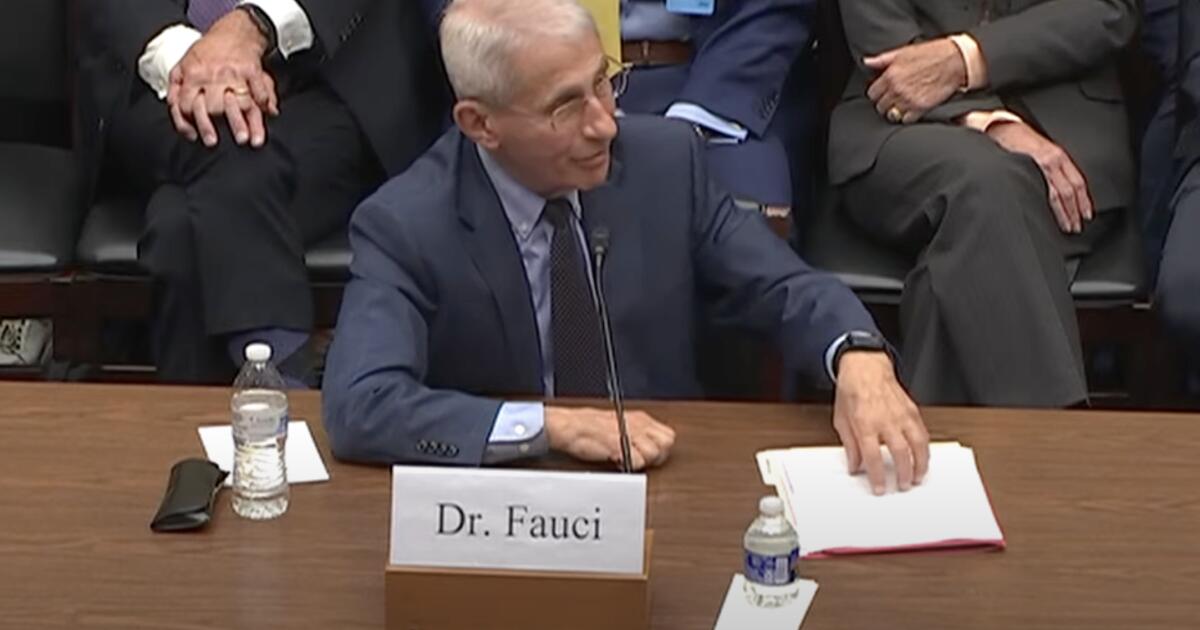
Here’s what we know about Dr. Anthony S. Fauci: As a staff member at the National Institutes of Health for 54 years and director of its National Institute for Allergy and Infectious Diseases for 38 years, Fauci was a key figure in the development of therapies for HIV and ensuring that funding was available for the search for a cure.
Under his leadership, NIAID invested billions of dollars in research that resulted in the development of mRNA technology, which in turn resulted in the development of COVID-19 vaccines in record time, saving millions of lives.
Under Fauci, NIAID also sponsored research into treatments for pandemic flu and the Ebola and Zika viruses. When COVID struck, he was tapped as a top advisor to then-President Trump — one of seven presidents he has advised during his career, from Reagan through Biden.
There have been credible death threats leading to the arrests of two individuals, and ‘credible death threats’ means someone who clearly was on his way to kill me.
— Anthony S. Fauci
He’s revered in the communities of immunologists and virologists; even after Trump sidelined him because he was speaking truths about COVID that Trump didn’t like, he was a prominent spokesman for a scientific approach to the pandemic.
Here’s how he was depicted by Republicans during a hearing Monday of the GOP-dominated Select Subcommittee on the Coronavirus: as the mastermind of “dogmatic” policies that resulted in school closings and business failures, of forced vaccinations, of “one of the most invasive regimes of domestic policy the U.S. has ever seen.”
As the financial sugar daddy of research overseas that created COVID. As the sponsor of policies that are “fundamentally un-American.” As a liar and hypocrite.
None of those accusations, which were aired Monday by subcommittee Chairman Brad Wenstrup (R-Ohio) and other Republican members, has the slightest relationship with truth.
They’re all elements of a campaign among Republicans and right-wingers aimed at painting Fauci, 83, who retired from NIAID in December 2022, as “a comic-book supervillain,” in the words of Rep. Jamie Raskin (D-Md.).
Why are they doing this? One answer must be that conspiracists always need a target to attack in order to attract followers.
At the core of this campaign is the Republican conviction that COVID escaped from a Chinese laboratory.
Since there is absolutely no evidence for this theory that anyone has yet produced, Plan B has been to smear anyone in the firing line. Unfortunately for Fauci, he’s the designated “it.”
As I’ve reported many times, according to reputable scientists who have studied the origin of COVID, scientific evidence suggests that it’s overwhelmingly more likely that COVID reached humans the same way most viruses do, as spillovers from wildlife — in this case, via a thriving trade in China in animals susceptible to the virus.
Let’s look at the particular rabbit holes into which the subcommittee has burrowed to smear Fauci, as set forth during the 3½ hour congressional hearing Monday and in a 15-hour interrogation of Fauci by the subcommittee in January, a transcript of which was released over the weekend along with a memo that misrepresented and cherry-picked his answers.
The committee members are fixated on the notion that Fauci “suppressed” discussion of the possibility of a lab leak. Why would he do that? Rep. Ronny Jackson (R-Texas) proposed an answer.
“It’s obvious to everyone,” he said, “that you and your organization, NIH, had a lot to lose if the American people were to discover that COVID-19 most likely leaked from a lab in Wuhan, China, and that you … actually funded this research.”
The problem there is that, first, Fauci has to this day stated that he is open-minded about the origin of the pandemic.
More to the point, documentary evidence in the subcommittee’s possession shows that in the early days of the pandemic — January and February 2020, when scientists saw features of the SARS-CoV-2 virus causing COVID that they didn’t recognize as coming from nature — he urged them by email to report their concerns, if validated, to “the appropriate authorities,” meaning the FBI in the U.S. and MI-5 in Britain.
“It is inconceivable,” Fauci said in his opening statement to the subcommittee, “that anyone who reads this e-mail could conclude that I was trying to ‘cover up’ the possibility of a laboratory leak. “I was advocating for a prompt and thorough examination of the data and a totally transparent process.”
As it happened, further scientific scrutiny convinced the scientists that “any type of laboratory-based scenario” was not “plausible,” as they reported in Nature in March 2020. Their conclusion has held up over time.
The subcommittee Republicans tried hard to contradict the notion that the lab leak hypothesis is a “conspiracy theory.” Fauci played along, up to a point. He acknowledged that speculation about a lab leak is not in itself a conspiracy theory, but that doesn’t go for the elaborations that many of its adherents have made of it.
“What is a conspiracy theory is the kind of distortions of that particular subject, like, it was a lab leak and I was parachuted into the CIA like Jason Bourne and told the CIA that they should really not be talking about a lab leak,” he said. “That’s a conspiracy.” He was referring to a ludicrous accusation published in September, with great fanfare but no factual support whatsoever, by none other than Wenstrup.
The members spent an inordinate amount of time Monday on the question of whether Fauci’s institute funded so-called Gain of Function experiments in China, so a brief primer on this issue is in order.
“Gain of Function” has become something of a shibboleth for lab-leak adherents, the way “critical race theory” and ESG have become dog whistles for activists trying to undermine, respectively, the public educational system and environmental and social concerns for investors — in this case, giving the term a uniquely sinister connotation.
Generically, however, it refers to laboratory work that augments natural qualities of a microbe to facilitate experimental scrutiny or achieve a necessary goal, such as allowing microbes to produce a flu vaccine or bacteria to produce artificial insulin.
From 2014 to 2017, the U.S. suspended gain-of-function experiments to develop a standard identifying research that might produce “potential pandemic pathogens.” The lab-leak camp asserts that NIAID funded experiments that gave a virus in the Chinese lab the features necessary to make it infectious for humans.
The work that NIAID funded in China was analyzed according to that standard, and it was determined by NIH not to fall into that category, as Fauci has testified before. The subcommittee peppered Fauci with questions aimed at eliciting an admission that the NIAID-funded work qualified under the broad, pre-2017 definition, but he made clear — and is supported by the public record — that the work did not fall into that category.
Much of the hearing was devoted to trivialities. The Republicans blamed Fauci for imposing a regulation on Americans specifying that effective social distancing required a six-foot space between individuals. The GOP members maintain that no scientific research validates a six-foot standard, and cited a 2020 peer-reviewed paper as confirmation.
This assertion is self-refuting, however; the paper actually says that under some circumstances, six feet may not be enough. When Fauci was asked about the issue in January, he explained that coughing, sneezing, wind and other conditions could play into the efficacy of social distancing at any distance. At that point his questioner, GOP counsel Mitch Benzine, acknowledged, “I didn’t think that through, I guess.” But the Republicans masticated the issue endlessly Monday nonetheless.
In any case, Fauci never had the authority to impose public health mandates — whether for masks, social distancing, vaccination or anything else. These were a product of state and local policy decisions. To the extent they relied on government recommendations, those came from the Centers for Disease Control and Prevention, a government body with which Fauci had no official connection.
The fundamental theme of Monday’s hearing was that Fauci should be blamed, even pilloried, for doing the best anyone could in dealing with a virus that no one had seen before, with means of transmission that were not understood for months or more and therapies that took more than a year to figure out.
It’s Fauci’s burden that ignorant and irresponsible politicians and their followers have chosen to turn their gunsights on him, for reasons that remain unclear.
“There have been everything from harassments by emails, texts, letters, of myself, my wife, my three daughters,” he said. “There have been credible death threats leading to the arrests of two individuals, and ‘credible death threats’ means someone who clearly was on his way to kill me. It’s required my having protective services essentially all the time.”
Is this how we wish to treat our most devoted public servants — by smearing them to the point that promising scientists choose not to place themselves in the firing line by entering the public health field?
At the close of the hearing, Wenstrup said his panel’s “goal is to take a hard look at the facts.” But there were few “facts” elicited Monday, just disinformation and character assassination.
Was that really the goal? There are no signs that the Republicans learned a thing from their 3½ -hour inquisition. In January, during Fauci’s interrogation, Rep. Michael Cloud (R-Texas) tweeted, “While many lost their loved ones, their businesses, and livelihoods, Dr. Fauci made millions and enjoyed the media spotlight. It was his most successful year.”
Monday, I asked Cloud if he still believed that. He replied, “I 100% stand by this tweet. Dr. Fauci received more money and glowing media coverage than he had ever received in his life, and if you can’t pick up that he both enjoyed it (and fed into it), then that is on you.”
Let’s give Fauci the last word on that. In January, he lamented that in 2020 he “became the villain number one of the extremists in the population,” which made it “one of the worst years of my life.” Shown the tweet, he remarked, “A congressman tweeted that?” When he was told, “Yeah.”
He replied, simply, “Jesus.”


In 1926, director Cecil B. DeMille hired hundreds of workers to build a set of Jerusalem inside the DeMille Studios in Culver City for the classic silent film “The King of Kings.”
A century later, Jon Erwin filmed his biblical epic ‘The Old Stories: Moses,’ starring Ben Kingsley, on the same studio lot now owned by Amazon MGM Studios.
Except now, much of the architecture, desert location, and supernatural parts of the three-episode miniseries were generated through artificial intelligence. The prequel to ‘The House of David’ series debuts on Amazon Prime on Thursday.
-
Share via
A production that traditionally would have taken months to shoot and require multiple locations was filmed entirely in one week with a crew of just 100 people — who never left Los Angeles.
“We did this massive sword-and-sandal epic, and we never left a soundstage, very similar to how James Cameron does Avatar or how Jon Favreau does ‘The Mandalorian,’” said Erwin, the director of the series. “When you preserve the performance and the work of the crews and the department heads, then you can do things that are incredibly cost-effective for studios.”
As Hollywood grapples with rapid technological change, a growing number of filmmakers and companies in Southern California are using AI tools to radically rethink how films and TV shows are made.
“Some are still resisting, but many are recognizing that, for better or worse, AI is here and not going anywhere and it is important to reimagine what film creation can look like in light of the new possibilities AI creates,” said Victoria Schwartz, director of the entertainment, media, and sports law program at Pepperdine Caruso School of Law.

A screen of LED panels called “the Volume” is used to film scenes for director Jon Erwin’s series “The Old Stories: Moses.”
(Genaro Molina / Los Angeles Times)
Erwin is among the first working directors at a major streaming platform to fully integrate AI into a commercial production.
Last month, he launched Innovative Dream, a Manhattan Beach production services company backed by Amazon. The company will rent its virtual production facilities to other studios and develop training programs for emerging filmmakers.
Although much of Hollywood is bracing for AI to hollow out jobs, Erwin argues the opposite: that AI, applied ethically around human performances, can return at least some production jobs that have been outsourced even as other positions are eliminated.
“I think the greater threat of job loss in our industry is actually just how expensive things have gotten and how long they take to make,” Erwin said. “If you can make things quicker, and you can make things at a price point that studios will say ‘yes,’ you can employ more people in aggregate and create jobs.”
Although computer graphics have been essential to Hollywood since the 1990s, they traditionally required hundreds of artists and months of post-production work to place actors or crowds in digital worlds. Much of the labor-intensive visual effects work known as rotoscoping was outsourced to shops in India and other countries with much lower labor costs than in California.
By 2019, productions such as Disney’s “The Mandalorian” series advanced this further by using massive LED screens to project images of photorealistic digital worlds — “Star Wars” ships, forests, or deserts — as actors’ performed in costume in front of them. A virtual art department spent months designing the digital environments, and then loading them onto the large screen on the day of the shoot.
AI takes the process a step further.
Through “Moses,” Erwin is championing what he calls “hybrid” filmmaking: a workflow that marries live-action with AI-enhanced workflows in virtual production. The process combines what used to be separate phases — filming with actors and visual effects — to occur almost simultaneously. Scenes shot on set is made available to multiple editors and AI artists within minutes on the production floor, as they show near-finished sequences back to the cast and director.
“You can create assets in three or four days, not 10 weeks. And that means you can actually kind of generate the environment while you’re shooting,” he said.
Erwin, 43, grew up in Alabama and built his career around faith-based films such as ‘I Still Believe’ and ‘Jesus Revolution.’ He had spent years trying to tell biblical stories at the scale portrayed in the source material.
When he pitched “House of David,” a drama about the life of King David, studio executives were initially skeptical. “I was told to just come up with a smaller idea,” he said.
To portray Goliath’s origin story, actors were filmed on green screens and AI was used to generate a mythical sequence involving dark sky, rain, mountains and angels with wings.
It marked one of the first integrations of generative AI in a major commercial production. The series, which premiered last year was viewed by 44 million viewers worldwide and reached No. 1 on Prime Video in the U.S.
By Season 2, the team used 30 different tools, both traditional and AI, to generate images, sounds and video. They pivoted from shooting solely on location in Greece to filming some parts in L. A. in front of an LED wall.
AI was used to generate battle scenes and expand the background crowd size to thousands of people in a fraction of the time traditional CGI required. The use of AI-generated scenes jumped from 70 in Season 1 to 400 shots in the second season.
Jeff Thomas, a generative AI filmmaker who directed two episodes of Season 2, said each episode was made for less than $5 million, defying studio consensus that the show required a “Game of Thrones”-level budget of $12 million to $15 million per episode. Erwin declined to disclose the budgets for the “House of David” series or the “Moses” prequel..
“The Bible describes that battle as there was 100,000 people on each side. Well, it’s never been portrayed like that because we’ve never had the resources,” Erwin said. “We’re finally able to show that scope and scale.”
Erwin conceived of the idea of “Moses” over Christmas, wrote the script in January and created a four-minute trailer entirely created by AI. Amazon greenlighted the series later that month.
Kingsley had a short window before his next commitment, so Erwin prepared and shot all three episodes on a soundstage in a week — a project that would have previously taken six months to prepare.
For the pivotal Red Sea scene, Erwin generated the water volumes and tidal waves in less than hour using AI models from Chinese company Kling AI and Palo Alto-based Luma AI, which would have taken weeks in the traditional process. They wrote text prompts that explored 18 different variations of the sea parting and discarded the ones that didn’t work, enabling Kingsley to react to a tidal wave projected onto a 360-degree LED wall screen.
“‘Moses’ really represented a whole new method of filmmaking for me,” Erwin said.

For “The Old Stories: Moses,” director Jon Erwin used AI for wide shots, stunt-heavy battle sequences and to generate large crowds to showcase the grand scope of biblical stories. The red line he said he wouldn’t cross is using it in place of actors.
(Genaro Molina / Los Angeles Times)
For crucial scenes portraying the palace hallway in Egypt, where Moses talks to the Pharaoh, they built cardboard boxes as the columns in the palace, and “reskinned” them with intricate carvings using AI. Although the set could accommodate only 20 extras, they used AI to create hundreds of background actors.
Erwin also used generative AI to synthetically expand partially built sets featuring sand and rocks and to “de-age” Kingsely to appear as a young Moses.
But some things were off limits for AI, including Kingsley’s performance.
“I just think our faces are so intricate and the micro expressions are so intricate, so that’s always real,” he said.
Instead, AI was used to co-design the character: Erwin originally imagined a bald Moses, but based on Kingsley’s feedback, they fine-tuned the look with weathered hair and mustache.
“The line in the sand for me is replacing an actor,” Erwin said. “I don’t want to be in the industry if I can’t work with actors.”

Jon Erwin’s “hybrid” production involves generating a variety of environments such as forests, deserts, or battle sequences using AI, and projecting them on the LED screen.
(Genaro Molina / Los Angeles Times)
When asked about the background extras displaced by AI crowd generation, Erwin said that’s the wrong way to think about it.
“It’s not a comparison of what would “Moses” have cost otherwise. It’s a comparison of “Moses” would have never been made otherwise, and that’s the way you have to think about it,” he said.
Overall contraction in Hollywood has led to fewer films being shot on location in Los Angeles, and a 30% drop in entertainment industry jobs since its 2022 peak.
“I think you can do those things three to five times faster, at less than 30% the cost,” he said. “I actually see this tool set as an antidote to the job loss problem in our industry.”
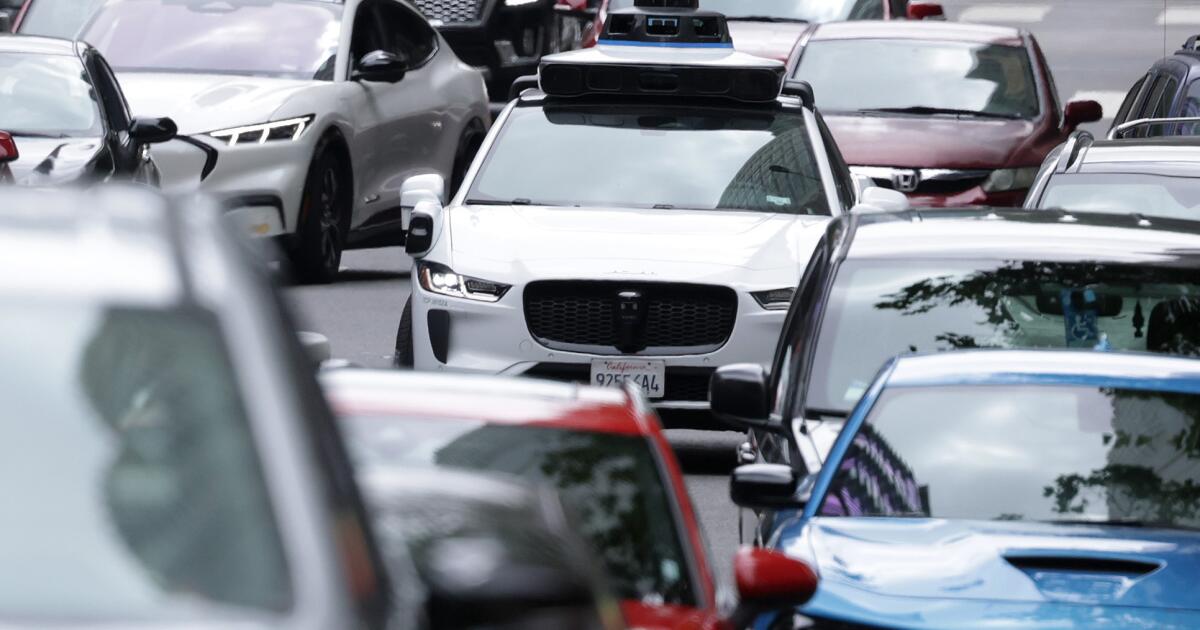
Waymo is recalling 3,791 autonomous taxis after a software defect caused some vehicles to drive into flooded roadways, according to a recall report from the National Highway Traffic Safety Association.
The voluntary recall filed April 30 affects Waymo vehicles operating on the company’s fifth and sixth generation Automated Driving System. The software “may allow the vehicle to slow and then drive into standing water on higher speed roadways,” a NHTSA report said.
“Entering a flooded roadway can cause a loss of vehicle control, increasing the risk of a crash or injury,” NHTSA said.
The recall followed severe weather in San Antonio, during which a Waymo entered a flooded and impassable road, the company said.
In response, Waymo has increased weather-related constraints on its vehicles and says it is working on additional software safeguards.
“We have identified an area of improvement regarding untraversable flooded lanes specific to higher-speed roadways, and have made the decision to file a voluntary software recall with NHTSA related to this scenario,” a Waymo spokesperson said. “Waymo provides over half a million trips every week in some of the most challenging driving environments across the U.S., and safety is our primary priority.”
Waymo operates in 10 major cities and has issued prior safety-related recalls. Last year, the company recalled more than 1,200 autonomous vehicles after minor crashes involving obstacles in the road.
The Alphabet-owned company has also come under fire for safety incidents, including striking a child outside a school in Santa Monica earlier this year and fatally running over a neighborhood cat in San Francisco.
According to data collected by Waymo over 170 million fully autonomous miles driven, Waymo is 13 times safer than human drivers in crashes involving pedestrians.
The Mountain View-based company is currently ahead in the race to scale robotaxis across the country, with thousands of vehicles transporting paying customers in cities including Los Angeles, Miami and Phoenix.
Competitors Zoox and Tesla are trying to catch up with their own self-driving technology, but have yet to match Waymo’s scale and reach.
According to NHSTA, all affected Waymo vehicles received an interim software update to mitigate the issue, but a full remedy for the recall is still under development.
Business
Commentary: Trump’s ‘weird war’ on wind power will jeopardize our energy future and cost Americans billions

Trump is shelling out $2 billion of taxpayer money to kill wind power projects, but his hatred for the technology is based on myths
Picking the wildest fantasy promoted by President Trump as a basis for public policy is increasingly challenging — is it his yarn about schoolchildren being secretly abducted from their classrooms and given sex-changing operations? The notion that the vaccines given to children are like “a vat, like a big glass, of stuff pumped into their bodies?”
Here’s one that has disrupted the economics of renewable energy generation and will cost Americans billions of dollars: It’s Trump’s “completely weird war on wind power in the United States,” based on a sheaf of “fact-free arguments.”
That judgment comes from Steven Cohen, a climate policy expert at Columbia University, who points out that wind already accounts for 10.5% of U.S. energy generation, that it’s destined to continue growing — and that most of it is generated today in red states such as Texas, Oklahoma, Iowa and Kansas.
Fifty years from now, people are going to be amazed that we burned these rare, useful hydrocarbons for fuel, when the sun was just sitting up there providing an essentially infinite source of energy.
— Steven Cohen, Columbia University
There is no question that Trump’s weird war against wind is full blown. On the day of his second inauguration, he issued an executive order shutting down all new permits for offshore wind farms and ordered the Interior Department to review existing permits.
A federal judge in Massachusetts blocked the executive order in December, and his orders suspending work on existing offshore wind projects have been halted by other federal judges. The Trump administration has blocked or delayed as many as 165 wind projects on private land, citing “national security” concerns, according to the American Clean Power Assn.
Most recently, Trump has reached agreements with offshore wind firms in which the government will pay them a combined $2 billion to abandon their U.S. projects.
At some level, this crusade resembles Trump’s misguided effort to revive the American coal industry, which is on the glide path to inevitable extinction. In that case, Trump is waging an explicitly partisan and ideological battle. “We’re ending Joe Biden’s war on beautiful, clean coal,” he declared last April.
Trump’s anti-wind program is part of his campaign to dismantle U.S. renewables policy because of its roots in the Biden administration.
Additionally, multiple commentators conjecture that his hostility to wind originated in 2011, when he groused that an offshore wind farm would be visible from one of his golf courses in Scotland. He sued to thwart the “ugly” project, and lost.
But Trump has mustered other arguments against wind, on- and offshore, none of which holds water.
During a cabinet meeting in July 2025, he called wind “a very expensive form of energy.” In fact, on average it’s cheaper than natural gas, coal and nuclear generation. Perhaps more important, the cost has been coming down sharply as technology improves and the sector reaches critical mass: falling to eight cents from 21 cents per kilowatt-hour from 2010 to 2024 for offshore projects, and to 3.4 cents from 11.3 cents for land-based wind farms over the same period.
Trump blamed wind turbines for mass killing whales and birds. Neither assertion is correct.
The National Oceanic and Atmospheric Administration, a federal agency, says “there are no known links between large whale deaths and ongoing offshore wind activities.”
The Audubon Society reported in January that although wind turbines can present hazards to birds, “developers can effectively manage these risks without significantly increasing project costs.” The biggest risks to birds come from the climate: “Two-thirds of North American birds are at increasing risk of extinction from global temperature rise,” the society reported — a threat that wind power can ameliorate.
Trump spokeswoman Taylor Rogers didn’t respond to my questions about the derivation of his anti-wind stance, but told me by email only that “President Trump has been clear: hard-earned taxpayer dollars shouldn’t be wasted on unreliable and costly wind farms that pose serious threats to our national security. Instead, we should be strengthening and expanding our infrastructure that produces reliable, affordable, and secure energy like natural gas plants.”
That brings us to the recent deals with offshore wind developers. The largest single deal, signed in March, was with the French firm TotalEnergies, which is to receive approximately $1 billion from the federal government to abandon all of its U.S. offshore wind projects and invest instead in oil and gas projects, including a liquefied natural gas export facility in Texas.
In his March 23 announcement of the deal, Interior Secretary Doug Burgum called offshore wind “one of the most expensive, unreliable, environmentally disruptive, and subsidy-dependent schemes ever forced on American ratepayers and taxpayers.”
This is what Huck Finn would call a “stretcher,” given the decades of subsidies spooned out to the oil and gas industry, reaching more than $30 billion a year in federal and state tax credits, indulgent regulation of pollution and low-cost access to federal lands. Indeed, the investment firm Lazard recently reported that renewables, including wind, are a cost-competitive form of generation even without subsidies. (Lazard’s calculation is of the “levelized cost of energy,” meaning the average cost over a generating plant’s lifetime.)
TotalEnergies fell into lockstep with the Interior Department in its own announcement, explaining its willingness to renounce U.S. offshore wind power because “offshore wind developments in the United States, unlike those in Europe, are costly,” echoing the agency’s position that “the development of offshore wind projects is not in the country’s interest.” Never mind that one factor that makes U.S. offshore wind development costly compared with Europe is the Trump administration’s opposition.
The government subsequently reached an agreement to pay the French company Ocean Winds $885 million to walk away from two offshore wind projects, including one in the waters off California. Ocean Winds described the deal as one driven chiefly by economics, but hinted at pressure from the White House.
“We welcome the opportunity to engage constructively with the administration on this agreement and acknowledge the clarity they have provided with this decision and deal,” Michael Brown, the chief executive of Ocean Winds North America, said when the deal was announced last month. “Our priority remains disciplined capital allocation and delivering reliable energy solutions that create long-term value for ratepayers, partners, and shareholders.”
The TotalEnergies deal, which the government has described as a “refund” of money the firm paid for its offshore leades, raised the hackles of congressional Democrats, who assert that it violates the law and constitution in multiple ways.
“We will hold you accountable for this billion-dollar ripoff,” Reps. Jamie Raskin (D-Md.), ranking member of the House Judiciary Committee and Jared Huffman (D-San Rafael), ranking member of the House Committee on Natural Resources, warned TotalEnergies CEO Patrick Pouyanné in an April 29 letter.
Among other infirmities Raskin and Huffman alleged, the government’s national security rationale for canceling offshore wind leases looks “fabricated”; the payout violates the statutory formula for compensation for canceled leases; the money is to come from a fund designed only to pay court-ordered judgments and settlements of lawsuits, which don’t exist in this case; and includes a provision preventing the deal from being reviewed by a court.
The last of those provisions would have to be authorized by Congress, the letter states, asking for documents and a response from the company by Wednesday. Committee spokespersons weren’t available to say whether they received a response from TotalEnergies, and the company didn’t respond to my request for comment. I received no response from the Department of the Interior.
The California Energy Commission has opened an investigation into the Ocean Winds deal.
“The Trump Administration is recklessly spending billions of taxpayer dollars on backroom deals that would turn back the clock on innovation” CEC Chair David Hochschild said. “Taxpayer dollars should be used to build a sustainable energy future, not to pay to make projects disappear.”
What’s especially wasteful about Trump’s crusade against wind power is that it’s almost certain to be time-limited.
It’s hardly debatable that renewables such as solar and wind will be our principal sources of energy in the future; holding back the clock achieves nothing but injecting uncertainty into investment decisions that need to be made now, at a time when the price of oil is on the upswing thanks to Trump’s Iran adventure and Europe and China are racing to transition away from fossil fuels, while the U.S. remains becalmed by ideology.
“In the long run, fossil fuels will be used for petrochemicals and not for burning,” Cohen told me. “Fifty years from now, people are going to be amazed that we burned these rare, useful hydrocarbons for fuel, when the sun was just sitting up there providing an essentially infinite source of energy.”
-

 Maryland3 minutes ago
Most Maryland sheriffs drop arrest agreements with ICE despite vows to fight a new state law – WTOP News
-

 Michigan9 minutes ago
Severe storm threat targets Southeast Michigan through Tuesday — What to know
-

 Massachusetts15 minutes ago
Trial of accused Boston serial rapist Alvin Campbell Jr. begins today
-

 Minnesota21 minutes ago
Gas Prices In Minnesota Rise 25.5 Cents, Now Averaging $4.42 Per Gallon
-
Montana39 minutes ago
Montana Lottery Big Sky Bonus, Millionaire for Life results for May 17, 2026
-

 Nebraska45 minutes ago
The Nine Biggest Reasons Nebraska Football Has Been Mired in Mediocrity the Last 10 Years
-

 Nevada51 minutes ago
Fatal crash on US-95 in Nye County
-

 New Hampshire57 minutes ago
Wrong-way driver hits state trooper’s cruiser head-on in New Hampshire

