Politics
Opinion: Could the guilty verdict cost Donald Trump the election? Sure it could

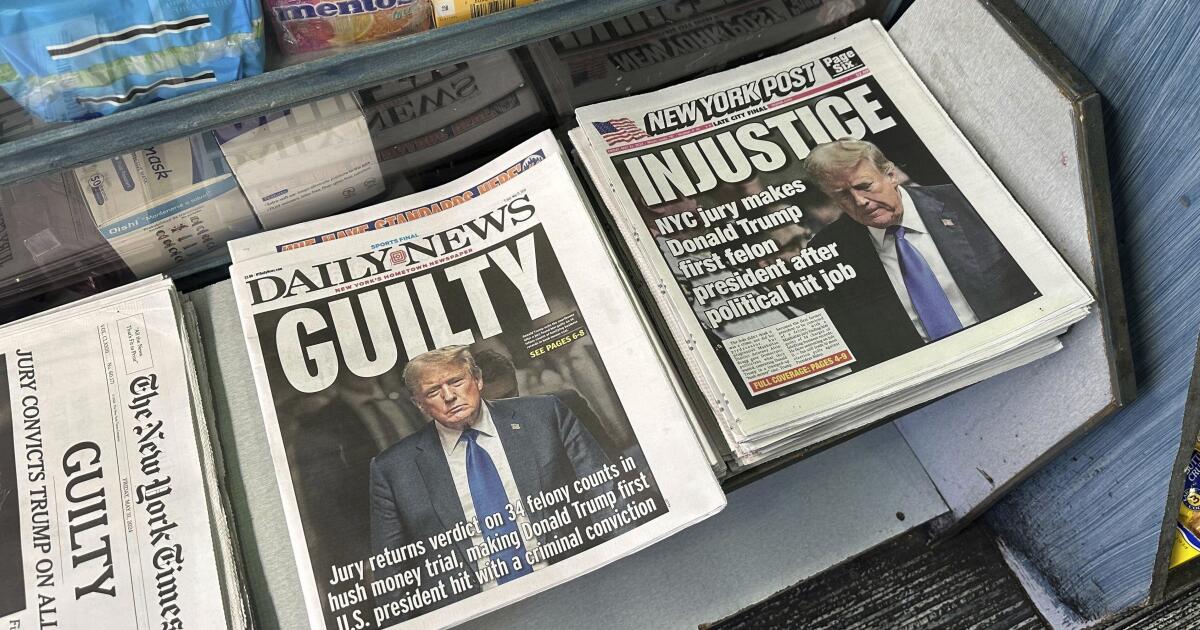
How much will Donald Trump’s conviction in the New York hush money case matter come November?
The obvious answer is that nobody knows. Still, I suspect the verdict will matter, just not in ways that are easy or even possible to predict.
A lot of the instant reaction revolves around polls. We talk about polls not because they are so important but because we lack much else to go on. Like the proverbial drunk who looks under the streetlamp for his lost keys because the light is much better there, we look at polls because they at least illuminate something, even if it’s not very much.
The smattering of surveys conducted since Thursday’s verdict show that slightly more than half of Americans think the jury was correct. A CBS poll found that the verdict changed very few minds, though a small number had more negative views of Trump. None of that is surprising given that attitudes about the trial have tracked attitudes about Trump.
Now, if the judge throws Trump in jail for an extended term — which seems both unlikely and indefensible, given the nature of the crime — it’s possible that attitudes will swing more in Trump’s favor. But if it’s just for a day, attitudes probably won’t change so much as intensify.
If the opinions indicated by the latest polling hold constant for the roughly 150 days to Nov. 5, one could plausibly argue that the verdict will cost Trump the election. The consensus among experts across the partisan spectrum is that this election will be decided by a tiny number of votes in a handful of states, so movement of even a couple of percentage points away from Trump could be decisive.
But opinions don’t hold constant, at least not among the kind of voters who will decide the election.
Until recently, Trump was enjoying higher favorability ratings than at any time during his presidency. A mixture of nostalgia for the pre-COVID Trump-era economy and dissatisfaction with President Biden has been better for Trump than anything he actually did as president.
No one knows what will happen over the next five months, but it’s not unreasonable to assume that the verdict will shrink in importance for everybody over time.
But given the closeness of the race and the voters who will decide it, that doesn’t mean it won’t have lasting consequences.
Many Trump boosters responded to the verdict with declarations such as “Trump just won the election.” This wish-casting stems from the belief that outrage over the verdict will cause more voters to rally around Trump. So far, however, the evidence points to the opposite.
It’s true that Republican outrage over the verdict has motivated Trump’s supporters in much the same way as the FBI search of Mar-a-Lago. The result has been a windfall of donations to the Trump campaign, including from crucial first-time donors. Given Trump’s fund-raising difficulties compared with Biden, that could matter.
But one analytical error that Trump world consistently makes is the idea that attitudes about him inside the MAGA bubble extend to voters outside it. Trump’s biggest fans believe they represent America generally, which is one reason they still believe America couldn’t have voted to oust him in 2020.
We don’t know how the verdict will change the behavior of not just the voters but also the candidates. If Biden overplays Trump’s status as a “felon,” it could underscore the view that he lacks any persuasive arguments for his reelection on the merits. It could also bolster the unfounded charge that Biden orchestrated the prosecution to his benefit.
Meanwhile, if Trump listens to his biggest fans and indulges his own sense of grievance — not a particularly big “if” — he could end up making the election a referendum on him, and the chaos he brings, rather than a referendum on Biden.
I don’t think this case ever should have been brought, but I also think it’s crazy to say it represents “the end of the country as we know it,” as Ohio Sen. J.D. Vance insisted. Indeed, it’s remarkable to see so many people who once claimed that the trial didn’t matter to voters suddenly insisting that voters will care so much about its outcome.
Voters will care about all sorts of things. And the odds are good that, to the extent Trump’s conviction matters at all, it ratifies the opinions most Americans already held.


NEWYou can now listen to Fox News articles!
Top Trump administration officials, Republican lawmakers and prominent Christian leaders gathered on the National Mall on Sunday for a massive prayer rally celebrating America’s upcoming 250th anniversary.
The event — “Rededicate 250: A National Jubilee of Prayer, Praise & Thanksgiving” — drew thousands for worship music, speeches and prayers focused on reaffirming the United States as “One Nation Under God.”
President Donald Trump, Vice President JD Vance, Secretary of State Marco Rubio, Defense Secretary Pete Hegseth, Director of National Intelligence Tulsi Gabbard and House Speaker Mike Johnson all addressed the gathering, alongside numerous other political and faith figures.
In a prerecorded message, Trump read from 2 Chronicles 7, reciting the well-known Bible verse calling on people to “humble themselves” and seek God.
TRUMP CALLS ON AMERICANS TO PRAY FOR NATION AS 250TH BIRTHDAY APPROACHES: ‘ONE NATION UNDER GOD’
Attendees watch a pre-recorded video of President Donald Trump reading from the Bible during “Rededicate 250” on the National Mall in Washington, DC, on May 17, 2026. (Matthew Hatcher / AFP via Getty Images)
“If my people, which are called by my name, shall humble themselves, and pray, and seek my face, and turn from their wicked ways, then will I hear from heaven, and will forgive their sin, and will heal their land,” Trump said.
Vance described the United States as “a nation of prayer,” saying faith has shaped the country since before its founding.
“In times of suffering and in times of triumph, millions of Americans continue to turn to prayer and their faith in God,” Vance said.
Rubio similarly tied America’s identity to Christianity.
“From the beginning, we have carried the belief that our country represents something new in the world,” Rubio said. “But the soul of our nation has always been rooted in an ancient faith.”
Gabbard urged Americans to humble themselves before God, saying the nation’s founders “knelt” and “asked for God’s mercy” before declaring independence.
FOR 2026, YOU SHOULD MAKE A RESOLUTION TO KNOW THE REVOLUTION
Johnson delivered a prayer of “rededication,” thanking God for guiding the nation since its founding.
“Heavenly Father, we thank you,” Johnson said. “Thank you so much for this great day that you’ve given us here, and we remember that your mighty hand has been upon our nation since the very beginning.”
Hegseth referenced George Washington’s faith, while Sen. Tim Scott, R-S.C., spoke about Christianity’s role in shaping the nation and argued prayer was central to the Civil Rights Movement.
Alveda King, niece of Martin Luther King Jr., praised Trump for encouraging Americans to “rededicate America to God.”
“This nation was founded on godly principles,” Alveda King told Fox News, adding that Martin Luther King Jr., “spoke to a crowd like this in 1963.”
Actor Jonathan Roumie, who portrays Jesus in “The Chosen,” also spoke at the event, encouraging Americans to recommit themselves to faith and prayer.
NEARLY 500 PUBLIC FIGURES FROM POLITICS TO HOLLYWOOD WILL READ BIBLE COVER TO COVER TO MARK AMERICA’S 250TH
House Speaker Mike Johnson delivers a prayer during “Rededicate 250” on the National Mall in Washington, D.C., on May 17, 2026. (Matthew Hatcher/AFP)
The event also featured appearances from Cardinal Timothy Dolan, Bishop Robert Barron, Rabbi Meir Soloveichik, evangelist Franklin Graham, along with performances from Grammy-winning Christian artist Chris Tomlin, among others.
Many attendees wore patriotic colors as they packed the National Mall.
CLICK HERE TO DOWNLOAD THE FOX NEWS APP
Freedom 250, the nonprofit behind the event, said the gathering is part of a broader effort leading up to America’s semiquincentennial celebration on July 4, 2026.
Fox News Digital’s Stephen Sorace and The Associated Press contributed to this report.

HONG KONG — As President Trump left Beijing on Friday, Chinese social media resurfaced a familiar nickname for the president — flattering at first glance — declaring that Chuan Jianguo, the “Nation Builder,” had returned.
It was not meant as a compliment. The nation he is building, according to the Chinese, is not the United States but their own, through a series of inadvertent yet costly mistakes inflicted by Trump at home and abroad.
-
Share via
If the Chinese government was self-assured entering Trump’s summit with Xi Jinping, then the results of the state visit, in which Beijing refused to offer Trump any meaningful deals or concessions, signal their unmistakable confidence in American decline.
Chinese government statements in local media stating as much made their way back to Trump as he was departing, aggravating the president, a U.S. official said. But the White House secured a clarification from the Chinese that seemed to placate Trump. America was only declining under President Biden, they said — not anymore.

President Trump and President Xi Jinping tour Zhongnanhai Garden on Friday in Beijing.
(Evan Vucci / Pool via Getty Images)
The Trump administration argues the trip was a success, having secured the display of conciliation and partnership the president had sought after years of increasingly dangerous acrimony.
Foreign policy hawks on China will be displeased with his new direction of friendship and cooperation with a government they view as openly hostile to the United States. But Trump seems to have reached a similar conclusion as past administrations, that China might require a relationship in pursuit of, as Xi put it, “constructive strategic stability.”
Trump was notably out of character throughout his stay here, deferential to his host, marveling at displays of Chinese power and reticent to speak with the press.
Five times over two days, Trump referred to Xi as his friend, taking every public opportunity to offer his compliments and pats on the back. None of it was reciprocated. The Chinese leader, Trump told Fox News in an interview, was “all business” in private, as well, apparently uninterested in his overtures of personal goodwill.

Presidents Xi and Trump tour Zhongnanhai Garden on Friday.
(Evan Vucci—Pool/Getty Images)
The summit may ultimately be remembered as the moment when Trump recognized a shifting power dynamic, where an American president had the rare and uncomfortable experience of entering a meeting clearly overmatched.
“I think the most important thing is relationship,” Trump said in the interview, describing the summit as “historic.”
“It’s all about relationship,” he added. “I have a very good relationship with President Xi.”
Taiwan was discussed ‘the whole night’
Little of substance was accomplished over two days of talks. But Chinese officials expected no less after warning Trump’s team before the summit that its minimal preparation had failed to lay the groundwork for diplomatic agreements.
Still, the lack of breakthroughs may come as a relief to some in Washington. Trump appears to have held to a long-standing U.S. line on Taiwan, for now, refusing to provide Xi with clarity on whether the United States would defend the self-ruled island if China tries to reclaim it by force.
The two men discussed the matter “the whole night,” Trump told Fox.
If China attacked, “they would be met harshly, and bad things will happen,” Trump said. Yet within the same answer, he questioned Taiwan’s “odds” against China if war were to break out, even with U.S. help, noting its proximity to the Chinese mainland and its vast distance away from the United States.
Whether Trump will proceed with arms sales to Taiwan — passed by Congress and obligated by law under the Taiwan Relations Act — is still an open question.
“If you kept it the way it is, I think China is going to be OK with that,” Trump said, referencing an ambiguous status quo around Taiwan’s status, “but we’re not looking to have somebody say, ‘Let’s go independent because the United States is backing us.’ ”
“Taiwan would be very smart to cool it a little bit,” he added. “China would be smart to cool it a little bit. They ought to both cool it.”

President Trump departs as President Xi looks on after a visit to Zhongnanhai Garden on Friday.
(Evan Vucci/ Pool via Getty Images)
Curious company
Trump’s choice of company in the U.S. delegation left the Chinese with questions over the purpose of the trip.
Lara Trump, a Fox News host and the president’s daughter-in-law, attended alongside her husband, Eric Trump, whose presence as a private citizen running the Trump Organization was a direct appeal to Beijing to treat the administration like a family business. Brett Ratner, director of the “Rush Hour” series and a documentary on the first lady that bombed at the box office, was given prime placement along with America’s top business leaders.
The last time a secretary of Defense attended a presidential state visit to China was on Richard Nixon’s famous trip in 1972. Chinese officials were unsure what to make of Pete Hegseth’s presence — whether it was meant to convey a softer stance, a hardening one, or simply an ignorance of basic diplomatic protocol.
Trump said he felt personally honored by the lavish welcome he received on the edge of Tiananmen Square, outside the Great Hall of the People, where China hosts all visiting dignitaries.
Before a lunch at Zhongnanhai, the secretive headquarters of the Chinese Communist Party, Trump asked Xi if he was special for getting to visit the compound. He was the fourth U.S. president to do so.
While the Trump administration offered itself glowing reviews of the outcome of the summit, the Chinese government offered little to say as he departed. And Chinese media highlighted Beijing’s resolute stance on American priorities — from trade to the Iran war — as evidence of Chinese confidence and American decline.
But all that business wasn’t the point of the trip, Trump told Fox’s Bret Baier. For the president, it was all personal.
“I want to thank President Xi, my friend, for this magnificent welcome,” Trump said in his toast at the state banquet, repeating the personal overture. “The American and Chinese people share much in common. We value hard work. We value courage and achievement. We love our families and we love our countries.
“Together, we have the chance to draw on these values to create a future of greater prosperity, cooperation and happiness and peace for our children,” Trump added. “We love our children. This region and the world — it’s a special world, with the two of us united and together.”

new video loaded: Cassidy Loses Primary After Drawing Trump’s Ire
transcript
transcript
Cassidy Loses Primary After Drawing Trump’s Ire
Republican Senator Bill Cassidy lost his Louisiana primary on Saturday after President Trump targeted him for voting to impeach him in 2021. The two-term senator took veiled swipes at the president in his concession speech.
-
Thank you, Louisiana! I want to say thank you to a very special man who you all know, the best president this country has ever had, President Donald Trump. I’ve been able to participate in democracy. And when you participate in democracy, sometimes it doesn’t turn out the way you want it to. But you don’t pout. You don’t whine. You don’t claim the election was stolen. Our country is not about one individual. It is about the welfare of all Americans, and it is about our Constitution. And if someone doesn’t understand that and attempts to control others through using the levers of power, they are about serving themselves. They’re not about serving us.”
By Cynthia Silva
May 17, 2026
-

 Maryland3 minutes ago
Most Maryland sheriffs drop arrest agreements with ICE despite vows to fight a new state law – WTOP News
-

 Michigan9 minutes ago
Severe storm threat targets Southeast Michigan through Tuesday — What to know
-

 Massachusetts15 minutes ago
Trial of accused Boston serial rapist Alvin Campbell Jr. begins today
-

 Minnesota21 minutes ago
Gas Prices In Minnesota Rise 25.5 Cents, Now Averaging $4.42 Per Gallon
-
Montana39 minutes ago
Montana Lottery Big Sky Bonus, Millionaire for Life results for May 17, 2026
-

 Nebraska45 minutes ago
The Nine Biggest Reasons Nebraska Football Has Been Mired in Mediocrity the Last 10 Years
-

 Nevada51 minutes ago
Fatal crash on US-95 in Nye County
-

 New Hampshire57 minutes ago
Wrong-way driver hits state trooper’s cruiser head-on in New Hampshire

