In Utqiagvik, Alaska, the Iñupiat rely on whaling and subsistence hunting for the bulk of their diet, a practice dating back thousands of years.
Powered by mineral wealth, the Iñupiat-run North Slope Borough Department of Wildlife Management employs a collaborative team of scientists and hunters.
Though the arctic is warming nearly four times faster than the global average, the Iñupiat are confident in their ability to adapt their practices to changing conditions.
The Department of Wildlife Management provides a potential model for collaborations between Indigenous peoples and western researchers — with Indigenous leaders in charge of funding and resource allocation.
For a few days each June, the saltwater wind that blows over the fairgrounds in Utqiagvik, Alaska mixes with the smell of coffee, salmonberry pie and fresh whale meat.
The festivities start early and end under the midnight sun during Nalukataq, the annual whaling festival. By noon, the tables at the center of the fairgrounds are filled with slabs of whale blubber, cauldrons of stew and baked goods — enough to feed the town for a month. After a prayer, crew members circle the fairgrounds and fill coolers with food. Meanwhile, captains trade turns making speeches, pumping up the crowd and singing songs into a megaphone.
On the first day of last summer’s festival, one cut of whale meat was conspicuously absent from the spread. The whale kidneys, which are usually slow cooked through the morning, were sitting in wildlife veterinarian Raphaela Stimmelmayr’s laboratory eight kilometers (five miles) away at the North Slope Borough Department of Wildlife Management.
A family accepts muktuk, whale blubber, at Nalukataq in Utqiagvik, Alaska. Image by Gabe Allen for Mongabay.
Stimmelmayr received the organs back in March, just hours after the Little Kupaaq whaling crew successfully harpooned a 25-ton animal. Little Kupaaq member Martin Edwardsen was in the boat that day. With the community’s help, the Little Kupaaq crew hauled the animal onto the ice and butchered the meat. But, as Edwardsen cut out the kidneys, he noticed something off. Tiny translucent worms wriggled along the surface of the organs. He set the kidneys aside and called Stimmelmayr.
“Nobody knows anything about them,” Edwardsen said of the worms. “So we don’t take them because we don’t know if they’re a parasite that could affect us.”
Advertisement
Stimmelmayr is now working on a study of the worms for publication this summer. She aims to find out where the parasites came from — perhaps they are spreading from other whale species that are moving into the Arctic as the climate warms. She also hopes to discern if the worms are a threat to the health of the whales or the humans that eat them. It’s a process that she’s been through before. During her time with the department, Stimmelmayr has evaluated numerous environmental threats to marine mammals, such as exposure to petroleum and algae toxins in seals.
In Utqiagvik, threats to marine animals are existential. Because the region is so isolated, most of the food that residents eat still comes from subsistence hunting. The only ways into the North Slope, aside from a small airport, are seasonal: a winter ice road and a summer shipping corridor. Food brought in from outside is prohibitively expensive, but the region is full of wild game.
The North Slope Borough Department of Wildlife Management is the community’s first line of defense. The team includes ecologists, biologists and hydrologists who work under the leadership of an Iñupiat director, Taqulik Hepa. The researchers are just half of the equation. The department also employs a robust team of Iñupiat subsistence hunters who are revered in the community for their ecological knowledge.
“It’s a real unique situation that’s different from anyplace else,” Hepa explained. “We have local hunters and local people working together with very well-respected scientists.”
The department’s approach makes it a potential model for the “true collaborations with local and Indigenous peoples” that the National Science Foundation called for in a 2021 letter, according to Eduard Zdor, a Chuktotkan PhD candidate in Anthropology at the University of Alaska Fairbanks. In 2022, a White House memorandum also urged federal agencies to consider Indigenous knowledge in “federal research, policies and decision making.” These recent calls to action have spurred new collaborations between researchers and Indigenous peoples.
Advertisement
Yet, collaborative efforts between Western researchers and Indigenous groups often run into unforeseen barriers or fall short of their goals, due to issues like mismatched interests and research fatigue.
The North Slope Borough Department of Wildlife Management has found a way to avoid these pitfalls and foster mutually beneficial cooperation. Perhaps, because the relationship between Indigenous knowledge and Western research is not so new in the North Slope. The people of Utqiagvik have worked at this intersection, for better and for worse, for nearly half a century.
In a town where a case of Dr. Pepper costs $14.99, subsistence hunting is essential. Image by Gabe Allen for Mongabay.A crowd gathers around a seal skin stretched between posts for a “blanket toss” at Nalukataq. Image by Gabe Allen for Mongabay.
A unique approach
The Prudhoe Bay oil strike of 1968 turned Alaska into a petroleum state, with the North Slope Borough at its epicenter. In order to offer contracts to oil companies, the federal government first had to settle outstanding land claims with Native groups across the state. In 1973, the Iñupiat emerged from the negotiations with immense mineral wealth, and the newly-founded Ukpeaġvik Iñupiat Corporation became a powerful player in the oil industry.
Around the same time, Alaska began the slow process of reforming its education system. A whole generation of Iñupiat had been stripped of their language and traditions. Now, a new generation had a chance to reclaim the practices that had almost disappeared. Chief among them was whaling.
So, shock waves rippled through the Northern Slope in 1977 when the newly-formed International Whaling Commission (IWC) removed an exemption that had previously allowed the Indigenous bowhead whale hunt. Overnight, the people of the North Slope lost an essential food source and a cultural practice dating back thousands of years. In Barrow, the town that changed its name to Utqiagvik in 2016, the news was felt by everyone.
“I was a teenager,” Colleen Akpik-Lemen, director of the Iñupiat Heritage Center, told Mongabay. “It was the saddest year.”
Advertisement
The document that led to the ban, the commission’s 1977 scientific committee report, estimated that the current population of bowheads in the region was only 6 to 10% of pre-commercial whaling levels. A National Oceanic and Atmospheric Administration report from the same year urged that Iñupiat whaling was “of great concern.” However, the data used to back these statements amounted to a handful of infrequent reports with widely varying estimates.
Iñupiat leaders saw a different reality. Whaling crews were encountering more healthy bowheads than ever.
A line of drummers pound qilaut at Nalukataq. Image by Gabe Allen for Mongabay.
“There are a lot of bowheads out there that the scientists aren’t counting. Many are out in the ice and therefore are not seen when they pass by Barrow. As a result of poor counting the scientific community helps put these unfair quotas upon us,” whaling captain Harry Brower Sr. told wildlife veterinarian Thomas Albert at the time.
The year before the ban, Iñupiat crews caught a record number of bowheads. From an Iñupiat perspective, that number suggested a healthy population of whales and a growing need for whale meat in the community. From the IWC’s perspective, the numbers represented an Indigenous community overhunting a vulnerable species to extinction.
In the end, the IWC’s perspective won out, in large part because Iñupiat leaders had no Western science or data to support their claims. So, the Iñupiat went looking for some.
Just months after the ban, North Slope Borough Mayor Eben Hopson formed the Alaska Eskimo Whaling Commission. In the early years, the commission worked under the watchful eye of the federal government to monitor bowheads and establish strict subsistence hunting quotas. Slowly, the community regained its right to harvest whales.
Advertisement
By 1981, the monitoring and management program was handed over to the North Slope Borough’s newly formed Department of Wildlife Management. Following in the footsteps of the Whaling Commission, the department hired a mix of community leaders, subsistence hunters and scientists.
“It was always a combination of very well-respected scientists and very well-respected hunters learning to interact with each other,” Hepa said.
Though it arose in the face of a crisis, the department’s approach proved enduring. And, fifty years later, it’s still unique. The major difference lies in who is working for who. The scientists at the department are employees of the Iñupiat municipal government of the North Slope Borough, not outside researchers seeking input from Indigenous knowledge holders. The work that they do starts and ends with the community.
Today, that dynamic is still paying off. The bowhead whale hunt is now protected, but the Iñupiat face another existential threat: climate change.
A ladder rests on the hatch an ice cellar in Utqiavik. As temperatures rise, most cellars have been lost to thaw and flooding. Image by Gabe Allen for Mongabay.A traditional ice cellar, used to store meat, erodes along the Arctic coast. Image by Gabe Allen for Mongabay.
Ice Trails
During the past few decades global warming in the Arctic, which is occurring almost four times faster than the global average, has presented a new set of research questions. Utqiagvik loses more than 15 meters (50 feet) of coastline every year to erosion, melting permafrost wreaks havoc on local infrastructure and environmental changes present new challenges for subsistence hunters.
One of the biggest challenges for whalers is the changing nature of sea ice. Each spring, junior whalers chip away a trail across the ice from the coast to where the ice meets open water. Back in the 1970s, the trail traveled over 16 or 24 km (10 or 15 miles) of smooth, multi-year ice to reach this edge. Now, the trail traverses a shorter distance over younger, thinner ice to an edge that often lies within a kilometer from town. The young ice is less stable and more unpredictable.
Advertisement
“I remember, 35 to 40 years ago, going out to the edge when I was 10 or 11 and seeing the ice breaking off,” said Lucy Leavitt, captain of the Pamiilaq whaling crew and subsistence research coordinator at the Department of Wildlife Management. “The ice was as high as the ceiling at the edge. Today it can be from inches to a couple of feet.”
Though the journey to the edge has become shorter, it is also more difficult. The young ice is rough and forms large ridges that must be razed to make way for whaling equipment.
“It’s gotten a lot rougher,” Billy Adams, a seasoned whaling captain and assistant director at the department, told Mongabay. “It’s made it really difficult for us to find smooth ice to pull up whales on.”
The changing ice inspired a new collaboration. Since 2007, researchers from the University of Alaska Fairbanks have worked with local scientists and Iñupiat whalers to create annual maps of the trails made through the sea ice. Year by year, the collaborators are building up a record of the passages used each season under varying conditions.
“There’s a long-term record of, not only where the trails are, but also the sea ice thickness along those trails,” said Donna Hauser, a research professor in marine biology at the University of Alaska Fairbanks and director of the Alaska Arctic Observatory and Knowledge Hub. “The maps get distributed back to the whaling captains each year. It’s a resource that has come to be expected.”
Advertisement
Visiting biologists photograph a bird at the northernmost point in the United States in Nuvuk, Alaska. Image by Gabe Allen for Mongabay.
How much is too much?
As climate change emerged as one of the most urgent scientific problems of our era, research in the Arctic has intensified. Now, scientists flock in droves to the North Slope every summer, and sometimes their interests clash with locals.
“There’s so much research up here, it’s almost too much,” North Slope Borough search and rescue coordinator Brower Frantz explained. “The way I see it, everybody that comes in is going to be disturbing wildlife in one way or another… We’ll get those calls and complaints in — ‘Hey, we were on a caribou and a helicopter flew between us and now we have no caribou.’”
In some ways, the prolific scientific inquiry in and around Utqiagvik has benefited the town. For instance, research on permafrost has helped the community plan and build local infrastructure that will withstand the test of time. Visiting scientists also bring money into the community.
“With that much influx of personnel it’s definitely good for the economy up here,” said Frantz said. “There has to be a balance.”
That balance, one that takes into account both local needs and important research questions, is frequently discussed in both scientific and Iñupiat circles. Yet, it’s hard to know exactly how to get there.
One solution may lie in a critical assessment of the underlying motivations for science. In a place as studied as Utqiagvik, it’s not enough to appeal to global importance if there is no local tie-in.
Advertisement
“This is their homeland and it’s their resource,” Stimmelmayr said. “It cannot be research for research’s sake. It has to benefit the resource.”
The projects that do this well tend to involve Iñupiat community members from start to finish, like the publications that come out of the Department of Wildlife Management. The work is not pure Western science, nor is it an expansion of Indigenous knowledge divorced from the scientific method: It’s a combination of both.
“Traditional ecological knowledge is an inherent knowledge system that has theory behind it and goes through the same motions as Western inquiry,” said Stimmelmayr. “Research will always benefit if you bring the two together.”
Geese at the edge of the Isatkoak Lagoon in Utqiagvik, Alaska. Image by Gabe Allen for Mongabay.Attendees of Nalukataq, an annual whaling festival, join hands for a prayer in Utqiagvik, Alaska. Image by Gabe Allen for Mongabay.
Adapting to climate change, no matter what
In the coming years, the Arctic will continue to warm. As it does, the Iñupiat will hunt, forage, travel and live in one of the northernmost ecosystems of the world, as they have for more than a thousand years. All that has changed is the tools of the trade — snowmobiles, rifles and aluminum watercraft have replaced sleds, clubs and seal skin boats.
Veteran hunters like Billy Adams feel a sense of responsibility toward the animals they hunt year after year. He can tell if a seal is looking for a mate, and will let it go on its way regardless of whether it’s technically hunting season or not. He makes sure to leave an egg or two when collecting from a goose nest.
“It’s nature’s way of stewardship — helping each other,” he said at a roundtable discussion at the Department of Wildlife Management. “Iñupiat people, and Indigenous people all over the world, are a part of the ecosystem,” said Billy Adams
Advertisement
Northern Slope locals are adamant that they can continue to adapt to an increasingly complex natural environment. In fact, you won’t find almost anyone in Utqiagvik bellyaching about global warming. They’re not worried, because they have a plan. They will care for the animals that sustain them, and develop new practices that function in a new climate reality.
In the 20th and 21st centuries, the Iñupiat have realized that it pays to have good scientists on their team, and their payroll. Now, the tools of the subsistence hunting trade include ecologists, hydrologists and veterinarians. And, in turn, the Iñupiat have provided these scientists with access to a wealth of Indigenous ecological knowledge — something invaluable.
“We’ve come so far and we’ve adapted so well,” Edwardsen said. “We’re going to continue to adapt to whatever is thrown at us, whether it’s the ice conditions or whatever else. We’ll try to figure out a solution and keep our traditions alive.”
Banner image: A crowd gathers around a seal skin stretched between posts for “blanket toss” at Nalukataq. Image by Gabe Allen for Mongabay.
Advertisement
Polar warning: Warming temperatures mean more than melted ice
Latest Mongabay podcast episode: Australian state fails on koala conservation while relying on faulty offset schemes, experts say. Listen here:
FEEDBACK: Use this form to send a message to the author of this post. If you want to post a public comment, you can do that at the bottom of the page.
The first Jesuit missionaries in Alaska sailed up the Yukon River in 1887. By the turn of the 20th century, the religious order of the Catholic Church had as many as 50 Jesuits in the state.
Now, only two remain. And by the end of June, there will be none.
The Jesuits’ nearly 140 years in the state was honored at an event at Bethel’s Immaculate Conception Church on June 16. A procession of priests wearing long white gowns with red hems walked down the aisle to open the event. The Bishop of the Diocese of Fairbanks, Stephen Maekawa, thumped the ground with a shimmering silver staff known as a clozier as he approached the altar.
Bishop of the Diocese of Fairbanks, Steven Maekawa, walks toward the altar at the Immaculate Conception Church in Bethel.
“My brothers and sisters, we gather together to celebrate this wonderful and blessed occasion to acknowledge the love of God and the work of God through the 139 year mission of the Society of Jesus of the Jesuit fathers,” Maekawa said to open the event.
Advertisement
A traditional Catholic mass followed, with readings in both English and Yup’ik. During the sermon, Maekawa acknowledged the vastness of the Fairbanks diocese, and the tremendous amount of work done by the Jesuits to establish it.
“All of the 46 churches of the Diocese of Fairbanks that we currently have were established by either the Jesuit fathers or by direction of a Jesuit bishop,” Maekawa said. “We have a long history of the Society of Jesus’ presence and ministry here in all of Alaska.”
The Jesuits are an order within the Catholic Church, akin to the Dominicans or Franciscans. They have a reputation for taking on some of the Catholic Church’s most remote assignments.
That missionary spirit brought the Jesuits to the Yukon River in 1887, where they built churches, schools, and ministries. Without their work, Catholicism may not have taken root in huge swaths of Alaska, particularly among Alaska Native communities.
The Immaculate Conception Church in Bethel.
But the Jesuits leave a complicated legacy. Their methods of converting Native people to the religion, particularly in the first half of the 20th century, created generational traumas still felt to this day.
Advertisement
Fr. Sean Carroll is the provincial of the Jesuits West Province, which oversees Alaska and nine other states.
Fr. Sean Carroll, provincial of the Jesuits West Province, speaks at an event recognizing nearly 140 years of Jesuit service in Alaska.
“Thank you for all that you have taught us about who Jesus is and how to love and serve Him wholeheartedly,” Carroll said. “I also thank you for your patience with us. For there have been times when we have sinned and when we have hurt you.”
Missionaries, including the Jesuits, forcefully converted and assimilated Alaska Native people into Western culture and religion. Students at Jesuit-run boarding schools were forced to abandon their Native languages and physically punished when caught speaking languages other than English. Native dancing and drumming were also banned.
The Jesuits West Province maintains a list of 150 Jesuits with credible claims of sexual abuse against minors or vulnerable adults. A quarter of the accused Jesuits served in Alaska at some point in time.
“I ask for your forgiveness for all that we have done that was not rooted in Christ and love for Him, and for when we did not value your culture nor recognize the presence of God in you,” Carroll said.
Advertisement
Carroll gave the order to withdraw from the state last spring. A big issue was the recruitment of Jesuits willing to travel and serve in remote villages. He told the congregation that the Jesuits’ work would continue, just without a permanent presence.
Fr. Rich Magner, one of the two remaining Jesuit priests in Alaska, attends a ceremony in Bethel.
Fr. Rich Magner is one of the two remaining Jesuit priests in Alaska. His last day serving Chevak, Hooper Bay, and Scammon Bay is June 30.
“We all always knew coming in, or should have known, that we’re not going to be here forever. It’s going to be mission accomplished at some point,” Magner said. “And then we hand it off to the diocese that we’ve helped create, and so that’s a good feeling.”
Magner’s next stop is a Clinical Pastoral Education residency in Tacoma, Washington.
The other remaining priest, Fr. Tom Provinsal, first came to Alaska in 1968 to teach. A fond memory, he said, was meeting Elders that practiced traditional subsistence lifestyles.
Advertisement
“Some of the grandmothers, their fingers were just all bent with arthritis and stuff like that, you know, their whole lives they’ve been working out in the cold and the wet, doing food, sewing, all that kind of stuff,” Provinsal said. “I’d say I just feel very privileged to have come when I did come and to see that.”
Provinsal returned in 1975 as a priest and has served in the region ever since. After moving away, he plans to take a five month sabbatical. What happens next, he said, is in God’s hands.
Two lines formed in the aisle for communion at the end of the mass. After taking communion, Bethel’s Parish Administrator Susan Murphy gave a final thank you.
“It’s difficult to say goodbye to people who have been a part of our lives for so long,” Murphy said. “We know that you have done what was yours to do, and have taught us to do what is ours to do. We are grateful.”
Jesuit priests form a row along the altar of Bethel’s Immaculate Conception Church as members of the congregation lift their arms and pray.
Dominic Hunt, a Yup’ik deacon that flew in from Emmonak for the event, led the congregation through a final prayer.
Advertisement
“Bless them with your wisdom, that they may be a word of hope, a world in need. We ask this through Christ, our Lord. Amen,” Hunt said.
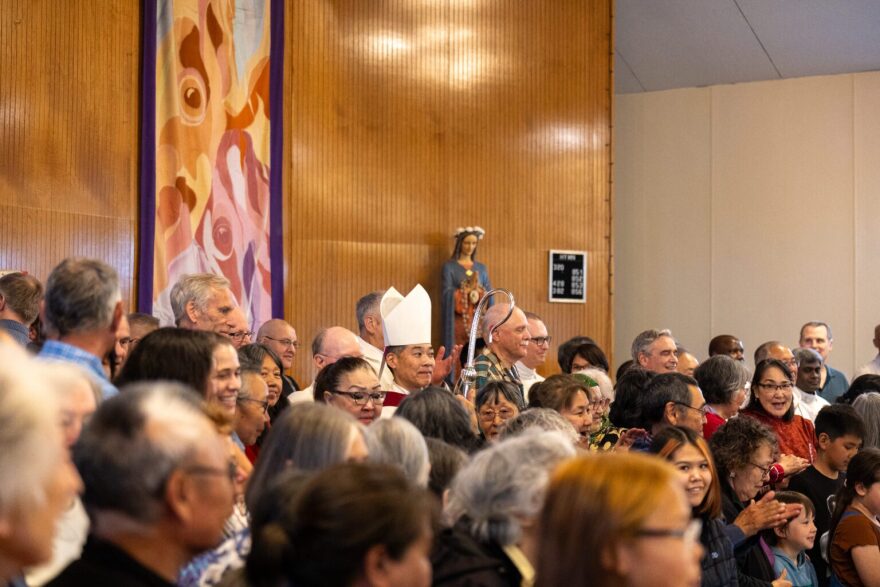
About 70 people posed for a photo on the altar – priests, deacons, parishioners, Elders and children — many of them smiling, some standing quietly.
The photo doesn’t tell the whole story. But it’s a moment when gratitude, grief, and memory all shared the same room.
Bishop of the Diocese of Fairbanks, Steven Maekawa, stands in the middle of a crowd waiting to take a photo at Bethel’s Immaculate Conception Church.
JUNEAU, Alaska (KTUU) – The Supreme Court of Alaska will be taking up the case of the State of Alaska, Division of Elections v. Daniel J. Sullivan, Jr.
The oral arguments will be held Monday at 10 a.m. via Zoom, according to an order and opening notice.
The document also specifies that a decision is expected to be made before noon on Tuesday.
According to documents from the Division of Elections, the state must start printing ballots at noon on the same day.
Advertisement
This comes after an Anchorage Superior Court Judge ordered Dan J. Sullivan on to the ballot Friday.
See a spelling or grammar error? Report it to web@ktuu.com