Lifestyle
The transformative joys (and pains) of painting your own house

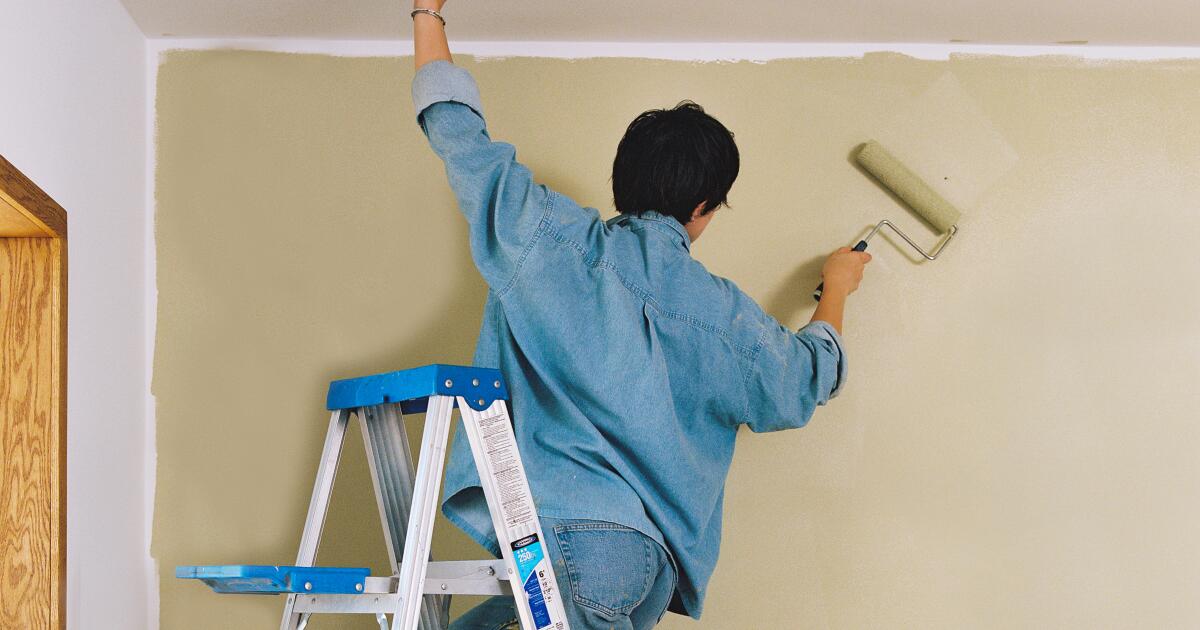
There are 38 walls in my house, including the ceilings. Of those, 14 are fully painted, 10 are in varying stages of completion, seven are covered in paint swatches and two are haphazardly skim-coated. The remaining five are as nature (the previous homeowners) made them, for now. I am now used to living in a kind of aesthetic limbo. I work beside a stack of gallon cans, paint trays and crumpled canvas drop cloths, below a half-painted ceiling. I no longer notice the flashes of lime green tape caressing door frames, encircling bathroom floors and smothering naked outlets. For the last six months, I’ve gone to sleep each night confronted with the same impossible choice swatched on the wall: Should the bedroom be Farrow & Ball’s Breakfast Room Green, Behr’s Roof Top Garden or Backdrop’s Lawn Party?
This purgatory is entirely of my own design — there are no professionals involved. Professionals get the job done. They make decisions, they bring their own rollers, they already own ladders. I self-impose and prolong these chaotic experiments because collectively, they form a promise: that one day I’ll be able to live happily in the house I’ve always wanted.
It’s hard to believe it’s already been two years. My relationship with my house is intense, tumultuous. Driven by a dark kineticism, it vacillates between contempt and gratitude at a velocity that catches my husband, my therapist, even me off-guard. It helps to start at the beginning.
I don’t remember how many houses we saw before the one that eventually became ours, but it was a lot. We started house hunting a little too late, just as interest rates started to claw their way back from historic lows. L.A.’s open houses were thick with the resulting panic, generated by throngs of millennial couples, looking-glass versions of ourselves, all desperate to get ahead of the curve.
At a viewing for a “developer’s dream” in Alhambra (complete with black mold blooming on the walls), I watched a fellow buyer-to-be grab onto the arm of the selling agent as she shouted to the rest of us that she wanted this house, that she would buy it today and that she would pay for it in cash. The market sensed our desperation. Prices rose quickly. Listings sold for tens of thousands over asking. Then hundreds of thousands.
On Redfin, a listing that attracts significant traffic is given the designation of a “Hot Home.” The first Hot Homes we found were architecturally significant with character and updated kitchens. Soon, they were simple, but solid, with more than one bathroom. Then came the quick flips with baggage, bisected by easements or on shaky foundations. Eventually, even the gnarliest tear-downs were in high demand. So when we met our house, we were immediately taken by its lack of homeowner-installed balconies, exposed wiring and sodden floors. There were no sewage problems, no five-foot-tall bathrooms, no wild animals living inside. It might not have been Hot, sure, but it was a Home. Beautification, we agreed, could come later. When our offer was accepted, we felt so lucky that we started counting our blessings and stopped running the numbers. And house stuff, it turns out, is very, very expensive.
The urge to paint is primitive and innate. Cavemen, famously, liked to doodle on the walls with pigments ground from charred wood, stone, bone and minerals, bound with plant sap and animal fat.
Faced with bloated mortgage payments locked in at an inarguably mid-interest rate, I turned to DIY. I forced myself to watch excruciatingly paced episodes of “This Old House.” I bought a voltage tester. I took a woodshop class, giddy with visions of Donald Judd-inspired furniture and dovetailed cabinets (I made a cutting board). But dabblings in more advanced forms of home improvement have been unequivocal failures. The enormous hole I cut in a load-bearing wall in a Gordon Matta-Clark-informed burst of inspiration required extensive professional intervention. A bathroom I decided to “redo” has sat undone for more than a year. I’ve learned that a lack of experience and ADHD, combined with the consumption of time-lapsed home renovation videos on social media, is an intoxicating and dangerous cocktail I’m better off without.
If you’re relatively able-bodied and OK with doing a bad job (which I always am), painting is pretty easy. And its transformative powers are overwhelmingly effective.
But paint. Paint is my friend. Unlike electrical work or cabinet construction, paint is statistically less likely to kill, injure or dismember you. Its essential tools are inexpensive and intuitive. If you’re relatively able-bodied and OK with doing a bad job (which I always am), painting is pretty easy. And its transformative powers are overwhelmingly effective.
I’m not alone in this belief. The urge to paint is primitive and innate. Cavemen, famously, liked to doodle on the walls with pigments ground from charred wood, stone, bone and minerals, bound with plant sap and animal fat. In honor of my ancestors, I eschew steps like sanding and priming. Choosing, almost every time, to paint first and ask forgiveness later. “Color good,” I reassure myself as I apply a coat of Backdrop’s reddish-purple Lobby Scene to a perfectly serviceable Ikea cabinet, boring bad.
Remembering the 16th and 17th century artisans commissioned to adorn the walls of wealthy Europeans’ homes with murals and trompe-l’oeil, I encourage my friends’ 4-year-old to draw on the living room wall. We were planning to paint over it until more urgent, enticing walls cut ahead in the queue. Her portrait of our dog, while anachronistic to the period, is still on view.
My practice isn’t always joyful. As I get down on my hands and knees to scrape paint drips off the floor, the results of my husband’s exuberant roller work, I empathize with the Puritans who looked down upon those who would dare paint their walls. “Heretics!,” they cried. Centuries later, my voice joins their chorus: “Drop cloths!”
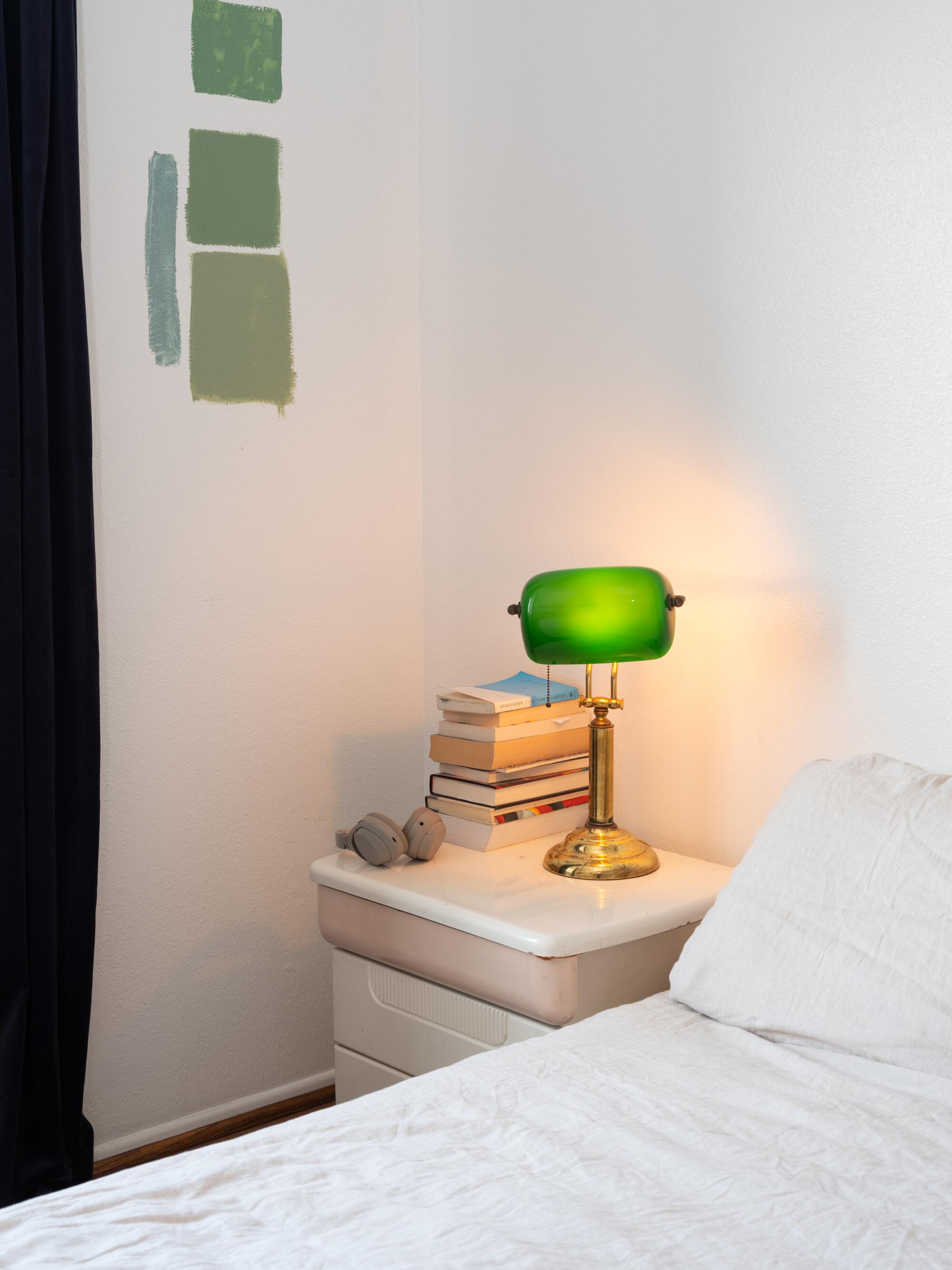
There are 38 walls in my house, including the ceilings. Of those, 14 are fully painted, 10 are in varying stages of completion, seven are covered in paint swatches and two are haphazardly skim-coated.
How old were you when you were asked for the very first time what your favorite color was? And how many times over the years has that answer changed, surprising even yourself? The paint and coatings market, built on our endlessly varied and forever shifting color preferences, is robust, with a reported market size of $206 billion in 2023. It might not surprise you to know that paint’s business started to really pick up swiftly around 2021, the year U.S. homeownership rates hit a 9-year high. We were one year into a global pandemic, and the nonessential among us were grateful for our health but sick of our surroundings. Snarled supply chains and crowded ports meant massive delays for furniture and furnishings. So we turned to paint.
The paint mass market has no shortage of options available: Behr, the pitiless paint god at whose Home Depot altar I am often forced to worship, boasts nearly 4,000 colors, and selecting one is just the beginning. “Do you want Behr Premium Plus®, Behr Scuff Defense®, Behr Marquee®, Behr Dynasty®?” the Home Depot paint associate silently asks, pointing at an infographic laminated on the counter top. Flustered, I step out of line to Google “Behr prmeium.plus vs. detnasty reddit,” and gesture to the next person to go ahead. The other mainstream paint brands, Benjamin Moore (3,500 colors) and Sherwin-Williams (1,700), offer similar experiences.
Our home’s previous owners painted every wall a cool, semi-glossed gray with greenish undertones. Under the piercing, cool white LED flush mounts installed every few feet, the effect was undeniably institutional. Paint was the obvious first step.
There was a time when I reveled in the sheer volume of the spectrum. Our home’s previous owners painted every wall a cool, semi-glossed gray with greenish undertones. Under the piercing, cool white LED flush mounts installed every few feet, the effect was undeniably institutional. Paint was the obvious first step. I drove happily to Home Depot, to Lowe’s, to Ace Hardware and picked free samples from the rainbow walls like flowers. Then came a bloody, months-long campaign to find a warm, non-white neutral for my office. It took eight samples and six trips to two hardware stores before I found it: Benjamin Moore’s Gentle Cream. But I was exhausted, spent, color-sick.
There are easier, softer, pricier ways. Backdrop Home (82 colors), Farrow & Ball (152 colors) and Little Greene (196 colors) way. Backdrop Home, in particular, has zeroed in with shameful, heat-seeking precision on aesthetically obsessed millennials who crave curves and architectural significance but can’t afford the homes that have them. Silverlake Dad is a slate blue-gray. Barragán-Cito, a bright pink, will speak to anyone who shelled out an extra $25 to take their own photos at the architect’s Mexico City home tour. The brand’s earnestness feels very L.A., which makes sense: When Backdrop co-founder Natalie Ebel and her family moved to Silver Lake post-pandemic, they brought the brand’s operations and production with them.
Ebel says L.A. is “adventurous with color … It’s a lot easier to play with color when you’re surrounded by color. And maybe it’s the size of the homes. In L.A., you have more real estate, you have more space and you’re open more to experimentation with the light, the windows, the sun.”
I was once skeptical of the Backdrops, the Farrow & Balls, dismissing them as the refuge of the less creative who weren’t capable of conceiving their own Color of the Year. But faced with so many walls still to go, I’ve found myself finally softening, succumbing.
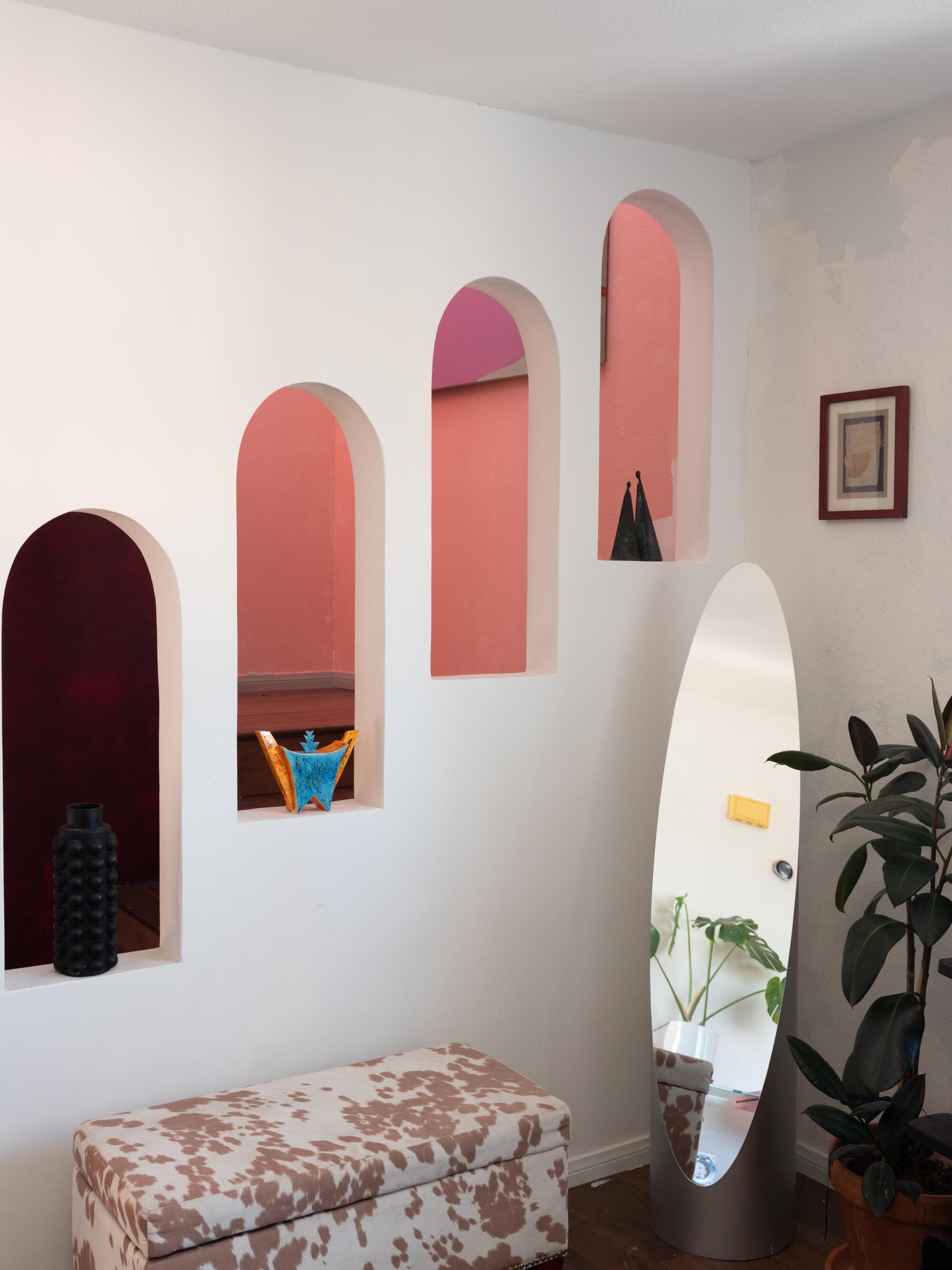
My house and I are birth-year twins, 1990 babies, Year of the Horse. When you get down to it, my house is very much a classic L.A. house — two boxy stories stacked atop a wide garage, straddling a hillside. It stands shoulder-to-shoulder with four identical siblings. I never know how to describe it, but you’d know it if you saw it. “Oh, it’s one of those,” a friend said, walking up to the door for the first time. “Why didn’t you just say so?”
It wasn’t the house I imagined myself living in. My dream house (think Jeff Shelton’s biomorphic surrealist creations) doesn’t exist in L.A. nature, at least not in my budget. Last year, according to the National Assn. of Homeowners, 32% were first-time buyers, with a median age of 35. In other words: millennials. Millennials, like me, were buying properties they could barely afford and, as supply shrank, perhaps didn’t particularly like. Our houses just didn’t feel like us.
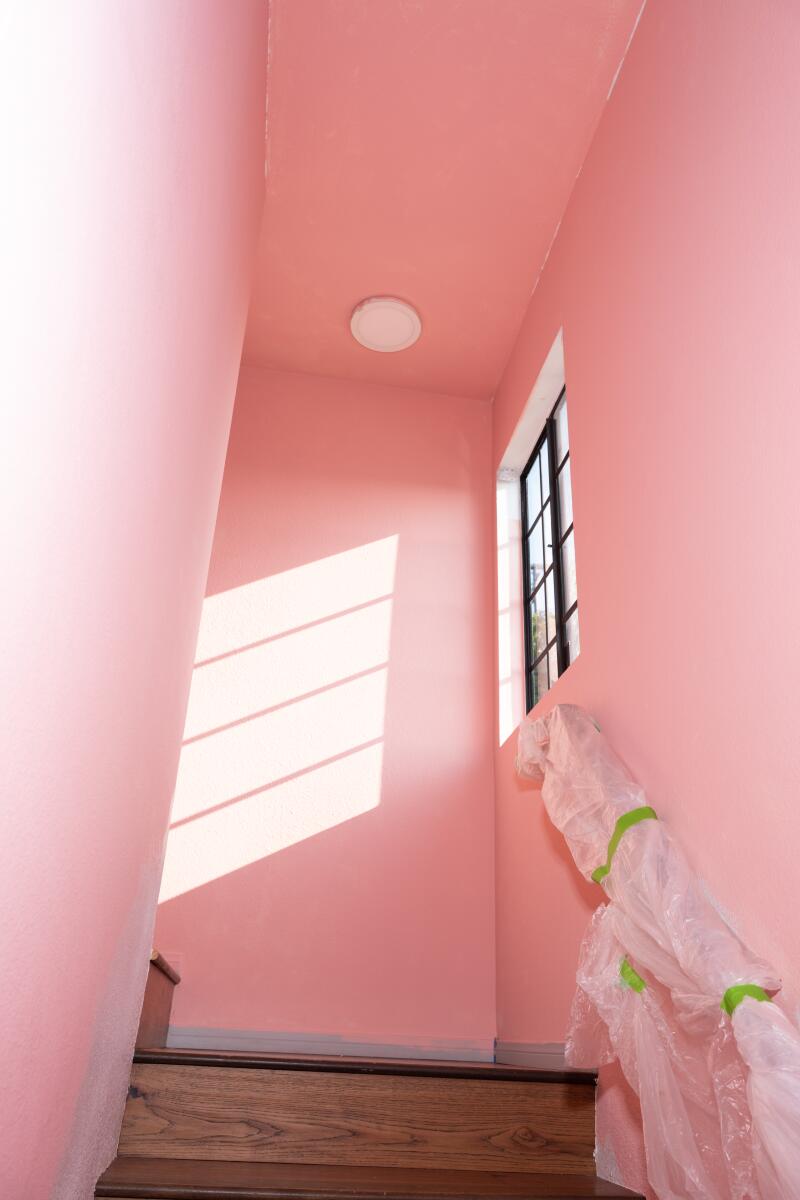
Maybe paint is the cheapest, easiest, fastest way to make our houses as unique as we think we are. It felt like a hypothesis worth testing. Over the last two years, I’ve drenched the bathroom in glossy navy, bisected an office with teal and mustard, painted the stairwell a bright, matte powdery pink. I’ve resurrected kitchen cabinets with a deep blue and spray-painted the corresponding pulls bright red. I painted the fireplace a truly heinous shade of green called simply Frog, only to re-paint it Frosted Sage, only to skimcoat over both (it currently stands naked and anxious, waiting for its next outfit change).
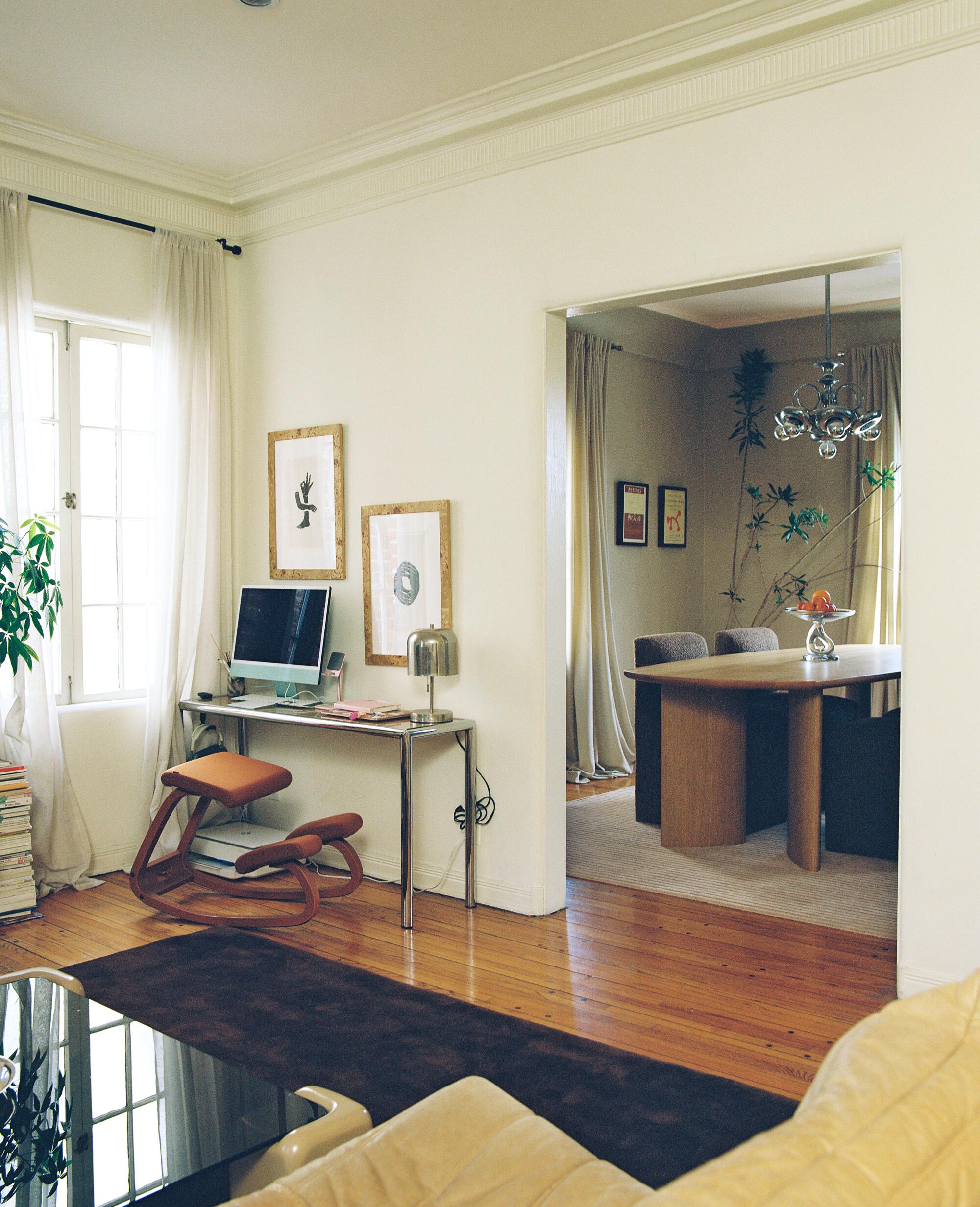
Alyssa Coscarelli’s Los Angeles home, painted with Backdrop colors.
Painting has almost become one of our love languages: part quality time, part acts of service. The house, we know, appreciates the physical touch.
I paint when I’m bored, when I’m excited, when I’m sad, when I’m anxious. I leave the tarps and paint trays out — perpetual invitations to explore. I’ve welcomed my husband home with a fresh wall of swatches; he’s surprised me by finishing walls I’d been forced to abandon during the workday. Painting has almost become one of our love languages: part quality time, part acts of service. The house, we know, appreciates the physical touch.
“I have a question,” a friend recently asked. “Do you think you’ll ever be done painting?” I considered it for a moment, but knew the answer was no. On the one hand, I’m fighting an unwinnable battle against awkward architecture armed only with pigmented latex, and stopping now would be surrender. But it’s not just this house — any house I live in would be one I needed to paint. Priming, painting, re-painting, I feel something shift and open. With every wall, every stroke of the roller, every roll of tape, the more I love my canvas. The more it feels like home.
Liz Raiss is a writer, editor and furniture enthusiast based in Los Angeles. She runs the (formerly anonymous) Instagram account @design.out.of.reach.



Once rivals on the tennis court, Martina Navratilova, left, and Chris Evert have become close friends in retirement. They are pictured above at the French Open in 1986.
Trevor Jones/Getty Images Europe
hide caption
toggle caption
Trevor Jones/Getty Images Europe
Chris Evert and Martina Navratilova were the most successful women’s tennis champions of their generation. Both were 18-time Grand Slam tournament winners — and each other’s greatest rivals.
Evert, a Florida native, became a tennis star in her teens. Navratilova was born in communist Czechoslovakia, and emerged as a player after Evert was established. They first faced off during a match in Akron, Ohio, in 1973, when Evert was 18, and Navratilova was 16. Evert won, but Navratilova left an impression.
“I remember thinking to myself, holy cow, when this young girl gets into better shape, she is going to be a force to be reckoned with,” Evert says. “She had so much talent. Her hands were quick, she had a big first serve, she had a big forehand, and she just was so powerful.”

Two years later, on the day she lost a semifinals match to Evert at the U.S. Open, Navratilova defected to the U.S. In the years that followed, her tennis game improved. Though she and Evert had initially been friendly, the friendship cooled as their rivalry heated up.
“Playing Chris was difficult because how can you not like Chris? What’s not to admire?” Navratilova says. “She was like the epitome of cool.”
The new Netflix documentary Chris & Martina: The Final Set tells the story of how Evert and Navratilova re-established their friendship and how they both faced cancer in retirement. Evert was diagnosed with ovarian cancer in 2021; Navratilova was diagnosed with throat and breast cancer in 2022.
“I can’t get away from her,” Evert jokes. “We had a 15-year career, and then we got cancer at the same time. It really is freaky, but I always say: If I want someone to be in the trenches with me, it’s Martina because she has been so supportive and so understanding.”

Navratilova agrees: “We have such a level of trust that we know whatever we say to each other, it stays there. We give each other the best advice we know how to. And there is no ulterior motive, no playing games.”
At the time that this interview was taped, Evert and Navratilova were both in remission from cancer. But late last week, Evert disclosed she’d recently been diagnosed with a recurrence of ovarian cancer.

“We know whatever we say to each other, it stays there,” Martina Navratilova says of her friendship with Chris Evert.
Netflix
hide caption
toggle caption
Netflix
Interview highlights
On supporting each other through cancer
Evert: There are a lot of phone calls between us. … I don’t cook, but Martina would bake bread for me, and her wife Julia would cook, make some chicken soup. … I got a lot of food from Martina. She got a necklace from me.
Navratilova: I get jewelry from Chris, she gets food from me.
Evert: Martina’s and my relationship — because we’ve had one for 50 years — is not the type where we have to talk to each other every day to maintain the closeness. I always knew she was there. She always knew I was there if we needed to talk, and that was that.
On the weakness they experienced with cancer
Navratilova: Chris’ diagnosis and treatment was much more life-threatening than mine, percentage wise, but my treatment was more difficult physically. … I was in New York for seven weeks and I literally sat on a yoga mat, maybe half an hour of the seven weeks, and did some stretching. I couldn’t even do the down dog pose because I would have fallen down. I had absolutely zero strength left.
Evert: The chemo kicked my butt, let’s put it that way. … It left me very weak, very, very weak. After chemo I would have three or four days of intense nausea and I just would feel tingling in my body and it just wasn’t nice. I didn’t have the energy. To walk six blocks was a big deal for me. And it was foreign. You know, it felt like it wasn’t my body, for sure.
On watching the old footage of their matches together for the documentary
Navratilova: For me, it was fun watching with Chris, because we had different reactions to what happened on the court. But what impressed me is how well we played with those wooden rackets. Because you know what? Those rackets are not easy to play with. But you try to put yourself in there physically, what it was like, mentally, what it is like. And it’s like, “Oh, I should have gone down the line,” or, “I can’t believe I missed that shot.” Or “Chris, you had such a great pass.” It was amazing. So it was impressive. … I wish I could still have that six-pack, but anyhow.

Evert: I remember feeling genuinely happy for her. I remember it was her first Wimbledon. That’s always been her dream since she defected. Her family couldn’t be there to watch her. She was all alone. And I just was happy for it. And I knew that this was gonna be one of many for her to win.
On defecting to the U.S. in 1975 when she was 18 years old
Navratilova: I was thrilled to be in the States. I always loved American cars. And when you ordered a ham sandwich, you got, like, two inches of ham and two slices of bread. Whereas growing up, you had thick bread and one slice of ham. So I thought I was in heaven. And it was $2.30 for that sandwich. I still remember it. I couldn’t believe how much ham I was getting.
Lauren Krenzel and Nico Gonzalez Wisler produced and edited this interview for broadcast. Bridget Bentz, Molly Seavy-Nesper and Beth Novey adapted it for the web.

-

 Detroit, MI13 minutes ago
5 realistic cornerback trade targets for the Detroit Lions after Terrion Arnold’s release
-

 San Francisco, CA25 minutes ago
Headlines, June 30 – Streetsblog San Francisco
-

 Dallas, TX28 minutes ago
LIVE | Ivory Coast, Norway meet for World Cup knockout match at Dallas Stadium
-

 Miami, FL33 minutes ago
Every Dolphins head coach’s start in Miami from worst to best
-

 Boston, MA40 minutes ago
Historian clears up one of the biggest myths about the Boston Tea Party
-
Denver, CO43 minutes ago
Nemanja Jokic, the older brother of\u00a0Denver …
-

 Seattle, WA48 minutes ago
3 Seahawks Rookies Who Must Step Up Right Away
-

 San Diego, CA55 minutes ago
Adobe Falls: The elusive waterfall that briefly returns after San Diego rains

