Northeast
Vermont Gov. Scott vetoes 'safe injection site' proposal

Vermont’s governor has vetoed a bill that would have allowed the creation of a pilot overdose prevention center in the state’s largest city of Burlington, including a safe injection site where people could use narcotics under the supervision of trained staff and be revived if they take too much.
Gov. Phil Scott, a Republican, wrote in a letter to lawmakers on Thursday that while such sites are well-intentioned “this costly experiment will divert financial resources from proven prevention, treatment and recovery strategies.”
The Democratic-controlled Legislature is expected to attempt an override next month.
VERMONT LEGISLATURE PASSES ONE OF THE STRONGEST DATA PRIVACY MEASURES IN THE COUNTRY
The legislation — an act relating to a harm-reduction criminal justice response to drug use — would have allocated $1.1 million in fiscal year 2025 to the Vermont Department of Health to award grants to the city of Burlington to establish such a center. The money would have come from the Opioid Abatement Special Fund made up of Vermont’s share of a national settlement with drug manufacturers and distribution companies. Before then, the bill required the Health Department to contract with a researcher or consultant to study the impact of the overdose prevention center pilot program.
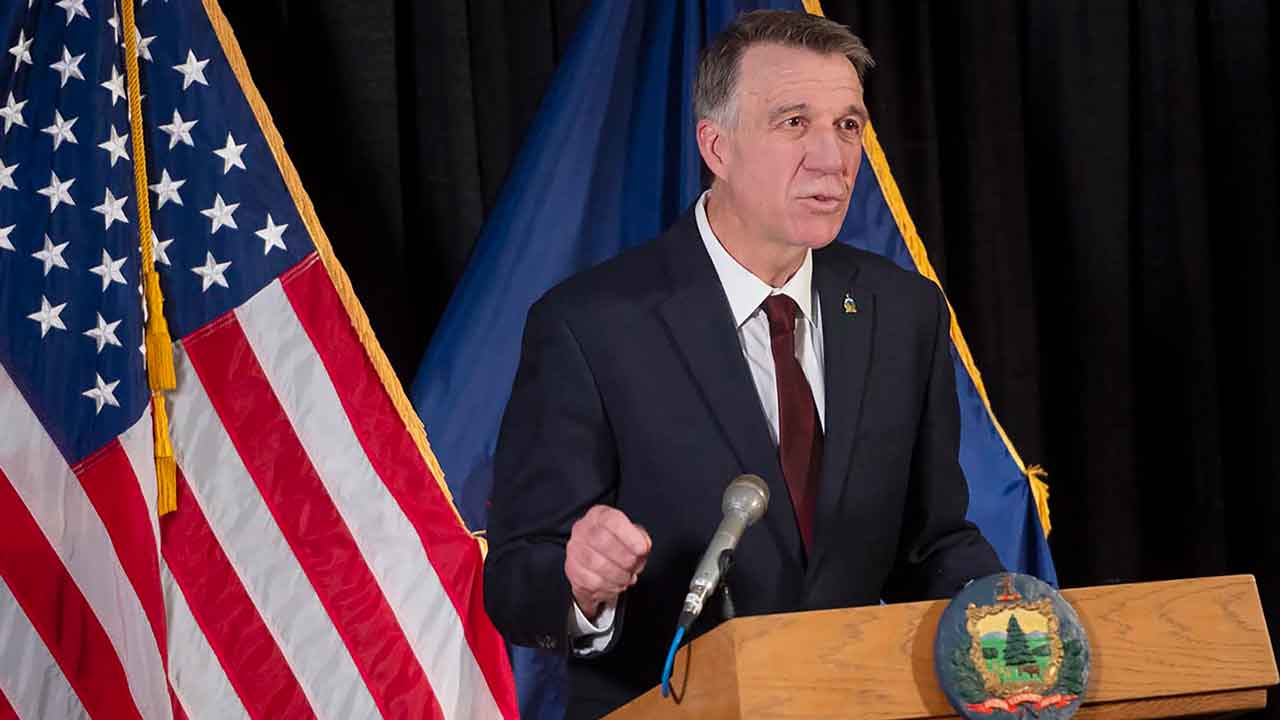
Vermont Gov. Phil Scott delivers his State of the State address remotely from the Pavilion office building, Jan. 5, 2022, in Montpelier, Vermont. (Glenn Russell/VTDigger via AP, Pool, File)
The center would have provided referrals to addiction treatment as well as medical and social services. It would also have offered education about overdose prevention and distributed overdose reversal medications.
Senate President Pro Tem Phil Baruth, a Democrat, said a statement on Thursday that “the dramatic rise in fatal overdoses over the past ten years is one of the most pressing crises facing our state.”
He said overdose prevention centers save lives, connect people to treatment while reducing pressures on emergency departments and Emergency Medical Services and decreasing drug consumption in public.
The governor vetoed a similar bill two years ago.
Read the full article from Here


“Mayor of Kingstown” has wrapped up filming its fifth and final season in Pittsburgh.
Since the Paramount+ show began filming in western Pennsylvania in 2022, the Pittsburgh Film Office says it has injected over $325 million into the local economy and created over 10,000 jobs. In total, the show has had 457 shoot days in the Pittsburgh area.
“We look forward to seeing your work on the screen and thank you for several years of dedication to the region,” the Pittsburgh Film Office wrote in a Facebook post.
Production of the show’s fifth and final eight-episode season began in March. According to Paramount+, the new season follows what happens when an FBI agent described as a “dedicated lawman” arrives in Kingstown and “threatens to disrupt the tenuous balance of power.”
Jeremy Renner, who stars as Mike McLusky, marked the end of the show in an Instagram post, saying he was “filled with gratitude.”
“I am so very thankful for all of your support over the years—it has given my stride and purpose in my recovery and love in my heart,” Renner wrote. “Thank you cast and crew for carrying me through when necessary.”
Renner broke dozens of bones and underwent multiple surgeries after he was involved in an accident involving a 7-ton snowplow on New Year’s Day in 2023. He has said that returning to the set of “Mayor of Kingstown” for Season 3 helped him cope.
The release date for Season 5 hasn’t been announced yet.

An 85-year-old priest has died after he crashed his car into a tree in West Hartford on Wednesday afternoon, police said.
Police received a report that a car went into the woods near Simsbury Road and Tumblebrook Lane around 2:41 p.m. The West Hartford Police Department responded, along with the West Hartford Fire Department and AMR medical personnel.
The driver, later identified as 85-year-old Terence Kristofak, of West Hartford, was the car’s only occupant. Firefighters extricated him from the car before he was taken to a hospital with serious, life-threatening injuries, police said. He was later pronounced dead at the hospital.
Kristofak served as a Passionist priest at the Holy Family Passionist Retreat Center, according to a Facebook post from the church.
“Father Terry had been visiting family and was on his way home at the time of the accident,” the church wrote. “We are filled with grief at the loss of such a kind, loving, and faithful friend. His presence touched the lives of so many, and his passing is a tremendous loss to our community.”
Simsbury Road was closed in both directions between King Edward Road and North Main Street while crews responded. The road has since reopened.
West Hartford police’s traffic division is investigating the crash.
The scene of the crash.
Anyone with information about the crash is asked to contact the West Hartford Police Department at 860-523-5203 or submit an anonymous tip by calling 860-570-8969 or emailing whpdtips@westhartfordct.gov.

Maine’s highest court weighed Wednesday whether the state can reject petition signatures collected by out-of-state circulators who did not check a box consenting to Maine’s jurisdiction, a legal dispute that could determine whether Mainers vote on transgender inclusion in sports this November.
The group called “Protect Girls Sports” initially submitted enough signatures to qualify for the ballot, proposing an initiative that would restrict what school sports teams, bathrooms and facilities trans students can access. Secretary of State Shenna Bellows later determined that the campaign had failed to qualify, after thousands of signatures were invalidated. That ruling was upheld by a Superior Court judge in June and the campaign appealed that decision to the Supreme Judicial Court.
More than 1,500 of the invalidated signatures were collected by four out-of-state circulators who had not checked a box on the form agreeing to Maine’s jurisdiction. The Maine Supreme Judicial Court must now decide whether those signatures were properly invalidated. The initiative is short 500 signatures to qualify.
The Maine Constitution prohibits out-of-state circulators from submitting petitions, but that ban was declared unenforceable by a federal appeals court in 2022, since it likely violated the First Amendment of the U.S. Constitution. In response to a lawsuit, Maine then entered into a consent agreement, which all citizen-led initiatives still rely on to hire out-of-state circulators to collect signatures. However, they must consent to the state’s jurisdiction.
Attorney Tim Woodcock, who represented Protect Girls Sports, argued that out-of-state circulators should be treated the same as Maine residents who collect petition signatures, since the consent agreement requires the state to allow them to work on campaigns. Woodcock said the consequences of not reversing the ruling would be dire.
“If this is upheld, it’s essentially a petition that has been pulled off the ballot with 1,520 otherwise valid ballot signatures,” Woodcock said in the Augusta courtroom. “That would be a remarkable result of these circumstances.”
The same argument was made after the May hearing before the Secretary of State’s Office as well as before the Superior Court, but neither accepted it.
Protect Girls Sports has not pushed back on any other findings showing a pattern of negligence in the signature collecting process, with circulators leaving forms unattended, adding ditto signs on some columns, and other infractions. Rather, Woodcock challenged the secretary’s authority to impose what he said was an unfair burden on out-of-state signature collectors by requiring them to check an additional box to consent to Maine’s jurisdiction.
Attorney Christopher Dodge from Elias Law Group, the national law firm representing the three Maine residents who initially challenged the petition signatures, said, “We are here today because Protect Girls Sports has essentially reached the bottom of the barrel for its last few arguments to try and dislodge the secretary’s well-reasoned and well-supported findings.”
“And each of those arguments basically concedes that the initiative violated … Maine law.”
Since the vast majority of the 120 out-of-state circulators complied with the requirements, Dodge said Woodcock could not make a convincing case that the rules were a burden.
“The burden here is they have to complete the circulator affidavit … and they have to check the box, that’s it,” he said. “And most of the non-resident circulators have absolutely no problem complying with it.”
One circulator, Cairo, had initially left the box blank but later checked the box through a corrected affidavit in May, three months after the petition was submitted for validation. Woodcock has previously argued that her signatures should be considered valid because of her corrected form.
However, her decision to intentionally leave the box blank was a “substantive lack of agreement” to Maine’s jurisdiction, Superior Court Justice Deborah Cashman said in her opinion validating Bellows’ decision on June 11.
Woodcock said in court Wednesday that the “consent agreement says nothing in it about when an out-of-state circulator must consent to jurisdiction,” and that those rules were being imposed by the Secretary of State’s office.
The Supreme Judicial Court is expected to rule on the appeal before mid-August, before the deadline for the secretary’s office to put a question on the ballot.
This story was first published by Maine Morning Star and is republished here under Creative Commons license CC BY-NC-ND 4.0.
-

 Denver, CO4 minutes ago
Where to Celebrate the 4th of July in Denver This Weekend – 303 Magazine
-

 Seattle, WA7 minutes ago
COUNTDOWN: Two days until West Seattle Fourth of July Kids’ Parade! Here’s the newest info
-

 San Diego, CA12 minutes ago
Man Stabbed 4 Times Outside San Diego Bar; Suspect Arrested
-

 Milwaukee, WI19 minutes ago
Dominique Noth impacted Milwaukee arts, culture scene for six decades
-

 Atlanta, GA22 minutes ago
FBI orders field offices to send analysts to Atlanta for 2020 election investigation, sources say
-

 Minneapolis, MN25 minutes ago
MN Street Style: Minneapolis People’s Pride 2026 – Racket
-
Indianapolis, IN34 minutes ago
2026 Indianapolis Colts Fantasy Preview: All eyes on Daniel Jones
-

 Pittsburg, PA37 minutes ago
“Mayor of Kingstown” wraps up filming final season in Pittsburgh


