Arizona
The CHIPS Act transforms an Arizona neighborhood


About 7 miles south of a massive construction site where Taiwan Semiconductor Manufacturing Co., the world’s biggest chipmaker, is building three factories, one neighborhood is undergoing dramatic change.
The Golden Triangle — as at least one real estate developer calls it — occupies about a half-mile square in Phoenix, Arizona. It has about 100 houses, connected by mostly dirt roads. In addition to the human residents, many of whom moved there in search of a rural lifestyle, it’s home to horses, goats, cows, donkeys, chickens, bees and a 16-year-old tortoise named Crush.

But the economy of the Golden Triangle is getting an overhaul. Three new apartment complexes, with a combined 852 units, have been approved for construction inside its borders. Developers and city officials say the housing is needed, in part, to meet demand driven by the semiconductor industry.
As part of our ongoing series “Breaking Ground,” about how federal government investment is changing the economy in complicated, invisible and contradictory ways, Marketplace looked at the impact of the CHIPS and Science Act on Phoenix. The landmark legislation is part of the government’s plan to rebuild the semiconductor industry in the United States
Residents, business owners and city officials each have their own interests in this development cycle. To explore how the changes are fanning the flames of competition among them, “Marketplace” host Kai Ryssdal spoke with these stakeholders in the Golden Triangle.
Click the audio player above to hear the story.
The small-business owners

Toward one corner of the Golden Triangle, there is a freshly built strip mall with a Mexican restaurant, a nail salon, a day care center and a couple of other small businesses. Its construction was part of a wave of commercial development in the area.
Kat Blaz, the owner of a Bricks & Minifigs franchise, which sells new and used Lego products, opened her store about 2½ years ago. “I was so excited when I found out what was going in behind us,” she said, referring to the planned apartment complexes. “It’s hard nowadays for brick-and-mortar [businesses] to survive with all the online shopping, and so the fact that we can get more foot traffic is awesome,” she said.

One door down, Yvette Stumpf, the owner of a salon franchise specializing in haircuts for kids, hopes the neighborhood’s new residents will bring more traffic to her business as well. But she has mixed feelings about how development is changing the neighborhood. “I see that as a boon to my business because it’s more people,” she said. “However, I also do not like the big-city feel, and we still feel like country.”
Those competing feelings — hopes for the benefits of development and the desire to retain the neighborhood’s character — reflect an ongoing battle over the future of the Golden Triangle as federal investment accelerates the changes.
The real estate developer
Real estate developer Charles Eckert is in the second category of stakeholder — he built the strip mall Blaz and Stumpf’s stores are in. “We’ve taken raw desert, basically, and turned it into this,” he said, gesturing toward the busy intersection.
“There were no curbs, no gutters, no sidewalks. The road was two lanes wide. That was a dirt road right there, and there was nothing here,” he said. “I’ve been developing in this area for 20 years.”

As more businesses invested in north Phoenix — some lured by state tax incentives — Eckert saw potential in that triangle. “That’s why I invested my entire net worth into this area,” he said.
Now, those bets seem to have paid off. He attracted a convenience store, an AutoZone, a Brakes Plus, a storage facility, a day care center and all the small businesses in that strip mall.
Last year, he sold some of his remaining land in the Golden Triangle to an apartment development company for $2.8 million. When making the case to the Phoenix City Council for a five-story apartment complex on that parcel, a representative for the developer cited its proximity to TSMC, the giant semiconductor producer.
“You’ve just got to look around and look at the commercial development that was coming here and say, ‘There will be housing demand here,’” Eckert said.
The neighbors
Laurel Brodie, who lives about 800 yards from Eckert’s strip mall, remembers what this neighborhood looked like before developers like him arrived.
“We’re in what used to be the middle of the desert,” she said. Brodie’s husband and father-in-law bought property here in the 1970s. They were among the first residents in the neighborhood.

Brodie showed Ryssdal an aerial photograph of her house from 1990, when the surrounding area was almost entirely undeveloped. “There’s nothing in this,” Ryssdal observed. “You can see all the way to the mountains.”
Although Brodie acknowledges that development in the area was inevitable, she and a group of her neighbors tried, and failed, to fight Phoenix City Hall about the planned apartments inside the bounds of their unincorporated island on county land.
They argued that high-density housing — especially a five-story apartment building — is inappropriate for the area. “Even the ones on the freeway don’t go up that high, and yet they find it appropriate to put five stories right here,” Brodie said.
“It’s rather threatening to my way of life,” said Alison McKee, who lives down a dirt road from Brodie and joined her in the resistance effort.

McKee and her husband bought their property about 12 years ago because they wanted land where they could have a horse. Now, in addition to the horse, the McKees have five donkeys, 26 chickens, 18 goats (nine kids and nine adults), a dog, a barn cat and a rotating cast of foster donkeys from a local rescue.
In the years since the McKees moved in, a megachurch was built across the street and shopping centers and apartments sprang up down the road. It’s clear that more will be coming with the investment in semiconductor plants.
“We do feel like we will be bowled over,” McKee said. “So am I the weird old lady that stands her ground and holds out? … Only time will tell.”
The city
Because both Alison McKee and Laurel Brodie’s properties sit on unincorporated county land, they do not pay Phoenix city taxes and cannot vote for Phoenix City Council candidates. But the city is getting closer and closer to them.
Councilwoman Ann O’Brien, who represents the district that includes TSMC and the Golden Triangle area, is responsible for balancing the competing interests. She supported the proposed apartment developments.
“You might know, we have a little bit of a housing shortage here, not just in Phoenix but the entire state of Arizona,” she told Ryssdal. “And one of my commitments when I ran for office in 2020 was to ensure that we brought a diversity of housing.”

The Phoenix metropolitan area, already among the fastest-growing in the nation, received a wave of new residents during the pandemic, exacerbating a housing shortage. An Arizona State University research report found that Arizona was short about 270,000 units in 2022.
TSMC, which is investing $65 billion in Arizona with a $6.6 billion boost from the CHIPS Act, plans to hire 6,000 workers. Additionally, the company expects those factories to create tens of thousands of construction and indirect supplier jobs. Those workers will need places to live.
“Phoenix is growing, and what used to be far out there isn’t so far out there anymore,” O’Brien said.
As trillions of government dollars flow into the national economy, more communities will have to grapple with the tradeoffs of development, as the Golden Triangle has. What is happening there will happen elsewhere.
“Change is coming?” Ryssdal asked.
“It’s not just coming,” O’Brien said. “It’s here.”
There’s a lot happening in the world. Through it all, Marketplace is here for you.
You rely on Marketplace to break down the world’s events and tell you how it affects you in a fact-based, approachable way. We rely on your financial support to keep making that possible.
Your donation today powers the independent journalism that you rely on. For just $5/month, you can help sustain Marketplace so we can keep reporting on the things that matter to you.



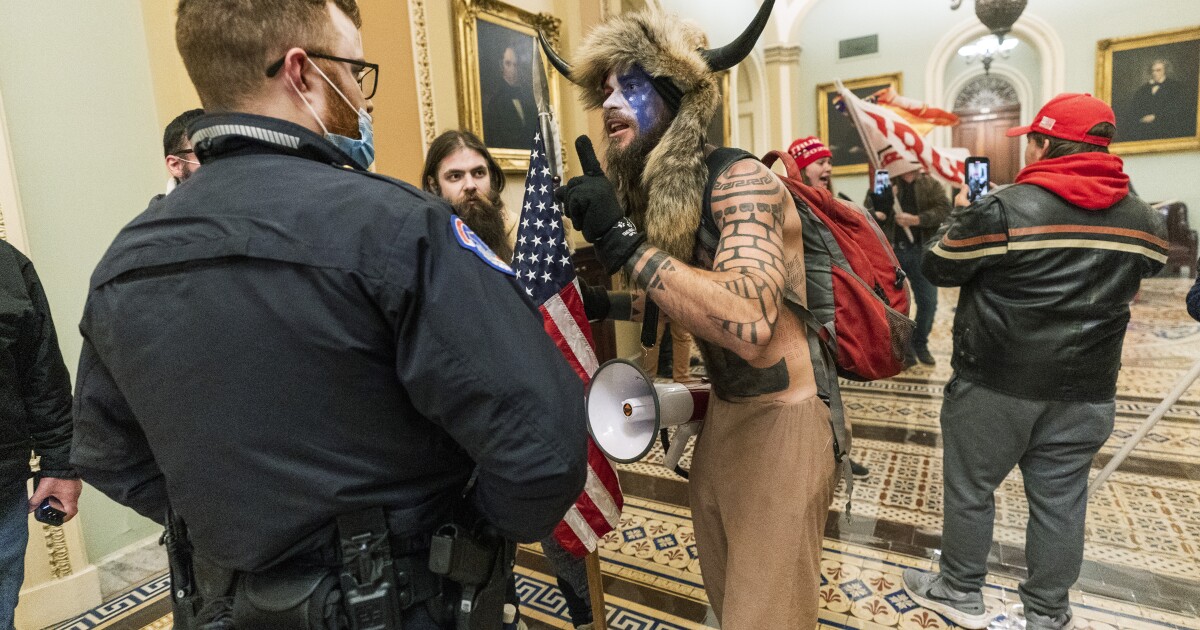
The Arizona man known as the “QAnon Shaman” said Wednesday that President Donald Trump’s new Anti-Weaponization Fund is an abuse of power by a would-be “king.”
Jacob Angeli-Chansley – the face of the Jan. 6, 2021, Capitol riot with his red, white and blue face paint and horned fur headdress – denounced the $1.776 billion program as a “slush fund” for Trump to reward his loyalists.
The Justice Department announced the fund on Monday as part of a settlement with Trump, who had sued the IRS for $10 billion over the leak of his tax returns. The settlement included an assurance that the IRS will drop all audits and claims for back taxes against Trump, his family and businesses.
“You think I’m gonna take a f—ing dime from Trump and the government after he’s using this thing to cover him and his family in perpetuity for all of their crimes?” he told Cronkite News by phone. “You think I’m gonna take a dime of that blood money?”
Trump pardoned more than 1,500 people who participated in the Jan. 6 riot the day he returned to the White House in January 2025. Many had been convicted of assaulting police officers.
Cronkite News reached out to 17 of those defendants with Arizona ties. None besides Angeli-Chansley responded.
Thirteen were convicted or pleaded guilty to crimes related to the attack. Four of the cases were dismissed after the pardon. The charges included assault on federal agents, physical violence at the Capitol and seditious conspiracy.
See our previous coverage of the Anti-Weaponization Fund and “QAnon Shaman” in the video player above.
Angeli-Chansley pleaded guilty to a charge of obstruction of an official proceeding. He served 27 months of a 41-month sentence. He was released from federal prison in March 2023.
During the riot, he carried an American flag fastened to a spear and used a bullhorn to call other rioters to the dais in the Senate chamber.
“He stated that ‘Mike Pence is a f—-ing traitor’ and wrote a note on available paper on the dais, stating, ‘It’s Only A Matter of Time. Justice Is Coming,’” according to prosecutors.
At a Senate Appropriations subcommittee hearing Tuesday, Acting Attorney General Todd Blanche defended the compensation fund, saying it will be open to anyone victimized by a politically motivated prosecution, not just Jan. 6 defendants.
“It’s not limited to Republicans. … It’s not limited to the Biden weaponization. It’s not limited to, in any way scope or form, January 6 or to (targets of special counsel) Jack Smith. There’s no limitation on the claims,” Blanche said.
He rejected Democrats’ assertions that the fund is a massive, taxpayer-funded attempt by Trump to whitewash the assault on democracy.
“I think it’s telling that everybody on the left and … the liberal side of the media immediately says it’s a slush fund for President Trump’s friends,” Blanche said. “If anything else, that’s an outright admission that they know that the people that really had this Department of Justice weaponized against them were President Trump and his friends. But … that is not what the AG order that I signed yesterday says.”
Blanche, who served as Trump’s private attorney in several cases – prosecutions over election interference and classified documents found at Mar-a-Lago and allegations of hush money paid to an adult actress ahead of the 2016 election – faced strong criticism from Senate Democrats.
“You are acting today like the president’s personal attorney and that’s the whole problem,” said Sen. Chris Van Hollen of Maryland, who also noted that a huge banner with Trump’s portrait was draped over the front of the Department of Justice building in February.
At a homeland security committee meeting Tuesday, Arizona Sen. Ruben Gallego called for legislation barring establishment of a fund of the sort proposed by the Trump administration.
He called it outrageous to provide compensation to “traitors who attacked the Capitol.”
“No president, Republican or Democrat, should be able to use the federal treasury as a personal checkbook,” he said.
Angeli-Chansley now refers to himself as the “American Shaman.” He was heavily involved in the QAnon movement, which centered on a conspiracy theory that Trump was fighting a cabal of Satan worshippers who engage in child sex trafficking.
He was a strong MAGA supporter when the pro-Trump mob stormed the Capitol, interrupting congressional certification of Democrat Joe Biden’s victory in the 2020 election.
Angeli-Chansley has since become disenchanted with Trump. He has also repudiated the QAnon movement.
In a rambling phone conversation with Cronkite News, he repeatedly cited Trump’s connections to Jeffrey Epstein, a wealthy financier and convicted sex offender who died in jail in 2019 while awaiting federal trial for trafficking young women and girls for sex.
He reiterated his anger with Trump for resisting the release of the Epstein files.
And he criticized Trump for attacking Iran and supporting Israel, among other things.
Angeli-Chansley sued Trump for $40 trillion in September 2025, asserting he is the true leader of the free world and vowing to use the sum to wipe out the national debt. The lawsuit was dismissed. He later filed a lawsuit against the CIA, FBI, World Bank and others in Maricopa County.
He urged fellow Jan. 6ers to “reject that … money.”
If courts allow the fund to operate, Angeli-Chansley said, it would mean that Trump “can do whatever it is that he wants.”


Teacher unions call for board member’s resignation after ‘Nazi salute’
Teacher unions call for District Boardmember Kimberly Fisher’s resignation after she made a “Nazi salute” during a public meeting on May 26, 2026.
Provided by Deer Valley Unified School District
School teacher unions are calling for the resignation of a Deer Valley Unified School District board member after she made a “Nazi salute” and said “heil’ at the end of a public meeting on May 26.
Boardmember Kimberly Fisher stretched out her arm, making the salute motion and repeating the word “heil” twice after the board president called for a vote to adjourn the meeting.
Fisher defended her actions in a Facebook video after the meeting, stating she made the gesture because she felt that the board had been under a “dictatorship” led by Board President Paul Carver and the district’s superintendent.
“All I could think of tonight was Hitler, so that’s why I said heil or whatever,” Fisher said in an eight-minute-long video.
Prior to the motion, Fisher and the board members were speaking on scheduling future meetings to discuss changes to district boundaries. Superintendent Curtis Finch stated they could not discuss the topic because it was on the meeting’s agenda. Then Carver quickly called for a vote to end the meeting, which prompted Fisher to make the salute.
The board members did not immediately react or acknowledge Fisher’s salute at the May 26 meeting.
This was not the first time Fisher has recently come under scrutiny. In October, she was slammed with a violation of Open Meeting Law by the Arizona Attorney General’s Office, The Daily Independent reported.
Fisher could not be immediately reached for comment.
How the community is reacting to Fisher’s Nazi salute
The local chapter of the Anti-Defamation League, an organization focused on advocating against antisemitism and hate, denounced Fisher’s use of the salute.
“We unequivocally condemn this behavior that glorifies Nazis and Hitler. Regardless of intent, these actions instill fear in the community and are unbecoming of officials entrusted with educating children,” said Sarah Kader, the deputy regional director of ADL Desert, in a social media post.
The Arizona Education Association and the Deer Valley Education Association are calling for Fisher’s resignation.
“Kimberly Fisher should apologize to the DVUSD community and step down,” the state union group wrote on X.
The local teacher union wrote in a Facebook statement that they were “horrified and disgusted” to see Fisher’s actions.
“Any leader who uses a Nazi salute during a School Board meeting is unfit for public service. There is no justification for this behavior,” the union wrote.
Boardmember Stephanie Simacek, in a statement, said “this is what antisemitism looks like when people get comfortable” and called for an “immediate censure.”
“I am calling for accountability. And I am calling on every parent, educator, and elected official Republican or Democrat — to stand up and say clearly: THIS HAS NO PLACE HERE,” she wrote in the statement.
Simacek is also a house member in the Arizona State Legislature and is running for a state senate seat.
She wrote, “What happened in that room was not a joke.”
The school district “does not condone, support, or endorse gestures or language associated with hate, discrimination, intimidation, or violence in any form,” said Kayla Pologa, a spokesperson for Deer Valley, in a written statement.
“As an elected official, Mrs. Fisher speaks and acts independently,” Pologa wrote.
She said Fisher’s views don’t reflect nor should be attributed to other board members or members of the school district.
Who is Kimberly Fisher?
Fisher has been a Deer Valley School District parent for 24 years, according to her biography on the district’s website. She had two children graduate from the district and her third is being homeschooled in his final year, her biography states.
She had previously served on the board from 2015 to 2018.
In 2017, Fisher was the school board president and was criticized for a social media exchange with a teacher.
She was reelected in 2020. Fisher’s current term ends in 2028.

Former Pinal County Sheriff Mark Lamb, the Republican candidate for Congressional District 5, is facing new criticism following a recent report published by The Arizona Republic.
What we know:
The article cites unidentified sources who allege Lamb engaged in racist and homophobic text exchanges and sent inappropriate and threatening messages to women.
There are a few things working in Lamb’s favor, which are his name recognition combined with an endorsement from President Donald Trump.
Big picture view:
Analysts said it ultimately comes down to what voters decide at the ballot box.
“People have weathered worse,” Stan Barnes said.
Barnes is a political consultant and former Republican state senator. He points to other figures, like former President Bill Clinton and current President Trump, who both faced high-profile misconduct allegations.
“The American people said, all right, but we still want to vote for him, and Mark Lamb could be in the same situation,” Barnes said.
What they’re saying:
Lamb has largely kept quiet on the issue, a strategy Barnes said can work for candidates.
“He might decide, you know what? It’s salacious, it’s unprovable,” Barnes said. “A lot of people won’t believe it, people aren’t paying attention, and name ID and Trump endorsement’s going to carry me through.”
Inquiries were made to Lamb’s campaign. They responded with a statement, saying in part: “The Arizona Republic admitted that their article was based on a 10-year-old text from a person that couldn’t be located, or might not be a real person. Not exactly what one would call quality, independent journalism.”
However, the allegations could present challenges for his path to Congress.
The other side:
“The problem for Mr. Lamb and his candidacy is that his opponent will attempt to remind voters,” Barnes said.
Lamb’s Republican opponent, Daniel Keenan, spoke out against the former sheriff following the report.
“This story only adds to a pattern of disqualifying, disgraceful, and embarrassing behavior unbecoming of a congressman,” Keenan said in part.
Dig deeper:
Noble, a political data researcher, said the accusations could hurt Lamb with moderate voters.
“There’s really no strong candidates running in that primary because he’s cleared the field,” Mike Noble said. “It’s going to hurt him with women, it’s going to hurt him with independents, self-identified moderates, those that have a high school or less education.”
In a heavily Republican district, Noble said if the accusations gain traction, it could help the opposing party.
“It could potentially be fatal for him in the general election and actually give Democrats an opening in the general election, which normally they wouldn’t,” Noble said.
What’s next:
On the Democratic side, there are four people running in the primary for Congressional District 5. The primary election is scheduled for July 21.
The Source: This information was gathered from the article from The Arizona Republic, a political consultant and Lamb’s campaign.
-

 Connecticut3 minutes ago
Are high gas prices fueling rise in Connecticut deadly motorcycle crashes?
-

 Delaware10 minutes ago
The best Delaware high schools for athletes? According to one study, these are top 25
-

 Florida13 minutes ago
As Florida debates property tax relief, a local official analyzed the potential impact on South Florida
-

 Georgia19 minutes ago
Georgia baseball will resume NCAA Regional game with LIU Saturday morning
-
Hawaii25 minutes ago
An eclectic, off-grid Hawaii haven, 3 dead men and a suspect caught on surveillance video
-

 Idaho28 minutes ago
Cattle ‘suffered’ after being shot, left to die on Idaho rangeland, police say – East Idaho News
-

 Illinois33 minutes ago
Illinois cannabis businesses push for regulatory changes as legislative session winds down
-

 Indiana40 minutes ago
Police searching for missing man with autism last seen riding bike in Highland, Indiana


