Arizona
The CHIPS Act transforms an Arizona neighborhood


About 7 miles south of a massive construction site where Taiwan Semiconductor Manufacturing Co., the world’s biggest chipmaker, is building three factories, one neighborhood is undergoing dramatic change.
The Golden Triangle — as at least one real estate developer calls it — occupies about a half-mile square in Phoenix, Arizona. It has about 100 houses, connected by mostly dirt roads. In addition to the human residents, many of whom moved there in search of a rural lifestyle, it’s home to horses, goats, cows, donkeys, chickens, bees and a 16-year-old tortoise named Crush.

But the economy of the Golden Triangle is getting an overhaul. Three new apartment complexes, with a combined 852 units, have been approved for construction inside its borders. Developers and city officials say the housing is needed, in part, to meet demand driven by the semiconductor industry.
As part of our ongoing series “Breaking Ground,” about how federal government investment is changing the economy in complicated, invisible and contradictory ways, Marketplace looked at the impact of the CHIPS and Science Act on Phoenix. The landmark legislation is part of the government’s plan to rebuild the semiconductor industry in the United States
Residents, business owners and city officials each have their own interests in this development cycle. To explore how the changes are fanning the flames of competition among them, “Marketplace” host Kai Ryssdal spoke with these stakeholders in the Golden Triangle.
Click the audio player above to hear the story.
The small-business owners

Toward one corner of the Golden Triangle, there is a freshly built strip mall with a Mexican restaurant, a nail salon, a day care center and a couple of other small businesses. Its construction was part of a wave of commercial development in the area.
Kat Blaz, the owner of a Bricks & Minifigs franchise, which sells new and used Lego products, opened her store about 2½ years ago. “I was so excited when I found out what was going in behind us,” she said, referring to the planned apartment complexes. “It’s hard nowadays for brick-and-mortar [businesses] to survive with all the online shopping, and so the fact that we can get more foot traffic is awesome,” she said.

One door down, Yvette Stumpf, the owner of a salon franchise specializing in haircuts for kids, hopes the neighborhood’s new residents will bring more traffic to her business as well. But she has mixed feelings about how development is changing the neighborhood. “I see that as a boon to my business because it’s more people,” she said. “However, I also do not like the big-city feel, and we still feel like country.”
Those competing feelings — hopes for the benefits of development and the desire to retain the neighborhood’s character — reflect an ongoing battle over the future of the Golden Triangle as federal investment accelerates the changes.
The real estate developer
Real estate developer Charles Eckert is in the second category of stakeholder — he built the strip mall Blaz and Stumpf’s stores are in. “We’ve taken raw desert, basically, and turned it into this,” he said, gesturing toward the busy intersection.
“There were no curbs, no gutters, no sidewalks. The road was two lanes wide. That was a dirt road right there, and there was nothing here,” he said. “I’ve been developing in this area for 20 years.”

As more businesses invested in north Phoenix — some lured by state tax incentives — Eckert saw potential in that triangle. “That’s why I invested my entire net worth into this area,” he said.
Now, those bets seem to have paid off. He attracted a convenience store, an AutoZone, a Brakes Plus, a storage facility, a day care center and all the small businesses in that strip mall.
Last year, he sold some of his remaining land in the Golden Triangle to an apartment development company for $2.8 million. When making the case to the Phoenix City Council for a five-story apartment complex on that parcel, a representative for the developer cited its proximity to TSMC, the giant semiconductor producer.
“You’ve just got to look around and look at the commercial development that was coming here and say, ‘There will be housing demand here,’” Eckert said.
The neighbors
Laurel Brodie, who lives about 800 yards from Eckert’s strip mall, remembers what this neighborhood looked like before developers like him arrived.
“We’re in what used to be the middle of the desert,” she said. Brodie’s husband and father-in-law bought property here in the 1970s. They were among the first residents in the neighborhood.

Brodie showed Ryssdal an aerial photograph of her house from 1990, when the surrounding area was almost entirely undeveloped. “There’s nothing in this,” Ryssdal observed. “You can see all the way to the mountains.”
Although Brodie acknowledges that development in the area was inevitable, she and a group of her neighbors tried, and failed, to fight Phoenix City Hall about the planned apartments inside the bounds of their unincorporated island on county land.
They argued that high-density housing — especially a five-story apartment building — is inappropriate for the area. “Even the ones on the freeway don’t go up that high, and yet they find it appropriate to put five stories right here,” Brodie said.
“It’s rather threatening to my way of life,” said Alison McKee, who lives down a dirt road from Brodie and joined her in the resistance effort.

McKee and her husband bought their property about 12 years ago because they wanted land where they could have a horse. Now, in addition to the horse, the McKees have five donkeys, 26 chickens, 18 goats (nine kids and nine adults), a dog, a barn cat and a rotating cast of foster donkeys from a local rescue.
In the years since the McKees moved in, a megachurch was built across the street and shopping centers and apartments sprang up down the road. It’s clear that more will be coming with the investment in semiconductor plants.
“We do feel like we will be bowled over,” McKee said. “So am I the weird old lady that stands her ground and holds out? … Only time will tell.”
The city
Because both Alison McKee and Laurel Brodie’s properties sit on unincorporated county land, they do not pay Phoenix city taxes and cannot vote for Phoenix City Council candidates. But the city is getting closer and closer to them.
Councilwoman Ann O’Brien, who represents the district that includes TSMC and the Golden Triangle area, is responsible for balancing the competing interests. She supported the proposed apartment developments.
“You might know, we have a little bit of a housing shortage here, not just in Phoenix but the entire state of Arizona,” she told Ryssdal. “And one of my commitments when I ran for office in 2020 was to ensure that we brought a diversity of housing.”

The Phoenix metropolitan area, already among the fastest-growing in the nation, received a wave of new residents during the pandemic, exacerbating a housing shortage. An Arizona State University research report found that Arizona was short about 270,000 units in 2022.
TSMC, which is investing $65 billion in Arizona with a $6.6 billion boost from the CHIPS Act, plans to hire 6,000 workers. Additionally, the company expects those factories to create tens of thousands of construction and indirect supplier jobs. Those workers will need places to live.
“Phoenix is growing, and what used to be far out there isn’t so far out there anymore,” O’Brien said.
As trillions of government dollars flow into the national economy, more communities will have to grapple with the tradeoffs of development, as the Golden Triangle has. What is happening there will happen elsewhere.
“Change is coming?” Ryssdal asked.
“It’s not just coming,” O’Brien said. “It’s here.”
There’s a lot happening in the world. Through it all, Marketplace is here for you.
You rely on Marketplace to break down the world’s events and tell you how it affects you in a fact-based, approachable way. We rely on your financial support to keep making that possible.
Your donation today powers the independent journalism that you rely on. For just $5/month, you can help sustain Marketplace so we can keep reporting on the things that matter to you.



Cardinals’ Burch shares what he learned as a rookie in 2025
Arizona Cardinals second-year player Jordan Burch says his defensive line teammates have formed a bond heading into the 2026 NFL season.
Last year in early July, Cardinals edge rusher Jordan Burch was a rookie third-round draft pick out of Oregon who was looking forward to his first NFL training camp and eventual first season.
That rookie year is behind him now, and Burch has identified what he needs to improve on heading into his second season. He said he now knows what to expect and look for, and after talking with outside linebackers coach Matt Feeney, Burch built an offseason plan with which he was comfortable.
“I don’t think anything was like a surprise,” Burch said on Thursday, July 9, at the Cardinals’ Tempe headquarters. “I kind of know what to prep for, so this offseason I can look at my old plays, and then I can call my coach and tell him, from last year to this year, what does he want to see on the field.”
Burch seeks to improve his pass rush. He played in all 17 games last season and had five solo tackles with a sack, and also broke up three passes.
Much of his position was dropping into pass coverage, so Burch looks to recognize pass catchers’ routes better in 2026. He gets help from veteran Josh Sweat, who is there to answer questions about the position they share.
“Every week, every game going against somebody good,” Burch said about takeaways from last season. “The talent of the quarterbacks. We’re playing the Rams, how quickly they get the ball out.”
Burch looks forward to building a stronger bond with his teammates, having invited some of them for dinner or to watch TV. He said he was happy with his progress as a player throughout last season.
The Cardinals open training camp Wednesday, July 22, at State Farm Stadium. It’s a week earlier than most teams because Arizona plays the Carolina Panthers in the Aug. 6 Hall of Fame Game in Canton, Ohio.
Cardinals legend Larry Fitzgerald will be among those inducted into the Pro Football Hall of Fame Aug. 8.

A new study has ranked Arizona as one of the worst states to move to for two years in a row, largely due to what it calls a poor quality of life.
The study conducted by Consumer Affairs analyzed the best states to move to in the United States, putting Arizona at the bottom of the list.
Before Arizonans get too defensive about the Grand Canyon State, Consumer Affairs used factors such as affordability, safety, economic strength and education to measure each state, leaving out factors like entertainment, retirement benefits and other considerations that may be important to people living here.
Popular states such as California and New York also landed at the bottom of the list due to their lack of affordability, even though they both have some of the best health care and education in the nation, Consumer Affairs noted.
Here’s why the study says you shouldn’t move to Arizona. Do you agree?
Why you shouldn’t move to Arizona
Arizona ranked No. 10 out of the worst states to move to, scoring especially poorly in quality of life.
Quality of life was measured by the state’s Social Progress Index, average air quality, weather, environmental protection and number of national parks. Due to Arizona’s extreme summers and Phoenix’s consistently poor air quality, it’s easy to see why Arizona ranked No. 44 in quality of life out of 50 states, even though the Grand Canyon is one of the most popular national parks in the nation.
However, Arizona also ranked poorly in other categories, sitting at No. 42 in health care and education, No. 41 in safety and No. 34 in affordability out of 50 states.
There was one category Arizona did impressively well in, ranking No. 5 in economic strength even as one of the youngest states in the country. Still, Arizona’s economic power wasn’t enough to boost its ranking.
Top 10 worst states to move to
Arizona wasn’t alone; some of the biggest states in the country were also considered the worst states to move to in 2026.
- New Mexico
- Louisiana
- California
- Arkansas
- Oklahoma
- Nevada
- Alaska
- Mississippi
- Oregon
- Arizona
Top 10 best states to move to
- Utah
- New Hampshire
- Idaho
- Minnesota
- Massachusetts
- Maine
- North Dakota
- Pennsylvania
- Iowa
- South Dakota
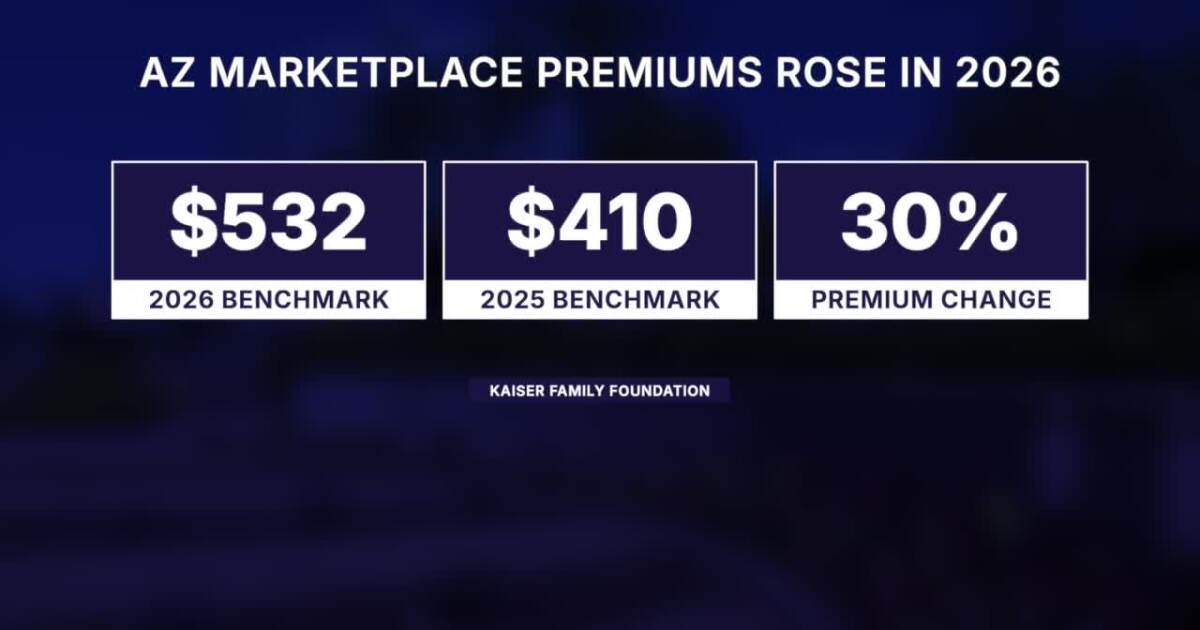
PHOENIX — Arizona’s ACA marketplace enrollment fell from 363,000 to just over 255,000 in a single year — a nearly 30% decline and the third-largest annual drop in the country.
Rising premiums and expired tax credits are driving the trend, with the average benchmark plan premium in Arizona now at $532 — up 30% from 2025.
In the player above, ABC15 Data Analyst Garrett Archer takes a look inside the numbers on how healthcare premiums are impacting health insurance enrollment.
This story was reported on-air by a journalist and has been converted to this platform with the assistance of AI. Our editorial team verifies all reporting on all platforms for fairness and accuracy.
Want more news in your community? Add ABC15 as a preferred source on Google below:

-

 Connecticut3 minutes ago
Marian Katz Obituary
-

 Delaware6 minutes ago
DE health officials ‘on pins and needles’ after measles cases in PA
-

 Florida11 minutes ago
Florida man accused of driving drunk, causing head-on crash and seriously injuring 2
-

 Georgia18 minutes ago
Georgia cops’ alleged misuse of Flock license plate tracking data fuels privacy concerns
-

 Hawaii21 minutes ago
3 candidates to be considered for District 18 seat
-
 Idaho26 minutes ago
“We won’t insure you”: Robie Creek homeowners struggle to get home insurance due to wildfire risks
-

 Illinois33 minutes ago
After recent Illinois lightning strikes, officials share safety tips
-

 Indiana36 minutes ago
Kelsey Mitchell winner completes Fever comeback against Mercury, without Caitlin Clark

