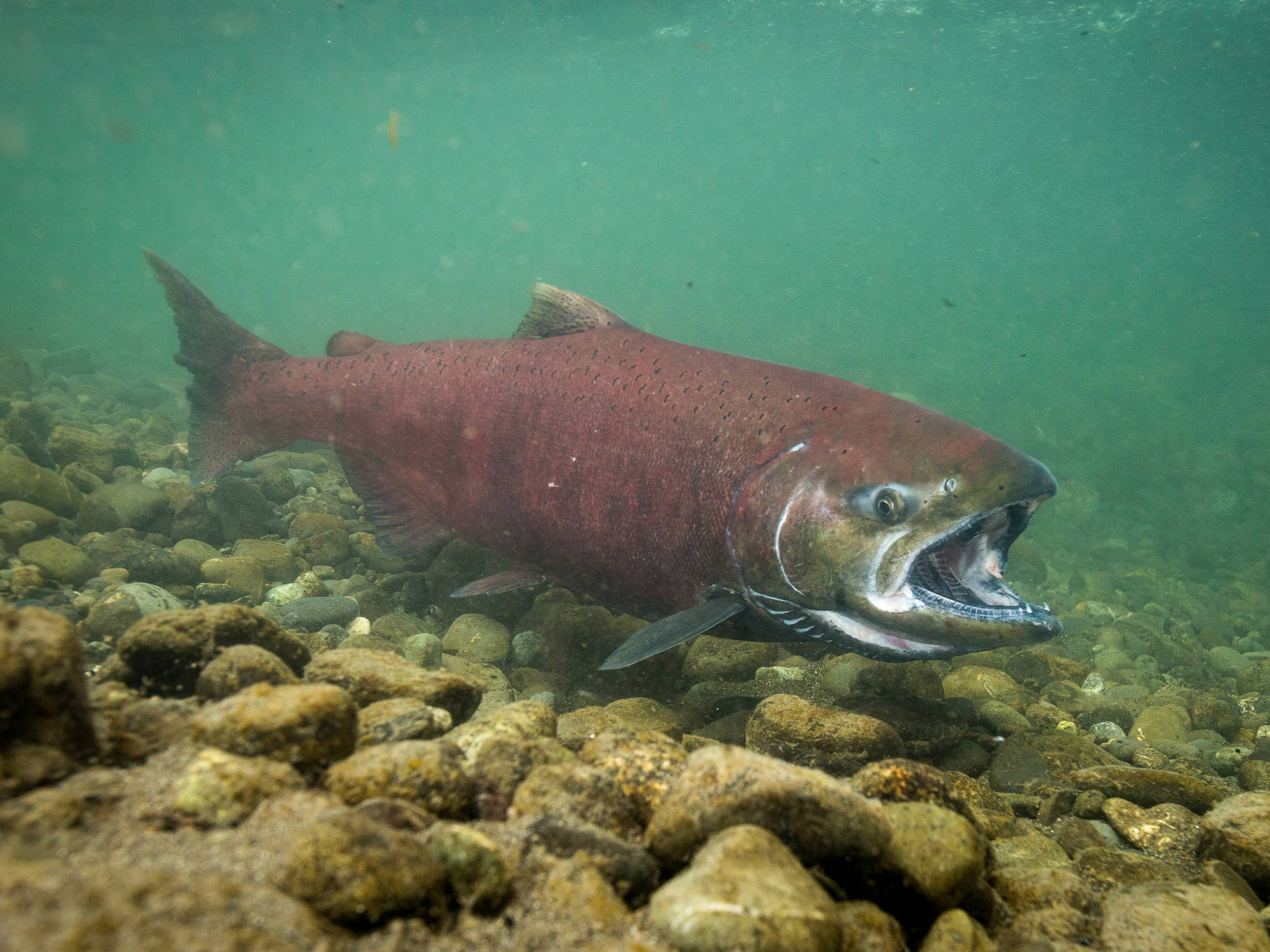
In fresh water, spawning king (Chinook) salmon can change to browns, reds or purples. Also look for a hooked upper jaw, the telltale sign of a male Chinook. Courtesy Peter Westley
“Memorial Day weekend has long marked the traditional – and unofficial – opening of the Southcentral salmon fishing season as this is roughly when the first significant numbers of Chinook begin to return to the Kenai, Anchor and Susitna River systems, among others. Runs build in June, peaking in the Kenai River and upper Susitna drainages in early to mid-July.”
— This excerpt from the Alaska Department of Game & Fish website, published only a decade ago in July 2014, now serves as a bittersweet reminder of much better days for the Alaskan Chinook salmon fisheries.
This month marks the 39th anniversary of Les Anderson’s world record king salmon catch on Alaska’s famed Kenai River. On May 17, 1985, Anderson, an auto dealer from nearby Soldotna, hooked the salmon fishing from his boat, then took to shore to land the 97-pound, 4-ounce Kenai king. Though bigger king salmon have reportedly been caught and released by anglers since then, Anderson’s world record stands. It also stands for a magnificent fishery now gone. These days, the fight for kings is to save them.
“We’ve seen a severe decline in the king salmon stocks in the Kenai and in other Alaskan river systems,” says Shannon Martin, Executive Director of the Kenai River Sportfishing Association (KRSA). “We’ve had complete closures to sportfishing for kings on the Kenai and other rivers. On some rivers, only hatchery-raised king salmon may be harvested. These days, I won’t target kings anywhere,” she said.
Advertisement
Chinook (King) Salmon See Major Declines
Fly fishing the Kenai River is changing dramatically as Chinook numbers decline. Courtesy Berkely Bedell, USFWS
Called kings around the Kenai, the species is commonly called Chinook across its range in the North Pacific. In many locations in Alaska, Chinook’s decline has been so severe in the last 30 years that the wild fishery is in peril. The stocks are diminished by all measures, including the numbers of fish returning to rivers each year, the size of those individual fish, and the seasons to catch them.
“I remember the Kenai,” says Peter Westley, an associate professor in the College of Fisheries and Ocean Sciences at the University of Alaska, Fairbanks. “You could put your head into the mouth of one of those big fish. People are feeling pretty pessimistic, saddened, depressed, longing for the good old days.
“Across the entire North Pacific region, Chinook are not doing well,” he said. “The story is told river by river, but there are big patterns, and Chinook salmon in lots of places are circling the drain.”
Threats to Chinook
The threats to Chinook are multifold, complex, and many decades in the making — degraded habitat, dams, rising sea temperatures, and increasing predation by protected sea mammals. Add to all that fishing pressure and hatchery-raised salmon that compete with native fish. Westley says, “Unless something fundamentally changes with how we interact with them, the future for Chinook is really grim.
“On some level,” he adds, “there are Chinook, but they’re hatchery fish. The habitat is so messed up that there wouldn’t be Chinook without those hatchery fish. The evidence is saying that the hatchery fish diminish the wild fish though. In places like the Kasilof and Ninilchik, you can fish for hatchery Chinook, but the problem is that no one can distinguish what gets caught.”
Advertisement
Westley presents a comprehensive vision of the threats facing Chinook when he says, “The ocean has always been dangerous and risky, but in recent years, it has become even more dangerous for fish. The Chinook’s life-history strategy of growing slowly and being in the ocean most of its life isn’t benefitting the species lately.”
The Future of Alaska Fishing
A chinook salmon swims up Ship Creek to spawn. Courtesy Ryan Hagerty, USFWS
Both Westley and Martin suggest that anglers shift their expectations of Alaskan fishing and realize that the kings need help and that there are plenty of other incredible fish to go for across the state and the region.
“We need to do our part to take the pressure off Chinook salmon,” says Westley. “If they want Chinook, people should go to places where the fishing has as little impact as possible on the wild stocks, places like Ship Creek, where it’s all hatchery fish,” he says. “There are also some healthy fisheries for wild sockeye. That’s a different ball game.”
Martin, from KRSA, said she is seeing a change in mentality in many anglers.
“Anglers are looking for other species, trying to protect that run of kings returning from the ocean. At the same time, our organization advocates for fishery managers to implement paired closings with commercial fisheries to include additional restrictions and protections. This would share the burden of conservation amongst all user groups. What matters is to get eggs in the gravel and that’s what we’re looking for.”
Advertisement
An Uncertain Future
Shannon Martin, with a Yakutat hatchery king salmon, caught in the ocean. Courtesy Shannon Martin
The fight will be long and hard to help protect Chinook, one of the Western World’s totemic sport fish, food fish, and a lynchpin of Alaska’s coastal ecosystem. Only recently, in March, the State of Alaska Board of Fisheries voted to lower the spawning escapement goal for the late-run Kenai River king salmon to support additional commercial fishing opportunities for other salmon, a decision that Martin and the KRSA lamented, painfully. Martin called it a “dark day for conservation in Alaska.” She said, “We’re essentially signing off on the managed decline of a species that has defined our region.”
Anyone who’s ever seen the broad, pink-green back of a Chinook salmon rising in a turquoise-colored, glacial river’s flow, while connected to that fish only by a thin line, knows the fear and the heartache that the fish might just break off and be gone, forever.
JUNEAU, Alaska (KTUU) – The Supreme Court of Alaska will be taking up the case of the State of Alaska, Division of Elections v. Daniel J. Sullivan, Jr.
The oral arguments will be held Monday at 10 a.m. via Zoom, according to an order and opening notice.
The document also specifies that a decision is expected to be made before noon on Tuesday.
According to documents from the Division of Elections, the state must start printing ballots at noon on the same day.
Advertisement
This comes after an Anchorage Superior Court Judge ordered Dan J. Sullivan on to the ballot Friday.
See a spelling or grammar error? Report it to web@ktuu.com
A new home under construction in Potter Valley in Anchorage. (Loren Holmes / ADN)
This June, two very different offers reach Alaska families, and both amount to the same thing: $10,000. The difference is everything.
Bill Walker, running for governor, would hand every eligible Alaskan a one-time $10,000 check and then end the Permanent Fund dividend for good. Ask one question: Where does his $10,000 come from?
It comes from the Permanent Fund, the people’s own money and the savings Alaskans built for their children. Walker would spend that endowment once to pay Alaskans to give up the yearly dividend forever.
Think about what that does. It cancels the annual check that gives a family a reason to keep an Alaska address and replaces it with a single payout. You hand people their own savings, call it a gift and cut the tie that held them here in the same motion. It is the oldest mistake in governing money: raid what you have saved to buy a moment’s applause and call the spending generosity.
Advertisement
A plan that spends the people’s savings to send the people away is not bold. It is foolish.
Now consider the other $10,000. Through Alaska Housing Finance Corp., the state offers families up to $10,000 to build a new, energy-efficient home. AHFC raids nothing. It earns its own way. Over the years, it has returned more than $2 billion to the state treasury, and it spends some of that income the way any good business does: to win a customer.
Here, the customer is an Alaskan who wants to own a home, put down roots and stay.
That is the oldest sound move in business: Invest a little of what you earn to bring in someone who stays. The homeowner remains, the community gains a family and the corporation keeps earning. The money spent comes back. A plan that puts earnings to work to bring people home is not charity. It is clever.
Same amount. Opposite source. Opposite wisdom. One spends savings; the other spends earnings. One pays Alaskans to leave; the other pays them to stay. One empties the state; the other fills it.
Advertisement
This Homeownership Month, the choice is the size of a single check, and the whole question is where the check comes from and what it asks of you. Ten thousand dollars of your own fund, to wave you goodbye. Or $10,000, earned and reinvested, to help you stay and build.
Evan Swensen is the publisher of Publication Consultants in Anchorage and the author of “What’s the Money For: A Permanent Fund Mortgage Proposal.”
• • •
The Anchorage Daily News welcomes a broad range of viewpoints. To submit a piece for consideration, email commentary(at)adn.com. Send submissions shorter than 200 words to letters@adn.com or click here to submit via any web browser. Read our full guidelines for letters and commentaries here.