Politics
Litman: Trump's hush money trial is about to go to the jury. What's the most likely verdict?

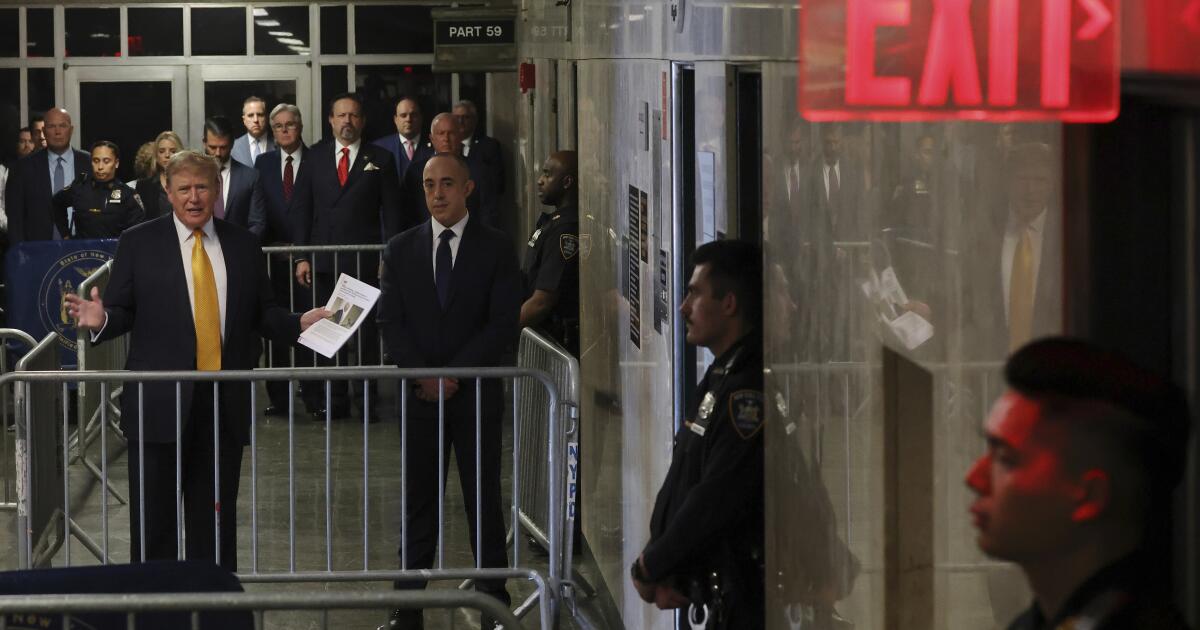
After 20 days, 22 witnesses and intermittent courtroom fireworks, the evidence in Donald Trump’s New York hush money trial is all in. The case will soon be in the hands of the jury.
Who holds the advantage at this critical juncture? My assessment, after attending much of the trial in person, is that it’s the prosecution’s case to lose.
With the standing caveat that it takes only one juror to block a unanimous guilty verdict — and that the law puts the greatest burden on prosecutors — the case as it has come in puts the district attorney’s office in the driver’s seat going into next week’s closing arguments.
The prosecution’s essential achievement was to provide a compelling, credible narrative that points toward only one plausible conclusion: that Trump is guilty as charged.
The defense, by contrast, took a scattershot approach focused on undermining the credibility of any and all of the prosecution’s witnesses, particularly Michael Cohen, Trump’s former attorney and fixer. But what Trump’s lawyers didn’t do is provide a counternarrative, a story compelling enough to leave jurors with a reasonable doubt as to which explanation of the facts is true.
Providing such a competing story isn’t the defense’s legal obligation, of course. The judge will instruct the jurors that if they have any reasonable doubt about the prosecution’s case, they should vote to acquit.
But my experience as a trial lawyer suggests a difference between freestanding doubt about one or more witnesses and a broader doubt about the rationale behind the charges — an alternative plotline that jurors might find believable. That’s the kind of defense being presented on behalf of Sen. Robert Menendez, for example, who is arguing that his wife is the guilty party.
From the first day of testimony, the prosecution has presented a tight, persuasive tale. It begins with an August 2015 meeting involving Trump, Cohen and tabloid executive David Pecker — who explained it to the jury from the stand — in which the parties agreed on a scheme to smother negative stories about Trump.
And sure enough, before the next year’s election, a series of scandal-mongers required neutralizing to insulate Trump from political damage. These episodes are akin to Acts II and III of the script, falling into place along the tracks that the Pecker testimony laid.
Hope Hicks’ testimony was brief but powerful given her longtime loyal service to Trump and her obvious candor notwithstanding her reluctance to harm her former boss, which seemed to cause her to break into tears. She confirmed in dramatic terms that Cohen and Allen Weisselberg, the Trump Organization’s then-chief financial officer, would not have cooked up the scheme to pay off the adult-film actor Stormy Daniels without Trump’s say-so.
The prosecution effectively corroborated in advance most of what would come from its last and most important witness, Cohen. At the same time, the prosecutors encouraged their own witnesses to disparage Cohen, lowering expectations before he took the stand.
When he did, Cohen was low-key, responsive and agreeable. With a few exceptions, he accepted the insults the defense served up, accounting for most of the discrepancies in his story by explaining that he had been telling the truth since he left the Trump fold.
A couple of low points in Cohen’s testimony got a lot of attention, and it’s natural for the media to zero in on dramatic moments. But the jury is more likely to evaluate the evidence in the context of the whole narrative and a witness’ general comportment.
Most important, jurors, like all of us, make overall judgments about credibility, which is the heart and soul of the jury system. Taking the measure of the people before them, they decide whether their accounts are basically trustworthy, notwithstanding the defects of the messengers. And all the stories in this case — not just Cohen’s but those of other flawed witnesses such as Pecker and Daniels — cohere and ring true.
It follows that the impertinence of Robert Costello, a defense witness who muttered in disagreement with Judge Juan M. Merchan’s rulings, probably caught the jury’s attention more than the flaws in Cohen’s largely even presentation — especially once Merchan forcefully rebuked Costello’s buffoonish grandstanding.
The prosecution’s cross-examination of Costello and redirect of both Cohen and Daniels were crisp, clear, textbook demolitions of the defense’s points. Trump’s team was more meandering and given to stray potshots, missing more than they hit.
I think the defense still has one largely overlooked escape hatch: the arcane legal instructions for deciding the felony charges. The charges require the prosecution to prove that Trump caused the alleged falsification of documents to further another crime. Prosecutors have offered up three different candidates for that other crime, each of which has flaws. I could see the jury, which includes two lawyers, considering the legal instructions very carefully and finding that the district attorney came up short. And in any event, the issue is sure to figure in an appeal.
But any appeal feels a millennium away. By the time that transpires, Trump will either be president, giving him extensive options for evading accountability, or a losing candidate facing three other criminal trials. This trial looks increasingly likely to be the only opportunity for a jury to decide for the first time whether a former president is a criminal. Going into the final act, I like the chances that he will be found guilty.
Harry Litman is the host of the “Talking Feds” podcast and the Talking San Diego speaker series. @harrylitman


NEWYou can now listen to Fox News articles!
Colorado Democrats formally censured Gov. Jared Polis on Wednesday after he commuted the prison sentence of former Mesa County Clerk Tina Peters, a prominent election denier convicted in a voting system breach case.
The Colorado Democratic Party State Central Committee voted Wednesday to censure Polis, a fellow Democrat, after he issued a controversial commutation for Peters, who was convicted in connection with a 2021 voting equipment breach case.
“Reducing her sentence now, under pressure from Donald Trump, is not justice,” the party said in a statement. “It sends a message to future bad actors that election tampering has consequences, unless you’re friends with the president.”
“That’s a dangerous and disappointing precedent to set,” the statement added.
COLORADO GOVERNOR COMMUTES TINA PETERS’ SENTENCE AS TRUMP POSTS ‘FREE TINA!’
Mesa County Clerk and Recorder Tina Peters speaks at a rally on the west steps of the Colorado State Capitol in Denver, Colorado, on April 5, 2022. (Hyoung Chang/MediaNews Group/The Denver Post via Getty Images)
The party accused Polis of having “materially harmed” the state party’s credibility and barred him from participating in official Democratic Party-sponsored events moving forward.
It also said the clemency decision “does not reflect the values, institutional positions, or democratic commitments of the Colorado Democratic Party.”
When reached for comment, a spokesperson for Polis defended the governor’s decision in a statement to Fox News Digital.
TRUMP CONTINUES TO PUSH FOR RELEASE OF TINA PETERS AS COLORADO GOVERNOR WEIGHS CLEMENCY
Colorado Gov. Jared Polis speaks to members of the media in the spin room following the first vice presidential debate at the CBS Broadcast Center in New York on Oct. 1, 2024. (Al Drago/Bloomberg via Getty Images)
“The Governor made this decision based on the facts of the case and what he believed was the right thing to do,” the spokesperson said. “Sometimes the right thing isn’t the popular thing with everybody. Democracy is strongest when disagreement is met with debate and dialogue, not censorship.”
The reprimand came after Polis announced clemency for 44 individuals last Friday, including 35 pardons and nine commutations.
Peters was among those granted a commutation, reducing her prison sentence and making her eligible for parole beginning June 1, 2026.
APPEALS JUDGE SEEMS SKEPTICAL OF SENTENCE FOR PRO-TRUMP COLORADO CLERK TINA PETERS
Attorneys for former Colorado election official Tina Peters filed a motion seeking her release from prison and urged the appellate court to recognize a pardon issued by President Donald Trump. The motion argues that Trump’s pardon applies to Peters’ state convictions, a claim disputed by Colorado officials as the court considers its jurisdiction. (Marc Piscotty/Getty Images)
Peters became a nationally known figure among 2020 election skeptics following the Mesa County voting equipment breach controversy and subsequent criminal prosecution.
President Donald Trump quickly weighed in on the commutation, posting on Truth Social: “FREE TINA!”
According to the executive order signed Friday, Peters’ sentence was reduced from eight years and three months to four years and four-and-a-half months.
The order also stated the clemency action “shall not in any way affect the underlying criminal conviction.”
Peters was convicted in 2024 of three counts of attempting to influence a public servant, along with conspiracy to commit criminal impersonation, official misconduct, violation of duty and failure to comply with secretary of state requirements.
In a statement announcing the clemencies, Polis said, “the Clemency power is a serious responsibility, and not one that I take lightly.”
“This power has the ability to change lives — help grant a second chance for someone who has made grave mistakes — and it comes with great consideration, and sometimes even controversy,” he added.
CLICK HERE TO DOWNLOAD THE FOX NEWS APP
The move was immediately condemned by Democrats, including Colorado Secretary of State Jena Griswold, who accused Polis of legitimizing “the election denial movement.”
Fox News Digital’s Jasmine Baehr contributed to this report.
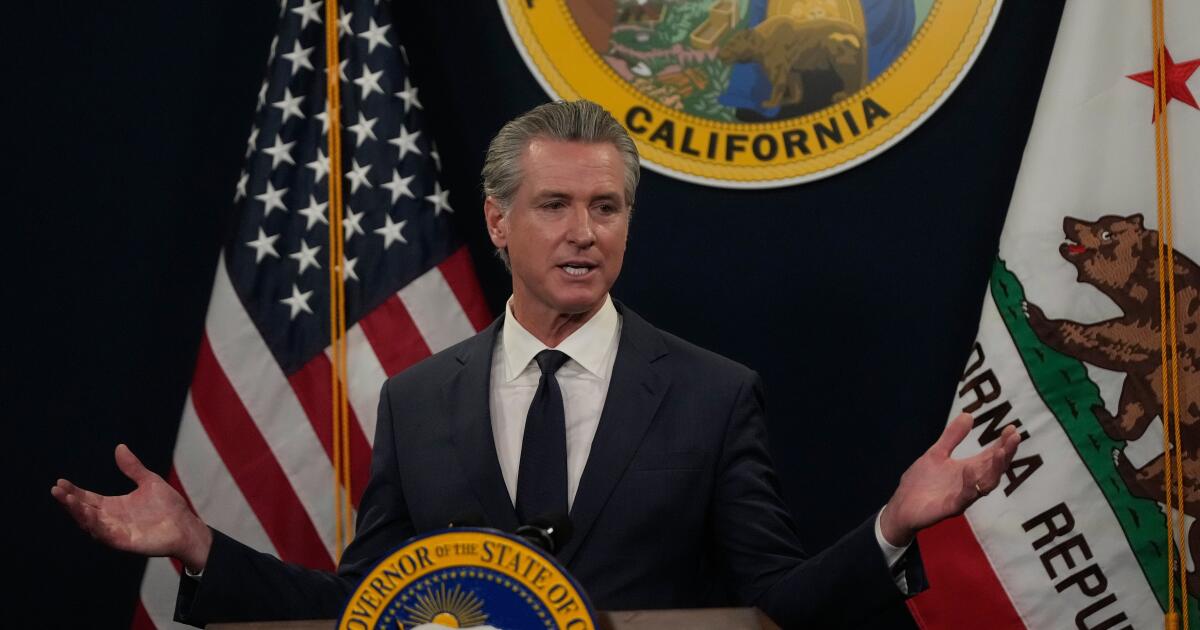
SACRAMENTO — Human rights advocates on Tuesday rallied outside the state Capitol to push back on Gov. Gavin Newsom’s proposed budget plan to reduce state-sponsored healthcare coverage for undocumented immigrants.
“We are here to demand a budget that protects California’s values,” said Kiran Savage-Sangwan, executive director of California Pan-Ethnic Health Network. “We are fighting for a budget that rejects Medi-Cal cuts, seeks new revenues and strengthens our safety net reserve to keep families whole.”
Newsom last week unveiled his revised budget proposal, which would further move away from his previous policy to provide free healthcare coverage to all low-income undocumented immigrants.
His proposal would require monthly premiums for undocumented immigrants receiving coverage from Medi-Cal, the state’s version of the federal Medicaid program. It would also continue to block new adult applications, a cutback imposed last year.
The governor has explained that his original policy was more costly than expected and that difficult decisions must be made as the state could soon face an economic downturn.
Speakers at Tuesday’s rally argued this was unacceptable.
The cuts would force many immigrants to choose between putting food on the table or visiting a doctor, said Savage-Sangwan. She said certain groups, including refugees, older adults and those with disabilities, would be left especially vulnerable.
“These are the kinds of actions we would expect from a federal government that scapegoats immigrants and sends violent ICE forces to terrorize our community,” she said. “Instead, these proposals were made by our own governor in a state that claims to value immigrant communities. We know California is better than this.”
The governor’s office did not respond to a request for comment about the rally.
The event drew about 100 attendees, including Anahi Araiza, a policy researcher with Imperial Valley Equity and Justice. She told The Times that many immigrants in their community struggle to afford medical care and subsequently put off doctor visits.
“They wait until it’s an absolute emergency,” she said. “We’ve heard stories where people delay care and then get diagnosed with Stage 4 cancer.”
The event was supported by several organizations, including California Pan-Ethnic Health Network, Survivors of Torture International, Communities Organized for Relational Power in Action, Health4All Coalition, and Organizing Rooted in Abolition, Liberation and Empowerment.
One man carried a large sign with an image of the Virgin Mary that read “Safety Net For All.” Other marchers donned flowing monarch butterfly wings. The orange-and-black insect became a symbol for the pro-migrant movement years ago because it travels long distances between Mexico and the United States.
Meanwhile, another group gathered outside the Capitol for a news conference to raise awareness about the instability caused by federal healthcare cuts.
Assemblymembers Patrick Ahrens (D-Sunnyvale), Robert Garcia (D-Rancho Cucamonga) and Tina S. McKinnor (D-Hawthorne) joined several doctors and nurses to call for a $500-million state investment into public hospitals.
“Public hospitals are the backbone of our healthcare system,” Ahrens said. “It is estimated that federal cuts will strip over $3 billion a year from the California public hospital system — we cannot balance our budget on the backs of the most vulnerable Californians.”
The Republican-backed “Big Beautiful Bill” signed by President Trump last year shifted federal funding away from safety-net programs and toward tax cuts and immigration enforcement. During a legislative hearing this year, healthcare professionals warned state lawmakers the cuts would harm all patients, including those with private insurance.

new video loaded: How Rubio Is Driving the U.S. Pressure Campaign on Cuba

By Michael Crowley, Nikolay Nikolov, Alexandra Ostasiewicz, Jon Miller and Whitney Shefte
May 20, 2026
-

 Oklahoma5 minutes ago
San Antonio at Oklahoma City, Final Score: Spurs’ late comeback falls short, 122-113
-

 Oregon11 minutes ago
Oregon Homegrown 2026 highlights “Deep Cut” Cascade Hops — New School Beer + Cider
-
 Pennsylvania17 minutes ago
Pennsylvania scrutinizes fraud prevention as feds put Medicaid under the microscope
-

 Rhode Island23 minutes ago
Shark season is here. One just popped up in a Rhode Island pond.
-

 South Dakota35 minutes ago
Blake Ellwein is South Dakota’s Mr. Basketball
-
Tennessee41 minutes ago
TN Lottery Powerball, Lotto America winning numbers for May 20, 2026
-

 Texas47 minutes ago
Storm cleanup continues after Central Texas thunderstorms topple trees, damage roads
-

 Utah53 minutes ago
Utah professor explains legality of settlement granted to Tennessee man jailed for controversial meme

