Entertainment
Academy Museum took heat for ignoring Hollywood's Jewish history. A new exhibition aims to fix that

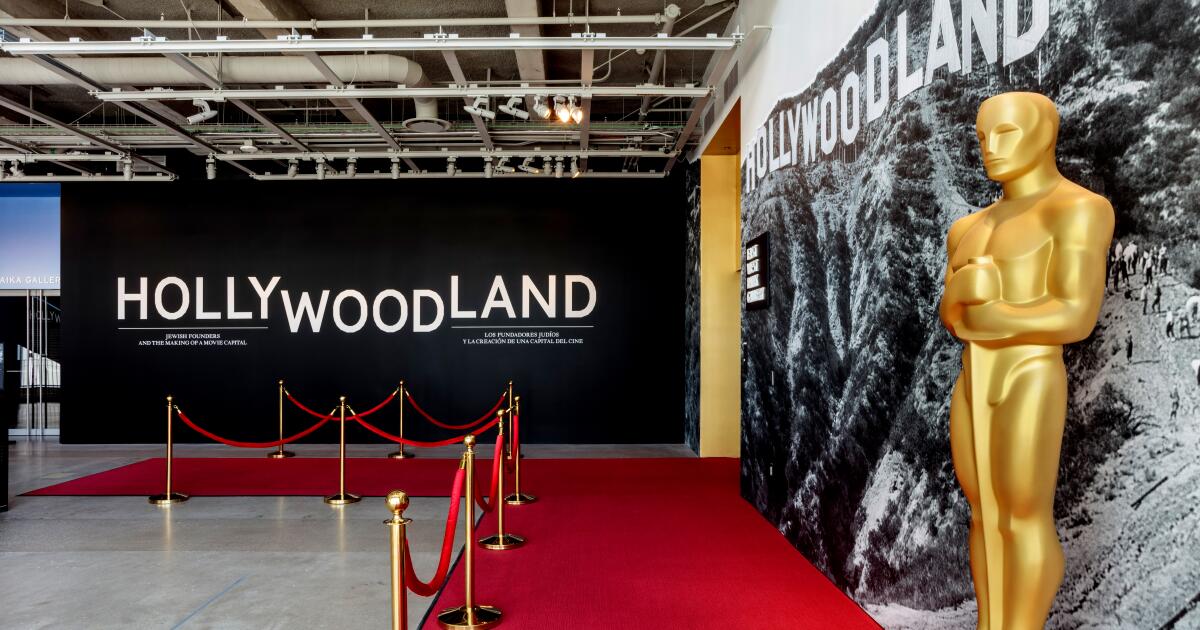
Schmuel Gelbfisz, Lazar Meir and the Wonsal brothers are not names that immediately come to mind when thinking about Hollywood legends, but Samuel Goldwyn, Louis B. Mayer and the Warner brothers are.
These monumental Hollywood figures changed their given Jewish names to ones they thought would be more palatable to Americans in the early 20th century in hopes of increasing their chances of success. While their studios had tremendous accomplishments, creating some of the best films of all time, these men’s birth names are not widely known.
The Academy Museum is aiming to change that.
A new exhibition titled “Hollywoodland: Jewish Founders and the Making of a Movie Capital,” which opens Sunday to the public, explores the stories of the Jewish filmmakers and studio founders who helped cement the Los Angeles area as the world capital of entertainment. It will be the museum’s first permanent exhibition.
“We want people to come away with a richer understanding of how this city is so intertwined with this industry and also a deeper understanding of why this is specifically a Jewish immigrant story,” said Dara Jaffe, an associate curator at the Academy Museum, who spearheaded the exhibition.
The immersive exhibition traces the development of the major Hollywood studios and the golden age of film in the early 20th century through the perspective of Jewish immigrants who were at the heart of the industry’s establishment.
Since it opened in 2021, the Academy Museum has been dogged by criticism for scarcely highlighting or recognizing the predominantly Jewish group of filmmakers who developed the industry. The Eastern European Jewish immigrants who laid the groundwork for Hollywood and their first-generation American Jewish children were not featured in the museum’s ambitious exhibitions that emphasized and celebrated the work of groups often marginalized in Hollywood.
Jaffe said the museum had always planned to include the stories of the Jewish founders in their exhibitions eventually, but also understands the criticism over the lack of representation at the time of the museum’s opening. She said she welcomed feedback while curating the exhibition to ensure it was something the filmmaking and Jewish communities felt accurately represented the history.
“We completely feel it is foundational to who we are as a film museum, representing this industry, and it’s central to who we are as a film museum in Los Angeles,” Jaffe said. “It’s important to us that every visitor who comes can get this story of the founding of Hollywood and the Jewish studio heads.”
The exhibition weaves the stories of a developing Los Angeles and film industry with the lives of the Jewish immigrants and first-generation Jewish Americans who founded and built Hollywood as we know it.
(Joshua White / JWPictures / Academy Museum)
With the exhibition opening amid Jewish American Heritage Month and during a time of rising antisemitism, Jaffe said she wants visitors to leave the exhibition with deeper knowledge of the relationship between Jewish people and filmmaking — and to understand that the history of that relationship is not “fodder for further antisemitism.”
“There have been so many times over the past couple years where I wished this exhibition was already open so we could point to it and say, ‘Please, come learn more,’ ” Jaffe said. “It’s a relief that it finally will be open.”
Author and film critic Neal Gabler, who wrote 1988‘s “An Empire of Their Own: How the Jews Invented Hollywood,” served as an advisor on the exhibition and will speak at its opening night event. In the widely cited book, Gabler wrote that Jews often faced barriers to entry in other industries, and entertainment was a field where they saw an opportunity to develop their own business.
Gabler wrote in his introduction that Jews created “their idealized America on the screen” — with strong families led by valorous fathers, ardent patriotism and resilience — and in doing so, American values became defined by their work.
Two sections of the exhibition’s three distinct parts spotlight these Jewish founders and their respective studios — Universal, Fox (later 20th Century-Fox), Paramount, United Artists and Warner Bros., to name a few — and how they built up the idea of the American Dream.
The “Studio Origins” section features multimedia displays that detail the founding of each of “the majors,” as they were often called, and dives into the stories of their respective founders. It also explores how the studio system operated in the late 1920s through the late ‘40s, when the eight major studios dominated production and often signed long-term contracts with actors and filmmakers.
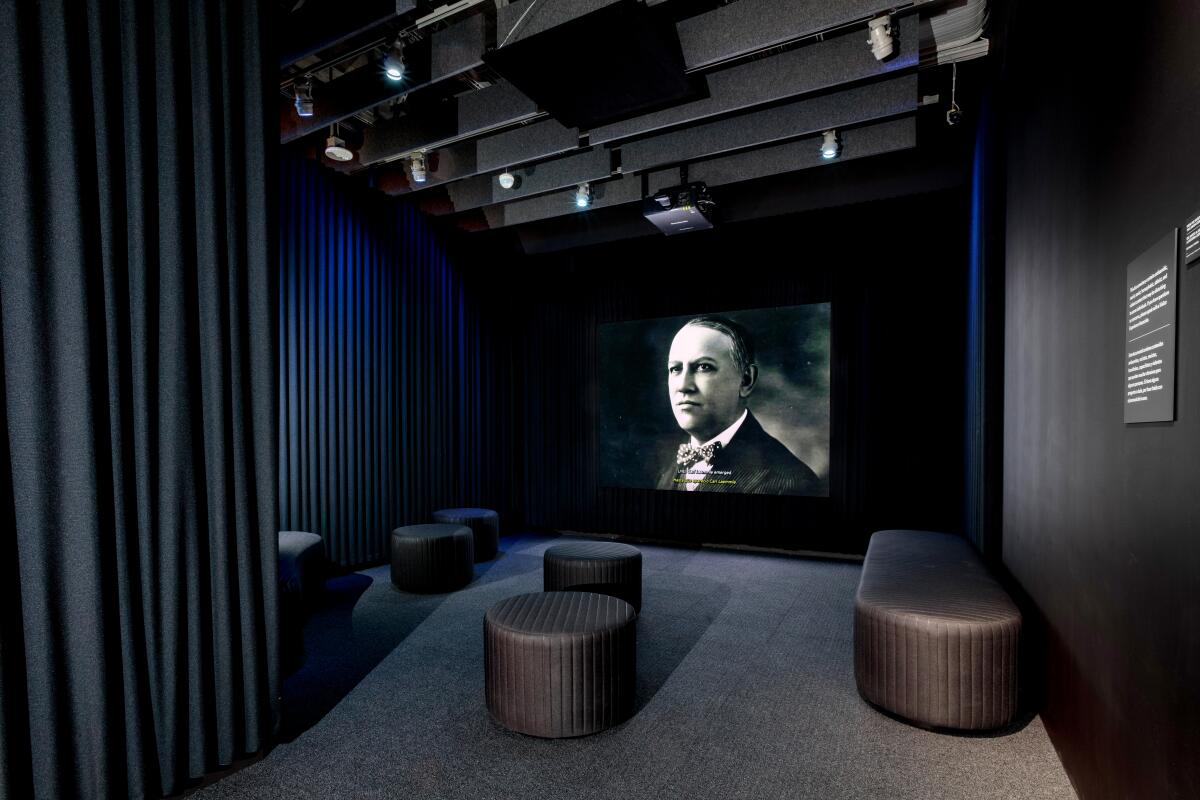
The exhibition includes a short documentary about the studio founders’ lives and their experiences of immigration and antisemitism.
(Joshua White / JWPictures / Academy Museum)
An original short-form documentary titled “From the Shtetl to the Studio: The Jewish Story of Hollywood,” focuses on the founders’ immigration stories and the challenges they faced as they built Hollywood. It details how experiencing antisemitism and oppression affected their careers. Ben Mankiewicz, the host of Turner Classic Movies and the grandson of “Citizen Kane” co-writer Herman J. Mankiewicz, narrates the documentary, which features archival images and video clips.
The exhibition also includes an animated tabletop and projections to illustrate how L.A. evolved alongside the growing film industry. The immersive display maps the city from 1902, when the first dedicated movie theater was built in L.A., through 1929, the year of the first Academy Awards. Jaffe said she wanted to make sure the exhibition “organically balanced” the stories of the founders and the city.
“Hollywood is both a place and an idea. There’s the geographic city of Los Angeles and Hollywood as a mythological symbol,” Jaffe said. “There was filmmaking in Los Angeles before the Jewish founders established the studio system, but it was truly the studio system that transformed Los Angeles into the idea of the mythological symbol of Hollywood.”


Watch Obsession in theaters now (and rewatch on digital later)
Curry Barker is the writer and director of Obsession, which he also edited himself. On board as associate producer is Cooper Tomlinson with Jason Blum as executive producer. Curry Barker and Cooper Tomlinson also have the YouTube channel “That’s a Bad Idea”, which is full of amazing shorts.
Also, they made the amazing horror-comedy movie Milk & Serial, which I highly recommend checking out. You can watch it for free on their YouTube channel.
Admittedly, I cannot even read the title of Obsession without hearing the Army of Lovers song with the same title in my mind. In fact, I am writing this review with that song on repeat (anything else would be madness to me). Oh yeah, one might even say that I am obsessed.
And yes, this movie has already had a similar impact on me, so I cannot wait to watch it again.
In any case, I would highly recommend watching it in the theater as well. The impact of a dark theater with gorgeous sound delivers a solid impact with Obsession. And then, of course, you’ll want to rewatch it when the unrated version comes out on VOD.
Oh yes, “unrated”… a terrifying thought. I can’t wait!
OBSESSION is out only in theaters where it premiered on May 15, 2026. Rumor has it that it will be out on VOD in early June 2026.

Sonny Rollins, a sublime tenor saxophonist and one of the last iconic figures of the golden age of post-World War II jazz, died Monday at his home in Woodstock, N.Y. Diagnosed years ago with pulmonary fibrosis, he was 95. His death was announced on his website.
Rollins survived virtually all of his contemporaries from the 1950s and ’60s, the period in which the fundamental elements of the contemporary jazz that followed for the next half-century were established. Among his peers were musicians such as Charlie Parker, Miles Davis, Thelonious Monk, Dizzy Gillespie, Bud Powell, John Coltrane, Cannonball Adderley and J.J. Johnson.
His long, productive career encompassed more than six decades, in each of which his live performances and recordings continually attested to his preeminence as one of jazz history’s most vital, innovative and influential artists.
“Rollins has an original jazz voice,” critic Zan Stewart wrote in The Times in 1990, “rooted in the bebop mode, but a voice that has evolved over time, incorporating other styles and other forms as they fit that voice.”
His magisterial presence was a constant in his performances, from the time he was in his 20s into his later years. A commanding figure at 6 feet 2, he played with a sound and an articulation to match his visual image. His affection for standard tunes brought startlingly new vitality to such unlikely songs as “The Surrey With the Fringe on Top.” And, on any given night, he didn’t hesitate to expand an improvisation to startling lengths, finding new ideas well beyond the imaginative limits of most jazz players.
“Rollins hates clichés and signature phrases — ‘licks’ — and refuses to play them,” critic Stanley Crouch wrote in the New Yorker in 2005. “Consequently, for him there are no highly polished professional performances. When he’s on, which is seven or eight times out of 10, Rollins — known as ‘the saxophone colossus’ — seems immense, summoning the entire history of jazz, capable of blowing a hole through a wall.”
He was also a master of structure, even during his more extended improvisations. Playing a standard tune, he would frequently develop paraphrases of the melody, taking it through unlikely re-imagining of the harmonies of a song. At times, the piano players in his groups would simply back off during part of Rollins’ solos, loath to risk following the twisting pathways of his improvising.
“The story begins with the melody,” he told Crouch. “You keep the story going by using the melody the way you hear it as something to improvise on. In reality, it should all be connected — the melody, the chords, the rhythm. It should all turn out to be one complete thing.”
Rollins clearly kept to that concept throughout his career, from his earliest recordings in the late ’40s, while he was still in his teens, to his work in his 70s and 80s. His playing style displayed evolving aspects over the years, and he chose a variety of different settings in which to display his improvisational wares. Yet the idea of an improvised solo as a story to tell, and of the melody as the vehicle for that story, was a constant in his music.
‘’I have the hope that a melody, any piece of music, can perform miracles,” Rollins told Lloyd Sachs in 2001 in the Chicago Sun-Times. “Years ago, Coltrane and myself used to feel that, boy, we were going to be able to turn the world around. We believed we could change the way people thought through music. That didn’t happen, but I still have faith in the power of music, in old songs, strong melodies, strong playing.’’
Theodore Walter Rollins was born Sept. 7, 1930, in New York City. His mother, Valborg, who had emigrated from St. Thomas in the Virgin Islands, worked as a domestic; his father, Walter, who had emigrated from St. Croix, was a petty officer in the U.S. Navy. Rollins and his two older siblings were all introduced to music early by their father, who was a clarinetist. His sister, Gloria, played piano; his brother, Valdemar, played the violin.
Rollins’ first instrument, at age 13, was the alto saxophone, followed by the tenor when he was in his mid-teens. By the time he graduated from Benjamin Franklin High School he was already working as a professional musician. He made his initial recordings in 1949 — first with singer Babs Gonzalez, then with pianist Bud Powell and trombonist Johnson. By 1961, he was beginning to perform and record with Davis, Parker and Monk.
Like many other young jazz artists of the period, however, he was deeply affected, not only by the playing, but by the lifestyles of the older beboppers who were his significant influences, many of whom had become addicted to drugs. Although Parker, his primary idol and mentor, urged him to stay clean, Rollins developed a heroin habit that eventually led to his arrest and 10-month imprisonment.
After his release, he was detained for violating the terms of his parole and sent to Federal Medical Center in Lexington, Ky. Emerging after four months, he was diagnosed, according to his record, as clinically “cured.”
Rollins returned to active playing, rapidly establishing himself as one of the important young saxophonists of his generation. After playing with the high-visibility Clifford Brown/Max Roach Quintet, Rollins recorded “Saxophone Colossus” in 1956 — a classic jazz album, and the highlight of a series of breakout recordings he made in the ’50s for the Prestige label. One of the tracks, a brightly melodic calypso theme titled “St. Thomas,” is Rollins’ best known composition, and a standard in the lexicon of jazz tunes.
In the late ’50s his musically exploratory efforts continued via “Tenor Madness,” a recording in which he is paired with Coltrane, showcasing the two principal tenor saxophone stylists of the era. He also recorded three albums — “Way Out West,” “A Night at the Village Vanguard” and “The Freedom Suite” — using the innovative lineup of tenor saxophone, bass and drums, omitting any chord-producing instrument.
Despite his rapid rise to the top of the jazz world, Rollins felt burned out in 1959 and decided to take time off to work on what he felt were the limitations in his music.
Seeking a location where he could practice without bothering the neighbors in his Manhattan apartment, he found a perch on the Williamsburg Bridge. When he returned to public view in 1962, he titled his comeback album “The Bridge,” quickly reestablishing his role as a primary jazz voice. For the balance of the ’60s he continued to explore new areas, with albums touching on the then-prevalent jazz avant-garde, Latin rhythms and one of his most persistent interests: the reexamination of unlikely standards from the Great American Songbook.
Rollins took another sabbatical at the end of the ’60s, when he went to India to study meditation, yoga and Eastern spirituality and philosophy.
On his return, he began to incorporate elements of pop, funk and rock in his music, primarily via his rhythm sections.
His recordings and performances from the ’80s on moved across the gamut of the various personal stylistic expressions he had developed in the ’50s, ’60s and ’70s. But, characteristically, he also frequently continued to stretch the limits of his music. One of the most unusual examples was his fascination with solo saxophone improvisations, notably on the appropriately titled “The Solo Album.”
In 2001, Rollins received a Grammy Award for jazz instrumental album for “This Is What I Do.” In 2006, at 75, he scored a triple win in DownBeat magazine’s readers poll with awards for No. 1 Tenor Saxophonist, Jazzman of the Year and Recording of the Year (for “Without A Song: The 9/11 Concert”). His performance on “Why Was I Born,” one of the tracks on the recording, was also awarded a Grammy for jazz instrumental solo.
Rollins was still searching and discovering while on tour into his 80s.
“I’m still trying to get a little further along the road to perfection, or salvation,” Rollins said in a 2011 Times profile. “I’m not there yet. I’m far enough away from that that I’m still engaged. Playing live is the only way. …
“On the concert stage, everything crystallizes. Performance is where it happens.”
In 2017, Rollins donated his archives to the Schomburg Center for Research in Black Culture in Harlem, where it is available to the public. Rollins’ last public performance was in 2012.
Rollins leaves no immediate survivors. Lucille, his wife of nearly 40 years, died in 2004.

Hello, dear reader! Do you like what you read here at Omnivorous? Do you like reading fun but insightful takes on all things pop culture? Do you like supporting indie writers? If so, then please consider becoming a subscriber and get the newsletter delivered straight to your inbox. There are a number of paid options, but you can also sign up for free! Every little bit helps. Thanks for reading and now, on with the show!
Warning: Full spoilers for the film follow.
I went into Slanted with rather limited expectations. The reviews have been middling, but I was willing to take a chance on it, both because I love body horror and because I love a film that grapples with complex social issues. To some extent, Slanted does do that–its story about a young Chinese-American woman who decides to undergo an experimental surgery that will transform her into a White person forever is one that has a great deal of contemporary relevance–but it ultimately isn’t willing to commit to its own bit. It stumbles in a host of ways, not least because it feels pulled in two different directions: on the one hand, its commentary is about as blunt as a sledgehammer, while on the other it never really goes whole-hog on its body horror conceit. The result is a film that’s both muddled and deeply frustrating.
Written and directed by Amy Wang, the film focuses on Joan Huang (Shirley Hunt), the daughter of Chinese immigrants Sofia and Roger Huang (Vivian Wu and Fang Du). Though she loves her father in particular, Joan carries around a deep shame and loathing of her Chinese identity, one that is exacerbated by her desperate desire to be prom queen. Her shame runs so deep, in fact, that when she’s offered the chance to undergo an experimental surgery to turn White, she jumps at the chance, transforming into Jo Hunt (Mckenna Grace). However, the transformation proves to be a double-edged sword, as it not only alienates her from her parents and her best friend but also has unforeseen physical side effects.
In order for a film like this one to really work–or, to put it slightly differently, for it to have real teeth as a piece of social and cultural commentary–it has to be willing to lean into whatever elements it’s playing with. This is particularly true when you decide to play in the genre of the body horror, which is known for its extremes and for its ability to make an audience squirm. For a while, I had hopes Slanted was going to go this route–there’s a quasi-gnarly moment during her hair transplant where we get a few close-ups of the machine pulling out her hair by the roots–but then the film just sort of limply indulges in some subpar body horror imagery, most of which involves Jo/Joan’s face starting to sag. It all leads to the fateful moment when she’s crowned prom queen, only for her once-beautiful visage to appear sagging and wrinkled, leading to her classmates’ revulsion.
In a braver film, this whole sequence could easily have been as horrifying and tragic as in Carrie, where the title character’s final humiliation leads to her self-immolation and that of most of her high school classmates. Slanted, however, chooses to play it safe. To be quite honest, I was very underwhelmed by the physicality of it all, which just felt sad rather than horrifying. I kept thinking…is this it? This is what all of this has been building to? It’s not that I wanted Joan to suffer, obviously, but when you’ve been told you’re watching a body horror film, you expect more…body horror? As it is, it was almost comedic, which just isn’t the vibe I think you were supposed to get from the film as a whole.
It’s especially frustrating that the most horror-inducing moment ends up being the very last frame, in which Jo, filled with remorse, has torn off parts of her White face, revealing glimmers of the girl she was before. One can easily imagine a film where this would’ve been the climax toward which it was all leading, and I’d go so far as to say this approach would have been genuinely horrifying. In my view, the best and most affecting horror films are those with an element of tragedy to them, and it’s hard to think of something more tragic than a young Asian American woman only recognizing the true consequences of what she’s done once it’s too late. As it is, it feels like more of an afterthought, and rather than engendering the emotions associated with horror it just left me frustrated for what the film might have been.
That said, I do think there’s something compelling, and more than a little terrifying about the film’s central premise, which suggests a distressing number of people of color would take the chance to be White if they could. One of the most genuinely disturbing films in the entire film is when we see an entire crowd of BIPOC folks clamoring to get in to see the doctor and get their own surgery. For his part, R. Keith Harris gives a chilling performance as Dr. Willie Singer, who was an Indian-American doctor who perfected the surgery, espousing the philosophy of “if you can’t beat them, be them.” However, as frightening as all this is, it just doesn’t quite gel with the rest of the film, in particular Joan’s desperate desire to be homecoming queen and the just general awfulness of her White peers, which sometimes become more caricatures than real people.
If there’s one thing that saves this film, it’s the performances of Vivian Wu and Fang Du as Joan’s parents. The scenes between Joan and her mother are particularly wrenching, especially since Sofia genuinely loves her daughter and wants to share important pieces of family lore and tradition with her. The fact that Joan can’t see this until too late is far more horrifying than anything that happens to her body after her transformation.
Is Slanted a bad movie? I wouldn’t go so far as to say that. However, it is undeniably a frustrating one, and I kept finding myself wishing it could’ve gone just a bit further, could’ve gone for the throat. Failing that, it could’ve been a bit subtler in its delivery, especially since its central message is an important one. The way that Whiteness–White identity, White skin, White culture–is constantly framed by our society as something toward which everyone should aspire is a problem, and it causes untold damage to BIPOC everywhere. However, while Slanted clearly aspires to Get Out levels of cultural commentary, it ultimately falls flat, leaving us wondering what might have been.
-

 Washington, D.C6 minutes ago
Tickets now available for new museum underneath Lincoln Memorial – WTOP News
-

 Cleveland, OH12 minutes ago
The Cleveland Cavaliers Are on LeBron Watch Again After ECF Sweep
-

 Austin, TX17 minutes ago
Texas primary runoff: It’s election day
-

 Alabama24 minutes ago
Federal court blocks Alabama from using GOP-drawn congressional map
-

 Alaska30 minutes ago
The Alaska Experiment That Could Reshape How Cruise Lines Navigate Wildlife
-
 Arizona36 minutes ago
Rodeo City Wreckettes prove that moving to music offers all kinds of benefits as you age
-

 Arkansas41 minutes ago
She Faced a Life-Threatening Miscarriage. Under Arkansas’ Abortion Ban, Even Calls to the Governor’s Office Didn’t Help.
-

 California48 minutes ago
California chemical tank crisis updates. What happens next?

