Entertainment
Academy Museum took heat for ignoring Hollywood's Jewish history. A new exhibition aims to fix that

Schmuel Gelbfisz, Lazar Meir and the Wonsal brothers are not names that immediately come to mind when thinking about Hollywood legends, but Samuel Goldwyn, Louis B. Mayer and the Warner brothers are.
These monumental Hollywood figures changed their given Jewish names to ones they thought would be more palatable to Americans in the early 20th century in hopes of increasing their chances of success. While their studios had tremendous accomplishments, creating some of the best films of all time, these men’s birth names are not widely known.
The Academy Museum is aiming to change that.
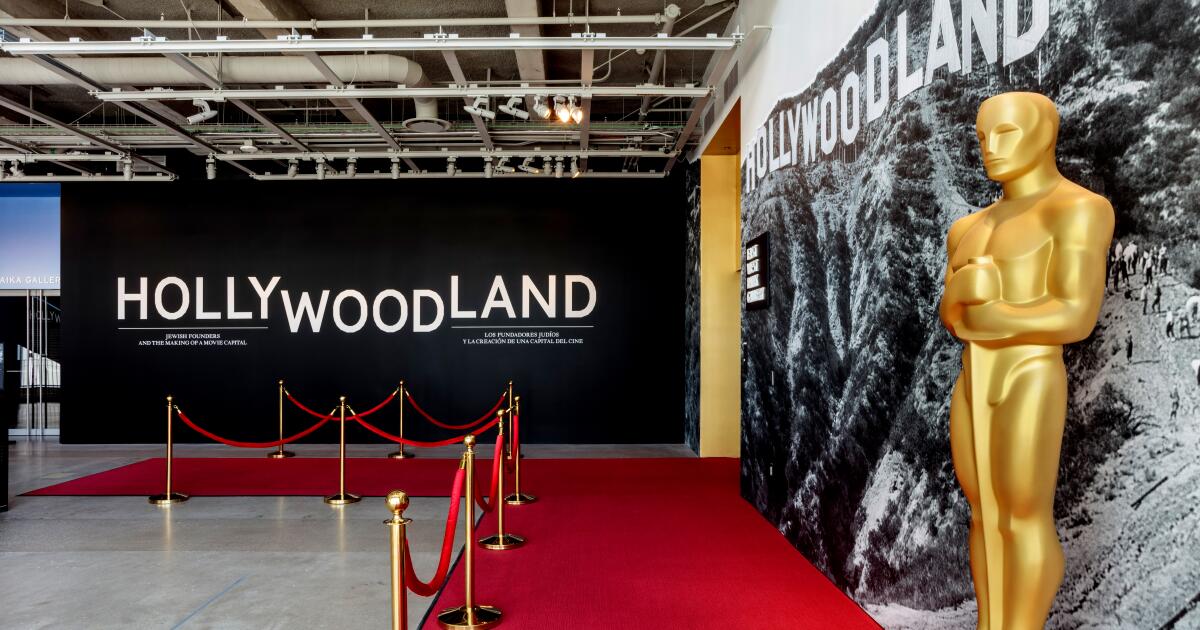
A new exhibition titled “Hollywoodland: Jewish Founders and the Making of a Movie Capital,” which opens Sunday to the public, explores the stories of the Jewish filmmakers and studio founders who helped cement the Los Angeles area as the world capital of entertainment. It will be the museum’s first permanent exhibition.
“We want people to come away with a richer understanding of how this city is so intertwined with this industry and also a deeper understanding of why this is specifically a Jewish immigrant story,” said Dara Jaffe, an associate curator at the Academy Museum, who spearheaded the exhibition.
The immersive exhibition traces the development of the major Hollywood studios and the golden age of film in the early 20th century through the perspective of Jewish immigrants who were at the heart of the industry’s establishment.
Since it opened in 2021, the Academy Museum has been dogged by criticism for scarcely highlighting or recognizing the predominantly Jewish group of filmmakers who developed the industry. The Eastern European Jewish immigrants who laid the groundwork for Hollywood and their first-generation American Jewish children were not featured in the museum’s ambitious exhibitions that emphasized and celebrated the work of groups often marginalized in Hollywood.
Jaffe said the museum had always planned to include the stories of the Jewish founders in their exhibitions eventually, but also understands the criticism over the lack of representation at the time of the museum’s opening. She said she welcomed feedback while curating the exhibition to ensure it was something the filmmaking and Jewish communities felt accurately represented the history.
“We completely feel it is foundational to who we are as a film museum, representing this industry, and it’s central to who we are as a film museum in Los Angeles,” Jaffe said. “It’s important to us that every visitor who comes can get this story of the founding of Hollywood and the Jewish studio heads.”
The exhibition weaves the stories of a developing Los Angeles and film industry with the lives of the Jewish immigrants and first-generation Jewish Americans who founded and built Hollywood as we know it.
(Joshua White / JWPictures / Academy Museum)
With the exhibition opening amid Jewish American Heritage Month and during a time of rising antisemitism, Jaffe said she wants visitors to leave the exhibition with deeper knowledge of the relationship between Jewish people and filmmaking — and to understand that the history of that relationship is not “fodder for further antisemitism.”
“There have been so many times over the past couple years where I wished this exhibition was already open so we could point to it and say, ‘Please, come learn more,’ ” Jaffe said. “It’s a relief that it finally will be open.”
Author and film critic Neal Gabler, who wrote 1988‘s “An Empire of Their Own: How the Jews Invented Hollywood,” served as an advisor on the exhibition and will speak at its opening night event. In the widely cited book, Gabler wrote that Jews often faced barriers to entry in other industries, and entertainment was a field where they saw an opportunity to develop their own business.
Gabler wrote in his introduction that Jews created “their idealized America on the screen” — with strong families led by valorous fathers, ardent patriotism and resilience — and in doing so, American values became defined by their work.
Two sections of the exhibition’s three distinct parts spotlight these Jewish founders and their respective studios — Universal, Fox (later 20th Century-Fox), Paramount, United Artists and Warner Bros., to name a few — and how they built up the idea of the American Dream.
The “Studio Origins” section features multimedia displays that detail the founding of each of “the majors,” as they were often called, and dives into the stories of their respective founders. It also explores how the studio system operated in the late 1920s through the late ‘40s, when the eight major studios dominated production and often signed long-term contracts with actors and filmmakers.
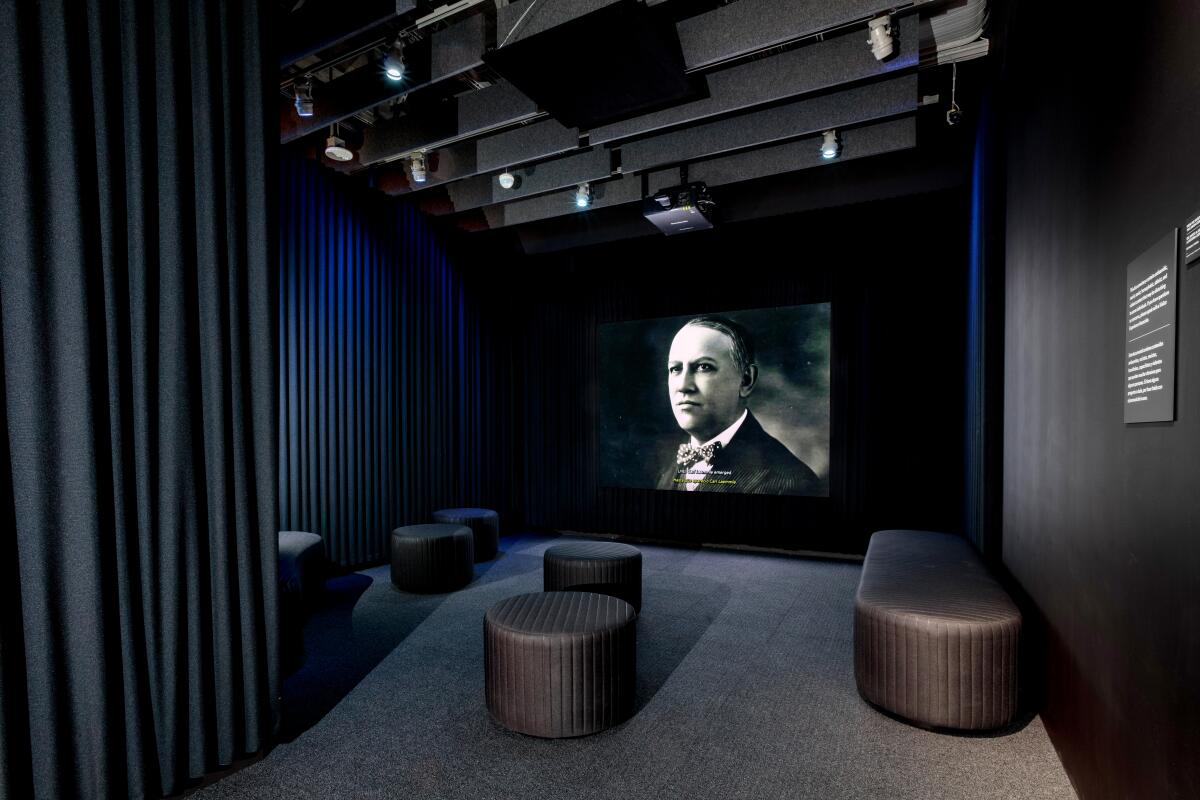
The exhibition includes a short documentary about the studio founders’ lives and their experiences of immigration and antisemitism.
(Joshua White / JWPictures / Academy Museum)
An original short-form documentary titled “From the Shtetl to the Studio: The Jewish Story of Hollywood,” focuses on the founders’ immigration stories and the challenges they faced as they built Hollywood. It details how experiencing antisemitism and oppression affected their careers. Ben Mankiewicz, the host of Turner Classic Movies and the grandson of “Citizen Kane” co-writer Herman J. Mankiewicz, narrates the documentary, which features archival images and video clips.
The exhibition also includes an animated tabletop and projections to illustrate how L.A. evolved alongside the growing film industry. The immersive display maps the city from 1902, when the first dedicated movie theater was built in L.A., through 1929, the year of the first Academy Awards. Jaffe said she wanted to make sure the exhibition “organically balanced” the stories of the founders and the city.
“Hollywood is both a place and an idea. There’s the geographic city of Los Angeles and Hollywood as a mythological symbol,” Jaffe said. “There was filmmaking in Los Angeles before the Jewish founders established the studio system, but it was truly the studio system that transformed Los Angeles into the idea of the mythological symbol of Hollywood.”


While a bit hollow as a character study, painting with broad thematic brushstrokes that often keep its hero at a distance, Young Washington is a compelling historical drama, with a grandiose scope that is rare in Hollywood, and an inspirational story befitting of America at its best.
About the Film
It’s trendy for Hollywood to disparage the United States with films that highlight how the country has fallen short of its lofty ideals (and the beauty of American liberty is that such critical self-reflection is possible). Last year’s One Battle After Another was the darling of the Academy Awards with such a tale. But this Independence Day, and in celebration of 250 years as a nation, audiences can be reminded that (like the men who founded it) America may be imperfect, but the American spirit is a noble and beautiful thing worth fighting for. Young Washington is the origin story, not just of one of those brave Founding Fathers, but of the patriotic spirit and noble values they inspired. While a bit hollow as a character study, painting with broad thematic brushstrokes that often keep its hero at a distance, Young Washington is a compelling historical drama, with a grandiose scope that is rare in Hollywood, and an inspirational story befitting of America at its best.
Director Jon Erwin (House of David, I Can Only Imagine) again proves to be one of the best all-around storytelling talents in Hollywood right now, faith-based or otherwise. Produced and distributed by Angel and Wonder Project, the film is among the most ambitious projects to emerge from the new wave of faith-based entertainment, even if Young Washington isn’t explicitly “faith-based” in a rigid sense. When I interviewed screenwriter Diederik Hoogstraten, he aptly referred to the storytelling approach as “values based.” It may not be a gospel-preaching cinematic tract (and it’s the better for it), but Christians will find plenty to affirm and celebrate here.
If we do count the film among the “faith-based” genre family, then it’s easily a peak achievement. It’s a visually beautiful and well-crafted film. For as good as the modern faith-based genre has become, few movies have warranted a theatrical viewing, being built more on wholesome narrative than visual spectacle. In contrast, seeing Washington gallop on a horse as cannon fire and the pandemonium of battle rages all around him is a full-blown cinematic experience that has rarely been achieved in the genre – other than perhaps Erwin’s own The House of David.
Young Washington is solid from start to finish, but it never fully soars. The film is more interesting than engrossing; good in most areas, but never quite great at any one of them. The clearest comparable, due to the subject matter, is perhaps Mel Gibson’s The Patriot (2000). Historical inaccuracies aside, that film packed a cinematic punch of action, spectacle, and emotional storytelling. Young Washington offers the first two but lacks the third. It’s a story that appeals more to the head than the heart, historically informative, but not making me feel much toward the story.
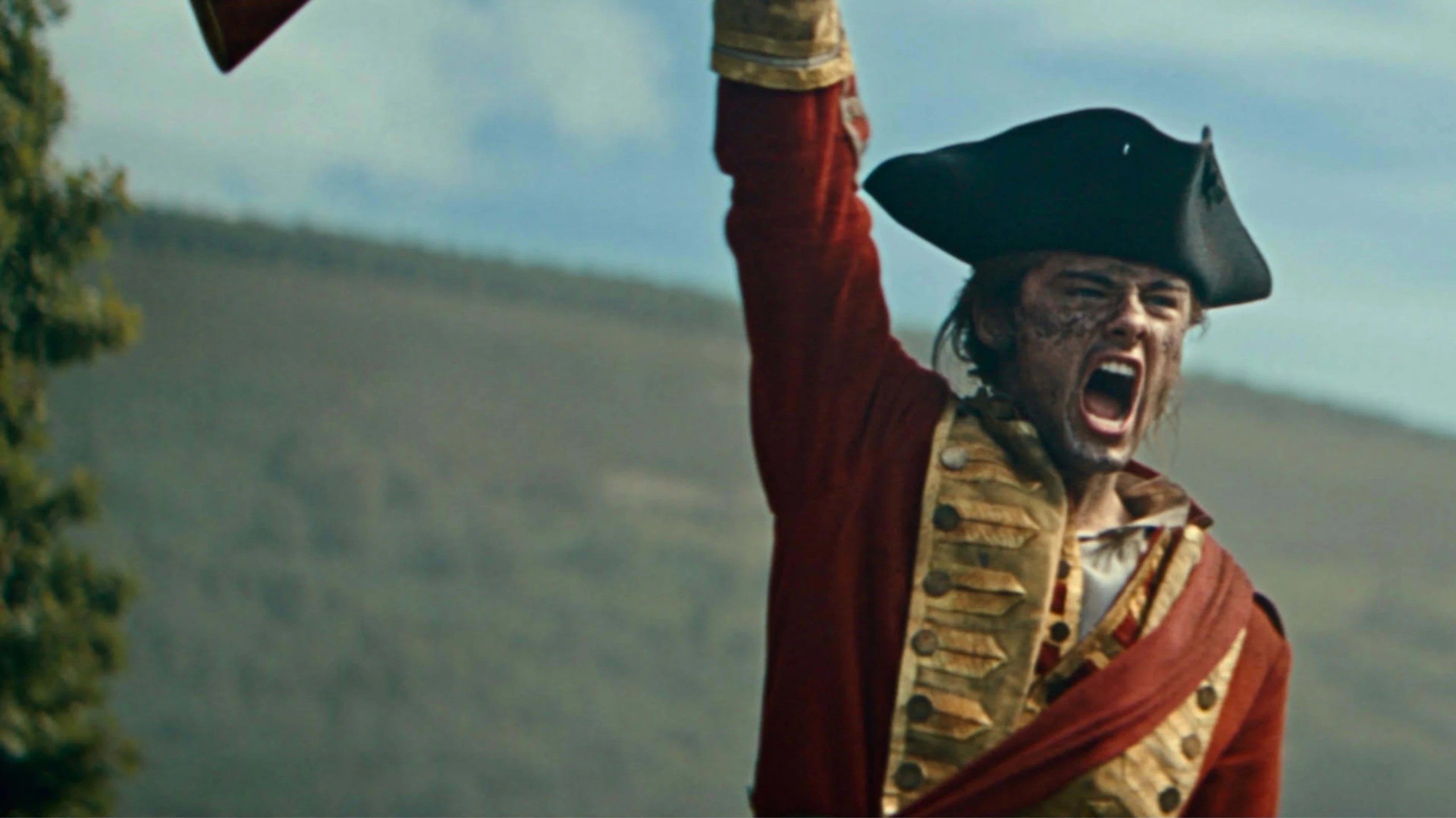
The creative decision to focus the story on a limited, formulative period of Washington’s early life shapes the film in significant ways. Many biopics fall into the trap of dutifully checking boxes, adapting a Wikipedia page more than unfolding a character journey. There’s still some of that with Young Washington, but the limited parameters lend the film a greater sense of focus and an opportunity to breathe. It feels like a story about something more than just putting historical events onto the movie screen.
At the same time, the film also feels like “part one” of a larger story, or a prequel for a film that doesn’t yet exist. The story seems constantly building toward something but then ends on the cusp of reaching it. Perhaps a future sequel is in the cards (although Middle Aged Washington doesn’t have the same ring to it), but the climactic pay off feels lacking. Interestingly, while the movie remains largely historically accurate (as far I can tell), the climactic final battle is more positively framed as a sort of inspirational victory, even when the historical battle was a crushing defeat. It’s perhaps an attempt to manufacture a thrilling third act resolution for a historical figure who was still only in the “first act” of his life. The decision mostly works, and that final battle is the film’s greatest triumph, but the story overall, as told, feels incomplete.

Also notable is that despite the intentionally patriotic release date, and centering on George Washington—arguably the American hero—the “Young” part of the film’s title means that the story pre-dates the revolutionary war. It sees Washington spend the duration of the runtime as a proud officer in the British army. Not quite the patriotic celebration the marketing has promised. Beyond existing knowledge of the historical significance of the protagonist, there is no real “America” at all, beyond a focus on his Virginian regiment, and some hints at the “American Spirit” that would one day define the nation (see themes below).
The fact that it has taken until the end of this review to discuss the character of George Washington himself is also telling. Unfortunately, he is the least interesting part of the film. The fault is not with actor William Franklyn-Miller, who does an admirable job. The problem is with the characterization. Washington has understandable motivations and inner conflict, but they are approached more from the perspective of an outside observer, rather than getting into his own headspace (we are told about struggles but rarely feel his turmoil). The film doesn’t probe deep enough into the root causes of these struggles, or the causes of his insecurity and drive for greatness. I left the film having learned about the events his early life, but without a better understanding of him as a man.
In the end, Young Washington boasts enough entertainment and quality filmmaking to please audiences. It’s a high floor, low ceiling type of film. There are no moments where the film fails to deliver consistent quality, but it just never seems able to achieve anything more. It’s good, but not great, which is something rarely said of George Washington himself. Still, I enjoyed it, and in retrospect, its legacy may be more for how it paved the way for the genre to enter a brighter future. Come to think of it, that sounds befitting of George Washington after all.
On the Surface
For Consideration
On the Surface—(Profanity, Sexual content, violence, etc.).
Language: There are three minor profanities (“d—” x2, “b—ard” x1).
Violence: There is plenty of wartime action, including men shot with rifles and cannon fire, although the action remains relatively bloodless. The most extreme violence comes when a man is hacked with an axe, although it is more implied than depicted on screen.
Sexuality: None.
Beneath The Surface
Engage The Film
The Makings of a Leader
George Washington was a larger-than-life person. By the end of the film, he is depicted as a near mythic figure (although, the scenes are adapted from details provided by several Pulitzer Prize winning biographies, so sometimes real life really is a Hollywood story). But one of the film’s central ambitions, and one emphasized in my interview with the screenwriter, is to humanize that mythical figure.

Early in the film, he is not necessarily even very likeable at times. He is stubborn, and his deep insecurities manifest as the appearance of pride and arrogance. His poor choices and refusal to heed wise counsel, such as the defeat at Fort Necessity, lead to serious consequences. Many biopics are hagiographical (such as the recent Michael), but Young Washington demonstrates the biblical truth that all men have sinned and fallen short of God’s standard (Romans 3:23). It answers the age-old question by suggesting that great leaders are not born great, they must become great.
In an early scene, George and his mother argue about their unfavorable circumstances. George’s mother wishes for her deceased husband back, but says, “Providence denied me this.” George responds, “Then providence is cruel!” His mother eventually counters, “God raises what is well grounded.” That exchange represents the heart of the film. We cannot control our circumstances, but we can shape our character (and allow God to shape it) to respond to them. As one character says, “Failure is the tutor sent by God.” Washington lacks the status and social advantages of others, and at first, he attempts to take it into his own hands to rise to prominence. Ultimately, after great failure, he learns that it is through humility and service that he can be used to do great deeds (Matthew 20:16). Interestingly, at the end of the film, even the pagan Indian tribes recognize God’s anointing on Washington’s life.

Entertainment
’47 Ronin’ director Carl Erik Rinsch sentenced to 30 months in prison for Netflix fraud case

Carl Erik Rinsch, the director of the 2013 Keanu Reeves action film “47 Ronin,” will serve more than two years in federal prison for defrauding Netflix of $11 million.
U.S. District Judge Jed S. Rakoff on Monday sentenced 48-year-old Rinsch to 30 months in prison, the U.S. Attorney’s Office, Southern District of New York, announced. Federal prosecutors convicted Rinsch in December of wire fraud, money laundering and other counts. A legal representative for Rinsch did not immediately respond to a request for comment on Tuesday.
Federal prosecutors indicted Rinsch in March 2025, alleging the $11 million went into Rinsch’s personal accounts. The filmmaker “quickly transferred” the money from the Rinsch Co. account, where it had been deposited March 6, 2020, by Netflix, through additional accounts until about $10.5 million wound up weeks later in a personal brokerage account. He lost more than half of that money in less than two months via risky investments in the stock market, the indictment said.
Though Rinsch told the streamer that his sci-fi show “White Horse” was progressing nicely, the filmmaker allegedly moved the remaining money into cryptocurrency and profited from crypto speculation over the next couple of years. The streamer had invested around $44 million in the show. Rinsch was accused of spending around $10 million on five Rolls-Royces, a Ferrari, watches, clothing, luxury bedding and linens, credit card bills, attorneys to sue Netflix for more money, and lawyers to work on his divorce.
He was arrested in West Hollywood and released the same day after agreeing to post a $100,000 bond to guarantee his appearance in a New York federal court.
Rinsch never finished the Netflix show.
During his sentencing, Rinsch and his legal team told the court his behavior was a result of mental health struggles and medication problems and they are working to address those issues with a new care provider, the Associated Press reported.
“I failed to recognize the danger of the state I was in,” Rinsch said, though his mental issues were not described in court, and his attorneys declined to provide further detail.
Ahead of the sentencing, Reeves — the star of Rinsch’s most notable project to date — penned a letter in May requesting “leniency and mercy as well as justice” in the filmmaker’s sentencing.
In addition to prison time, Rinsch must serve three years of supervised release, forfeit the $11 million and pay $700 in mandatory special assessments, according to Monday’s announcement. U.S. Attorney Jay Clayton said in the announcement: “Today’s sentence sends a deterrent message: fraud will not be tolerated.”
The Associated Press and former Times assistant editor Christie D’Zurilla contributed to this report.

Minions & Monsters, 2026.
Directed by Pierre Coffin and Patrick Delage.
Featuring the voice talents of Pierre Coffin, Trey Parker, Allison Janney, Christoph Waltz, Jeff Bridges, Jesse Eisenberg, Zoey Deutch, Bobby Moynihan, Phil LaMarr, and George Lucas.
SYNOPSIS:
Follows the Minions in 1920s Hollywood as they search for frightening creatures for their monster movie, partner with a green creature, and must save the planet after unleashing monsters.

Minions & Monsters comes with a genius creative choice to reinvigorate a tired schtick. The slapstick antics of the mischievous Minions have always felt partially inspired by comedic stuntwork from the likes of Buster Keaton (at one point, a house comes down over a Minion, paying homage) and Charlie Chaplin, so it’s seamless for director Pierre Coffin (who continues to voice all of them) to place them in the Golden Age of Hollywood. Yes, these movies are critic-proof and will crack one billion dollars regardless, and a case could be made that the filmmakers could have made bank once again going down an artistically bankrupt path, so it is refreshingly welcome that he (directing alongside Patrick Delage and crafting the screenplay with Brian Lynch) chooses to insert these yellow goofballs into a Hollywood love letter that doubles as an avenue for children and anyone else to develop an interest in the era.
Generally, when nostalgia-pandering is discussed or Easter Eggs flood a cinematic experience, it’s about placating fans and giving them what they want out of corporate obligation to put a film in the best position to succeed financially. Minions & Monsters is an animated feature that begins by rewinding the Universal Pictures logo all the way back to when it was The Trans-Atlantic Film Company, with an opening scene that uses The Horse in Motion, the earliest example of photography resembling a motion picture. From there, it’s an adventure involving Minions and Hollywood, giddy to reference anything it possibly can, from classic monsters to Humphrey Bogart to Westerns to Citizen Kane to a plot point that feels ripped out of the recent more cynical and vulgar Babylon, with the red-hot popular Minions struggling and failing to adjust to the transition from silent-era flicks to talkies.

There is a narrative here (more so than in the first two installments, which is a huge part of why this film works in addition to its sincerity) in that a present-day Hollywood museum tour guide (voiced by Allison Janney) educating kids about E.T. the Extra-Terrestrial, The Matrix, George Lucas (voicing himself while locked inside a glass casing), and more, eventually comes across a pair of Minions named James and Henry with quite the sweet friendship and story worth telling. Its initial stages aren’t too far off from what we already know about Minions in that they have always existed looking for evildoers to serve, this time coming across a cyclops, a wizard, a mummy, a viking, and others that they inadvertently kill through slapstick means.
The chaotic up-and-down history leads them to Hollywood, disrupting the shooting of an intense train robbery scene, which sends its director Max (voiced by Christoph Waltz) into a neurotic panic until studio executives, the Bright Brothers (voiced by Jeff Bridges), express that they find these yellow demons utterly hilarious and captivating to watch as they wreak havoc. As previously established, good things don’t last forever, and the Minions find themselves shoved aside in a new movie-making landscape, but not before a montage celebrating numerous genres across silent-era films and leaving James and Henry with a dream to make “the best movie ever”, Minions y Monsters.

This is where the film slightly loses its way, transitioning into a more familiar animated feature/Minions story, as they bust out the sorcerer’s spellbook they found ages ago to summon Cthulhu as their monstrous antagonist. Instead, they conjure up a tiny blob named Goomi (Trey Parker, voicing a different character in the franchise this time while sounding like an amalgamation of about five different South Park characters with plenty of Cartman coming through) who can’t be what they need for the movie but can help find other suitable monsters, all while joined by sidekicks Philips and Howard (voiced by Bobby Moynihan and Phil LaMarr).
While James and Henry (who are joined by Ed as their cinematographer) try to make this dream happen, the other minions search for another villain to serve, stumbling across robot Dort (Jesse Eisenberg voicing a character riffing on Gort from The Day the Earth Stood Still), who turns out to suck at being evil even though he desperately wants to break bad. Rather amusingly, he befriends a suffragette (voiced by Zoey Deutch) in a completely bizarre, random subplot that mostly works because of how out-of-left-field it is. Nevertheless, it’s mostly filler material until the Minions meet their match in the climactic showdown that, unfortunately, has more in common with modern blockbusters than the classical Hollywood it’s trying to imitate, even if the enormous blob they’re up against looks icky, with gross animation details that deserve applause.

Setting that aside, it is noteworthy that even if there are still plenty of jokes with the Minions here that don’t land, it is also funnier when they are interacting with not only recognizable scenes, genres, and movies, but also what shouldn’t be forgotten. There is also a joyous friendship at the center holding it together, whereas I couldn’t tell you a damn thing about the Minions from previous movies other than that one of them was named Bob. Minions & Monsters is still more of the same, while also a testament and celebration of the beauty and magic of making and watching movies, with earnest love for the era that shines through. For the first time, the brain isn’t turning to mush watching one of these.
Flickering Myth Rating – Film: ★ ★ ★ / Movie: ★ ★ ★
Robert Kojder
https://www.youtube.com/watch?v=embed/playlist
-

 Wyoming5 minutes ago
Free Crow Culture Program at Fort Phil Kearny
-

 Crypto8 minutes ago
UK investors sue Binance in London for £150 million
-

 Finance13 minutes ago
What the Supreme Court’s campaign finance ruling means for the 2026 election
-

 Fitness20 minutes ago
I pushed myself too hard at the gym – and ended up in the hospital
-

 Movie Reviews28 minutes ago
Young Washington (Christian Movie Review) – The Collision
-

 World38 minutes ago
Neon Closing in on Luca Guadagnino’s Sam Altman Open AI Movie ‘Artificial’ After Amazon Drops Controversial Film
-
 Lifestyle1 hour ago
‘Dead but Dreaming of Electric Sheep’ is full of beautifully written grotesqueries
-

 Technology1 hour ago
Google’s NotebookLM can sum up your research in a TikTok-style clip

