Utah
Lakebed dust is a worry in Utah. In California, it’s already a problem

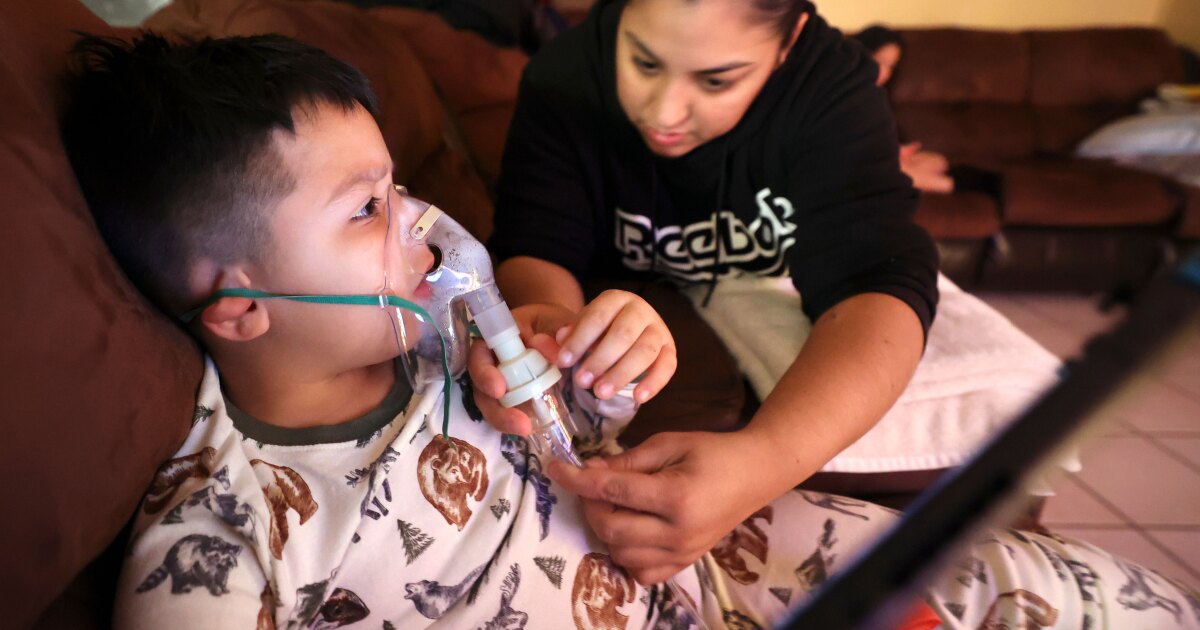
Sitting on the couch next to his mom inside their mobile home in Mecca, California, 5-year-old Ruben Mandujano lets out a gurgled cough while playing on a tablet. The phlegm stuck in his throat is noticeable. But the constant cough is something he’s used to.
His mother, Rosa Mandujano said he came down with some kind of illness about “eight out of the 12 months of the year” when he was younger. Now, after various surgeries, an asthma diagnosis, medications and a nebulizer, Mandujano estimates her son is sick “five months out of the 12.”
The family has grown accustomed to the frequent infections. Both of their children suffer from asthma. A cupboard in their kitchen is dedicated to dozens of over-the-counter and prescription drugs.
Mandujano said her son’s problems get worse when the air quality is awful – another common issue for Coachella and Imperial Valley residents. Mecca, where the Mandujano family lives, is enveloped by agricultural fields and a short distance from the north shore of the declining Salton Sea, a saline lake facing similar turmoil as Utah’s Great Salt Lake.
Dust storms have become the norm being so close to agricultural fields and the Salton Sea, she said. Winds reaching 75 miles per hour whip through predominantly low-income and immigrant communities. The dust gets so bad, Mandujano said, that “you can’t see what’s in front of you.”
Kristin Murphy
/
Deseret News
With the exposed Salton Sea lakebed and the loose dirt and pesticides from the surrounding fields, Mandujano said it’s rare to find a Coachella Valley resident who doesn’t suffer from allergies or asthma. But the impact of the bad air quality and dust storms is worse for some, like Ruben.
“His asthma and his allergies combine, it’s a ticking bomb for him,” Mandujano said. “He says that everything hurts. His ears hurt, his eyes hurt, his nose hurts. He doesn’t even want to get touched.”
When the phlegm won’t leave his throat, Ruben has to use a nebulizer, which circulates well-known asthma medications like Albuterol or Pulmicort through a mask. Mandujano said she hooks her son up to the nebulizer about 121 times a year.
“He hates it because it makes him throw up because it gathers all of the phlegm,” Mandujano said. “He knows he’s going to start throwing up. So he just says, ‘Mommy, I don’t like this,’ and keeps trying to take it off.”
While Rosa Mandujano fights to keep her family healthy, California state leaders, scientists and community advocates are trying to identify solutions to clean up the air, especially as it pertains to the dust accumulated from the Salton Sea. Like Great Salt Lake, there are toxins in the sediment of the exposed lake bed.

Kristin Murphy
/
Deseret News
Scattered near the roughly 27,000 acres of exposed Salton Sea playa are lines of hay bales.
Charlie Diamond, a researcher with the Salton Sea Task Force at the University of California Riverside, said it’s a “dust suppression project” aimed to “break up the flow of air right at the ground level.” The goal, Diamond said, is for the hay bales to “suppress the dust production or emission.”
During high wind events, Diamond said toxins and other sediments like gypsum and salt get “blown around in the surrounding communities, [and] causes a lot of problems with respiratory health, especially in young folks.”
Usually, Diamond said, the hay bales are planted with native vegetation, which the shoreline severely lacks. That acts as another dust suppressant. But “these projects are really contingent on some external source of freshwater,” Diamond added, and that’s the crux of the issue – in the arid climate, there isn’t enough fresh water making its way to the Salton Sea to begin with.
With an exorbitant amount of dried lakebed, it’s unlikely hay bales will prevent all the dust from pummeling community members.
“That’s not a solution, it’s a band-aid,” Diamond said.
Local officials are working on other remedies. The Imperial Irrigation District, which oversees the hay bale projects, is also planting and germinating natural vegetation near the shoreline. Environmental specialist Ross Wilson said the district is using groundwater to hydrate the plants.

Kristin Murphy
/
Deseret News
Wilson said there isn’t a way to “necessarily make less dust,” the hope is the natural vegetation “catches the dust” like the hay bales and results in better air quality.
The agency also uses a Portable In-Situ Wind ERosion Lab, also known as a PI-SWERL, to figure out what exactly is in the dust. The device, which resembles an industrial floor polisher, replicates wind speeds and collects air quality measurements. Wilson added it also tracks which areas produce the most emissions.
“No one has the money to just mitigate the entire sea. So if we can dial down which areas actually are emissive and which areas are the problem, then we can really nail down our resources to those specific areas,” he said.
If more water isn’t funneled into the Salton Sea, the Imperial Irrigation District predicts upward of 70,000 acres of bare lakebed within the next 10 years.
Utah’s Great Salt Lake is up against the same fate as the Salton Sea when it comes to dust.

Kristin Murphy
/
Deseret News
Great Salt Lake Commissioner Brian Steed noted in the state’s first Great Salt Lake Strategic Plan that the lake’s low water levels are increasing dust emissions. He added the accumulation from the estimated 800 square miles of the exposed lake bed poses a public health risk and is causing snow to melt approximately 17 days sooner than normal.
Steed told KUER’s RadioWest that he believes dust from Great Salt Lake is “going to be the hardest one [problem] to solve.”
“When you have an exposed lake bed that weathers over time, which has happened over years, you see additional dust days and problems with PM 2.5 and PM 10,” he said. “And we know that we’ve had a problem [with air quality] along the Wasatch Front especially.”
The Utah Office of Legislative Auditor General highlighted in the Great Salt Lake Strategic Plan that it would cost a minimum of $1.5 billion to keep the lake’s dust at bay, along with $15 million each year for ongoing maintenance.
Steed recognizes the price tag associated with dust mitigation. In an ideal world, “the lowest cost alternative” is lifting Great Salt Lake’s water levels so the crust “keeps that dust in place.”

Kristin Murphy
/
Deseret News
Utah is just beginning to grapple with its looming dust problem, but for Rosa Mandujano in California, the dust is enough to make her contemplate if it’s worth staying in her hometown. Her two kids love to be outdoors, but the air quality often triggers adverse reactions, especially for Ruben, forcing them to remain inside.
“I’ve talked to my husband and said if we get a good job opportunity and we would have to move out of the state, I mean, let’s go,” Mandujano said. “I know it’s scary because my family’s here. All his family’s here, but I’ve seen friends done it. It’s nothing out of the world. You have to start somewhere.”
KSLTV5’s Alex Cabrero contributed to this report
Copyright 2024 KUER 90.1


SALT LAKE CITY — The Environmental Protection Agency awarded Utah and Salt Lake County a total of $3.5 million in grants to assess potentially polluted properties for eventual cleanup and redevelopment.
The agency announced a $2 million grant to Utah’s Department of Environmental Quality and $1.5 million to Salt Lake County to conduct environmental assessments and inventory brownfield sites for cleanup. Brownfields are sites that may be difficult to redevelop or expand because of “the presence or potential presence of a hazardous substance, pollutant or contaminant,” according to the agency.
“These brownfields grants will help Utah communities clean up contaminated sites and unlock opportunities for redevelopment and investment,” EPA Regional Administrator Cyrus Western said in a news release announcing the grants earlier this week. “By transforming underused properties into community assets, EPA is helping create healthier neighborhoods and stronger local economies.”
The two grants awarded to Utah and Salt Lake County are among more than $248 million awarded to nearly 200 communities nationwide for brownfield assessment and cleanup. Utah’s Department of Environmental Quality plans to focus the resources on several areas in Ogden, Heber City and Fillmore, among others, according to Bill Rees, who leads Utah’s brownfield cleanup program.
“What we do is work to secure the funding and then begin to reach out to our communities across the state, say, ‘Listen, there’s opportunity to do some assessment work in your community if you’re interested,’ and then work with our rural partners, work with our urban partners to see if there are sites that will fit that bill,” he told KSL.
The state has received similar grants in the past, and Rees said the money can help local governments determine what to do with ailing properties such as old schools, hospitals or private property that have gone to waste.
“Is there asbestos in it, or is there hazardous material in it? Or could there be something that’s impacting the soil or the groundwater, and a policymaker needs to make a decision?” asked Rees. “Knowledge allows you to make good decisions.”
The $1.5 million awarded to Salt Lake County is the largest brownfields assessment grant the county has ever received, according to a county press release.
“This grant is a real win for our communities,” said Mayor Jenny Wilson. “This funding will let us do vital environmental work on a larger scale and in more neighborhoods. It reflects exactly the kind of partnership between local and federal government that gets results for residents.”
The county grant funds will be used to help create cleanup plans in three areas, including a vehicle storage yard in Salt Lake City’s Ballpark Neighborhood, a 4.26-acre vacant lot in Millcreek and a small commercial building in Magna that was damaged during an earthquake in March 2020, according to the EPA.
Contributing: Don Brinkherhoff
The Key Takeaways for this article were generated with the assistance of large language models and reviewed by our editorial team. The article, itself, is solely human-written.

The National Weather Service in Salt Lake City issued red flag warning Friday morning as emergency workers continued to battle one of the state’s largest wildfires in its history.
The red flag warning, issued when critical fire warnings are occurring or imminent, was to be in place through midnight Saturday.
“This is the FIRST Particularly Dangerous Situation Red Flag Warning issued in NWS Salt Lake City history. This is an exceptionally rare event,” the federal agency said in its warning.
A map of the area under the warning covered much of central and southwest Utah, with an area of the southwest, central and southern mountains also outlined as “particularly dangerous red flag.”

The particularly dangerous area includes the Cottonwood Fire, near the town of Beaver, which started Monday and had grown to covering almost nearly 71,000 acres by Thursday, 15 News reported. The fire forced evacuations.
The NWS warned that gusty winds and dry conditions would lead to rapid fire growth.
Utah also was dealing with the Iron Fire, which started June 19, and nearly destroyed the town of Eureka. The fire was about 27% contained Friday morning.
The fire danger led Utah Gov. Spencer Cox to issue executive order restricting fireworks statewide during the July 4 holiday, which marks the nation’s 250th birthday this year. The ban is in effect through July 5.
“Nothing about this decision was easy,” Cox said in a statement issued by his office Thursday.
“This is unlike anything we’ve seen in recent memory. We’re seeing fires spread farther and faster under conditions that defy historical expectations” Jamie Barnes, Utah state forester and director of the Utah Division of Forestry, Fire and State Lands, added in the statement.
Cox allowed cities and local communities to set aside areas where fireworks could be safely used. The city of Provo announced it would enforce a citywide prohibition on fireworks and would not designate a safe area for fireworks.
“This year is different,” Provo Mayor Marsha Judkins said in a statement. “The wildfire danger facing our community is real, and protecting lives, homes, and our natural spaces must come first.”

SALT LAKE CITY (KUTV) — Earlier this month, 2News Investigates brought you a former inmate’s federal lawsuit alleging Utah Department of Corrections leaders failed to address reports of alleged sexual assault by correctional officers. Now, 2News Investigates examines another key claim in that lawsuit.
MORE: Federal lawsuit alleges Utah prison leaders covered up guards’ sexual assaults on inmates
The lawsuit alleges a mass cross-gender strip-search operation – women being viewed by men was intended to further silence female inmates.
Federal law generally prohibits cross-gender strip searches of female inmates except during emergencies or when conducted by medical personnel. UDC says that during body-search procedures, male correctional officers are not allowed in the immediate area and inmate privacy is maintained. Former inmates say that couldn’t be further from the truth.
Three former inmates agreed to speak with 2News Investigates but asked that their identities not be revealed.
“It was very traumatic.”
According to the lawsuit, on May 13, 2025, UDC carried out a large-scale operation known as a “reset” in women’s housing units at the Utah State Correctional Facility (USCF) in Salt Lake City.
Wendy: “They call it a reset. What do you call it?”
“A violation.”
“It’s like a rape.”
The lawsuit alleges UDC Deputy Warden Derick Zorn and Warden Sharon D’Amico directed the operation, along with more than a dozen members of the Critical Incident Response Team, or CIRT.
According to the plaintiffs, officers stormed dormitories, shouted profanities, and issued conflicting commands.
The women say and the lawsuit states they were ordered to pack their belongings into totes and change into state-issued uniforms in front of male CIRT officers. They were then marched to the Emerald Building for processing.
“It felt almost like we were at a concentration camp.”
The lawsuit alleges the women were required to undergo body scans and then strip completely naked. Plaintiffs claim they were ordered to lift their breasts, spread their buttocks, and cough while visible to male staff.
Women who were menstruating allegedly were instructed to remove menstrual products in full view of others.
“Just use one hand to remove it. Hold it up in front of you.”
“I felt really small and worthless.”
The lawsuit alleges some women were forced to hold soiled menstrual pads while performing physical maneuvers.
“I just did what I was told. I just wanted to get it over with.”
The plaintiffs also claim they were required to sit on toilets or squat to provide urine samples while completely naked and visible to male officers.
“It was humiliating. It was degrading.”
The lawsuit further alleges cell doors were left open, exposing naked women to other inmates and male staff.
An overhead observation booth with reflective glass overlooked the strip-search area. Plaintiffs say they observed movement inside and believed they were being watched from above.
The lawsuit alleges the female inmates were being watched from above during a mass strip search on May 13, 2025
“I could see in the overhead, the two-way mirror. There were multiple men walking around up there who had direct vision inside those cells.”
The lawsuit alleges Captain Jared Beers and Lieutenant Matthew Coombs were inside the booth and that Deputy Warden Derick Zorn observed women in various states of undress.
“I made eye contact with Officer Arroyo, and I also saw Deputy Zorn.”
“I knew if I could see the male officers, they could see me.”
One former inmate described the experience as state-sanctioned sexual violence.
“When that happens, and you’ve gone through the same kind of thing as a child, it’s very traumatic.”
The lawsuit alleges Warden D’Amico knew male officers were viewing naked female inmates and “ratified, condoned, and failed to stop it.”
An allegation in the lawsuit filed on May 15, 2026
“You’re pretty much a hostage.”
UDC Executive Director Jared Garcia declined repeated requests for an on-camera interview. A letter sent said:
“During the body search process in female living areas, male correctional officers are not allowed in the immediate area, and privacy is maintained. In general, resets are conducted routinely, according to UDC policy and under strict protocols designed to ensure safety while also preserving the privacy and dignity of incarcerated individuals.”
“The manner matters.”
Walter Mason represents the plaintiffs.
He told 2News Investigates, “The law protects inmates from being exposed to members of the opposite sex viewing their naked bodies unless there’s an emergency. Unless there’s what the law calls an exigent circumstance, the prison can take necessary actions to protect safety. There was no emergency. There was no exigency.”
UDC says the reset involved approximately 150 trained staff members and was conducted according to department policy.
UDC’s letter goes on to say:
“Every effort was made to treat belongings with care and document confiscated items appropriately. UDC stands by our methods and policies, which are intended to maintain the highest standards of integrity, safety, and efficiency during the reset process.”
Written response from the Utah Department of Corrections regarding 2News investigations
I asked UDC whether any exigent circumstances existed on May 13, 2025, during the reset operation.
The response:
“No exigent circumstances occurred on May 13, 2025.”
I also requested information about what items were confiscated. UDC said it could not provide a specific list.
Response to questions posed by 2News Investigates to UDC regarding mass strip search and if exigent circumstances existed that day
The lawsuit seeks a jury trial and accuses the defendants, all supervisors, of participating in a “coordinated effort to humiliate, mock, and psychologically degrade the plaintiffs … operating with a brazen and intentional disregard for clearly established law, fueled by an institutional custom of impunity.”
_____
-

 North Dakota2 minutes ago
Burglars steal from Grand Forks business, cancer fundraiser
-

 Ohio9 minutes ago
20-year-old Emerson homers in Ohio homecoming
-

 Oklahoma11 minutes ago
523 animals rescued in SE Oklahoma City meth bust, animal welfare overwhelmed
-

 Oregon16 minutes ago
The Cost of the Crackdown: How Trump’s immigration enforcement affects Oregon
-

 Pennsylvania24 minutes ago
Federal government sues Pennsylvania, others over SNAP data
-

 Rhode Island26 minutes ago
Target 12: State of RI’s fire hoses
-

 South-Carolina31 minutes ago
Mississippi State baseball lands Will Craddock, South Carolina transfer infielder
-

 South Dakota39 minutes ago
South Dakota Republicans reject censuring John Thune over stalled SAVE America Act

