Lifestyle
Las Vegas' new must-see show plays with animation, dance and what it means to be human

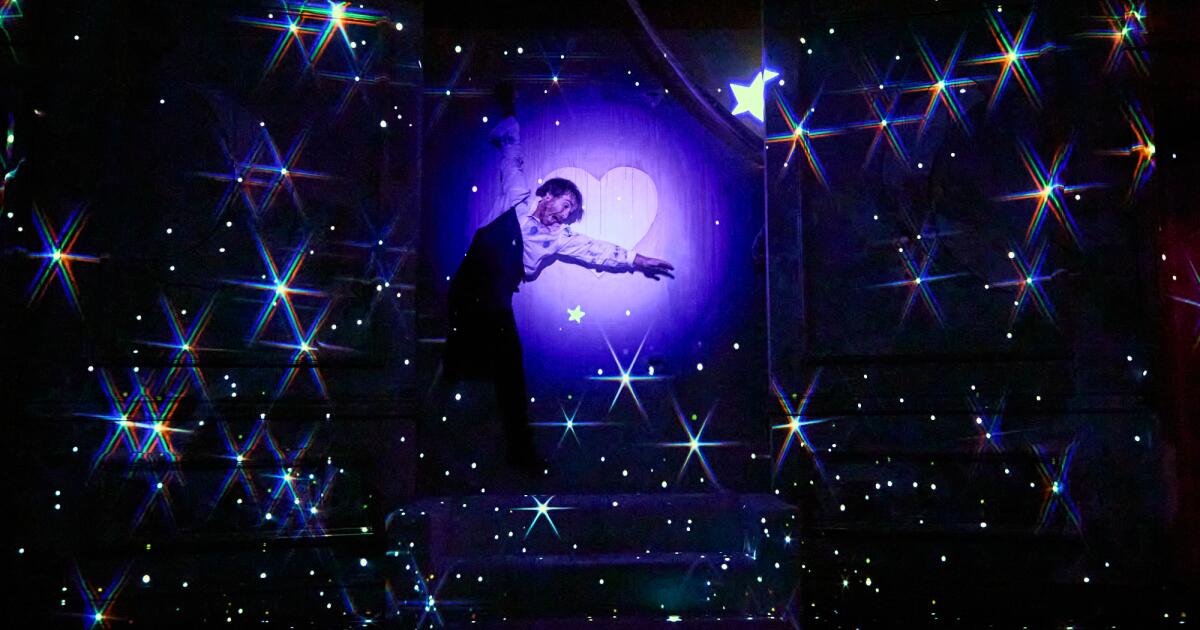
There are multiple dance duets in “Particle Ink: House of Shattered Prisms,” a mixed-media theatrical production that debuted last month on the Las Vegas Strip. They are highly acrobatic and borderline risqué — this is Vegas, after all — and they are also feats of wonder, for the dance partner is not another human but an animated character.
Particle is his name, and he’s a glowing white figure with a circular head and a rectangular body, a mix of simple shapes that can convey an array of human emotions via elastic, exaggerated movements. Animation, rooted in imagination, has long had the power to amplify human feelings and heighten reality. But in “Particle Ink,” animation enters our reality, as Particle, for instance, leaps from wall to pillow, dashes across a bed curtain and even cries into a physical bucket.
“I wish I was 3-D,” Particle scrawls at one point on the wall, but the show makes us believe that he is vaulting among us. Look into a mirror, and Particle sits and walks atop our heads, becoming essentially a virtual animated pet. At one point, a dancer contorts herself as she carries Particle, tucked in a birdcage, across a room. Actors appear to hold Particle’s hand, and Particle even does battle with metaphorical demons, his projected body bounding across a room and swirling in and out of a toilet bowl.
Animation, with “Particle Ink,” has entered its live-theater era. It’s doing so via an exploration-focused production, meaning guests wander from room to room following actors as the acts unfold — or, in the case of “Particle Ink,” guests may be trailing animated figures or a puppet.
Think of it, then, as a sort of next-generation “Sleep No More,” New York’s long-running immersive production that is set to close this year. Only here, the theme is an original fairy tale rather than “Macbeth,” one where animation and augmented reality tools are used to explore our inner world, bringing it to life on walls, floors and furnishings with whimsical, highly active drawings that appear born of light.
Created by an enigmatic three-person creative team known as the LightPoets, a group with roots in Las Vegas, “Particle Ink” dates to 2017, when a proof-of-concept installation was shown at the Sundance Film Festival. It caught the attention of entertainment industry vets Jennifer Tuft and Cassandra Rosenthal, who, with their mixed-reality company Kaleidoco, have been working to bring “Particle Ink” to life. The show had a brief run in 2022 in downtown Las Vegas, but pre-pandemic it was planned for New York, where Kaleidoco once had a 10-year lease on a five-story Manhattan building targeted for the show.
The character of Lilith (Dani Maloney) shares a dance with animated Particle on a bed in “Particle Ink: House of Shattered Prisms,” a new immersive show in Las Vegas.
(Particle Ink)
“We went big,” Tuft says, noting the group was about six weeks from loading when the COVID-19 lockdown began and altered the “Particle Ink” plans. Most of the initial costs proved to be recoupable or able to be redirected to a different space. “Particle Ink” now is committed to the Luxor Hotel & Casino for at least four years, residing in what used to be the hotel’s wedding chapel.
The inward-looking fantasy is set in multiple black-box rooms with minimalist furnishings — a communal, ritualistic hub, a library, a bathroom, a bedroom and a mini forest among them. The dancing is rigorous, with performers often seeming to be wrestling with themselves as they do battle with sometimes hidden (and sometimes not) existential demons. Fast-moving digital artwork comes alive on walls, much of it drawn via a wand, by a nameless artist, portrayed by Elenah Claudin, who serves as the show’s protagonist.
His rainbow-colored creations spring from a chest, and in one moment he turns a couch into a piano and in another sketches out a mystical horse and appears to gallop through his invented world. The images split the difference between something childlike and fanciful street art. Strategic use of projections among the sets allows the animation to appear tangible.
This merging of tech and animation into a believable landscape — what the LightPoets refer to as the “2.5 dimension” — is the triumph of “Particle Ink.” But it’s not the show’s heart. This is ultimately a story about loss, and searching to regain one’s footing after extreme grief. A black-lighted scribble on the wall in the show’s lobby spells it out: “Some of us are dead,” alluding to characters in the show that may live on only as memories or creative visions.
“It’s about everything from childhood wonderment to grief and loss, to really accepting yourself,” Tuft says. “It’s about striking a balance about reaching within and understanding oneself. These are concepts that don’t necessarily lend themselves to what people generally consider ‘Las Vegas entertainment.’”
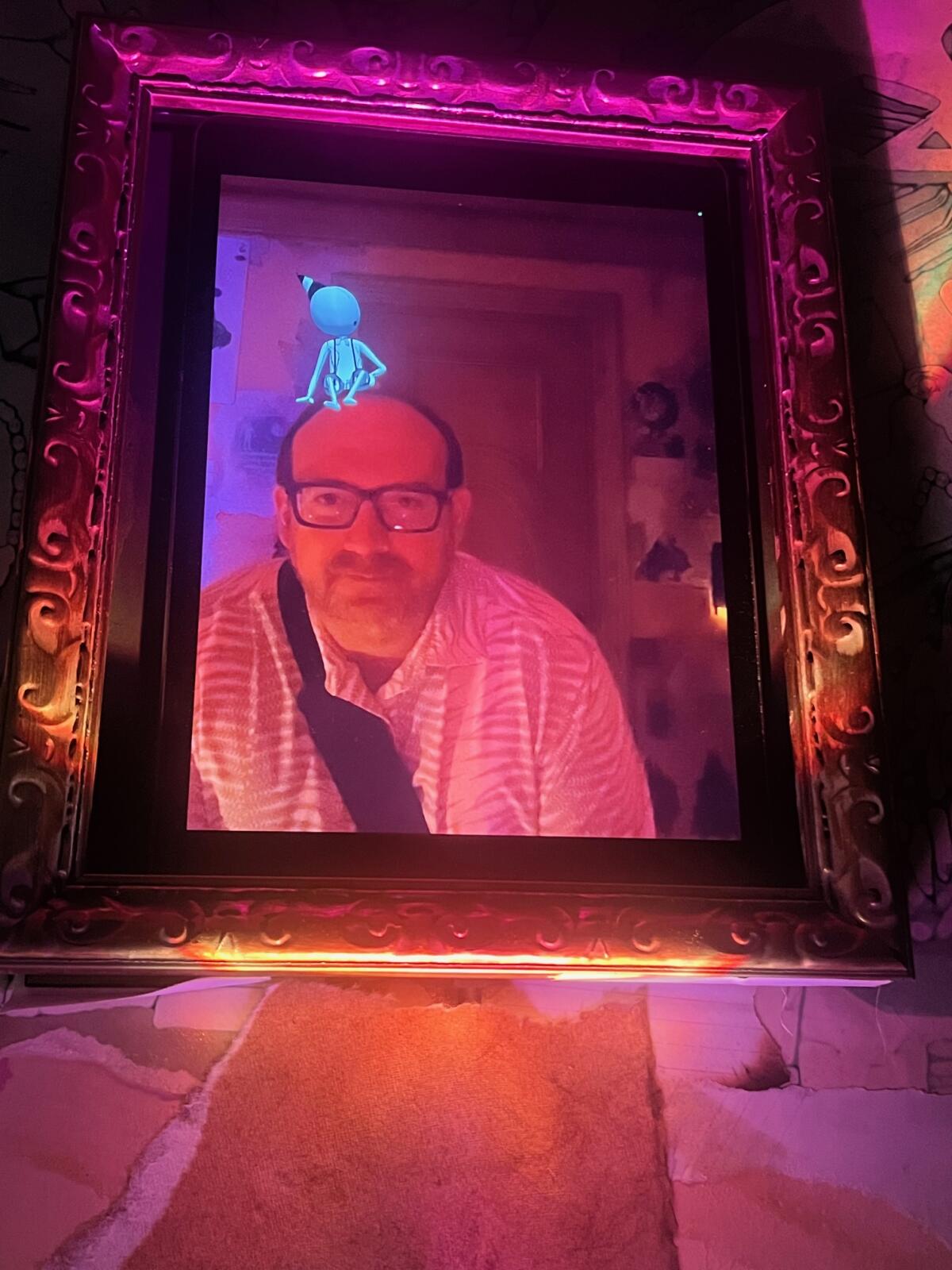
Times Game Critic Todd Martens interacts with the animated character of Particle in the new Las Vegas immersive show “Particle Ink: House of Shattered Prisms.”
(Todd Martens / Los Angeles Times)
And yet here it is, complete with nods to mysticism, as well as tarot and oracle art. “Particle Ink” ultimately strives to tell a personal narrative about the journey to regain one’s creativity, relying primarily on movement and animation to do so. There is little dialogue outside a wandering puppet, a sort of wise man who can exist between worlds (or fill in narrative gaps for those who choose to focus on one of the show’s touchscreen-like walls and handful of augmented reality devices that further the adventures of Particle and his pals).
“Particle Ink” is a story of heartbreak. It follows the artist, his partner, Lilith (Dani Maloney), and the world he conjures. It pulls from age-old tales of light and dark, and how our minds are factories of fascination but also places of imprisonment. It also wants to remix the theatrical experience, as it not only heavily relies on technology but also takes influences from the world of gaming. A projection of a sword being drawn emerges on a wall, and then it becomes a prop for a battle scene. Its narrative too is quest-based, a journey for Particle to recover pieces of his creator’s shattered heart.
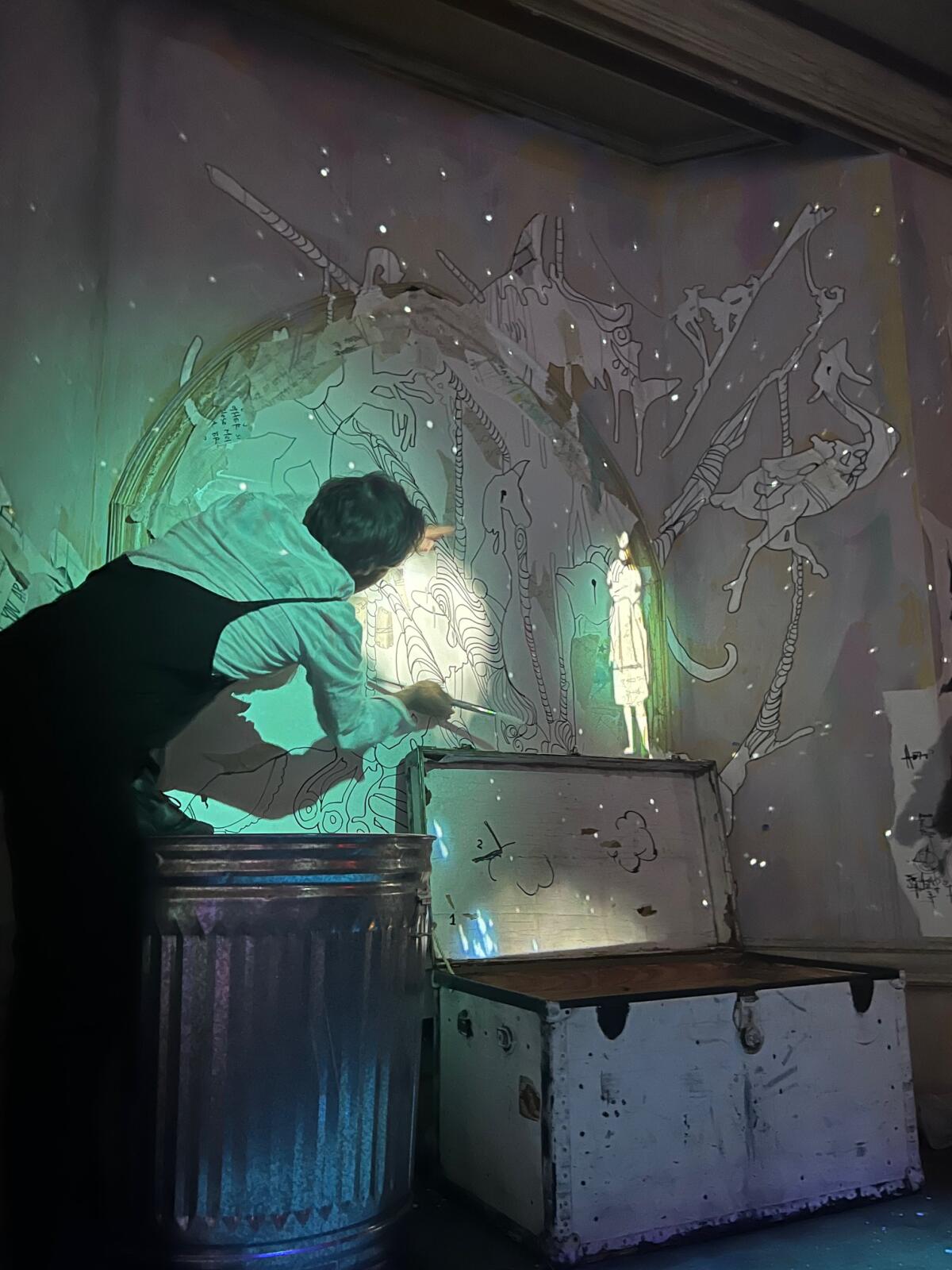
Animation comes alive via light and projections in “Particle Ink: House of Shattered Prisms,” a show that explores how an artist (Elenah Claudin) harnesses the power of creativity in overcoming grief and heartbreak.
(Todd Martens / Los Angeles Times)
Jo Cattell, a Chicago-based theater director and one third of the LightPoets, sometimes even intermingles the word “player” and “audience member,” noting that immersive theater only works if attendees quickly understand the rule-set of the creative work. While there’s no real onboarding in “Particle Ink,” the first scene builds to a communal ritual centered around light-gathering stones, one that allows our distressed artist to briefly tap into his creativity only to quickly lose it again. Particle, then, prods the audience on a journey of recovering his splintered heart.
I saw “Particle Ink” twice, the first night focusing heavily on interacting with the animation. Throughout the theatrical space are tablets that are reconfigured to look and feel like magic mirrors, further glimpses into the so-called 2.5 dimension. The second night, however, I decided to zero in on the narrative, and found both charm and anguish in the way Particle strives to heal his creator’s broken heart — Particle’s tiny size, playful nature and purposefully hand-drawn feel created a sense of fragility. Grief can be a stubborn place, but I felt moved in the way “Particle Ink” used creative tools — painting, creating and animation — to show how what we lose continues to live with us.
Thinking about the future of theater, Cattell wonders about today’s younger generations weaned on smartphones and games. While she says this isn’t a LightPoets thesis, she’s eager to experiment with ways to make theater a more active experience. The tradeoff is that the experience is less controlled, but those who go along for the ride can home in on certain characters or emotions. In theory, it creates a more personal show.
“I don’t want to call it a playground because I think that has connotations,” Cattell says. “But we definitely want people to play and create and have fun and enjoy, but at the same time watch something that might move them. Depending on who they are, or what moment of their life they’re in, it might break their heart.”
‘Particle Ink: House of Shattered Prisms’
Manifestations of grief and inner turmoil here emerge as giant characters outfitted as ink blots. The metaphor isn’t terribly difficult to uncover: With depression, and a loss of purpose, life is depleted of color. But it’s how the story is told that matters, and with a mix of animation and highly athletic dance, “Particle Ink” is 75 minutes of unexpected theatrical interactions. Cattell, for instance, estimates that there are about 10 hours of original animation, and creating a show in which performers would be interacting with walls and objects was a challenge.
“When you go to theater school, you don’t get taught to play with the walls,” Cattell says. “It’s been interesting coming from a theatrical background. We’re going to break rules. We’re breaking rules in storytelling, in genre and format. But there’s a reason those rules exist. How do we still make sure the performer is connecting with the audience when the performer is now turning away from the audience?”
The solution: Find a way for those wall-bound animated characters to break free. And then let them dance.


The Kennedy Center, the facade of which remains covered with a tarp, is seen in Washington, DC, on June 28, 2026. A US federal judge asked on June 24 for an explanation for why a tarpaulin continues to cover the facade of the Kennedy Center where President Donald Trump’s name was recently removed. District Judge Christopher Cooper gave the board of trustees of the performing arts venue until the end of July to explain “the purpose for and status of the tarp and scaffolding that Defendants have erected on the front portico of the Center.”
ALEX WROBLEWSKI/AFP via Getty Images
hide caption
toggle caption
ALEX WROBLEWSKI/AFP via Getty Images
More than two weeks ago, President Trump’s name was removed from the Kennedy Center facade though it is still covered by a tarp and the legal battle continues.
On Monday, a U.S. Department of Justice filing on behalf of the Kennedy Center included some surprises. The document was submitted in response to issues raised by lawyers for ex-officio board member Rep. Joyce Beatty of Ohio who is suing to remove President Trump’s name from the center and stop its closure for renovations.
Among the revelations, the Kennedy Center admitted that, during a board meeting on December 18, 2025, Beatty had been “muted and prevented from speaking.” It was at that meeting that the board voted to add President Trump’s name to the center. The filing later acknowledges the congresswoman was “prevented from voicing her opposition.”
The John F. Kennedy Center for the Performing Arts is a living memorial to its namesake. The guidelines for how the theatre complex spends federal dollars are very specific. Among other rules, it states that “no additional memorials or plaques shall be designated or installed.” Beatty argues adding Trump’s name runs afoul of those rules and that any change requires approval from Congress.
According to one of Beatty’s filings, “There was no advance notice in the agenda that the Board would be considering a name change,” a statement the Kennedy Center now does not deny. The center admits that, prior to voting, there was “no discussion about potential risks or downsides of the vote to adopt a secondary name for the Center.” Nor was there a board discussion “about any potential conflict of interest that might result from the vote.”
The center’s lawyers previously contended that if Trump’s name were to be removed, it would “lose money from donors who support” him and “impede the Center’s fundraising efforts.”
Closing for renovations
Earlier this year, Trump announced on social media that the Kennedy Center would close for two years for renovations. He wrote that he made the decision after “a one year review” with “Contractors, Musical Experts, Art Institutions, and other Advisors and Consultants.”
But, according to the center’s lawyers, Trump’s announcement “was made without presenting any plans, analyses, timelines, or funding information to his cotrustees and without any Board vote.”
The Kennedy Center has long denied reporting by The Washington Post that ticket sales plummeted after President Trump became the Center’s board chair. In Monday’s legal filing, the Center admits that, by October 2025, “nearly half of the Center’s tickets were going unsold.”


Paul Tremblay has made a career of pushing the horror genre – and the novel format – in strange and exciting new directions.
In his latest, Dead but Dreaming of Electric Sheep, the author offers an amalgamation of genre elements that can be best described as psychological-dystopian-science-fiction horror. It’s a mouthful, but the narrative does all of that and more in a way that defies categorization.
Julia Flang is a former semiprofessional gamer working two mediocre jobs she dislikes and living in a modest ranch house in a San Fernando Valley suburb with her retired uncle, whom she calls Uncle Fun. Julia likes movies and gaming but there’s little else going on in her life, so when her estranged mother, the CFO of a large tech company, contacts her with a possible job offer – a “once-in-a-lifetime thing” that pays handsomely just for doing the interview – she hesitantly agrees.

The job is relatively simple and perfect for someone with gaming skills: using a controller built into a phone to get a man, who is stuck in a vegetative state, from California to the East Coast. It will require her to learn how to control his body – walking, moving, sitting, standing, using his arms – so she can maneuver him out of the facility where he is located and into cars and planes and through crowded airports. A fan of movies, Julia decides to call the man Bernie – after the movie Weekend at Bernie’s. When the ethics of the job start to bother her, Julia realizes it’s too late and she must go through with it. However, she’s soon contacted by people interested in sabotaging the whole thing, people who, like her, don’t align with the shady interests of conglomerates and those set to make “gobs of money” from this new, somewhat inhuman technology.

As with every Tremblay novel, any synopsis barely scratches the surface. The novel’s chapters alternate between Julia and you (yes, you). Julia’s chapters are “normal” in the sense that they obey a chronological order and have action, basic descriptions of movement and places, and dialogue. The chapters in second person are like fever dreams from a shadow world; the desperate experiences of a man trapped inside his own body with no control of it, no clue what’s happening to him, and only a few fragmented memories of his life. Also, Tremblay uses a similarly fragmented style of storytelling (including words and sentences trapped in boxes and/or “moving” on the page) to keep things interesting but also confusing and creepy.
This novel operates on several different levels and – planes of existence? Bernie has a head full of AI that controls his body, but his consciousness is still there and struggling to regain control, struggling to remember things. There are monsters, leeches, mysterious rabbits, and eerie shadows in his world, but the true horror comes from the lack of control, from being moved around against his will and having no clue what comes next. Bernie is the embodiment of losing control to AI, and when taken together with the commentary of creativity and AI and the meta interludes in which the author takes a wrecking ball to the fourth wall and addresses readers, this is the best anti-Generative AI story horror has produced so far.
Despite the horror of it, this is a very funny novel. Julia is sarcastic and struggles to keep her comebacks in line, but the conversations she has and messages she writes are always entertaining. However, the humor is far from the crown jewel here. That title belongs to a plethora of big ideas Tremblay juggles. The nature of life, death, and consciousness, the evils of conglomerates, inhuman practices in the name of capitalism, and AI, and even what it means to be human are all explored here: “Is Bernie alive? Is he feeling pain? Is he experiencing everything as a prisoner looking through the bars of his body? Has his consciousness been winnowed to a metaphysical keyhole? Where does consciousness begin or end?” There are no definite answers here, but the way Tremblay infuses humanity, love, the importance of relationships, and humor throughout the narrative provides the kind of answers that can’t and don’t need to be spelled out.
A genre-bender full of big ideas that constantly switches between a world full of real or uncomfortably plausible nightmares and a bizarre hellscape in which loss of self, memory, and autonomy are only the tip of the proverbial iceberg, Dead but Dreaming of Electric Sheep is a horrific and terrifyingly disorienting novel that invites readers to consider a future that already started. Tremblay has always been an innovator, but this beautifully written collection of real and imagined grotesqueries cements him not only as one of the most original and exciting voices in horror but also as one of the smartest, most engaging authors in contemporary fiction.
Gabino Iglesias is an author, book reviewer and professor living in Austin, Texas. Find him on X, formerly Twitter, at @Gabino_Iglesias.

-

 Movie Reviews37 seconds ago
‘Supergirl’ Movie Review
-

 World9 minutes ago
Map: 6.0-Magnitude Earthquake Shakes Off Mexico’s Coast
-

 News16 minutes ago
In the United States, Every World Cup Team Is a Home Team
-
Lifestyle54 minutes ago
How does the Kennedy Center board make decisions? This legal filing sheds some light
-

 Technology1 hour ago
Meta is adding ridiculous ‘rate limits’ and a soft paywall to its smart glasses
-

 World1 hour ago
Boy, 2, pulled alive from rubble six days after Venezuela’s devastating twin earthquakes
-

 Politics1 hour ago
Socialism goes west as DSA-backed challenger ousts longtime Democrat
-

 Health1 hour ago
Americans are giving up multivitamins for a different daily health habit, study finds

