South-Carolina
Migrant crime is politically charged, but the reality is more complicated


It’s no surprise immigration is a hot political issue this year, as the number of foreign-born people in the United States reaches record levels and waves of migrants throng the southern border applying for asylum. What’s less clear is why candidates are campaigning on the issue of migrant crime.
Donald Trump and the Republicans have highlighted cases such as the killing of nursing student Laken Riley in February, allegedly by a migrant from Venezuela.
“That could have been my daughter. It could have been yours,” Sen. Katie Britt of Alabama said in the Republican response to President Biden’s State of the Union address.
But national statistics show no sign of a migrant-driven crime wave. Violent crime is trending down, after the spikes of 2020-2021, even as migration has surged. Past studies have found immigrants to be less likely to commit crimes. While it’s possible the newer arrivals are contributing to crime rates, it’s nearly impossible to tell how much, as the FBI’s statistics aren’t parsed by immigration status.
Still, at the local neighborhood level, some see a problem.
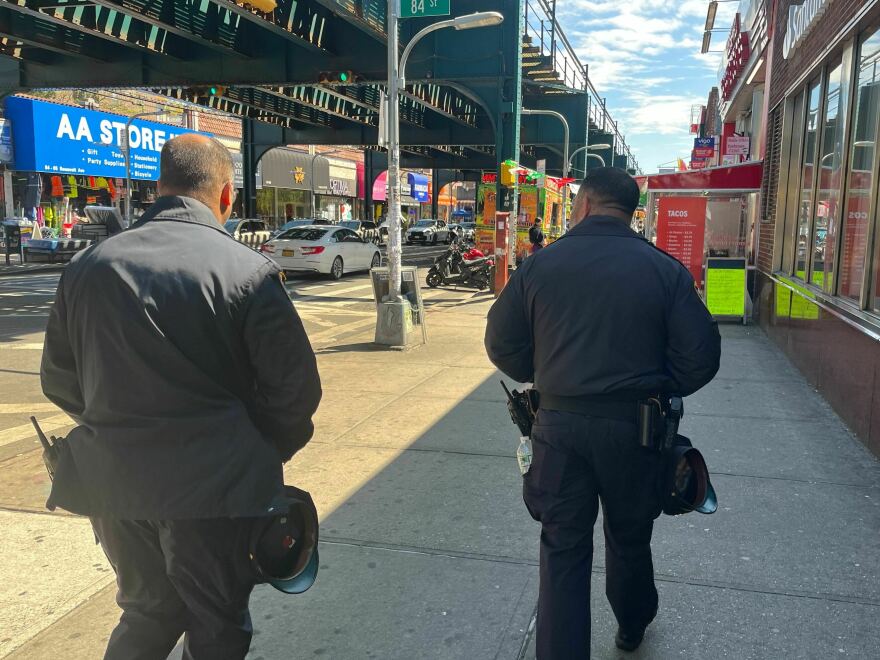
“Unfortunately, crime is up,” Carlos Chaparro says in Spanish. He runs a vocational school on Roosevelt Avenue in Queens, New York. It’s a traditionally Latin American neighborhood that has become a magnet for many of the approximately 190,000 migrants who’ve come through New York in the last two years.
“My clients say that when they leave [the school] at night, they’re being attacked and mugged, increasingly in the last year,” he says.
NPR talked to more than 20 people along this commercial strip, and they all said their impression was that crime has gone up in the last year. It’s a trend that is reflected in the statistics. According to the New York City Police Department’s CompStat system, crime in this precinct is up more than 15% in the first four months of this year compared to the same period last year, while it’s down in the city as a whole. Robbery is up more than 40% in the first four months of this year compared with the same period last year.
“It happens a lot,” says Johnny Velasquez, as he comes from his night shift as a security guard in Manhattan. Like Chaparro, he says there has been a lot more theft in the neighborhood lately — especially the grab-and-run kind.
“It’s an everyday thing. People on the scooters, like driving by while you’re on the phone, they’ll take it. Every day, you walk here, you don’t know what’s gonna happen,” he says.
Velasquez, Chaparro and others on the street blame the influx of newcomers.
“A lot of them [are] standing in front of the store selling lollipops to make a living,” Velasquez says, but “there’s other ones that come here for the wrong reasons.”
Velasquez just witnessed an attempted street theft — a man tried to grab a backpack, but his victim fought back and the suspect was struggling with police just 10 feet away. But in this case, the apparent thief is American, and the victim is a migrant — a young man from Ecuador who’d been trying to fix the wheel on his scooter when he was attacked.

Jack Donohue, who worked for the NYPD for 32 years and is now a senior fellow at the Center on Policing at Rutgers University, calls the rise in crime in that neighborhood “substantial,” but he says you can’t automatically blame the migrants.
“It’s a question of what’s happening and dissecting it. Not just the occurrence, but who gets arrested for it, would shed a little light on what dynamics are in play there,” Donohue says.
The available statistics don’t shed much light, though. Neither the NYPD nor the mayor’s office would talk to NPR for this story.
Meanwhile, the question of migrant crime in New York City has become politically charged, as local news reports focus on migrants accused of attacking police and participating in organized theft rings.
Most alarming to some are the dire news stories about a violent new gang.
Tren de Aragua is a Venezuelan prison gang that has spread to other South American countries, and there have been reports of migrants in the U.S. sporting the gang’s tattoos.
But Steven Dudley, an expert on Latin American gangs and co-director of the research group InSight Crime, says there’s a difference between the arrival of migrants with ties to a gang and the arrival of the gang itself.
“You may see individuals connected to Tren de Aragua that may commit crimes on their own. But that doesn’t mean that Tren de Aragua as a criminal organization is operational,” Dudley says. “For us to consider Tren de Aragua operational in the United States, they would need to be active in a collective manner, committing crimes in a collective manner over a period of time.”
He adds that migrants with “ties” to the gang may be coming to the U.S. to get away from the gang.
Carolina Reyna says she’s worried about regular street crime. She lives in New York’s largest migrant shelter, the Roosevelt Hotel near Grand Central Terminal in Manhattan. She says the constant police presence there makes her feel safe, but she says she’s no longer willing to go to the Latin American neighborhood in Queens — not since she was mugged there coming home from her job at a bar.

“The boy stabbed me on the left side, in the breast,” she says. She says the kid had an Ecuadorian accent. “It’s way too dangerous around there,” she says. “There are people who are doing things that don’t fit with why we came to this country.”
Police took her to the hospital and told her there is security video of the attack. But since February, the case has gone cold.
While the NYPD wouldn’t speak to NPR on the record, police say privately that the real problem is not that migrants commit more crimes. It’s that those who do are difficult to find and prosecute.
“Making cases against the migrants, it’s just very frustrating,” says Christopher Flanagan, a retired NYPD detective who was commander for major cases. He says that migrants typically don’t have the local roots and associations that investigators rely on and that there’s often no criminal record available from the country of origin.
“They’re going in with no information, very few avenues to identify people,” he says. And if they do make an arrest, “they have very little confidence that the person’s going to be present in court.”
Venezuelans working along Roosevelt Avenue in Queens say those who commit crimes and get away are making it harder for the rest of the migrants.
“You have to enforce the law against them,” Jose Villalobos says. He has been in the U.S. for five years and has worked jobs ranging from parking cars to selling snacks — which he does now under a tent draped with a Venezuelan flag. In his home country, he used to have a job with the central bank calculating the inflation rate until he was forced out for political reasons. Now that he’s making his way in the U.S., he thinks his countrymen are getting a bad rap from other Latin Americans in the neighborhood.
“They say, ‘Here come the criminals,’ but no, we’re not all like that. We’ve come to work and do good. As with any country, we have good people and bad,” he says.
Copyright 2024 NPR



Powerball, Mega Millions jackpots: What to know in case you win
Here’s what to know in case you win the Powerball or Mega Millions jackpot.
Just the FAQs, USA TODAY
The South Carolina Education Lottery offers several draw games for those aiming to win big.
Here’s a look at June 30, 2026, results for each game:
Winning Mega Millions numbers from June 30 drawing
26-41-50-53-62, Mega Ball: 12
Check Mega Millions payouts and previous drawings here.
Winning Pick 3 Plus FIREBALL numbers from June 30 drawing
Midday: 6-6-5, FB: 3
Evening: 1-1-7, FB: 2
Check Pick 3 Plus FIREBALL payouts and previous drawings here.
Winning Pick 4 Plus FIREBALL numbers from June 30 drawing
Midday: 5-1-7-3, FB: 3
Evening: 5-6-8-6, FB: 2
Check Pick 4 Plus FIREBALL payouts and previous drawings here.
Winning Cash Pop numbers from June 30 drawing
Midday: 15
Evening: 09
Check Cash Pop payouts and previous drawings here.
Winning Palmetto Cash 5 numbers from June 30 drawing
17-19-22-36-37
Check Palmetto Cash 5 payouts and previous drawings here.
Feeling lucky? Explore the latest lottery news & results
Are you a winner? Here’s how to claim your lottery prize
The South Carolina Education Lottery provides multiple ways to claim prizes, depending on the amount won:
For prizes up to $500, you can redeem your winnings directly at any authorized South Carolina Education Lottery retailer. Simply present your signed winning ticket at the retailer for an immediate payout.
Winnings $501 to $100,000, may be redeemed by mailing your signed winning ticket along with a completed claim form and a copy of a government-issued photo ID to the South Carolina Education Lottery Claims Center. For security, keep copies of your documents and use registered mail to ensure the safe arrival of your ticket.
SC Education Lottery
P.O. Box 11039
Columbia, SC 29211-1039
For large winnings above $100,000, claims must be made in person at the South Carolina Education Lottery Headquarters in Columbia. To claim, bring your signed winning ticket, a completed claim form, a government-issued photo ID, and your Social Security card for identity verification. Winners of large prizes may also set up an Electronic Funds Transfer (EFT) for convenient direct deposit of winnings.
Columbia Claims Center
1303 Assembly Street
Columbia, SC 29201
Claim Deadline: All prizes must be claimed within 180 days of the draw date for draw games.
For more details and to access the claim form, visit the South Carolina Lottery claim page.
When are the South Carolina Lottery drawings held?
- Powerball: 10:59 p.m. ET on Monday, Wednesday, and Saturday.
- Mega Millions: 11 p.m. ET on Tuesday and Friday.
- Pick 3: Daily at 12:59 p.m. (Midday) and 6:59 p.m. (Evening).
- Pick 4: Daily at 12:59 p.m. (Midday) and 6:59 p.m. (Evening).
- Cash Pop: Daily at 12:59 p.m. (Midday) and 6:59 p.m. (Evening).
- Palmetto Cash 5: 6:59 p.m. ET daily.
This results page was generated automatically using information from TinBu and a template written and reviewed by a South Carolina editor. You can send feedback using this form.

(WPDE) — ABC15 is the new official broadcast home for South Carolina Education Lottery (SCEL) drawings, beginning Wednesday, July 1!
Weekday evening drawings for Pick 3, Pick 4, Palmetto Cash 5 and Cash Pop will air live just before the 7:00 p.m. newscast and are approximately one minute long.
ABC15 will also air live jackpot drawings during its 11 p.m. newscast on:
- Mega Millions: Tuesdays and Fridays
- Powerball: Wednesdays and Saturdays
In addition to the live broadcasts, official SCEL results will be displayed on-screen following the midday Pick 3, Pick 4 and Cash Pop drawings. Weekend evening drawings will also be shown through official results crawls.

Richard Hricik, South Carolina’s Democratic nominee for attorney general, has officially launched his campaign for November’s general election.
Hricik was unopposed in the primary, automatically advancing to the ballot in November. He will now race against the Republican nominee David Stumbo, who beat Republican challenger Stephen Goldfinch in a runoff on June 23.
Hricik launched his campaign on June 25, just two days after the Republican primary runoff concluded.
In a press release Hricik, a Charleston attorney of more than 25 years, said that his campaign focuses on the fact that the rule of law should protect everyone equally.
“The Rule of Law isn’t red or blue. It has to apply to everyone, and be defended for everyone,” Hricik said. “An Attorney General who treats the law as their own political agenda — who protects some people and not others — threatens our democracy and makes every South Carolinian’s rights less safe. If someone attacks the State House in Columbia, I won’t ask who they voted for; it won’t matter — they are going to prison. That’s the law, and the Attorney General’s job is to defend and uphold The Rule of Law. For everyone.”
Hricik also announced that he has a no-money pledge for his campaign.
“An Attorney General is supposed to answer to two things: You and The Rule of Law. No one and nothing else,” Hricik said. “So, I take no money — not from special interests, not even from myself. That’s not a gimmick. It’s my firewall against corruption and influence. When you owe no one, you can fight for everyone and The Rule of Law.”
There has not been a Democrat in the attorney general office since Thomas Medlock, who left office in 1995.
Stumbo, who is currently serving a fourth term as Solicitor for the Eighth Judicial Circuit of South Carolina, ran his primary campaign on the basis of being a career prosecutor and lifelong Republican.
On runoff election night, Stumbo and his supporters gathered at the City Club of Greenville to watch results come in. In his winning speech that night, Stumbo said that while there hasn’t been a Democratic attorney general in South Carolina in many years, there would still be work ahead.
“We still got a lot of work to do, and I need everyone in this room fighting like crazy for the next few months to make sure that when we’re standing there on election night in November that we are officially the next attorney g eneral of South Carolina,” Stumbo said.
Ruth Cronin covers Greenville County business, growth and development. Contact her at rcronin@usatodayco.com.
-

 Indianapolis, IN5 minutes ago
Edwards Checks Out At Indianapolis – SPEED SPORT
-

 Pittsburg, PA6 minutes ago
Analysis: Here’s why the Pittsburgh Symphony’s budget just jumped by $7 million to $42 million
-

 Augusta, GA12 minutes ago
Augusta’s role in the American Revolution: An underdog story 250 years in the making
-

 Washington, D.C15 minutes ago
Looking for indoor July 4 plans in DC? Try these America250 exhibits
-

 Cleveland, OH20 minutes ago
Rangers capitalize on costly Guardians mistake, extend winning streak to six
-

 Austin, TX27 minutes ago
Apptronik opens robot training hub in Austin, Texas and debuts Apollo 2
-

 Alabama30 minutes ago
Alabama grocery bills will change as tax returns July 1
-

 Alaska35 minutes ago
OPINION: Alaska’s LNG future requires creative thinking – Homer News

