Washington, D.C
Cops in nation’s capital draw ire, support for staying away from campus protest


Student protesters arrested as police clear UCLA’s protest encampment
Police clashed with demonstrators in UCLA’s pro-Palestine protest encampment site in the early morning hours as they cleared the area and made arrests.
As police swarmed pro-Palestinian demonstrations on college campuses across the country this week, officers in the nation’s capital refused to get involved, igniting ire from Republican Congressmembers and raising thorny ethics questions about bringing outside cops to university property.
Fueling part of the controversy are reports that Metropolitan Police supposedly turned down pleas from university administrators to get involved amid escalating protests against the war in Gaza on George Washington University’s Washington, D.C., campus late last week. The move deviated from decisions by other police departments to march on college campuses, disband student demonstrations, and arrest hundreds this week.
The tent encampment covering University Yard, a square area in the center of the George Washington University campus, entered its eighth day on Thursday. Hours after around 20 tents went up in the early morning hours of April 25, the university demanded that protesters disperse and dismantle them.
When the demonstrators refused to leave, the university reached out to metro police to break up the encampment, with President Ellen Granberg and Provost Christopher Bracey calling it an “unauthorized use of university space.”
But metro police refused to send their officers into the campus, fearing the optics of a police crackdown on students less than a mile from the White House, according to the Washington Post.
Police wrote in an email to USA TODAY that the department “stood in support” of the response of campus police, who take “the lead in the response to first amendment demonstrations occurring on GWU grounds.” The department declined to comment on “operational tactics or procedures.”
George Washington officials did not provide additional comment in response to USA TODAY’s request.
Listen: Police order dispersal of gathering at UCLA as protests continue nationwide | The Excerpt
GOP congressmembers make trip to GWU
The metro police decision not to get involved presented an opportunity for a political jab from some Republican members of the House Oversight Committee, who visited the encampment on Wednesday to condemn the police department’s refusal to act.
“We expect these encampments to be cleared out,” Committee Chair James Comer said, after walking through a crowd of protesters booing and heckling. In a letter to Washington Mayor Muriel Bowser, he and Committee Chairwoman Virginia Foxx also slammed metro police for refusing to get involved “over fears of public criticism.”
But experts cautioned university administrators to think carefully before involving police in campus protests. Before calling in law enforcement, university administrations should have a crystal clear picture of what’s going on, said Christy Lopez, a professor at Georgetown Law. That level of certainty could be missing from the decisions of some administrations.
“Sometimes it’s just really fuzzy and things are moving quickly, and you need to make sure that you understand what’s going on,” she said. “Sometimes, it can be sort of reckless to the point of almost deliberate” to call in police without the full facts established, she added.
Lopez commended police in the nation’s capital for not getting involved in the protest at George Washington. “We should not have to rely on police departments restraining themselves,” she said. “But as that instance shows, sometimes you have to rely on the police department to show the level of judgment that campus officials may not be showing.”
Almost every recent instance she had seen of police response to student protests could present grounds for a critical incident review of officers’ actions, she said. “I think that every single crackdown that I’ve seen warrants that level of scrutiny,” she added.
Protesters Face Charges: Campus protests across the US result in arrests by the hundreds. But will the charges stick?
Hundreds arrested at campus protests
The decision made metro police an outlier among other city police departments that sent officers into the chaotic center of campus demonstrations.
The NYPD made its first wave of around 100 arrests on Columbia University’s Manhattan campus in mid-April after it entered campus upon request from university President Minouche Shafik to dismantle a tent encampment. The situation has only escalated since then – on Tuesday night, NYPD officers arrested nearly 300 people at demonstrations at Columbia and the City College of New York.
At a news conference on Wednesday, New York City Mayor Eric Adams said NYPD carried out the operation at the university’s request. “The request we received in writing could not have been clearer,” he said.
In Austin, police in riot gear, riding horses, and wielding batons and pepper spray descended on protests at the University of Texas campus last week upon the university’s request. Although charges against the 57 people arrested were dropped, officers returned on Monday to arrest nearly 80 more.
In an email to USA TODAY, Austin police said the level of assistance that its officers provided to campus police changed with the dynamics of the situation. At first, officers helped to transport those arrested to jail. More recently, campus police asked Austin officers to assist them in making arrests. After campus police and Texas Department of Public Safety officers decided to disband the protest, “it became apparent that additional resources were needed for officer safety and the safety of those taking part in the demonstration.”
“Moving forward as the demonstrations continue, APD will remain ready to provide assistance to [campus police] if requested,” Austin police said in the email.
Experts say police should build trust with protesters
Lopez said building up a level of trust with protesters by acting with restraint can help law enforcement work effectively in the midst of a protest. “Is there an alternative to just going in and tearing apart an encampment or shutting down a protest? Or can you be more directed and actually figure out who’s causing the problems?” she said.
Either way, law enforcement’s response to the protests could leave a lasting mark on how young people view the ethics of policing, Lopez said. “How the police respond here is going to be as indelibly marked on the political consciousness of youth today, as the police response during the Vietnam War protest was on youth of that era,” she said.
“This is going to define how they think about not just police, but government, about the legitimacy of authority,” she added. “That’s really, really an important thing for police and leaders to be thinking about, is that they’re forging that reality and those perceptions right now.”
Cybele Mayes-Osterman is a breaking news reporter for USA Today. Reach her on email at cmayesosterman@usatoday.com. Follow her on X @CybeleMO.



WASHINGTON – Washington, D.C., mayoral candidate Kenyan McDuffie on Thursday conceded the Democratic primary race to Janeese Lewis George.
Although the official certification of the primary race is continuing, McDuffie said in a statement that “it is clear that the voters have chosen a different path.” The former member of the D.C. council said he had contacted Lewis George and congratulated her. He thanked his supporters and urged them to continue working for the city.
“The campaign may be over, but the work of building a safer, more affordable, more prosperous city continues.”
The Associated Press has not declared a winner in the race. Lewis George had a little less than 53% of the vote Thursday morning, which is just a few percentage points above the 50% threshold to avoid ranked choice voting.
The city is scheduled to release preliminary ranked choice voting results on Sunday. AP will call the race before then if it is clear that the ranked choice process will be avoided.
Lewis George has pledged to aggressively stand up to federal intervention into Washington, D.C.’s, affairs, setting up a potential showdown with President Donald Trump over his administration’s moves to challenge the city’s limited autonomy.
If the results stand, Lewis George is likely to win November’s general election in the heavily Democratic city. The winner in the general election will replace Muriel Bowser, who decided not to run again after three terms.
Lewis George would join Robert White Jr., who won the Democratic primary for the district’s delegate to Congress, as the top local officials who likely will contend with the federal government’s intentions for the city. They each campaigned on a promise to take a harder line than their predecessors against the Trump administration’s moves on the district, including its deployment of the National Guard on an ongoing, open-ended mission meant to fight crime.
“As mayor, I will work with anyone who makes D.C. safer,” Lewis George told a crowd of cheering supporters Tuesday night, “but I will also stand up to Trump.”
Washington has limited autonomy and federal leaders retain significant control over local affairs, including approval of the budget and laws passed by the D.C. Council.
Trump further encroached on that autonomy last year when he briefly federalized the city’s police force and deployed an ongoing law enforcement surge that included the National Guard. His efforts to downsize the federal government also roiled the capital region, costing thousands of people their jobs. And he has been reshaping the city by renovating storied landmarks and putting his name or image on buildings.
Lewis George, a self-described democratic socialist and a member of the D.C. Council, has already come under fire from Trump, who last week threatened to place the city under federal control if she won.
“Maybe we’d take back Washington, run it on the federal basis,” he said.
Lewis George, 38, and a third generation Washingtonian, has vowed to overrule an executive order by the city’s police chief permitting local law enforcement to cooperate with Immigration and Customs Enforcement agents. Lewis George argued the order “hurt the trust of our community.”
She also pledged to use any levers available to her through the city’s home rule compact to resist what she called authoritarian infringements on the district’s local governance.
“We have legal tools we can use to fight back,” she told the AP in an interview before the vote. “And we know that when we have gone to court, we’ve won.”
Bowser found herself walking a fine line between staying in Trump’s good graces and responding to the concerns of constituents, many of whom said she didn’t push back hard enough on Trump’s actions. Eleanor Holmes Norton, the 18-term, 89-year-old delegate to Congress, meanwhile, faced mounting concern from critics who said she wasn’t forcefully pushing back on the Trump administration’s moves against the city.
Copyright 2026 The Associated Press. All rights reserved. This material may not be published, broadcast, rewritten or redistributed without permission.
Darren Lyn
18 June 2026•Update: 18 June 2026
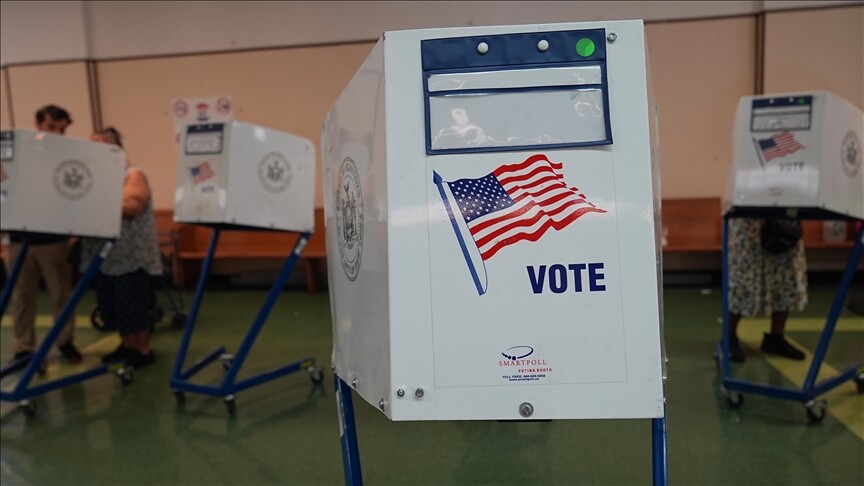
Democratic socialist Janeese Lewis George currently leads the vote tally as of Wednesday versus six other candidates in the Washington, DC Democratic mayoral primary, and if victorious, could be following in the footsteps of the most notable democratic socialist in the United States — New York Mayor Zohran Mamdani.
With 73% of the ballots counted since Tuesday’s primary election in the nation’s capital, the Associated Press (AP) has Lewis George leading with 52.9% of the vote. Her closest challenger is Kenyan McDuffie, who currently holds 36.5%.
The mayor’s office in the District of Columbia has traditionally been a Democratic stronghold, and political experts have said that any Republican challenger is not expected to put up meaningful competition for the mayor’s seat in the general election.
If Lewis George keeps her current lead and wins the majority, she will head to the November election as the favorite to replace three-term Mayor Muriel Bowser, who decided not to run for a fourth term.
A victory for Lewis George would be to the ire of US President Donald Trump, who told reporters that he could attempt a federal takeover of Washington if she won the mayor’s race, according to local media reports.
“We won’t put up with it,” Trump told reporters at a news conference.
Yet Trump has already seen a democratic socialist take power in America’s largest city, with the election of Mamdani as mayor of New York City.
Not to be outdone, the race for the mayor’s office in Los Angeles, California — the second largest city in the US by population — has a democratic socialist, Nithya Raman, in the runoff to vie for the position in November’s general election. Raman will face incumbent Democratic Mayor Karen Bass, who narrowly edged out Raman in the primary 34.3% to 29.0%.
In California’s 14th congressional district, two candidates will head to a runoff election to replace former US Rep. Eric Swalwell, who resigned from Congress in April amid allegations of sexual assault, including rape.
Aisha Wahab secured the first runoff spot on Tuesday with 38.3% of the vote, with the AP on Wednesday calling the second position to go to Melissa Hernandez, who tallied 17.2%.
The runoff election will be held on Aug. 18, with the winner finishing out the rest of Swalwell’s term.

At time of writing, the Associated Press estimates that around 64% of votes have been counted. Races where no candidate wins a majority of first choices will proceed to a ranked choice voting count – most likely the at-large Council and Ward 1 Democratic primaries. With RCV, all nominees will have support from a majority of their party – as will the winner in an at-large Council special election.
Mayor
In the closely watched mayoral race, Councilmember Janeese Lewis George leads with 52.8% of voters’ first choices, followed by former Councilmember Kenyan McDuffie at 36.6%. If Lewis George remains above 50% as the remaining votes are counted, a ranked choice tabulation will not be necessary to determine the winner.
Congressional delegate
Five candidates ran in the Democratic primary to succeed retiring Delegate Eleanor Holmes Norton. Councilmember Robert White won that election with 63.2% of first choices. Councilmember Brooke Pinto came in second with 21.5% of first choices.
At-large Council Democratic primary
Nine candidates ran for the Democratic nomination to succeed at-large Councilmember Anita Bonds. No candidate has won a majority of first choices. Oye Owolewa leads with 33.8%, followed by Lisa Raymond at 15.2% and Kevin Chavous at 13.8%. The result will likely be determined by a ranked choice voting count.
| Candidate | Share of first choices |
| Oye Owolewa | 33.8% |
| Lisa Raymond | 15.2% |
| Kevin B Chavous | 13.8% |
| Greg Jackson | 11.0% |
| Candace Tiana Nelson | 7.7% |
| Dwight Davis | 6.0% |
| Fred Hill | 5.4% |
| Dyana N. M. Forester | 3.7% |
| Leniqua’dominique Jenkins | 3.0% |
| Write-in | 0.4% |
In a choose-one election, Owolewa would have won the nomination despite 66% of voters voting for another candidate. In 2022, for instance, Councilmember Anita Bonds won the Democratic primary for this seat with only 36% of first choices. Now, ranked choice voting will ensure the nominee – whether Owolewa or someone else – has majority support.
At-large Council special election
In the special election for at-large Council, former Councilmember Elissa Silverman is leading with 54.8% of first choices, followed by appointed Councilmember Doni Crawford and Board of Education President Jacque Patterson, with 25% and 19% respectively. If Silverman maintains a majority of first choices, there will be no ranked choice tabulation.
Ward 1
In the competitive Democratic primary for Ward 1 councilmember, Aparna Raj leads with 47% of first choices. Depending on remaining ballots, Raj may win with a majority of first choices, or the winner may be determined by a ranked choice voting count.
Candidate
Share of first choices
Aparna Raj
46.7%
Michael Trindade Deramo
20.3%
Rashida Brown
17.2%
Jackie Reyes Yanes
10.0%
Terry Lynch
5.8%
Write-in
0.1%
Notably, in three Council races – the at-large Council Democratic primary, at-large Council special election, and Ward 1 Democratic primary – candidates cross-endorsed each other, asking voters to rank each other on their ballots. Past elections show that voters often listen to cross-endorsements by candidates they support, so it’s possible candidates who cross-endorsed will benefit when their races go to RCV tallies.
DC’s ranked choice voting elections offer a sharp contrast with the District’s recent past, in which candidates regularly won key primaries without majority support. Since 2012, every districtwide office and six of the eight wards have seen Democratic primaries won with less than 50% of the vote. Since 2020, Ward 2 and Ward 7 have had Democratic Council primaries won with less than 30% of the vote.
FairVote will post more analysis of the DC election over the coming week. In the meantime, visit Grow Democracy DC to learn more about RCV in DC.
-

 Crypto3 minutes ago
Crypto’s Courtside Takeover: Digital Assets in Pro Tennis
-

 Finance6 minutes ago
Consumer confidence plunges among younger adults
-

 Fitness11 minutes ago
Kylie Minogue, 58, shares how she stays fit without a strict exercise routine – ‘I don’t really work out’
-

 Movie Reviews21 minutes ago
Movie Review: ‘Leviticus’ makes a demon out of desire in an auspicious debut for Adrian Chiarella – Sentinel Colorado
-

 World33 minutes ago
Video: A Small Election Could Change British Politics
-

 News36 minutes ago
Inside Trump’s Touring Exhibition of American Heroes
-

 Politics41 minutes ago
Video: Erika Kirk’s Message for Women at Turning Point USA
-
 Lifestyle1 hour ago
The second life of a classic: ‘Amores Perros’ is remastered and back in theaters

