Business
Bitten by a billionaire's dog? Or a case of extortion? A legal saga from an L.A. dog park

A dog-bites-woman story usually isn’t much of a story at all. But an incident in one of L.A.’s wealthiest enclaves has become something else entirely.
What began in a Brentwood park on a summer day in 2022, when a dog owned by billionaire surgical-device inventor Gary Michelson allegedly bit another pet owner, has turned into dueling lawsuits and an allegation of blackmail.
Michelson claims it’s a simple case of extortion. He says interior designer Sandra Evling tried to force him to pay her $85,000 by threatening to publicly humiliate him and report his dog to authorities, which she claimed would lead to the pet being put down. He filed suit first, seeking damages in excess of $250,000.
From Evling’s perspective, he should have known better. She alleged Michelson, a philanthropist prominent in animal welfare circles, let his dog run free despite knowing it had bitten other animals and one other person — traumatizing her and causing severe injuries, according to a personal injury lawsuit she filed in response seeking unspecified damages.
In a town where the rich have legitimate fears of extortion, is this a case of a person seeking a payday? Or a billionaire using his wealth and legal savvy to protect himself from responsibility for an aggressive animal?
Dr. Gary Michelson at a 2019 gala for his Michelson Found Animals Foundation in Beverly Hills.
(Albert L. Ortega/Getty Images)
Michelson, 75, seems an unlikely antagonist in a dog-bite case. After reaching a $1.35-billion patent dispute settlement with medical device maker Medtronic two decades ago, he has made a name for himself as a philanthropist in animal welfare and other fields.
After Hurricane Katrina in 2005 orphaned more than 100,000 pets, he established the nation’s first free microchip pet registry. He has a standing prize offer of $25 million for the development of a single-dose medication that can permanently and safely sterilize both cats and dogs.
Michelson’s devotion to animal welfare extended to his own pet Blue, a beige-and-white dog with droopy eyes he celebrated on Instagram with the tongue-in-cheek handle @scarypitbully. The page, since taken down, documented the maturation of the American bully XL, the largest of a muscular breed derived from the American pit bull terrier that the United Kennel Club describes as more gentle and playful, making it an excellent family dog.
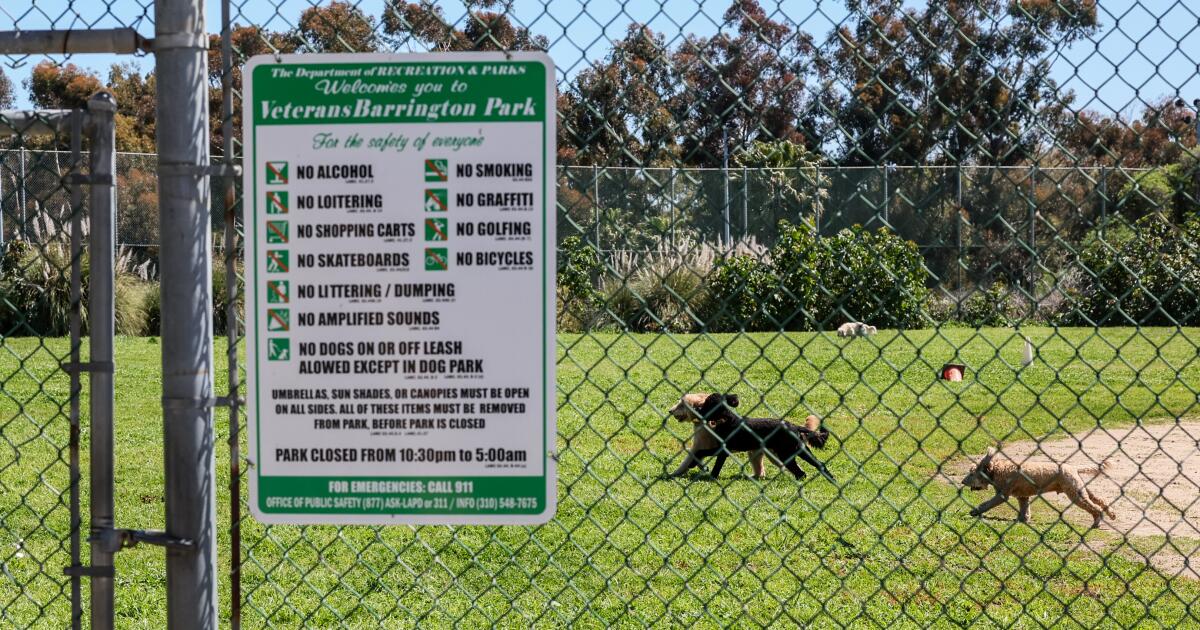
Michelson and Evling, 37, an immigrant from Sweden, were regulars at Veterans’ Barrington Park. They lived nearby: Evling in an apartment and Michelson in a $24-million mansion.
The incident took place Aug. 9, 2022, just outside a fenced-in dog park on ball fields where owners let their dogs run free.
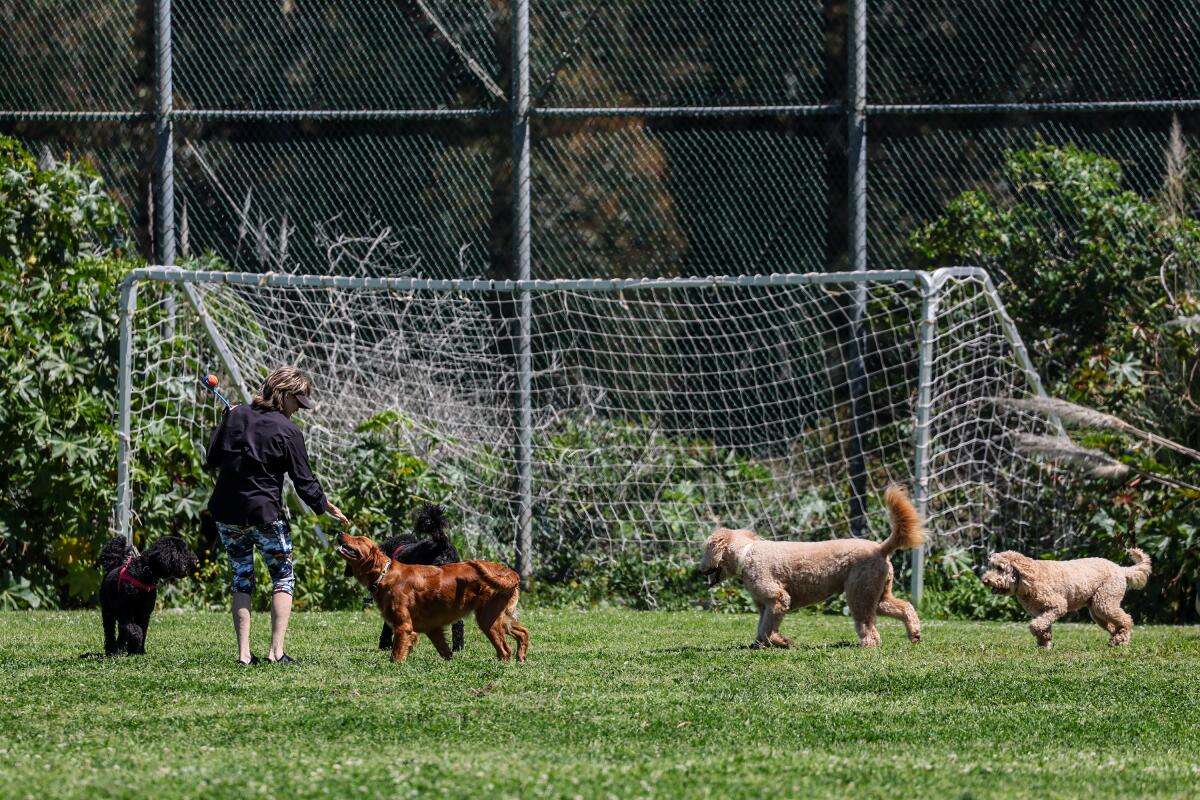
Dogs tend to play off-leash on a sports field adjacent to the dog park at Veterans’ Barrington Park.
(Robert Gauthier/Los Angeles Times)
Evling, in her lawsuit, said that she was walking with her dog Neo, a tamaskan, when Blue charged her pet, and that she was bitten trying to protect it. She sought treatment that evening at an urgent care clinic complaining of pain in her left hand from a crush injury and an abrasion to her right elbow, according to medical records reviewed by The Times.
An X-ray found no fractures or vascular injuries in her hand, which was put in a finger splint. She was given a tetanus shot and prescribed antibiotics, the records show.
In messages sent to The Times, Michelson said the records are not evidence of dog bites, claiming instead she might have twisted her finger on her dog’s collar and scraped her elbow while falling. He said that afterward he checked on Evling “for days” and offered to pay her medical bills. He said that the calls were cordial and that she “seemed ok.”
Michelson said he also set up a session at his house with celebrity dog trainer Cesar Millan, a longtime friend, to work with Neo and Blue together so that “Sandra could feel comfortable at the dog park with Blue around.”
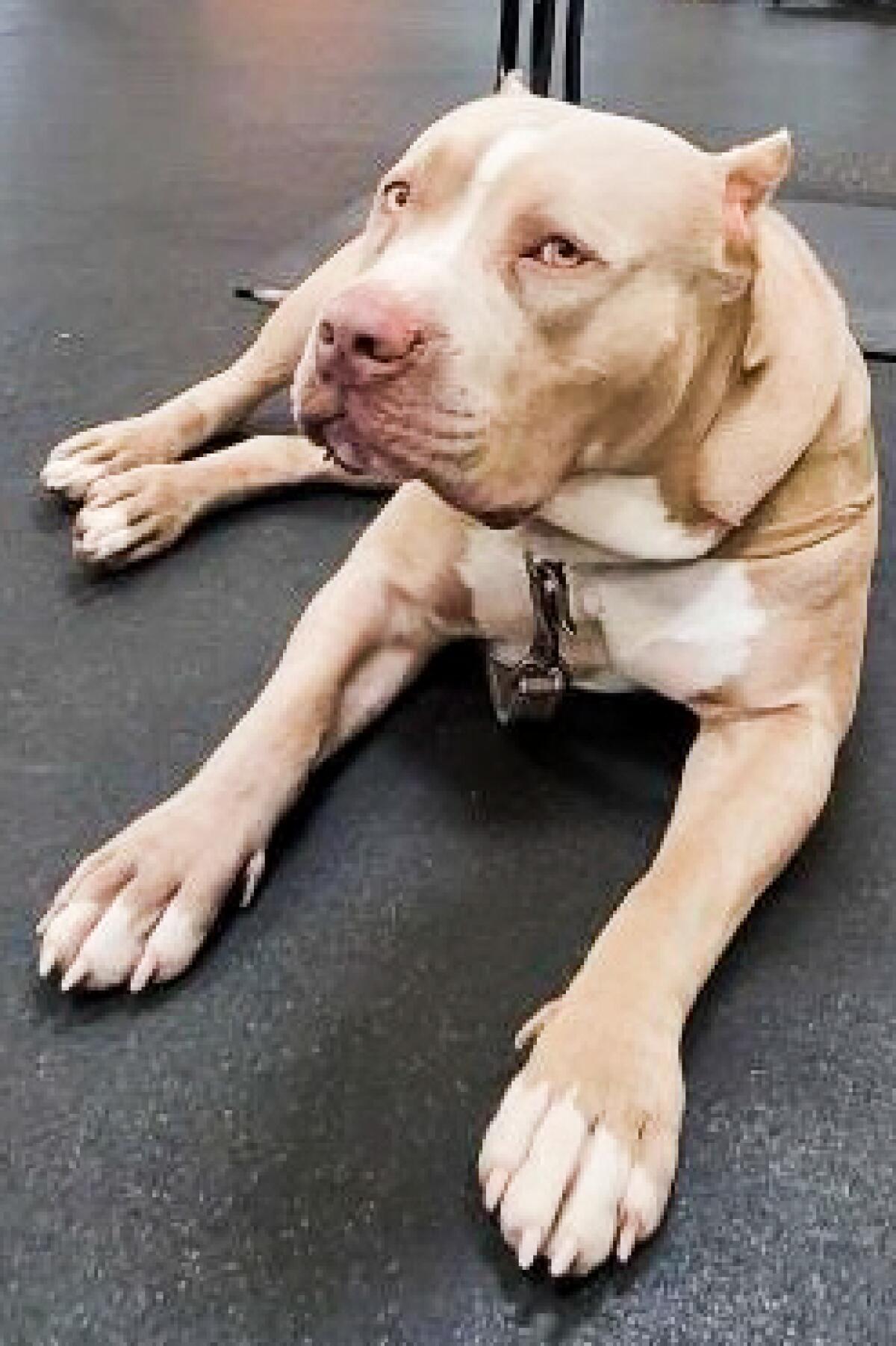
Gary Michelson’s dog Blue.
(Courtesy of Gary Michelson)
After the session, Michelson said, he and Evling would see each other at Gold’s Gym Venice, where they both brought their service-dog pets. He said that “things were always quite friendly” and that Evling never complained of being bitten until she learned of his wealth.
Attorney Benjamin Taylor, who represents Evling in the extortion lawsuit, said Evling knew Michelson’s background “well before this incident.”
On April 20, 2023, eight months after the alleged attack, Evling texted Michelson asking to meet the next day at the gym, according to a copy of the pair’s text string provided by former Los Angeles County Dist. Atty. Steve Cooley, a friend of Michelson’s who is listed as one of his attorneys in the extortion lawsuit.
Their conversation continued via texts. Evling complained she was suffering from “severe PTSD” and a lifelong scar from the attack, and chastised Michelson about another alleged incident at the park involving Blue.
“When I was told that you had taken Blue off leash at the park this week and that he had attacked another dog all my trauma came back (like it happened all over again) and a severe anger that you’re not taking this problem seriously. Is it going to take someone getting killed before you realize how serious this is?” she texted. (Michelson denied Blue ever attacked another dog or person in answers to a list of questions sent to Cooley in February.)
Evling, who had stated she didn’t want to involve attorneys, laid out two options.
If Michelson chose Option A, she would have him and his dog expelled from the gym, file a report with police and animal control that would result in the dog being put down, and file a class-action lawsuit with other parkgoers that “will cost you a loooot of money.”
If Michelson chose Option B, Evling texted, he could keep Blue as long as he paid her $85,000, kept his dog on a leash and didn’t bring it to the park. She promised not to file a complaint with the gym so long as Michelson kept Blue away from her while she was training. She added she would sign a nondisclosure agreement that would be voided only if Blue attacked her or her dog again, not if Blue was aggressive with others.
“It is time for you take responsibility and suffer the consequences of your actions,” she texted.
Several days later, Michelson asked Evling how she arrived at the compensation figure and how he and his wife, recording artist Alya Michelson, could trust that she wouldn’t carry out her threats anyway.
Evling said she had consulted with several law firms and claimed the $85,000 would be less than a court judgment. She assured him she wouldn’t talk to anyone or file legal action. “I AM a person of my word and just want to move on as much as you do and leave this in the past,” she texted on April 27.
The negotiations then turned sour. Michelson told Evling he had just learned from several dog park friends that she was recruiting plaintiffs for a lawsuit, accusing her of “already breaking your promise.” However, he said he was immediately sending a “good faith” payment of $10,000 if she would not take the steps she had outlined. “Hopefully, this small measure of restraint will be acceptable to you,” he texted.
Evling disputed that she was preparing a lawsuit, contending she had only learned of the new alleged attack through a dog park chat group.
After being assured the $10,000 was a partial payment, Evling said she would not take further action as long as she received a contract by May 15 for the remainder of the $85,000. Michelson filed his extortion lawsuit days later on May 3.
Taylor said Evling had sought payment to resolve the matter informally without attorneys in the hopes of avoiding a “spectacle.” “Now that Dr. Michelson decided to sue her first, she looks forward to her day in court,” he said.
Attorney Ryan Baker, a founding partner of L.A. law firm Waymaker, reviewed the exchange to offer an opinion on whether it amounted to civil extortion, which under California law includes receiving a benefit such as money through the threatened exposure of any “disgrace or crime” even if falsely alleged.
Baker said that Evling had the right to pursue a private settlement under the threat of her own lawsuit, but if she threatened to report Michelson unless he met her demands she crossed a “bright line.” “She can’t become her own private judge, jury and executioner,” he said.
Michelson was “extremely shrewd,” he said, to seek the demands in writing and send the $10,000, since receiving it would be a key element of civil extortion.
Baker said a “critical question” a jury would have to decide was whether Evling had extorted the money or had simply received and kept it.
After Evling was sued, she filed a personal injury lawsuit that claimed Blue had bitten four dogs and one person in 2022 before the attack on her, and one poodle afterward.
Her lawsuit provided few details about the other alleged attacks. Blue, though, was a topic of a dog park group chat on April 17, 2023 — the day of the alleged poodle attack. Multiple members of the chat alleged that Michelson brought his dog to the park and that his dog had repeated altercations with other animals.
Michelson denied Blue has a history of aggression, contending “chat rooms are not acceptable or reliable sources of factual information,” in response to the questions sent Cooley. He said that Evling’s characterization of his pet, which is referred to as a “vicious animal” in her lawsuit, “reeks of outdated stereotypes.”
Michelson pointed to a lack of complaints with Los Angeles Animal Services as evidence, which the department confirmed in February in response to a California Public Records Act request.
Judie Mancuso, the founder of Social Compassion in Legislation, a public policy group that advocates for animals in Sacramento, said Blue was “super well behaved” at a fundraiser Michelson and his wife hosted for the nonprofit in July at the couple’s Brentwood home.
“The dog didn’t even bark at anyone,” Mancuso said.
At the time of the dog park incident, neither of their dogs were neutered. Michelson said in a text this was to allow Blue to compete as a purebred show dog. He said he opted to have Blue neutered last month because of the difficulty of participating in competition with a dog whose breed is not recognized by the American Kennel Club. “As I am a champion for S&N [spay and neuter], I gave up and had him neutered,” he texted.
Evling’s dog was 8 months old at the time. He has since been neutered, according to Taylor.
In support of her allegations that Blue was aggressive, Evling collected the names and numbers of some two dozen people she alleged had witnessed attacks, including 12 chat group members, whose identities were disclosed in court filings. The Times attempted to contact all of them; most did not respond or would not comment publicly.
Syed Ahmed, a Brentwood data analyst, was an exception. He said that his dog Turbo, a male 70-pound Doberman pinscher, and Blue got into a fight in March 2022 and that Michelson’s dog “ended up grabbing my dog by the throat.” Evling’s lawsuit alleged a dog of that name was bitten that month.
Turbo was treated for puncture wounds, according to a veterinary bill provided to The Times, along with photos of the bite wound.
Ahmed said he didn’t ask Michelson to reimburse him for his $908.10 bill. Michelson “was very apologetic, and that’s why I didn’t pursue anything. I was like, OK, you know, s— happens,” he said.
After Michelson learned from The Times last month that the dog had been injured, he reimbursed Ahmed for his veterinary bill.
Michelson said that he believed Turbo just wanted to play, but that Blue bit the dog because he had been attacked several times by other male dogs. “Blue misread the dog’s intent and reacted to protect himself. I was very upset that it happened,” he emailed. “I will testify under oath that I have never seen Blue attack anyone, ever.”
Michelson’s and Evling’s lawsuits are wending their way through Superior Court. Trial dates for each have been set for next year.
In early December, Evling saw Westside plastic and reconstructive surgeon Michael Zarrabi to examine the scar allegedly left by the dog bite on her right elbow. Zarrabi called the injury “disfiguring” and recommended surgery, multiple laser treatments and topical ointments that he anticipated would improve the appearance 80%, according to medical records reviewed by The Times. The estimated cost: $41,900.
Michelson, in a text, called the estimate “beyond absurd.” He said in an email that he consulted a “well-regarded” Beverly Hills plastic surgeon who, after seeing pictures of the abrasion, said the scar tissue could be removed for $5,000 — half the $10,000 he had already sent her.
As the two parties await trial, Evling has started a business selling Swedish cookies, while Michelson has remained active in civic and philanthropic circles. He rubbed elbows with Gov. Gavin Newsom at an event announcing UCLA’s acquisition of the former Westside Pavilion mall, which the university is converting into a research park. It will house the California Institute for Immunology and Immunotherapy, which Michelson chairs and has pledged $120 million toward.
One place he apparently has not been in a long while is the Barrington dog park.
After the alleged poodle attack, Michelson texted Evling that he was never going to the dog park again and “it is my intention to stay as far away from you as possible.”
Taylor said she had stopped going there too.


Elon Musk wants to take investors on a ride to the moon — and beyond.
His pioneering rocket company SpaceX filed Wednesday for what’s expected to be the largest initial public offering in history, potentially raising at least $75 billion and valuing the company at as much as $2 trillion.
The registration statement with the Securities and Exchange Commission for an expected public offering next month explicitly sets aside stocks for retail investors, though the exact number will be spelled out in a later filing, as will the offering price and company valuation.
Interest in the stock offering is expected to be high despite the billionaire’s controversial politics, including his involvement last year with the Department of Government Efficiency, the makeshift cost-cutting effort that resulted in the loss of hundreds of thousands of government jobs.
“Potential investors are probably just as polarized as the electorate is too, given his dabbling in politics,” said Carol Schleif, chief market strategist for BMO Private Wealth. “But it’s not just the SpaceX IPO per se, it’s a bigger, broader excitement among investors for space investment in general.”
Investor interest was piqued by the Artemis II moon mission this year that SpaceX did not participate in, she said. However, the company is expected to play a larger role in future missions that take astronauts to the moon..
Ultimately, Musk, 54, wants to establish a colony on Mars but those plans have been set on the back burner, with NASA now focusing on moon missions.
Musk will remain the company’s chief executive and chairman. Under a dual-class stock structure as a holder of special Class B shares he will be able to control the election of directors, the filing says.
The IPO is expected to be at least twice as large as the current record holder: Saudi Aramco, the state-controlled national oil and gas company of Saudi Arabia, which raised nearly $30 billion in 2019.
Nearly two dozen banks will be underwriting the IPO and offering shares to investors, including Goldman Sachs, Bank of America and Citigroup.
Founded in 2002 in El Segundo, SpaceX has revolutionized the aerospace industry by developing the reusable Falcon 9 rocket that has radically lowered launch costs.
The company moved its headquarters from Hawthorne to Texas in 2024. However, SpaceX retains large operations in the South Bay city and blasts off regularly from Vandenberg Space Force Base in Santa Barbara County.
Scores of former SpaceX employees have launched startups in Southern California, including rocket company Relativity Space, hypersonic missile startup Castelion and satellite manufacturer Apex Space.
Since developing its reusable rocket technology, SpaceX has established its Starlink network as the leading satellite-based broadband internet service. It also is moving into satellite-based cellular service and this year merged with Musk’s xAi artificial intelligence company that also included his X social network.
Marco Cáceres, an aerospace analyst at Teal Group, said that the advantage of going public for SpaceX lies in the IPO’s ability to raise a large amount of capital quickly to complete development of its Starship rocket.
“It is going to dominate the market even more than the Falcon 9 is dominating the market now,” he said. “That’s going to be ultimately what’s going to drive their business for the next 10 years.”
The 12th test launch of Starship is set for Friday from the company’s south Texas launch facility. The rocket is the third version of craft, standing more than 400 feet tall and with about three times the payload of the second version.
The regulatory filing claims that the market for its rocket, internet and mobile telephone businesses could be as large as $28.5 trillion.
SpaceX also plans to launch thousands of orbiting data centers powered by the sun that would perform AI calculations.
With the company making massive capital investments, it recorded a $4.28-billion loss in the first quarter. Last year, it recorded $18.7 billion in revenue and lost $4.94 billion, according to the filing.
The public offering is expected to hit the market next month after a “road show,” during which SpaceX will seek to drum up interest from institutional and retail investors.
It will arrive after a fairly quiet year for IPOs that was brightened last week when Cerebras Systems, a Sunnyvale company that makes semiconductors for AI supercomputers, went public.
Shares at Cerebras were offered at $185 and jumped 68% on its opening day. They closed Wednesday at $290.69.
Matt Kennedy, a senior strategist at Renaissance Capital, said the SpaceX offering would dwarf that of Cerebras, as it is expected to raise more than every IPO combined in the last two years.
“A win here or a loss could really impact the IPO market,” he said. “The sheer size of this deal is going to make or lose fortunes.”
Among the oddest disclosures of the IPO is a decision by the company’s board in January to grant Musk 1 billion Class B shares if the company reaches a certain market capitalization and establishes a “permanent human colony on Mars with at least one million inhabitants.”
Erewhon opened its newest location in Glendale on Wednesday, marking the luxury grocer’s 14th store in Southern California with more set to open soon.
The new store, located at 520 N. Glendale Ave., includes the chain’s signature cafe and tonic bar as well as an indoor-outdoor patio space.
Known for its upscale, trendy products and high prices, Erewhon has grown into a tourist destination in Los Angeles and a hot spot for celebrities and influencers.
The Glendale location will bring Erewhon staples to trendy consumers in the area, including the beloved Strawberry Glaze Skin Smoothie, which until last year was named after the model Hailey Bieber.
Employees at the store handed out complimentary gift bags and fresh flowers during the grand opening Wednesday morning.
“This location was designed to reflect the spirit of the neighborhood while creating a welcoming space to gather, centered around wellness, connection, and a commitment to the quality standards that define Erewhon,” Erewhon President Josephine Antoci said in a statement.
The company purchased the space, which was formerly a hardware store, in 2024.
Erewhon has locations in several of Southern California’s wealthiest areas, including Calabasas and Beverly Hills. It also has stores in Venice, Manhattan Beach and at the Grove.
“Erewhon’s decision to invest in Glendale reflects confidence in our city’s economic future,” Glendale Mayor Ardashes Kassakhian said in a news release.
The grocer was founded in 1966 by Japanese immigrants Michio and Aveline Kushi — pioneers of the natural-foods macrobiotic movement — who began selling imported organic goods out of their Boston home. In 1969, the company opened its first Los Angeles location on Beverly Boulevard.
Josephine and Tony Antoci bought the company in 2011 and helped launch it to its luxury status with a cult-like following. Tony serves as chief executive while Josephine handpicks much of the store’s merchandise.
By the mid-2010s, Erewhon had become a watering hole for celebrities such as the Kardashians and the Beckhams.
The company has its eye on further expansion. A Thousand Oaks location is slated to open this August and stores in Costa Mesa and downtown Los Angeles are planned for 2027. An Erewhon cafe opened in the Los Angeles County Museum of Art’s new David Geffen Galleries earlier this month.
The Pacific Palisades location, which shut down after the wildfires last year, is set to reopen in January.
The Glendale Erewhon takes the place of Virgil’s Hardware Home Center, which opened in 1932 and closed in 2019.

Volvo Group North America has agreed to pay nearly $197 million to resolve allegations from California regulators that company’s heavy-duty truck engines violated California emissions standards and certification requirements.
About 10,000 diesel truck engines manufactured by Volvo were equipped with an undisclosed device, causing them to release excessive levels of smog-forming pollution across California, according to the California Air Resources Board, the state agency that regulates air pollution and greenhouse gases.
Volvo is developing a software fix to repair many of these vehicles and extend their warranties at no cost to the owners. Eligible truck owners are expected to be notified of a non-mandatory recall on these trucks next year.
CARB found inconsistencies in the Swedish automaker’s data while testing trucks with Volvo engines from model year 2010 to 2016, which resulted in the investigation and ensuing settlement.
“This case underscores why CARB’s compliance testing and strong enforcement are essential to protecting the state’s air quality and public health,” said Lauren Sanchez, chair of the state Air Resources Board. “Our responsibility goes beyond adopting regulations — we are committed to upholding them by identifying violations and holding companies accountable for meeting emissions standards.”
Under the settlement, Volvo will pay $17.5 million in civil penalties to reimburse the state for the cost of the investigation and support its vehicle-testing operations. Another $179 million will go toward investing in clean-air initiatives, such as electric vehicle incentive programs, to offset air pollution that resulted from the alleged violations.
-

 Cleveland, OH4 minutes ago
Off-duty Cleveland Police officer involved in deadly shooting in Glenville neighborhood
-

 Austin, TX10 minutes ago
Arizona State softball heads to super regionals at Texas with momentum
-

 Alabama16 minutes ago
AMAZING AMERICA 250: Alabama BBQ Joints Keeping Tradition on the Fire
-

 Alaska22 minutes ago
Opinion: Alaska’s win-win constitutional solution – Homer News
-

 Arizona28 minutes ago
Where to watch Colorado Rockies vs Arizona Diamondbacks: TV channel, start time, streaming for May 21
-

 Arkansas34 minutes ago
Turkey season was one of the best | Northwest Arkansas Democrat-Gazette
-
 California40 minutes ago
They used to battle in CA elections. Now, they back the same candidate
-

 Colorado46 minutes ago
Colorado residents who switch to heat pumps can expect more rebates this summer

