Oklahoma
Audit finds Oklahoma is 'becoming a no-bid state' amid mismanagement by state agency

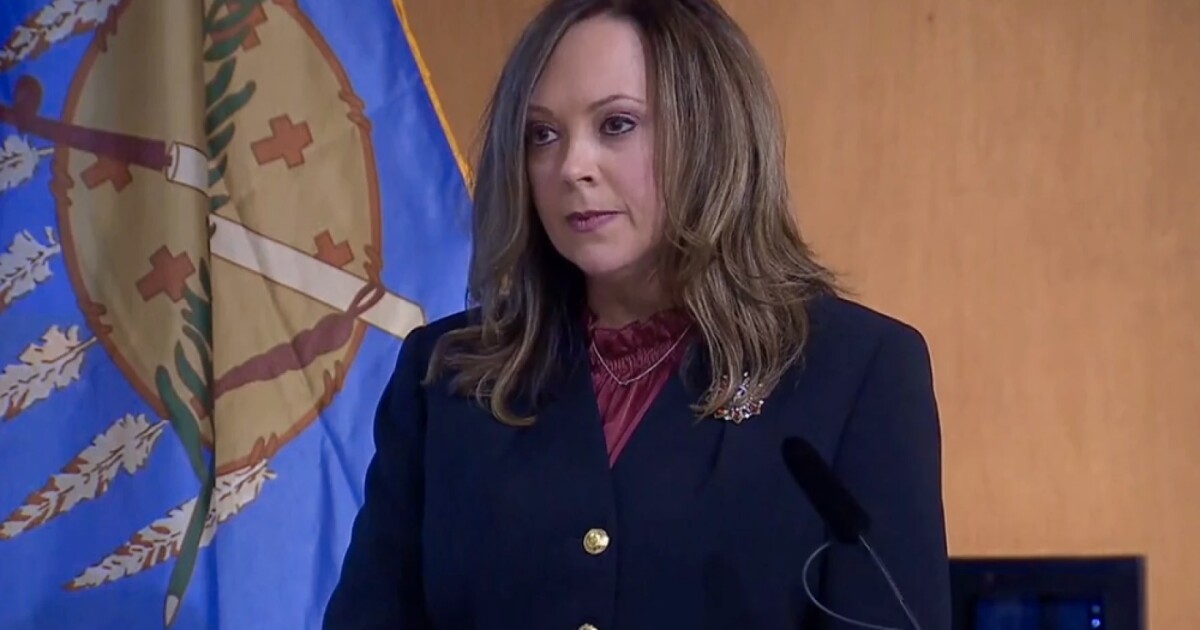
The audit finds at least $30 million and up to $100 million of questionable costs passing through OMES.
Byrd finds the agency created a new set of rules for vendor contracts that bypass the competitive bidding process. Other issues include exorbitant management fees for the distribution of rental assistance and a cushy contract for the husband of an agency leader.
As a result, Attorney General Gentner Drummond is calling for the resignation of Secretary of Tourism Shelley Zumwalt. She is the former OMES director. Zumwalt denies the allegations and has told reporters she won’t be resigning.
‘Becoming a no-bid state’
In 2019, OMES introduced “Statewide Contracts” for vendors. Under one of these contracts, a company would no longer be required to participate in a competitive bidding process. Competitive bidding is meant to ensure contract work is the most cost-effective use of taxpayer dollars.
“Oklahoma is rapidly becoming a no-bid state,” reads a release from Byrd’s office. “This is a grave disservice to every Oklahoman.”
The audit report says there were no written protocols to ensure these “Statewide Contracts” were legal. Byrd’s office recommends OMES develop policies and procedures for these contracts and present them to the state legislature, which could decide whether to eliminate them or affirm their legality.
Conflicts of interest
During her time in leadership positions at OMES, Zumwalt hired software company “Phase 2” for millions of dollars of work. But Zumwalt never disclosed to the state that her husband was the vice-president of Phase 2, despite being required to fill out annual conflict of interest forms.
After Zumwalt became its Chief Innovation Officer, OMES paid her husband’s company around $7 million in taxpayer money for software services.
Zumwalt became the Executive Director of the Oklahoma Employment Security Commission in May 2020. During her time there, the OESC paid Phase 2 $8.5 million across five contracts.
Zumwalt only revealed her conflicts of interest at Phase 2 when she became director of the Oklahoma Tourism and Recreation Department in 2022. She also serves as Gov. Kevin Stitt’s Secretary of Tourism, Wildlife and Heritage.
After the release of the audit report, Attorney General Gentner Drummond called for Zumwalt’s resignation, calling her actions “wholly inappropriate and potentially unlawful.”
“This level of self-dealing represents an unforgivable breach of trust that disqualifies Ms. Zumwalt from overseeing the expenditure of our tax dollars,” Drummond said in a statement.
Pandemic relief pandemonium
Federal pandemic relief money brought even more questionable costs through OMES.
The Office contracted with the non-profit Communities Foundation of Oklahoma (CFO) to distribute $241 million in federal rental assistance. The audit found CFO mismanaged around $25 million, which included inflated administrative fees, undistributed grants, ineligible grants, unallowable bonuses, and inappropriate expenditures. The latter includes more than $33,000 in costs including “visits to entertainment venues, cooking class, succulent planting class, painting, and restaurants.”
OMES also spent more than $718,000 on questionable contracts with former employee Jill Geiger. A year after Geiger left the OMES Budget Department in 2019, her consulting company was awarded a no-bid contract to oversee the distribution of the agency’s federal pandemic relief grants, including the Emergency Rent Assistance distributed through CFO.
According to the audit, Geiger’s company did not have the experience or credentials to oversee federal grant funds, which Byrd said requires a “high level of expertise.” The audit couldn’t always determine whether Geiger’s company had completed the work it was paid for.
The foundation also used state funds to pay Geiger’s company an additional $41,000 without a contract.


A contentious debate over water and growth is intensifying in Yukon as residents and city leaders grapple with the long-term costs of supplying major industrial projects, including a data center that uses up to 3 million gallons a day.
The discussion spilled into another packed Yukon City Council meeting, where residents learned how strained and expensive the city’s water outlook could be over the next 25 years.
Emotions ran high, with one resident comparing city leadership to a Nazi regime.
Yukon’s water supply plan examines eight options, including five aquifers, non-potable reuse water, direct potable reuse water, and purchasing 2 million gallons a day from Oklahoma City.
Projected costs exceed $200 million, with millions more expected over the next 25 years for operations and maintenance.
The data center was part of the conversation from the start of the water study, which began in late 2024.
The facility uses up to 3 million gallons a day to cool its servers. One option discussed for meeting that demand is a non-potable supply providing 3 million gallons a day, with $55.9 million in capital costs and a required 18-inch pipe stretching 3.5 miles.
The option is recommended to meet great industrial demands, including a data center.
Council member Rick Cacini said his focus is on residents’ needs rather than industrial users. Cacini said, “We had water problems 8 years ago when I started, and we have water problems today.”
Another council member raised the idea of taking cost out of the equation when considering whether to supply water to the data center.
Residents spoke out one after another against the data center after hearing details of the water plan and costs.
One resident referenced Piedmont, where two data center proposals were tabled on Monday. Another resident said, “It’s not a good deal for us, and the other cities know it already.”
Some residents escalated their criticism of city leadership. One resident said, “I voted for Pillmore, and I regret that vote more than anything probably I’ve ever done in my life because this feels like some nazi regime.”
Others called for city leaders to be recalled. “We will collect those signatures within 30 days, and we’re gonna remove you.”
Concerns also grew over the data center agreement, centered on the purchaser having an “out” while the seller does not.
The city manager was said to have gotten something wrong in August.
The meeting ended with Cacini threatening to sue Mayor Brian Pillmore over comments made in an early May meeting.
Pillmore was not at the meeting, saying he was on vacation with his family.

INOLA, Okla. — Oklahoma Attorney General Gentner Drummond has filed a petition in Rogers County seeking to block a proposed aluminum-smelting facility in Inola.
According to Drummond, Emirates Global Aluminum holds a 60% controlling interest in the project. The company is based in the United Arab Emirates.
Century Aluminum, a company headquartered in Chicago, owns the remaining 40%.
If completed, Oklahoma Primary Aluminum would be the largest primary aluminum production plant in the United States. However, the facility would produce hazardous waste, which has raised concerns in both the Inola community and across the state. Billboards have been spotted along Highway 412 in Inola, warning others about the proposal.
The facility would also draw more than 1,000 megawatts of continuous energy.
“A primary aluminum smelter does not belong in a community’s backyard, and its emissions do not respect property lines,” Drummond said, adding that winds could carry pollutants into the surrounding northeastern Oklahoma communities. “The injury is imminent, it is grave, and it is irreparable.”
However, Oklahoma Governor Kevin Stitt has criticized Drummond’s actions, saying the facility would be one of the state’s largest economic development projects in history.
It is important to note that Drummond is currently running for Governor.
“As soon as President Trump made his endorsement in the governor’s race, Drummond dropped the act and showed his true colors,” said Stitt. “Now he is turning his machine against one of President Trump’s top priorities, once again weaponizing his office to settle scores instead of serving Oklahomans. President Trump’s aluminum project in Inola will rapidly grow Oklahoma’s economy and strengthen America’s supply chain for generations, while Drummond turns his back on our state in favor of cheap political gimmicks and personal gain.”
President Trump has endorsed Mike Mazzei in Oklahoma’s gubernatorial race. The Republican primary is scheduled for June 16.
Stay in touch with us anytime, anywhere —

Oklahomans will soon see semis on the road without a driver inside. That has people asking questions about safety.
The Oklahoma legislature passed a law in 2019, which was modified in 2022, allowing for fully autonomous commercial trucks on Oklahoma highways as long as they meet federal safety standards and follow state traffic laws.
The Oklahoma Highway Patrol is tasked with governing the operation of these trucks on Oklahoma roads. Troopers have been meeting with the truck makers and have trained to learn as much as possible about these trucks before they start operating. News On 6 asked troopers questions like: How will troopers pull them over? How do the trucks avoid crashes? How do the trucks handle unexpected situations?
Nearby states like Texas already have these trucks on the roads, which OHP says is helpful.
“We did have a lot of the same questions the public has. We have a lot of the same concerns about safety,” said Lieutenant Mark Southall with OHP. “We haven’t heard any bad stories from these other states. This company claims they’ve traveled two million miles without an at-fault collision. Meaning they have not been the causation of any collision.”
High-tech cameras in the trucks
OHP says they learned the trucks have cameras that can see a small animal 600 meters away, day or night. This camera system helps the trucks avoid crashes or anything in the roadway.
“We learned the camera systems in these vehicles are very sophisticated, that they can capture an image as small as a small animal up to 600 meters away. Looking at that the human eye can’t see 600 meters away or see something that small, but these cameras can pick that up and begin to make maneuvers to make sure they stay safe,” said Southall. “The cameras are very, very accurate, and they can avoid those crashes. We watched videos when we went to this training where we watched them avoid those crashes.”
How does the truck handle an unexpected road closure?
OHP says the trucking companies say the trucks have been put through just about every situation imaginable.
“The company has put this vehicle using AI through multiple different situations and scenarios that it’s learned from. If it comes upon a situation it wasn’t prepared for, using the camera system inside the vehicle, I think it begins to recognize what it needs to do,” said Southall.
How does law enforcement pull over the trucks?
“These trucks, from what we are told, are made to recognize when they are being stopped, they are made to recognize the red and blue lights and pull over to the shoulder,” said Southall. “If the vehicle senses red and blue lights and maybe they are not being pulled over, they’ll still pull over to the shoulder and stop and let the emergency vehicle go by.”
How does OHP get information if there is no driver?
OHP says there is a number on the cab of the truck that they call, and it takes them to a dispatch center. All of the trucks are equipped with a lock box with the truck’s documentation.
“The dispatch center will give us a code to be able to get into the box, and we can look at the documents on the truck from there,” said Southall.
What if a citizen sees a truck that has crashed or is on fire?
If a citizen sees the truck crashed or on fire, they can call the number on the cab, which goes to the dispatch center.
What if the truck has a mechanical problem while on the road?
OHP says if the vehicle has any sort of malfunction, it is supposed to pull over to the side of the road and stop, and it will alert dispatch.
Will the trucks be on every highway in Oklahoma?
The trucks won’t be on every highway in Oklahoma. For now, the trucks are expected to only run on the major travel routes like I-35 and I-40.
“We don’t work for this trucking company; our interest is working for the people of Oklahoma to make sure these roadways are safe. This is something the state legislature made state law, and we’ve got to begin to work with it so we can understand it,” said Southall.
The trucks could be on Oklahoma roads with drivers for testing as early as this month.
-

 South Dakota33 seconds ago
South Dakota primary results leave Legislature seats in limbo
-
 Tennessee3 minutes ago
Franklin police ticket 13-year-old after e-bike crash, and a new Tennessee law brings more changes July 1
-

 Texas9 minutes ago
National Democrats aim to flip 12 Texas House seats under newly expanded target list
-

 Utah16 minutes ago
Utah’s wonderful women took Kevin O’Leary to school over his…
-

 Vermont19 minutes ago
Hundreds of housing units in the works at closely-watched project in Burlington’s South End – VTDigger
-

 Virginia23 minutes ago
Crews put out house fire in Bristol, Virginia
-

 Washington31 minutes ago
Deputies use drone to catch man wanted for damaging car in Washington County
-

 Wisconsin33 minutes ago
Racing Sausages, Wienermobile, ancient canoes all call this place home

