Lifestyle
You don't 'hike' Fiery Furnace, Utah's exclusive maze of slot canyons. You get lost in it

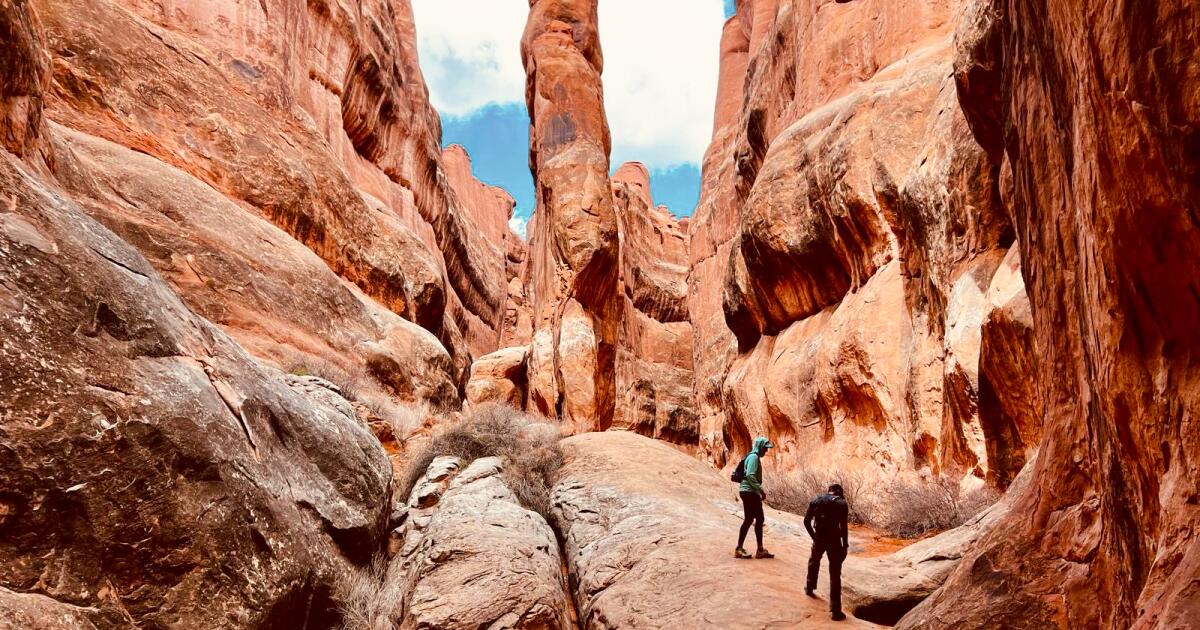
“Is that the trail?” I asked Steve, my longtime adventuring buddy. Not out of frustration or worry. I was more amazed at how this trail was marked, which is hardly at all. So you know, Steve has led me off trail only once in 10 years along dozens of hikes. He’s that good as a navigator.
“Matt — any idea?” I asked my other friend, who was head down in his GPS app, trying to decipher the snaking mess that was our location against the supposed “trail.”
The official ranger-led hike is about two miles, but if you opt to explore on your own, your trek may be much longer.
(Blake Snow)
Before I move on, you need to understand that GPS works only within 10 feet of your actual position, which is pretty amazing for triangulating satellites that are thousands of miles away. But not quite amazing enough for those afraid of getting lost on one of the most exclusive hikes in America: Utah’s Fiery Furnace in Arches National Park. One wrong step here, and you’ll be backtracking, head scratching and disorientingly wondering whether you’ll ever find the trail again in this maze of red rock, slot canyons, towering arches, divisive fins, giant spires and blue skies.
And that’s the fun of it. Here’s what you need to know — what I wish I’d known — before visiting this mostly safe and contained playground for an afternoon or more.
Utah’s Fiery Furnace is a 30-minute drive from Moab, Utah. It’s one of the only protected wilderness areas in the national park system. Open to only 75 people a day (and no reservations longer than seven days out), it’s also one of the hardest park permits to score. Compared to other hikes, Fiery Furnace is more of a moonshot when it comes to crossing its Martian terrain. “Everyone but the park rangers get lost,” our guide told us during a pre-hike orientation. “Not even GPS will save you, so it’s best just to meander and go with the flow.”
She was right about all but one thing: Although GPS tracking in the popular AllTrails app spectacularly failed to keep us on path, it did help us get out eventually so we could make it to our next hike in Arches. But if I could have a redo, I would have accepted the guide’s advice and planed for more time and mindless wandering in this special place among an already special southern Utah.
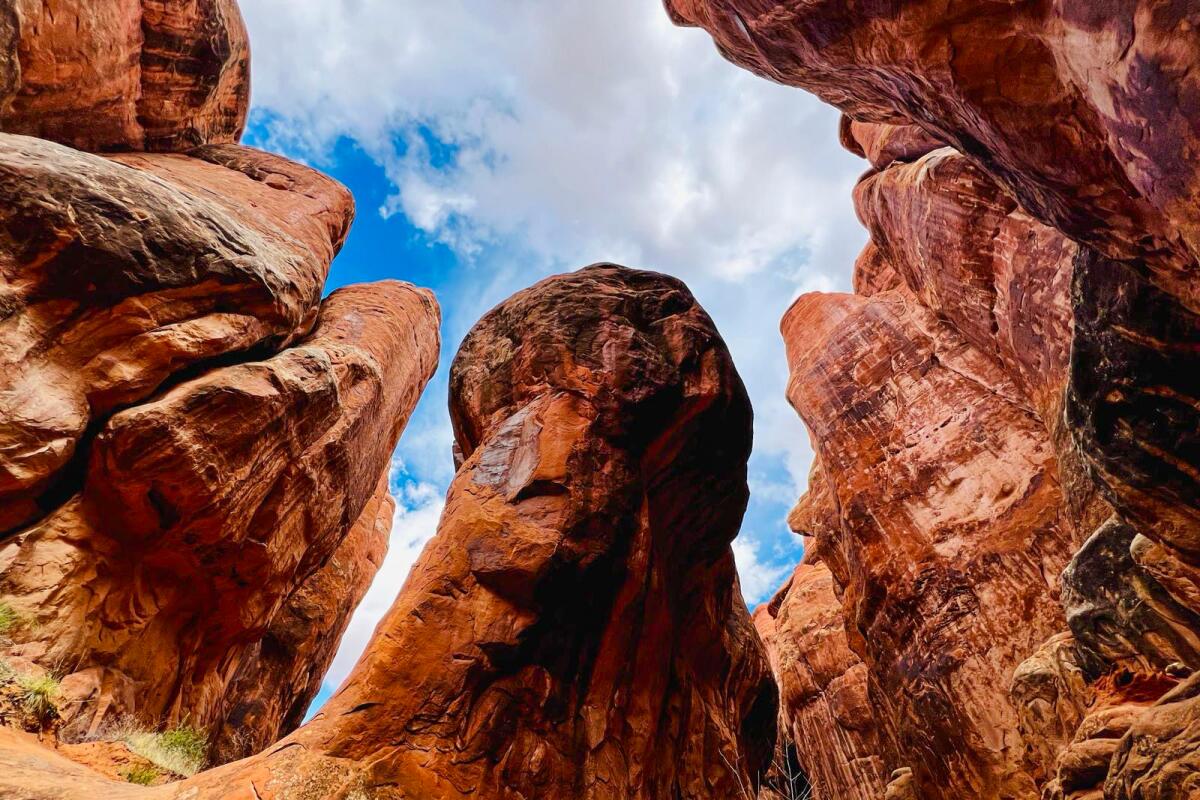
Be sure to look up, down and all around as you walk through this otherworldly maze.
(Blake Snow)
Speaking of the orientation, it’s mandatory. After picking up your $10 permit, you’re required to enter a small conference room and watch a 10-minute video about what the hike demands in terms of water, following the so-called trails and complying with the strict environmental and preservation regulations. You’ll even be verbally tested on what you watched, and the rangers won’t let you leave until you get the answers right.
After that, you’re on your own. Literally and figuratively.
During our hike, our party of three encountered just three other groups in the three hours we were inside. We jokingly exchanged pleasantries and accepted that none of us knew where we were going. But we did offer helpful tips of where we had been. “There’s a cool arch back there… Watch out for the giant gap ahead… Stay to the left or you’ll dead-end at a cliff.”
I say Fiery Furnace is mostly safe because I had to jump a gap and nearly tripped into what would have been severe injury some 20 to 30 feet below. Whoops. It’s not necessarily a physically demanding or overly technical experience. But parts of the furnace are tricky, and I wouldn’t advise anyone in poor shape to go inside. But able adults and sure-footed children regularly make their way through. For everyone else, there’s a stunning view of the furnace from the oncoming road and official viewpoint.
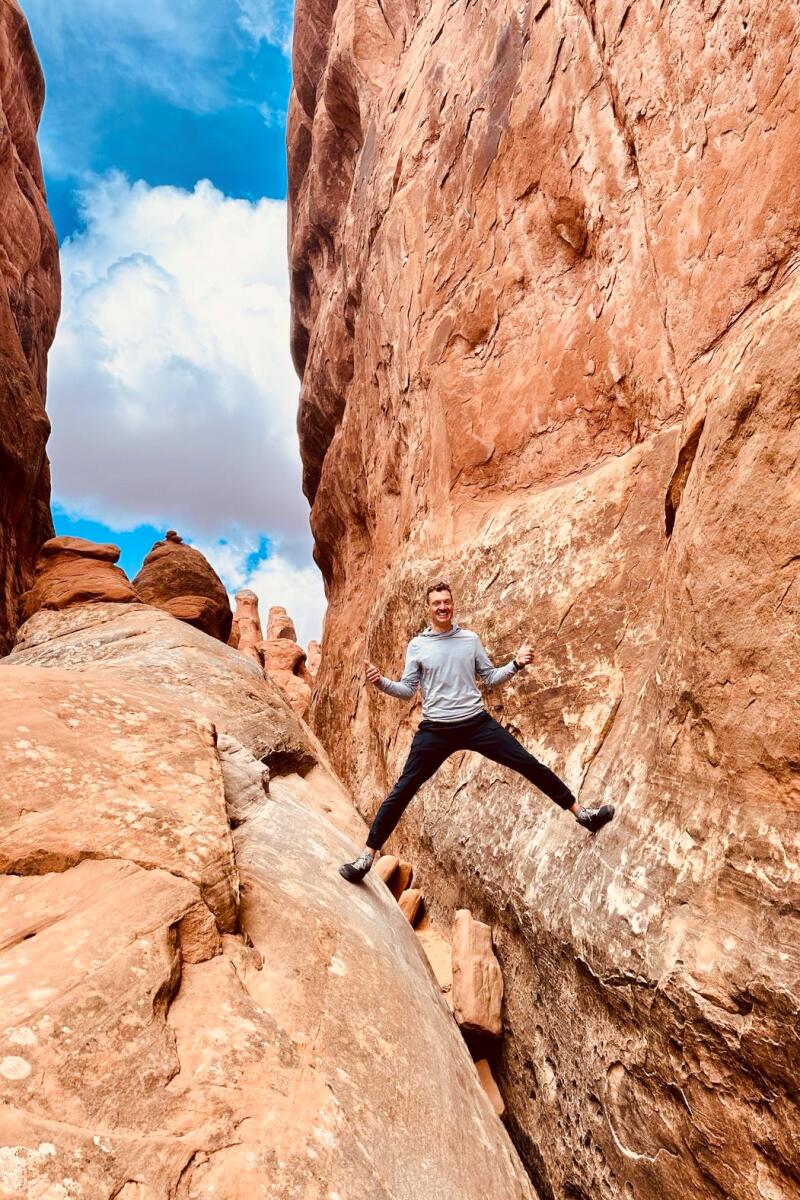
The view on a trip to the Fiery Furnace canyon in Arches National Park, Utah. (Blake Snow)
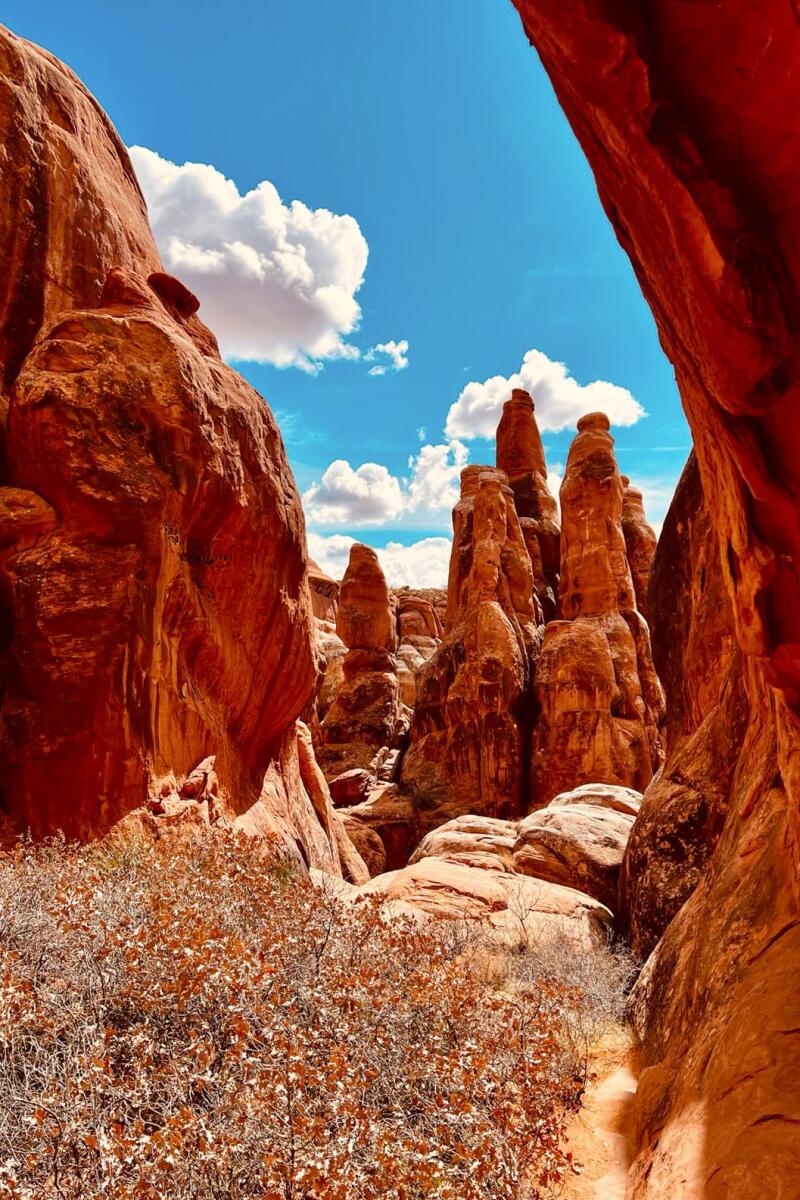
Blue skies and red rocks inside Arches National Park, Utah. (Blake Snow)
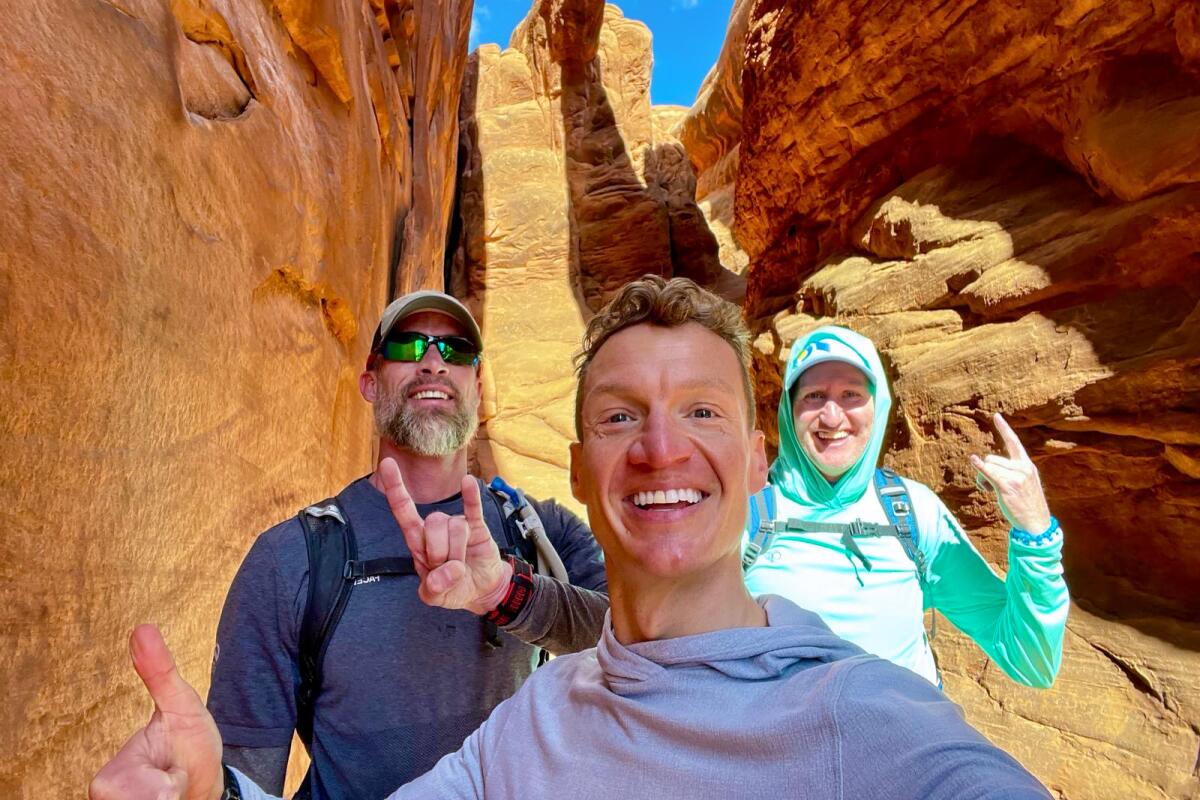
The author, center, and his hiking pals made it out of Fiery Furnace in time for their next Utah trek.
(Blake Snow)
While hiking the furnace, you can expect several arches, a sea of balancing rocks and mushroom like toadstools, massive cliff walls, incredibly tight slot canyons, layers upon layers of sandstone fins that divide the landscape and even a few open spaces. There are deep canyons, dead ends, sweeping vistas of distant formations elsewhere in the park, and a deafening amount of silence.
My friends and I lunched in the spring shade of Surprise Arch, a natural stone arch sandwiched between two massive rock walls. I have no idea how it or any of us got here. But there we were, dining al fresco in this otherworldly place.
If venturing the unknown of Fiery Furnace all alone doesn’t appeal to you, park rangers offer guided tours several times a day to permitted guests.
For the lucky few who enter Fiery Furnace, my advice is this: Get rid of your GPS — at least until you’re ready to leave. Plan for a few extra hours inside, if not an entire day. Meander. Get lost. By all means hike — but don’t expect your average point to point or loop trail. You probably won’t see the whole area, and that’s a good thing. There’s reason to return and have an experience that’s entirely new.
The ranger was right. Just go inside and enjoy the view.



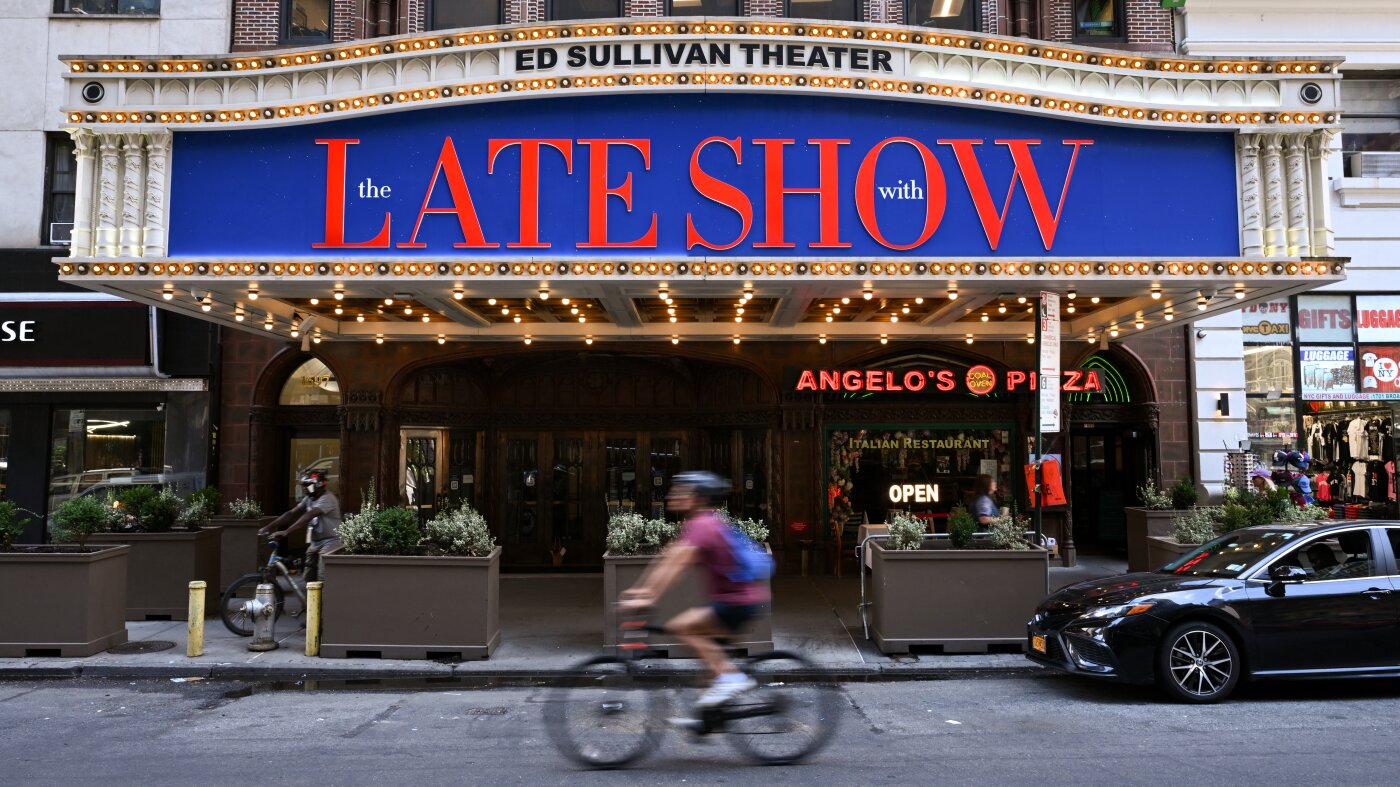
A marquee for The Late Show with Stephen Colbert at the Ed Sullivan Theater in New York City.
Angela Weiss/AFP via Getty Images
hide caption
toggle caption
Angela Weiss/AFP via Getty Images
The Late Show with Stephen Colbert ends its run on Thursday night. Our critic-at-large, Eric Deggans, will be posting his takes on the last episodes right here.
Most TV shows wrapping up after more than 10 years in the game would start off their finale week with an avalanche of clips capturing the most impactful moments from the program’s long run.
But The Late Show with Stephen Colbert is no ordinary program.
So Colbert kicked off the show’s last four episodes Monday, with a “best of the worst of” episode, featuring a bunch of comedy bits so awful they mostly never aired at all. Which was really a sideways strategy for paying tribute to the show’s staff – who packed into the seats at the Ed Sullivan Theater in New York for this cavalcade of awful, shouting out comments on stuff like video clips featuring a fake ad for “erotic body gravy” that Colbert originally declined to air because the good-looking actors featured in it just looked like “soft core gravy porn.”
Words cannot describe how right Colbert was then.
There was more: A Graphics Graveyard bit featuring a never-aired image proclaiming Hillary Clinton the 45th president (they had hoped to use it during live election coverage in 2016 – sad trombone sound here). A middling field piece featuring Colbert and a staffer buddy surprising a perplexed woman living in the apartment where they once stayed in Chicago. And longtime staffer Brian Stack playing Shrieking Joe, a Kid Rock parody so abrasive that ratings took a nosedive whenever he was on – a trend I don’t expect to end with Monday’s episode.
YouTube
It all unfolded in a way that left this critic feeling like he crashed the show’s last office party – watching lots of mildly funny material that probably hits a lot harder when you know the office drama behind making it.
As the show counts down its final nights, Colbert has tried hard to deflect anger, sadness or lionizing of his work. So I can see how an episode like this might have felt like a saucy way to redirect the inevitable nostalgia. But Monday’s episode didn’t give fans much to celebrate, beyond the obvious camaraderie the staff enjoys, even now.
In the end, as David Letterman’s former bandleader Paul Shaffer joined Colbert, the band, a bunch of dancers and one of his writers to sing a fish-themed parody of Shaffer’s 1982 disco pop classic “It’s Raining Men” – by the way, it’s not hard at all to believe that Colbert’s writers rejected this bit four times since 2011 – it all felt like a bit of a missed opportunity.
Here’s hoping the next three episodes give fans what they really want – a chance to celebrate the final hours of one of late night’s best satirists.



It is not just any Tuesday.
It is 9 p.m. on a dreary night in Shadow Hills, just miles away from the lush foothills of the Verdugo Mountains. The delicate pitter-patter of a drum’s cymbal is the only sound to break through the thick brick wall of the obscure performance venue, Sun Space, and reach the wide, desolate Sunland Boulevard.
There is no sign outside, but follow the noise inside to find the Host arrive on stage from a door hidden behind a hypnotic dayglow projector visual. He’s wearing a gold sequin jacket over a fresh-pressed polka-dot shirt, fuchsia bell-bottoms and yellow trucker hat and he has an Appalachian-style beard.
-
Share via
The Host is just one of a strange cast of characters to escape the loose folds of Noel Rhodes’ mind and make it on-time to the circus. Rhodes, 63, founded Sun Space in 2017 as a performance art venue for wayward artists who don’t properly fit the rigid mold of the Los Angeles club and bar circuit. The space is “not quite open mic,” Rhodes says, but all lovers of experimental ambient music, free-form jazz, observational comedy, paleontology and asteroseismology lectures or just plain old rock ‘n’ roll are welcome on the schedule, nearly every day of the week.
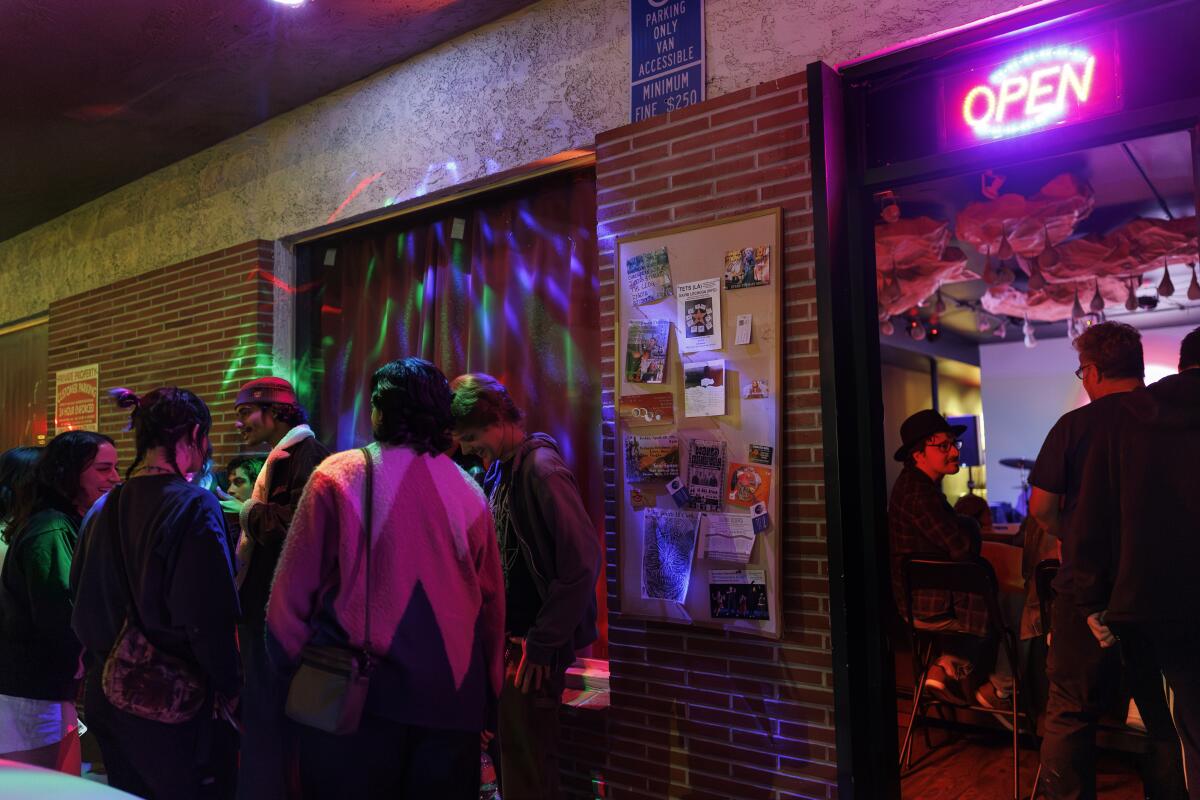
Patrons gather outside Sun Space during a break between performances in the intimate setting for Unusual Tuesday.
(Gina Ferazzi / Los Angeles Times)
Tuesdays, however, are somehow more unusual.
The crowd drowns in the second-long tension as they sit below teardrop-shaped papier-mâché stalactite hanging from handmade alien geodes on the ceiling. A 2-foot-tall, human-goat lovechild mask rests on the stage. Demographics for Unusual Tuesday range from late teens to septuagenarians, mingling and meandering as they await the start of the show.
“Let’s all together, as one great rising cluster, try, together, to accomplish one thing,” says the Host.
“Let’s figure out what this whole thing is!”
The house band drums intensify, a violin cries and guitar chords growl.
“It’s Un-usual Tuesday,” the congregation replies in song. “And all of those other days, like Friday and Saturday and Sunday … are just big wastes of ti-ime!”
Chaos breaks loose. Rhodes’ bones transform into wild, loose cartilage. Tonya Lee Jaynes, the drummer, puts her entire life force into the bass and snare. The crowd sings the chorus in dissonant harmony.
On an entirely normal Wednesday walk through a nature preserve north of Los Angeles, Rhodes says the idea for Sun Space and the hallmark Unusual Tuesday came from small fundraiser shows his father put on for their small Pennsylvanian town when Rhodes was a child. Vague memories of “The Little Rascals” and “Monty Python” influenced the sketch-based, psychedelic feel of Unusual Tuesday, with Sun Space serving as an outlet for other misfit artists looking to perform on the other days of the week.
“My goal was just to cover the rent with volunteers and equipment already bought,” Rhodes says. “I knew it would work if we weren’t having to pay our home rent on it, you know, our medical bills … as long as it stayed afloat.”
Despite its obscure location, stuck between a cafe and vacant building, the weekly show began to attract an eccentric crowd of artists and attendees.
“The whole ethos is creativity, expression and most importantly, freedom,” says Eddie Loyola, who has attended Unusual Tuesday near-weekly since 2017. “It’s really unusual. It helps support the idea of ‘come show us what you got’ rather than something that’s just cliquey, like at other venues.”
For a fledgling artist like Bailey Zabaglio, who most commonly performs electrocrash music at small house shows, Unusual Tuesday can be a time to experiment with other genres outside of their comfort zone. On the last Unusual Tuesday of April, Zabaglio performed soft electric-indie ballads to a roar of applause as the first act of the night.

Musician Bailey Zabaglio performs an original song on an electric guitar during Unusual Tuesday.
(Gina Ferazzi / Los Angeles Times)
“The fact that the demographic is so vast and wide and every person you meet is such a f— character, it’s really cool,” Zabaglio says. “It’s so beautiful that everyone agreed to get off the phone, off their couch on a Tuesday in the middle of the week.”
The social media presence of Sun Space is sparse, so Unusual Tuesday attracts most of its attendees by word of mouth. Zabaglio’s brother, Jamie, visited from Washington and performed a witty free-form comedy act only a few slots after his sibling.
“I used to have a variety show in Washington, and this whole trip has been very healing for me,” Jamie says. “I started my own show and I was just doing whatever I could. … I felt like I would never experience something like that again, but I got it again tonight.”
Booking for this specific show is a strange calculus, says Jamie Inman, who does scheduling, sound engineering and other odd jobs for Sun Space, which he now co-owns with Rhodes. Acts are booked two to three weeks in advance and selected from a pool of artists who expressed interest in performing.
“Every single Tuesday is different. Some weeks are singer-songwriter heavy, some weeks are modular synth heavy, some weeks are everything in between,” Inman says. “Sometimes we have expert lecturers come. … We just mishmash everything together until it makes sense. Or if it doesn’t make sense, that’s fine too.”
The only break in the show’s near decade-long history came during the COVID-19 pandemic, when artists all around the city were holed up in their homes with nowhere to play. Rhodes, Inman and Chris Soohoo, Sun Space’s visuals engineer, threw together a Twitch livestream to continue the chaos.
“[Unusual Tuesday online] was nothing like this, but we all learned some new stuff, like, I got into all the visual stuff,” Soohoo says. “Someone said that their first Unusual Tuesday experience was the stream, and now they get to come here in person. … It’s good to know that we did what we could.”
During the online show, Rhodes’ character Austin Drizzles, who performs the crackpot weekly weather report, would field calls from crazed viewers. Now, back on the regular news cycle, Drizzles accepts photo submissions from viewers before the show with added commentary at the end of Unusual Tuesday.
“This was sent in by Rebecca,” Drizzles says of a photo of a squirrel. “That is a cute little wild dog. … The effervescence there. I hope they eat a banana just like they always do.”
Left Unsaid, a jazz breakbeat fusion duo, performed live for the first time at Unusual Tuesday‘s last April show. Lucian Smith and Sander Bryce, who formed the group this year, say performing in L.A. proper to an attentive audience can be a difficult feat, but Unusual Tuesday provides a full venue for nontraditional acts.

A patron watches the Unusual Tuesday show in very low light at Sun Space.
(Gina Ferazzi / Los Angeles Times)
“There’s so many venues where people are waiting for you to pull them into it,” Smith says. “But here everyone seems like they’re getting something special, and they’re excited to see what they’re gonna find out. … Coming from having no audience, I loved having this.”
For the faithful observers, many of whom attend weekly, Unusual Tuesday is welcomed as a reprieve from the stress, struggle and day-to-day drag of the working week, says August Kamp, an artist and regular attendee of the weekly sermon.
“I think we’re over-saturated with mundane everything,” she says. “The fact that there is a day of the week where I know I’ll feel extra alive and that it’s a day that is otherwise not allocated for that is really valuable.”
Many interviewees likened Unusual Tuesdays to church, a cult or a religious movement. Rhodes, raised Swedenborgian — a Christian denomination that emphasizes “divine love” based on the writings of theologian Emanuel Swedenborg — does not outright reject the comparison.
“Unusual Tuesday is definitely a church service in that we get together and hypnotize the musicians, get into a rhythm and all that stuff,” Rhodes says. “Get people into us — into a vibe.”
Near midnight, following Austin Drizzles’ weekly forecast, the church once again erupts into the Unusual Tuesday gospel. A rapturous feeling takes over the room, as if all of the disparate identities and backgrounds came together in spiritual tune — the cluster having finally risen. Some mouth the words, but others belt away, letting all the emotion built up over the six other days of the week fall onto Rhodes, who’s not Rhodes then, but simply the Host.
He delivers only one promise, which he no doubt will keep: “I will see you in six days, 22 hours, and however many minutes, for Unusual Tuesday!”

A promo image for Wait Wait…Don’t Tell Me featuring Peter Sagal, Ken Jennings, and Bill Kurtis
Araya Doheny, Timothy Hiatt, and NPR/Getty Images and NPR
hide caption
toggle caption
Araya Doheny, Timothy Hiatt, and NPR/Getty Images and NPR
This week, legendary Jeopardy champion and host Ken Jennings joins panelists Tom Bodett, Joyelle Nicole Johnson, and Faith Salie to talk swearing on air and making up little lies to tell Alex Trebek
-

 New York29 minutes ago
Video: Judge Grants Luigi Mangione’s Request to Supress Some Evidence
-

 Los Angeles, Ca35 minutes ago
Cardi B in the lead as 2026 BET Awards nominations announced
-

 Detroit, MI59 minutes ago
Southfield police chase ends in fiery crash in Detroit
-

 San Francisco, CA1 hour ago
San Francisco ninth graders will now be measured by a controversial ‘Wheel of Power’ — so how would the city’s leaders fare? We put them to the test. – The Voice of San Francisco
-
Dallas, TX1 hour ago
Mailbag: Could Valdes-Scantling battle for WR3?
-

 Miami, FL1 hour ago
Men arrested for defacing Miami Beach pride bench with antisemitic graffiti, cops say
-

 Boston, MA1 hour ago
Boston’s Logan airport opens first-in-nation remote airport terminal
-

 Denver, CO2 hours ago
Vehicle goes airborne, hits home overnight in Denver: Police

