Business
Hollywood's stunt-driving industry is dominated by men. These women are fighting for change

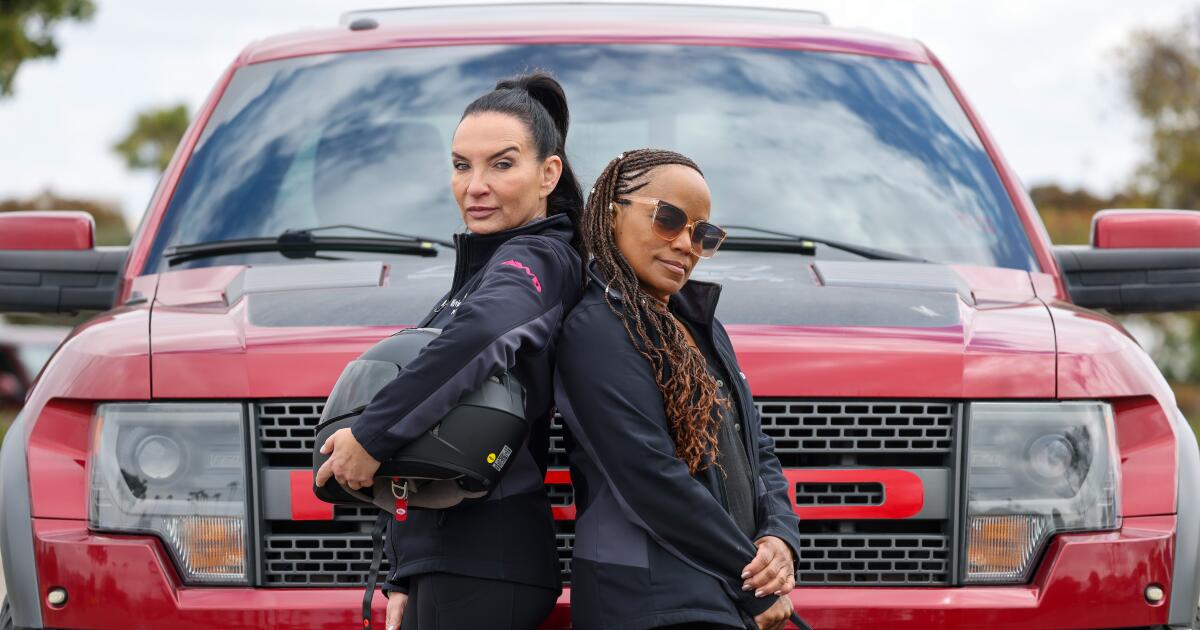
Four months after her father died in June 2019, Olivia Summers showed up to an introductory meeting at a production company in Santa Monica.
While discussing her extensive work as a stunt driver on numerous car commercials, one of the producers remarked that he was not aware there were women in the stunt-driving industry.
“We just put a guy in a wig,” Summers recalled the producer saying.
Summers, who had fought hard over the past 15 years to make a name for herself in an overwhelmingly male-dominated field, was devastated. Not only did this producer openly admit to “wigging” — a union-prohibited, gender-discriminatory practice where a male stunt performer wears a wig to double for an actress — he acted as if he didn’t even know that drivers like her existed.
Hurt and discouraged, Summers returned to her truck, put the key in the ignition and turned to her biggest supporter — her late father — for guidance. As the engine revved, Summers — who was raised Catholic and makes a sign of the cross before performing stunts — heard her father’s voice.
“He just said, ‘Start an all-female stunt-driving team,’” Summers told The Times. “And that’s how it came about.”
Summers in 2020 founded the Assn. of Women Drivers, billed as “the first and only all female stunt … and performance driving team” in Hollywood. Historically, stunt-driving teams recruited as a unit for commercials, films and/or TV shows have been led by and composed of mostly men.
The goal of the Assn. of Women Drivers, which Summers of Playa Vista runs alongside fellow stunt performer Dee Bryant of View Park-Windsor Hills, is to increase visibility and employment opportunities for female stunt workers.
The Screen Actors Guild-American Federation of Television and Radio Artists — which represents all stunt performers — has collected gender information from 4,636 stunt workers in the union. About 22% (1,025) identified as female, according to a source close to the labor organization who was not authorized to comment.
Summers doesn’t hide her frustration at the boys’ club culture of the stunt-driving industry.
“It’s bulls— because a lot of the guys on the team don’t even like each other,” she said. “They’re just trying to keep it that way so none of the work goes to us or any other independent driver out there. It’s super shady. It’s dark.”
Dee Bryant, left, and Olivia Summers smoke the tires of Summers’ Dodge Challenger in Marina del Rey.
(Brian van der Brug / Los Angeles Times)
Stunt performers of all genders have been striving to get more respect from the industry. They’ve been in the spotlight recently after the Academy of Motion Pictures unveiled a new Oscars category for casting, perceived as a snub to the stunt community, which has long pushed for Academy Awards recognition to no avail.
The lack of appreciation is particularly galling to stunt workers, who risk their safety to make more famous actors look good. Despite strict on-set rules to prevent accidents, stunt performing remains dangerous work, by definition.
Due to the entertainment industry’s reliance on stunning action set pieces, demand for stunt performers’ services remains significant, despite the rise of computer-generated graphics, the looming threat of AI and the occasional stars performing their own death-defying feats.
Combined, Summers and Bryant boast hundreds of credits on commercials, films and TV series, including “CSI,” “9-1-1,” “Bridesmaids” and “L.A.’s Finest.” While executing complex crash and high-speed chase sequences, Summers has doubled for actors such as Sarah Paulson, Phoebe Waller-Bridge and Ming-Na Wen ; while Bryant has subbed in for Angela Bassett, Regina King and Kerry Washington.
Viewers might have seen Summers weaving through oncoming traffic in an apocalyptic frenzy while doubling for Paulson in the Netflix thriller “Birdbox”; or Bryant zooming through the crowded streets of Hollywood on a motorcycle while doubling for Gabrielle Union during a police pursuit in the pilot episode of “L.A.’s Finest.”
“What dawned on me was the fact that this would create visibility for women and no longer give stunt coordinators, producers, ad agencies … the excuse to wig a male,” Bryant said. “I thought that this would be exactly what we needed to put a stop to that practice.”
Both women were encouraged by their fathers to take up sports such as waterskiing and dirt-biking and learn how to maneuver various types of vehicles from a young age.
Growing up in Toronto, Summers was operating snowmobiles solo by the age of 12. The third child of five, she experienced her fair share of mishaps — flying off the back of her dad’s snowmobile, slicing her hand open in a boating accident, repeatedly trying and failing to stand on water skis until her lips turned blue .
Olivia Summers, left, and Dee Bryant have driven in commercials for various car companies, including Ford.
(Brian van der Brug / Los Angeles Times)
Meanwhile, Bryant’s father — a Harley guy who belonged to a motorcycle crew — gifted his daughter her first dirt bike at the age of 11. Bryant grew up piloting motorcycles on the sunbaked terrain of California’s San Gabriel Valley.
“My dad bought me a motorcycle, and now I have 13 motorcyles,” Bryant said. “It’s his fault.”
Before long, she set her sights on water sports and eventually the “the big Tonka toys” that rumbled around construction sites.
For now, Bryant and Summers are the only two members of the Assn. of Women Drivers. They do, however, have plans to expand by recruiting drivers specializing in cars, motorcycles, dirt bikes and watercraft.
After catching wind of their efforts, some Hollywood producers at William Morris Endeavor approached Bryant and Summers with a pitch for a reality competition program centered on their search for the most talented women stunt drivers — and asked the duo to hold off on recruiting more members while they shop the idea.
But that hasn’t stopped them from mentoring fellow female stunt drivers looking to carve out space for themselves in the entertainment business. Summers and Bryant said it’s in their best interests to help train aspiring female stunt drivers so that their protégées can lead by example.
“Yesterday I drove two hours to help one of the girls that I’m mentoring buy a stunt car because I want these girls to look good on set,” Bryant said. “It’s a reflection on us if they don’t. Then the coordinator goes, ‘See, there’s no good women drivers.’”
Decatur, Ga.-based stunt driver and motorcyclist Jwaundace Candece — who has worked on “Atlanta,” “WandaVision” and “Baby Driver” — credits Bryant with teaching her how to “ride for the cameras” and pointing her to people who could further her career.
When she was hired by stunt coordinator Darrin Prescott to work on “Baby Driver,” Candece relied on Bryant’s sage advice: “Hold your own, drive like a man and prove them wrong.” Impressed, stunt coordinator Thom Williams tapped Candece for HBO’s “Watchmen.”
Bryant and Summers “are starting something that is innovative and revolutionary,” Candece said. “I hope it’ll open up doors to hire more women, more women of color — more women, period — because that’s what’s needed.”
In addition to wigging, Bryant, Candece and other stunt women of color have had to contend with “paint downs” — or putting white people in brownface or blackface instead of hiring stunt women of color to double for non-white actors. Fewer than 10 years ago, Warner Bros. publicly apologized for casting a white stunt woman to double for a Black guest star in the superhero series “Gotham.”
“I first spoke up against that … maybe 15, 20 years ago, and it’s still happening,” Bryant said. “That’s what happens in this business behind the scenes.”
As onscreen representation for women is shifting and more actresses are being cast in action roles, Hollywood needs to hire more women stunt drivers to double for them.
And it’s not just the stars who require doubles — for every action hero or villain who operates a vehicle onscreen, there are dozens more background drivers populating the streets, called “nondescript drivers.”
It’s especially rare for women stunt performers to get work as nondescript drivers. Bryant estimated that 90% of the time she is tapped for a project, she is in the “hot seat,” doubling for a principal cast member.
“How stupid does it look when you watch the movie, and you’re like, ‘Not one woman cop in 2023?’” Summers said. “When they get out [of their cars], and you just see a bunch of white guys with their guns drawn on the criminal. Come on, that doesn’t look right.”
To address this issue, Bryant called on entertainment companies to employ people to oversee hiring practices in the stunt department and advise the studios to diversify their stunt-driving teams.
The Oscars controversy was just another poke in the eye. After the academy’s recent decision to create a new Oscar for achievement in casting sparked outrage in the stunt community, ABC incorporated a sizzle-reel ode to stunt performers into this year’s Oscars telecast — a move Bryant dismissed as “a joke.”
“I have not watched the Oscars in over 20 years,” Bryant said. “I boycott because I think it’s ridiculous. … We, as stunt performers, are putting our life and limb on the line.”


A rule intended to prevent rent gouging in the wake of the Eaton and Palisades fires has lapsed in Los Angeles County, possibly exposing some renters to hikes.
The executive order that blocked rent increases was issued by Gov. Gavin Newsom amid the devastating wildfires last year. Under the order, landlords couldn’t increase rents by more than 10% above their prefire levels.
The rule, which was supposed to be temporary and was repeatedly extended, ended Friday after a vote to extend it again failed to garner enough votes. Supervisor Lindsey Horvath, whose district includes Pacific Palisades, sounded the alarm in a motion to extend price protections that failed to pass at the Board of Supervisors’ May 19 meeting.
“These price gouging protections continue to be necessary as construction and rebuilding continue, and as thousands of people remain displaced,” the motion said. “Families which signed short-term leases could face drastic price increases of 50% or more without further price gouging protection.”
Los Angeles County is home to more than 1 million rental properties, though not all of them needed protection from the new rule. There are already stricter rent increase caps for many residences, depending on the location, type and age of the building. Despite the rent control in the region, the people of Los Angeles pay among the highest rents in the country.
It is uncertain whether renters will face rapidly rising rents now that the protection has lapsed. But some real estate experts and policymakers said there was no need for the temporary rule that was part of the governor’s state of emergency.
Supervisors Kathryn Barger, Janice Hahn and Holly Mitchell abstained from voting on the motion to extend the protection, while Supervisors Hilda Solis and Horvath supported it.
“I abstained because I did not see sufficient evidence to justify extending this emergency ordinance, nor did I see evidence to eliminate it entirely,” Hahn said.
Barger’s office said she supported allowing the protections to sunset while waiting to see whether new information emerged.
“Market data already shows countywide rents are only about 2% above pre-emergency levels and rental inventory has grown,” Barger representative Helen E. Chavez Garcia said. “The Supervisor is also mindful of the burden these ongoing protections place on small property owners throughout the county.”
Mitchell did not immediately respond to a request for comment.
There haven’t been steep rent hikes in neighborhoods within three miles of the Palisades fire, according to a Times analysis of data from Zillow, the property listing company.
In ZIP Codes within three miles of the Palisades fire, rent increased 4.8% from December 2024 to April 2025. In areas around the Eaton fire, which destroyed swaths of Altadena, rent jumped 5.2% in the same period.
In L.A. County, ZIP Codes farther from the fires saw only about a 2% increase.
A landlords representative, Jesus Rojas of the Apartment Owners Assn. of Greater Los Angeles, told the supervisors during public comment at the meeting that the county’s rent-gouging rules have “long outlived the emergency they were intended to address” and are now being “wrongfully used to harm thousands of rental housing providers throughout the county.”
“There is no proof that multifamily rental housing providers are hugely increasing rents for impacted homeowners,” Rojas said.
Indeed, there are strong signs that the property market in the Los Angeles area has at last begun to cool.
L.A. metro-area rent prices recently fell to a four-year low, with the median rent slipping to $2,167 in December.
Meanwhile, condominium sales had their slowest start of the year in decades. Condo sales in Los Angeles have plummeted to a 20-year low, with fewer than 2,000 units sold in January and February — the worst start to the year since 2005.
Newsom defended the price-gouging protections shortly after they went into effect.
“In the days following the Los Angeles firestorms, we worked quickly to protect Los Angeles survivors from any form of exploitation,” he said in February 2025. “The state has the tools in place to not only block price gouging during this emergency, but also to prosecute bad actors.”
The Los Angeles County Department of Consumer and Business Affairs said it received more than 2,000 complaints after the fires, alleging that retailers and landlords were taking advantage of people put in hardship by their losses, and sent out more than 2,000 cease-and-desist letters to businesses and landlords for alleged price gouging, said Morine Merritt, who oversees department investigations into consumer and real estate fraud.
“Close to 90% of the complaints that we received involved allegations of rent increases,” Merritt said in an interview. Now that the fire-related protections have expired, existing laws and “regular market conditions determine price increases for goods and services, including rents,” she said.
Crackdowns on fire-related rent gouging have been rare, said Chelsea Kirk of the activist organization the Rent Brigade, which analyzed L.A. County’s rental market in the year after the fires. It reported 18,360 potential examples of price gouging in listings but said that few lawsuits had been filed by authorities so far.
Last week, Rent Brigade announced what it said was the first private civil lawsuit brought by a family that claimed to be rent-gouged in the aftermath of the wildfires. Plaintiffs Randall and Candy Renick, whose Altadena home was damaged, said they were charged nearly three times the maximum permitted rate for nearly 10 months. They seek restitution of $96,000 plus civil penalties and attorneys’ fees.
The rental market has probably stabilized since the fires, Kirk said, but other families may still be “locked into illegal rents” that they agreed to pay when they were in a rush to find housing after they were displaced.


Dear Mr. Pelley:
I meant what I said in my letter last week to the 60 Minutes team: joining 60 Minutes is the honor of my career and I am grateful to be working alongside the people who have contributed to the most important television journalism brand this country has ever produced. While I’m new to 60 Minutes, I’ve devoted my career to investigative journalism and storytelling. I started this job excited to collaborate and to benefit from the wisdom and experience of the 60 Minutes veterans, with you among them. For that reason, one of the first things I did in my new role was call you to talk and invite you to dinner. It is a profound disappointment that you rejected that overture and chose ambush instead. Yesterday, you hijacked my first meeting with staff to disparage me, my qualifications, and my intentions with remarkable incivility and contempt. I welcome a diversity of viewpoints and respectful debate among the team, but this was nothing of the sort. Yesterday’s performative display of hostility enacted in front of the staff instead of in a civil, private conversation-demonstrated that you have no interest in contributing to the future success of the show, or approaching my new tenure with a mind open to collaboration and progress. I am here to deliver first-in-class news programming, not to make headlines about newsroom drama. I am eager to work alongside those who share this goal.
Despite yesterday’s misconduct, I had hoped that in sitting down with you today we could find a path forward together. You made clear that you are not interested in such a path.
Your antipathy to the future of the show has come through loud and clear. And I have heard you. I therefore write on behalf of CBS News, Inc. (“CBS”) to inform you that your employment with CBS is terminated for cause effective immediately. Enclosed is your formal termination letter.
Sincerely,
Nick Bilton
Executive Producer, 60 Minutes

The co-founder of Aspiration, Joseph Sanberg, was sentenced to 14 years in prison on Monday after defrauding investors and lenders of over $248 million.
The startup, an eco-friendly digital banking company boasting fossil fuel-free investments, carbon offsets for gas purchases, and a debit card with cash-back benefits for shopping at clean companies, was founded by Sanberg and Andrei Cherny. Cherny left the company in 2022 and has not been charged.
Sanberg, an Orange County native, pleaded guilty to wire fraud in October after being arrested in March last year. Aspiration subsequently filed for bankruptcy and liquidated all of its assets by July.
Sanberg and venture capitalist Ibrahim AlHusseini, who also faces charges, together forged a series of bank statements in order to obtain loans. From 2020 to 2021, the pair forged AlHusseini’s bank statements to show millions of dollars in assets in order to obtain millions of dollars from lenders.
Additionally, they forged a letter from their audit committee stating that $250 million in funds were available, when in reality Aspiration had less than $1 million. The amount of loans defrauded exceeded $248 million.
In 2021, Sanberg artificially inflated Aspiration’s 2021 revenue by $44 million by recruiting 27 fake customers to sign letters of intent pledging tens of thousands of dollars per month for tree planting services. Sanberg himself funded the contracts and used the inflated revenue numbers to obtain more loans.
The charges sparked an NBA investigation into salary cap allegations due to Aspiration’s connections with Clippers owner Steve Ballmer.
Ballmer personally invested $60 million in Aspiration, all of which was lost. He is now the target of a civil lawsuit alleging his participation in the scheme. Ballmer denies the allegations.
The team announced a $300-million sponsorship deal with Aspiration, and Clippers player Kawhi Leonard signed a four-year, $28-million marketing contract with the company, which reportedly performed no duties. The issue has raised concerns about how players are circumventing the NBA’s salary cap.
The team lost the $300-million sponsorship deal and an additional $20 million paid for carbon offset purchases.
-

 World3 minutes ago
Video: A Death at the Epicenter of Ebola
-

 News8 minutes ago
Map: 5.1-Magnitude Earthquake Strikes off the Coast of California
-

 Politics15 minutes ago
Video: Steve Hilton Holds Slim Early Lead in California Governor’s Race
-
 Lifestyle45 minutes ago
We’re having a main character summer. Are you? : It’s Been a Minute
-

 Technology53 minutes ago
Microsoft AI chief Mustafa Suleyman says there are three labs that matter — and he wants Microsoft to be the fourth.
-

 World60 minutes ago
US ally Kuwait condemns ‘brutal and ongoing Iranian attacks’ after airport was hit
-

 Politics1 hour ago
Spencer Pratt surges to runoff in LA mayor’s race after angry voters send message to Karen Bass
-

 Health1 hour ago
One extra serving of processed meat a day linked to higher cancer risk

