Entertainment
'Curb Your Enthusiasm' finale and its 'Seinfeld' moment: 'A joke 26 years in the making'

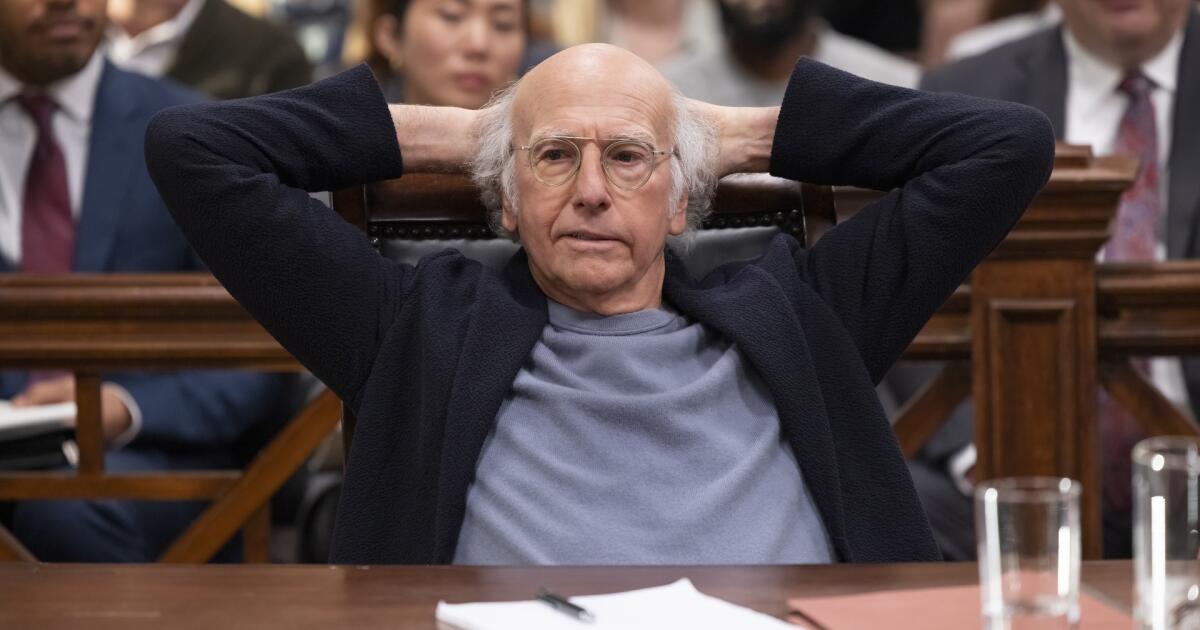
“Mr. David. It seems you have a history of doing the same things wrong over and over. And I truly hope this time you finally learned your lesson,” Dean Norris’ Judge Whittaker told Larry David — the fictionalized version of himself — during the series finale of HBO comedy “Curb Your Enthusiasm.”
He has not.
The line, which came with the judge sentencing the comedian and writer to a year in jail, was meant to be read as both literal and meta. Neither the fake Larry David, who has spent 12 seasons calling out “pig parkers” and insulting someone’s “beloved aunt”— and who now can’t even pay attention as his attorney Sibby Sanders (Sanaa Lathan) attempts to deify him to a jury — nor the real Larry David, who is a staunch defender of the similar ending for his and Jerry Seinfeld’s NBC sitcom “Seinfeld,” has ever been capable of learning a life lesson (Driving the point home, the last episode of “Curb” is titled “No Lessons Learned”).
“Curb” executive producer and showrunner Jeff Schaffer, who also directed Sunday’s finale, says the impetus for the finale came when they were writing a scene from earlier in the episode when a boy hits David’s character in the head with a ball. The child’s mother wants him to apologize and learn from his mistakes. The wisdom David’s character imparts to the tyke? That, despite being a septuagenarian, he’s never learned a life lesson.
“We realized we should own that and tell everyone Larry’s never learned a lesson and just do the finale again,” Schaffer says, adding that “Larry doesn’t care what you thought about the ‘Seinfeld’ finale. He cares so little about your thoughts that he’s going to redo it.”
And, although the “Curb” finale is full of call-backs and nods to the “Seinfeld” finale — including bringing back Seinfeld himself to be the episode’s Superman to save the day by getting the charges dropped — there is at least one major difference between the two. In “Seinfeld,” the four leads stand trial for their meanness and are sentenced to a year in jail together because they were caught mocking another person. In “Curb,” our hero’s on trial because of a decent act. He gives water to his friend Rae (Ellia English) when she’s in line to vote during a hot day in Georgia; a gesture that’s illegal under the state’s Election Integrity Act of 2021.
Still, Schaffer says “the parallel between the ‘Seinfeld’ and ‘Curb’ instigating incident doesn’t really exist” and that “it wasn’t something that motivated us in the writing.”
“It was Larry saying, ‘You know, this is crazy law in Georgia, I should get arrested for that,’” Schaffer explains. “It wasn’t ‘I’m gonna perform an act of kindness.’”
In an interview that has been edited, and condensed, for clarity, Schaffer and “Curb” co-star Susie Essman school The Times on “Lessons Learned” and other takeaways from the show’s last season.
Susie Essman, not Larry David, has the last line in the “Curb Your Enthusiasm” finale.
(John Johnson/HBO)
Susie, you have the last audible line of “Curb.” Your character, Susie Greene, and other key characters are fighting on the airplane on the way back to Los Angeles and you tell David’s character, in so many words, to shut up and go back to jail. How does that feel?
Susie Essman: It feels good. It made me very happy. I saw it last night for the first time. And I was like, “Oh, wow, I have the last line.” It’s fitting that Susie should have the last line in the world that we have created here. I don’t think that was on purpose. My voice just happened to be loud.
Jeff Schaffer: It was a final, strident grace note. When we were filming that scene, we tried a lot of different things, as we always do. There were these moves that as everyone was arguing, we would drift over to Larry. The idea, as we conceived it, was sort of ending on Larry’s face. When we were in the editing room, Larry goes, “This isn’t right. It shouldn’t end on me, it should end on our group.”
He was so great about that. Because when we ended on Larry, no matter what expression he gave, it still felt sentimental. And that’s not what we were going for. But when you end it on our guys doing what they do best, which is going at each other, you get this feeling of this is what they’re always going to be like. It’s the best retinal ghost of the show.
The finale also pays homage to Richard Lewis, who was sick while filming this season and died in February, by referencing a scene from the first episode of “Curb” and also seeing Larry continue to sabotage his friend’s love life. Were you intentionally trying to focus on him?
Essman: We didn’t know Richard was going to die, that’s for sure. He was not well, and clearly anybody who sees the season can see he’s not well. But his death was quite shocking. I don’t think anything was written toward that.
Schaffer: Once we knew we were going to do this recapitulation of the “Seinfeld” finale, the question was how far do we take it? How close do we get to the end? I really wanted us to get to that pull-out shot [of Larry in jail and repeating a conversation he’s already had; just as Jerry had done]. … It was all about [let’s] take it as far as we possibly can and make people think that we just were redoing it, shot for shot at the end.
There’s also a whole bit in the courtroom of David swatting at a fly as his attorney attempts to lionize him. And some of it is shot from the fly’s point of view. Why did you want to change up the look of the show by directing that?
Schaffer: Honestly, because it’s funny seeing Larry really go into that straight-to-camera of him trying to kill that fly during this spirited defense. The fact that he didn’t hear a word she said was funny. So we were just mixing up the shots. We wanted that shot. We wanted to see it from the jury’s POV. We wanted him in the background. There was also just one shot of his hand slamming on the table.
It was just building that sequence out of Larry trying to hunt the fly like he’s a tiger in the jungle during that speech.
Larry David and Jerry Seinfeld in the series finale of “Curb Your Enthusiasm.”
(John Johnson/HBO)
The finale has a “Seinfeld”-like scene with Larry and Jerry riffing on a hypothetical about dating a bearded lady from the circus. I’m assuming there’s a lot of unaired footage from that exchange.
Schaffer: Larry had had this hypothetical that he wanted to talk about during the season. … We didn’t know what show to put it in. And it was like, ‘Oh, this is perfect.” I’m so glad we saved it. It was the perfect hypothetical for Jerry and Larry to talk about so you could just see these two be funny together and get a sense of “OK, maybe this is how ‘Seinfeld’ got written. It was just watching these two pals making each other laugh.”
And I’m assuming that Seinfeld was OK with poking fun at his show’s finale?
Schaffer: He loved it. After we shot the jail scene, he said, “This is so great. This is a joke that’s 26 years in the making.”
This season has also gotten some intense fan reactions. An actual billboard of Essman’s character modeling her line of caftans was defaced in a similar manner to what happened to the one on the show. And a fan at a Bruce Springsteen concert came with a sign that referenced the musician’s guest appearance on the show. How are you feeling about this fandom?
Essman: Oh, my God. People called and said, “Are you upset by this?” when the billboard was defaced. I thought it was the funniest thing in the whole world. I mean, it was no small feat to get up there and do the graffiti. … They needed ropes and scaffolding.
Schaffer: It was our genital “Field of Dreams.” If we build it, they will deface it.
And poor Bruce. He does us a huge favor. He does one day of shooting, and now, for all of his concerts .…
Essman: And let me say something very important: Bruce improvised that line. He was really not given his stuff. Sometimes, somebody comes on and they’re not an actor and are spoon-fed. That’s not true. He was brilliant.
Do either of you find the “Seinfeld” finale to be as divisive as the rest of the internet seems to?
Essman: I haven’t watched it since it aired. And honestly, when it aired, I thought it was fine. And I haven’t really thought about it since then.
Schaffer: Larry and I watched it again when we realized we were doing this. … And [we both thought] that it was funny. That made this even more perfect. Because it was like, if you didn’t like that, f— you. We’re gonna do it again.
That’s one of the things I love about this finale. It’s bigger than “Curb” and it speaks to Larry as a contrarian. It not only wraps up the show, but it helps wrap up all this amazing work that Larry has done in a very Larry way. [That] is, “I thought it was funny. And you know what, I still think it’s funny.” And you know what? He’s right.



Lots of disturbing movies take place at summer camps. “Friday the 13th,” “Sleepaway Camp,” “Care Bears Movie II: A New Generation,” the list goes on, and it just keeps going because shoving dozens of kids into an emotional pressure cooker at the edge of civilization with minimal supervision and no escape is usually a bad idea. And that’s before you give them all bows and arrows.
Avalon Fast’s sophomore feature isn’t a typical summer camp horror movie. It’s a trippy, melancholic tragedy about healing psychic wounds, and finding out they’re already infected. Try to imagine an angsty, indie teen drama that’s parasitically burrowing its way into a Florence + The Machine music video. Now imagine it’s in theaters now and it’s called “Camp.”
“Truth or Dare” is a crappy game, even on “Love Island,” but it’s even crappier at the start of “Camp.” The halfhearted young friends of Emily (Zola Grimmer) can barely muster enough gusto to come up with a dare, and when they give up, their fallback “truth” is just asking her for her biggest regret. It may have been a haircut. It may have been the time she ran over a four-year-old with her car. Either way it’s a lousy icebreaker.
As if her night couldn’t get any worse, Emily’s best friend overdoses in her car, sending her spiraling into grief and misery. Months go by and her father arranges to get her a camp counseling gig, looking after other troubled youths at a place called only “Camp.” (I’d say the least plausible part of Fast’s film is that the domain name “camp.net” wasn’t already taken, but shut my mouth, because it really isn’t.)
The kids are non-entities, a vague distraction from her worries, but her fellow counselors are badasses. They smoke. They drink. They say things like, “I feel like doing drugs” and look, you gotta give ‘em credit, when they say they’re going to do something they do it. I can’t even take the recycling downstairs most of the time and here these girls are, saying they feel like doing drugs and then doing the damn drugs, making me feel like a lazy jerk.
There’s just one problem. Or maybe there isn’t. Emily’s new cohort, led by the alluring and oddly motherly Clara (Alice Wordsworth), begins each summer with a ritual to make their wishes come true. Nev (Lea Rose Sebastianis) wishes to have sex with their boss, Dan (Austyn Van De Camp), “really, really hard” and wouldn’t you know it, her wish was essentially a command.
Avalon Fast knows that’s wrong, but she knows her characters don’t care very much. Dan starts trudging across the camp grounds, confused and disturbed. He was saving himself for marriage, the poor guy, and looks like he’s on the verge of something terrible. But sacrificing Dan’s virginity gave Emily and her friends a taste of power, and it manifests in sparkly animated hand flourishes, which do nothing, it seems, except look cool. But it’s their power and they’re taking it, and they’ll take a lot more.
The problem with describing the plot of Fast’s “Camp” is that it places way, way too much emphasis on the plot. This movie doesn’t run from scene to scene, it gradually sinks into emotional rot. Emily thinks she’s getting better, finding friends and — in her own way — finding her spirituality. It’s just a selfish, detached spirituality and sees no value in anyone else’s feelings. Or anything else about them. What looks like a film about finding your way back from the darkness is, instead, a labyrinth that Emily probably can’t solve. She may not even want to.

“Camp” is a dreary, disturbing day dream of a movie, the kind you have when you’re all in your feels and close to getting heatstroke. It’s not about getting better, it’s about getting worse, and how that sometimes feels like getting better. You may not have worked through your baggage, you may not have processed your trauma, but at least everything looks simple. You can just while away your days with excess, abandoning all empathy, even for yourself.
It’s a sad film, “Camp,” and it’s a little tricky. Fast is working with familiar horror movie clichés, and falling into the old routine where witchcraft is initially empowering, then horrifying, and that probably doesn’t do real-life witches many favors. Then again, neither do a lot of the classic witch films — especially “The Craft,” the goth 1990s elephant in the room — and most of them aren’t as emotionally salient as Fast’s interpretation, although they’re typically more “fun.”
“Camp” isn’t a fun movie. That’s not a criticism, it’s just the way it is. Avalon Fast’s gloomy, lo-fi aesthetic occasionally segues into ornate, gorgeous imagery, proving the filmmaker — and cinematographer Eily Sprungman — are in total creative control. Fast wants us to feel Emily’s despair and the futile moral ambiguity of her distractions. It’s a cautionary tale, perhaps, about not hanging out with the wrong crowd, or taking solace in mind-altering experiences, but more than anything it’s a sympathetic mirror, and it’s pointed at anyone who ever got lost.


As La Cruz continues to break down barriers for the LGBTQ+ community in reggaeton, the rising Venezuelan star enjoys living out his gay fantasies in his music videos. Take the sultry video for his 2023 breakthrough single, “Quítate La Ropa,” which sees shirtless men perreando (twerking) before him in a locker room.
But at the same time, La Cruz has come to understand that his platform as a gay reggaeton artist coincides with a time when conservatism is sweeping the globe — and queer rights are receding.
“It fills me with happiness to represent a community that has been denigrated, treated badly and pushed into a corner for many years,” a bedheaded La Cruz says over Zoom from his New York City hotel room. (He had just performed at a Pride event the night before.)
“It’s a fact that [LGBTQ] rights are becoming progressive, but they’re rolled back even faster than they advance,” he adds. “This is very painful and concerning. This is happening in every country in different ways. During these difficult times, I’m going to keep putting my heart into my music more than ever.”
La Cruz is the stage name of Alfonso La Cruz. The native of La Guaira, a coastal city in Venezuela, pursued a music career after relocating to Spain in 2015. Following a brief stint on the singing competition “Operación Triunfo” three years later, La Cruz was closeted and found his momentum stifled. In 2022, he took the brave step of singing about his affection and lust for other men in his debut album, “Hawaira.”
Venezuelan reggaeton singer La Cruz released his new EP, “El Nene, Vol. 2,” on June 11.
(Maria Camila Pinzon)
Backed by the beats of reggaeton, a genre that had historically excluded the LGBTQ+ community, La Cruz found both his groove and his tribe with hits like “Te Conocí Bailando” and “Quítate La Ropa.” Early supporters included Colombian superstar Karol G, as well as Mexican American R&B singer Omar Apollo.
Alongside Puerto Rican provocateurs like Young Miko and Villano Antillano, La Cruz has continued to queer the heteronormative urbano space. He has also pushed his sound to broader horizons in his new EP, “El Nene, Vol. 2,” which includes “Sírveme,” a Brazilian funk banger with drag pop star Gloria Groove — and “Te Perdí,” a touching tribute to the victims and survivors of the 2016 Pulse nightclub shooting in Orlando, Fla.
La Cruz’s EP dropped on June 11, the day before the 10th anniversary of that tragedy, which largely impacted the queer Latino community. In an interview with The Times, he opened up about being a gay reggaetonero and “Te Perdi,” his tribute to the 49 people lost at Pulse.

It’s been three years since you first went viral with “Quítate La Ropa.” What have you learned about yourself during that time?
There are songs that have brought me a lot of love and I’m thankful to my fans that consider that song to be a classic. It’s brought me a lot of blessings. At this moment, I feel like I have the best opportunities in my life. However, I feel like the industry is a bit uncomfortable with an artist that’s openly gay and wants to be a part of this. That hasn’t stopped me at all. It’s the gasoline in my motor. It’s what pushes me to keep working hard. My fans are what’s building my career and I won’t let them down. I’m sticking with this until the end.
You connected with Karol G early in your career. Did she give you any advice when you met her?
I want to say publicly that I would love to open for her concerts on her Viajando Por El Mundo Tropitour. I’m very close to her. I love her so much. She has always treated me with so much love. I hope that something between me and her can happen sometime. I know everything happens in due time. I told her that I love the way she is and how she connects with her fans. When I see her singing and performing, I feel like she’s a sister to me. A big piece of advice that she gave me and that I’ll always carry with me is to never lose the humility and closeness that I have with my fans. The key to success is humility. I never want to be out of reach. I want people to see me and say, “I want to achieve my dreams like he has.”
How did your collaboration “Sírveme” with Gloria Groove come together?
I love her so much! I’ve always been a big fan of hers. I’ve gotten close to a lot of artists in Brazil and Gloria has been one of them. We didn’t think twice about making this song. Gloria was coincidentally traveling to the amusement parks in Orlando. I told her: “Baby, let’s go! I’m ready for you in Miami.” She told me: “Baby, I’m going to Miami!” We met one afternoon to create this song. She paused her vacation to go to the studio with me. It was very beautiful. I love my Brazilian fans.
With “El Nene, Vol. 2,” why was it important for you to also shed a light on the 10th anniversary of the Pulse nightclub shooting?
In 2016, when I recently arrived in Spain and my brother recently arrived in the U.S., we had a call with our family. My brother said, “There was a shooting close to where I live and it was in a gay club.” My family has supported me since I first told them about my sexuality. I thought that that could’ve happened to me.
I’m following up on this tragedy because it shaped my life. As the years go on, information about this attack has faded away. Each day people are talking less about it. It’s a tragedy that’s super important to remember, like 9/11 and the [2017] Las Vegas shooting, because it’s one of the worst attacks in U.S. history. Why are we not talking about it anymore? We have to keep talking about things so that they don’t happen again.
What inspiration did you pull from the Pulse tragedy for your song “Te Perdí”?
On this path, I’ve gotten to know the stories of people that survived that shooting. For example, there was a boy with his mother that lost her life and he survived. There’s a lot of stories of love from that club that have [since] come out. When I went to the studio, I was inspired by loss, or a love that’s gone away, with respect and love for the community that supports me. It is my gift, to be a voice for this situation that should never be repeated. There are people that don’t know about this tragedy and I want to let the world know that this happened. I hope that the victims’ families and the people that survived are living lives of peace and calm.

RICHMOND, Va. (WRIC) — In this episode of 8News Reel Talk, Julia Broberg sits down with Hekla Petursson and Catori Ryan to talk about “Toy Story 5.”
The hosts gave their reviews and provided the following star ratings:
Catori: ★★★★
Hekla: ★★★★★
Julia: ★★★★.2
To watch more livestreams and digital video content, head to the WRIC+ Originals page. You can also watch full on-demand videos on your smart TV using the WRIC+ app.
-

 Los Angeles, Ca5 minutes ago
Woman ambushed, violently attacked by robber in downtown Long Beach
-

 Detroit, MI23 minutes ago
Where to watch Houston Astros vs Detroit Tigers: TV channel, start time, streaming for June 26
-
San Francisco, CA35 minutes ago
I own a Turkish Restaurant in San Francisco. Turkey’s World Cup match here has changed my business.
-

 Dallas, TX38 minutes ago
Australia advances at World Cup, how to buy Australia soccer tickets
-

 Miami, FL43 minutes ago
2 detained after police pursuit ends with bailout, neighborhood search in NW Miami-Dade – WSVN 7News | Miami News, Weather, Sports | Fort Lauderdale
-

 Boston, MA50 minutes ago
Delta flight returns to Logan after smoke scare in cockpit – Boston News, Weather, Sports | WHDH 7News
-

 Denver, CO53 minutes ago
Pat Surtain II Gets More Bad News Amid Broncos’ Uncertainty
-

 Seattle, WA58 minutes ago
The World Cup 2026 Pride Match between Egypt and Iran that Seattle hopes can ‘unite football community’

