Business
Shift in China-U.S. trade is hurting California, helping Texas

As if it weren’t worrisome enough for California that more highly skilled, highly paid workers have been leaving for Texas, evidence shows that the Lone Star State has begun to siphon trade dollars and uncounted jobs away from the Southland’s ports and the distribution hubs in the Inland Empire.
And the apparent cause of the new wrinkle in the Texas-California rivalry is not some new policies or programs adopted in Texas to make it a greater magnet for economic activity that was previously in California. Instead, it’s a consequence of the U.S.-China trade war that began when Donald Trump occupied the White House and has continued with President Biden’s efforts to reduce American dependence on China, especially for high-tech products that involve national security and other issues.
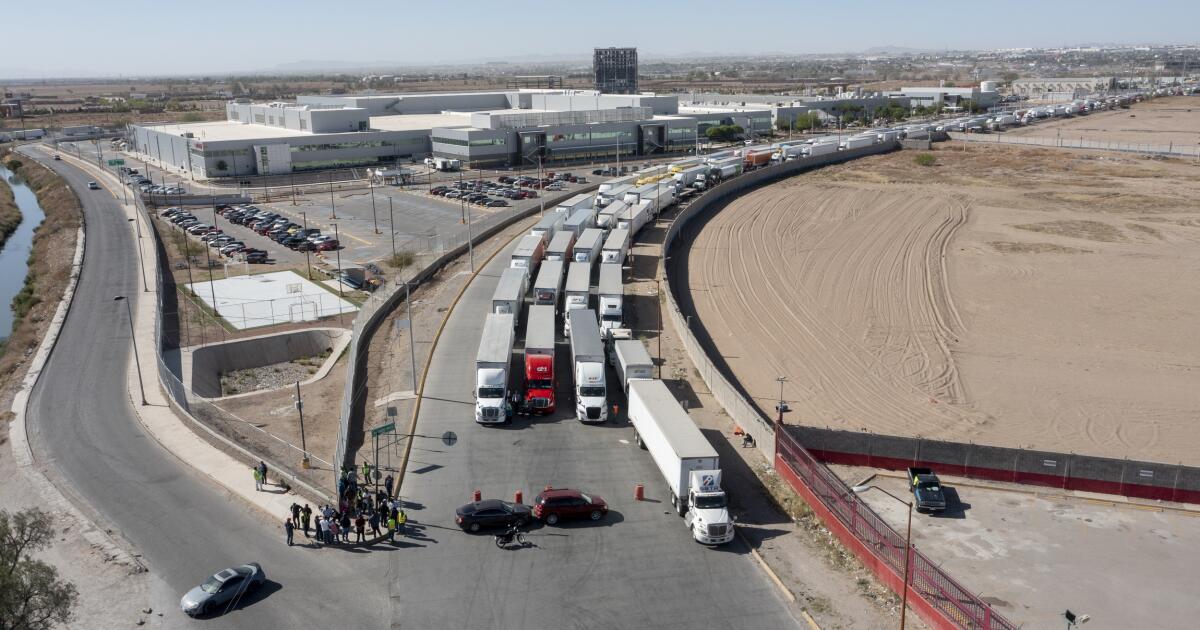
To get around the U.S. tariffs and trade restrictions, Chinese companies have sharply stepped up investments into Mexico and been moving products into the United States by truck instead of shipping by sea through the massive port and distribution systems in Southern California.
The ports of Los Angeles and Long Beach are the busiest in the nation and handle about 40% of all ocean cargo from Asia. But last year the number of 20-foot-equivalent containers from China entering the San Pedro ports complex fell a combined 12.5% from 2022, to the lowest level in at least a decade, according to data from S&P Global Market Intelligence.
“If we’re doing less business, it means fewer jobs, quite simply,” said Gene Seroka, executive director of the Port of Los Angeles. He said that every four containers translate into one job. “Economically, where all of us spend our money, if we don’t have this cargo coming through, it will be less — and there will be choices to be made.”
China’s share of all containers entering the Port of L.A. still remains dominant, at 53% last year, although that’s down from 57% in 2022. Seroka sees that percentage slipping to the mid-40s in the coming years.
The Southland’s cargo volume, overall, has picked up significantly in recent months, thanks to the end of labor contract talks and diversions to the West Coast due to military conflict and drought disrupting the Suez and Panama canals, respectively.
But longer term, Seroka said a dwindling of Chinese inbound containers has to be made up elsewhere. In addition to some 15,000 longshoremen, the two ports support hundreds of thousands of jobs in the region — in trucking, warehousing, trade finances and countless small businesses.
California’s stringent environmental regulations and high business costs add to the pressure.
To be sure, increased Mexican imports also benefit Southern California, which historically has gotten a large volume of overland trade, particularly electronic products coming up the San Diego border. But the biggest entry point for Mexican goods is Laredo, Texas, just north of the big manufacturing center in Monterrey, Mexico, and then El Paso, close to Juarez.
“Since more and more goods are coming from Mexico, Texas is geographically and conveniently located,” said Sung Won Sohn, an economics professor at Loyola Marymount University.
Tom Fullerton, a border business economist at the University of Texas in El Paso, said a lot of things made in Mexico are intermediate components, many of which go back and forth across the border as many as a dozen times. Some 90% is transported by trucks. No wonder employment for truck drivers in Texas has been growing nonstop, while California’s has come to a screeching halt, according to the U.S. Bureau of Labor Statistics.
“Increased Chinese investment simply creates more business opportunities for firms in Texas,” Fullerton said.
At the moment, trade economies in both Texas and California face some head winds, including a slowing U.S. economy as a result of anti-inflation efforts, plus cutbacks by retailers and other buyers that overstocked merchandise even as American consumers have been shifting their spending from stuff to services, such as travel and entertainment.
“Now that we filled the house with everything, everything we could wear and use for years, they’re saying, ‘Let’s go to the movies, the ballgame,’” said Jock O’Connell, a California trade specialist at Beacon Economics. “U.S. demand for imported goods from anywhere is slacking.”
Last year U.S. imports of all merchandise from China, by ship and air, fell by a whopping 20% from 2022, to $427 billion. The Commerce Department reported Thursday that Chinese imports in January were up slightly from December, but down 6% from January 2023.
Meantime, U.S. imports from Mexico continued to rise in January and compared with a year earlier, extending the lead over China. Mexican imports jumped after the worst of the pandemic passed and reached $476 billion last year. It was the first time in more than two decades that Americans bought more merchandise from Mexico than China.
Overall, the U.S. trade deficit of all goods and services fell last year by almost 19%, the largest drop since 2009, as Americans bought less foreign oil and fewer China-made phones, toys and household goods. In January, the trade deficit increased, to $89 billion, as American exports were lower than December and year-earlier figures.
Efforts to diversify production away from China have been going on for years, in part as a hedge against political risks and rising labor and business costs in China. But the move to Mexico and some other nations gained speed after then-President Trump in 2018 slapped large tariffs on a wide array of Chinese imports.
President Biden hasn’t lifted them, and in some ways further tightened the trade screws on China. The pandemic added to the so-called reshoring or near-shoring momentum as multinationals, stung by a breakdown in transport and supply chains, sought to be closer to their markets.
Harry Moser, founder of the Reshoring Initiative to bring manufacturing back to the U.S., said the changes in trade volume by country don’t tell the full story. Although he called the drop in the American trade deficit with China last year a good thing, Moser questioned whether the U.S. is really less dependent on China.
What’s happening, he argued, is that there’s considerable rerouting of trade from China through Mexico. And he fears it could get worse, pointing to the Chinese firm BYD’s plans to build an electric vehicle factory in Mexico for export to the U.S. Even Tesla, which makes its cars in Shanghai as well as Texas, is apparently urging some of its Chinese suppliers to locate in Mexico, he said.
“It’s not time to celebrate the China news,” Moser said of the reported drop in Chinese imports to the U.S.
Apparently there’s no cause to celebrate in the Southland either.
Chinese automotive parts companies have been among the most aggressive in stepping up investments in Mexico. Thirty-three car parts suppliers of Chinese origin are now registered in Mexico, and 18 exported $1.1 billion worth of products to the U.S. last year, up 15% from 2022, said Michelle Sagrero, communications manager at INA, the auto parts industry association in Mexico. She said more Chinese investments are in the works, though she said it was too early to disclose how many companies.
Overall, Chinese foreign direct investment, while stalling in the U.S., has kept growing in Mexico and topped $2.5 billion in 2022, a fivefold increase from 2000-04, according to Red ALC-China, a nonpartisan network of academics in Mexico and other countries. The tally for Chinese investments in 2023 hasn’t been published yet, but “it’ll be substantially higher,” said Enrique Dussel Peters, coordinator for the Center for Chinese-Mexican Studies at UNAM, a university in Mexico City.
The U.S.-China trade war has undoubtedly played a big role, he said. In his study for a United Nations economic group, Dussel Peters found that in 2021, companies exporting goods from China to the U.S. paid 18.8% of the value of their shipment in tariffs and transportation costs. The comparable costs for Mexico-originated exports to the U.S. — 1.05%.
“The difference is substantial, to put it politely,” he said.
Dussel Peters said he expects more Chinese and other foreign companies to invest and set up shop in Mexico. Mexico has free trade pacts not only with the U.S. but also a few dozen other nations, and it has its own sizable domestic market too. But he noted that there is one potential hitch. Thus far, Washington hasn’t come down hard in pressuring Mexico to follow the U.S. on China trade and investments.
“There is always the threat that the U.S. becomes more serious about complying with U.S. regulations and restrictions,” Dussel Peters said. “You can’t continue with a trade war and profound conflict and have a major partner of the U.S. with a sign saying to the Chinese, ‘Welcome to Mexico.’”


An Orange County real estate investor accused of criminally defrauding an Arizona bank of nearly $100 million pleaded not guilty Monday and remains in custody.
Mahender Makhijani, 44, of Corona del Mar — who also was ordered by an arbitrator to pay $1.34 billion in a separate civil fraud case — was arraigned in Santa Ana federal court on two charges.
He is accused of bank fraud and making a false statement to a bank in a June 8 case involving a $100 million real estate loan made by Phoenix-based Western Alliance Bank. He was taken into custody on June 10.
Makhijani is accused of providing bogus collateral for the October 2024 loan now in default. In a civil lawsuit, Western Alliance said the outstanding balance as nearly $99 million.
Prosecutors say he falsified title insurance policies that showed the bank would have a first lien on the underlying collateral if the loan went bad, when in fact it did not.
A trial was set for August 11 before U.S. District Judge David O. Carter in Santa Ana.
Michael Schachter, his criminal defense attorney, did not respond to messages seeking comment.
In the civil case, an arbitrator in May ordered Makhijani to pay Laguna Beach real estate mogul Mohammad Honarkar $1.34 billion after ruling he had fraudulently induced him into a 2021 joint venture — and then wrested control and lost to creditors more than two dozen properties Honarkar had owned.
Makhijani has not been criminally charged in that case, but prosecutors alleged in an affidavit in support of the bank fraud charges that he used “force and threats” in his dealings with Honarkar and others — including taking over the landmark Hotel Laguna in 2023 that Honarkar was renovating.
Prosecutors sought to hold Makhijani without bail after his arrest.
The affidavit noted he is a legal Indian immigrant with a home and bank accounts in that country, has access to private jets and threatened to “run away” if caught in a difficult situation.
The request was denied and he was granted $500,000 bail.
However, Makhijani remains in custody after a hearing sought by prosecutors last month before Magistrate Judge Autumn Spaeth.
The judge declined to accept a $450,000 cashier’s check submitted by a Makhijani associate for the bail, finding insufficient proof the source of the funds was legitimate, according to court records.
Makhijani is not prominent outside Orange County real estate circles, but he established a thriving distressed-assets business over the last decade that attracted prominent Southern California real estate investors.
Prosecutors said it paid for a lifestyle that included two multimillion-dollar homes in Corona del Mar, a luxury apartment in Newport Beach and various luxury vehicles.
As of last month, prosecutors had not fully traced his assets, which they believe are not held in his name and some of which may be in India.
The businessman employed an array of shell companies and strawmen to sign documents on his behalf, and to stand in for him as operators of his companies, according to the affidavit.
Makhijani told an associate he took extra precautions because wanted to insulate himself from litigation and that “they were sharks in the distressed world who took advantage of people,” the affidavit stated.
Business
Many indie festival films struggle to get distribution. Alamo Drafthouse is trying to change that

Dine-in movie theater chain Alamo Drafthouse Cinema is launching a new initiative to show unreleased independent films that had successful festival runs, a move that comes as specialty films have struggled to gain distribution.
The Alamo Exclusives program, announced Wednesday, will give limited theatrical runs to films that showed at festivals including Sundance, the Toronto International Film Festival, Tribeca Festival and South by Southwest festival, as well as Alamo’s own Fantastic Fest.
The idea is to help showcase films that received critical acclaim, but did not secure distribution or acquisition deals. The chain will not acquire these films, but instead will enter into agreements with filmmakers to exhibit their films on Alamo Drafthouse screens. By showing these films to audiences on the big screen, these films could get the momentum they need for further opportunities.
The program’s first film will be the documentary “Butthole Surfers: The Hole Truth and Nothing Butt,” which debuted last year at South by Southwest and chronicles the history of the punk rock band.
The film will be shown in Alamo Drafthouse theaters for a limited time later this summer.
The Austin-based chain, which is owned by Sony Pictures, has a long history of curating indie films for its audiences, giving Alamo Drafthouse confidence that its viewers want to see these kinds of movies, company chief executive Michael Kustermann said in a statement.
“Time and again, they’ve shown they’ll come out to support bold, original films when given the opportunity,” he said. The new Alamo Exclusives “gives us another way to champion filmmaker-driven films that deserve to be discovered and connect them with the wider Alamo Drafthouse audience.”
The initiative comes at a difficult time for indie films. Since the pandemic upended the movie business, traditional studios and distributors have had less appetite for risk, including betting on smaller indie films out of festivals.
And as the 2023 dual writers’ and actors’ strikes thinned out theatrical lineups, that aversion to uncertainty became a push for reliable and profitable hits.
“Too many incredible films premiere at festivals and then never receive the theatrical life they deserve,” Lisa Dreyer, director of Fantastic Fest and film innovation at Alamo, said in a statement. “We are actively searching for films across all genres, from horror to comedy, to everything in-between, to champion in this new, exciting way.”
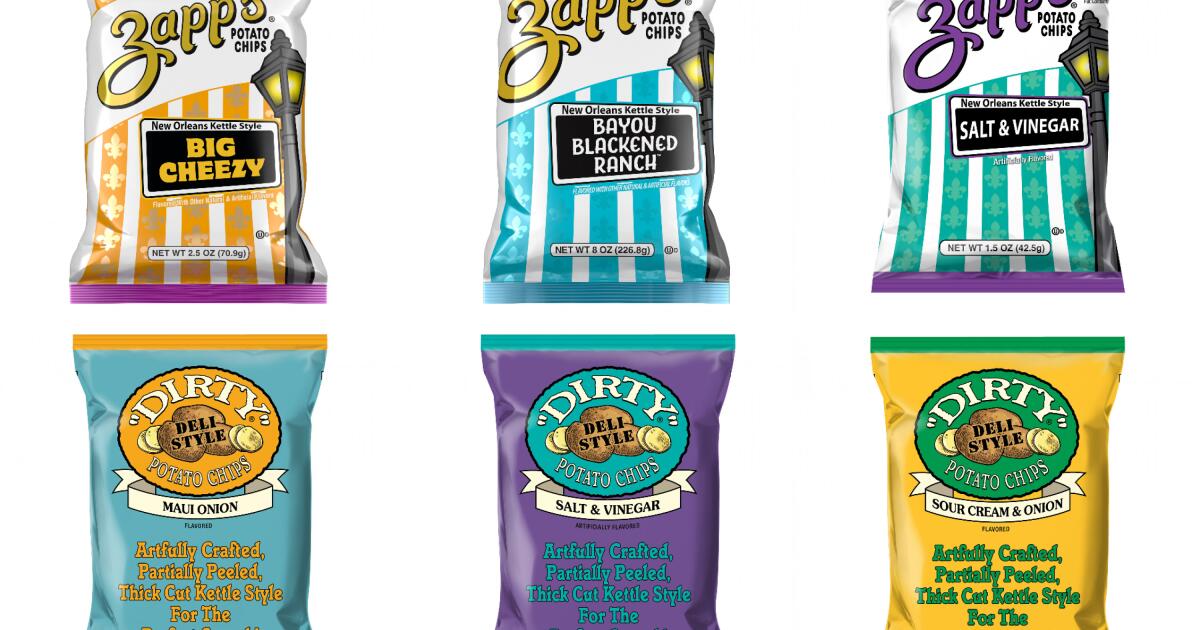
The recall of a popular chip brand over salmonella concerns was recently upgraded to the U.S. Food and Drug Administration’s highest level, just ahead of the Fourth of July holiday and countless backyard barbecues.
On June 24, the FDA designated the recall of several varieties of Zapp’s and Dirty brand potato chips as Class I, meaning it’s “a situation in which there is a reasonable probability that the use of or exposure to a violative product will cause serious adverse health consequences or death.”
FDA has classified the following items as Class I:
Zapp’s
- 1.5-ounce Zapp’s Bayou Blackened Ranch Kettle Chips
- 2.5- and 8-ounce Zapp’s Bayou Blackened Ranch Potato Chips
- 1.5- and 8-ounce Zapp’s Big Cheezy Potato Chips
Dirty
- 1.5- and 2-ounce Dirty Brand Salt and Vinegar Potato Chips
- 2-ounce Dirty Maui Onion Chips
- 2-ounce Dirty Sour Cream and Onion Potato Chips
The chips are produced by Utz Quality Foods, LLC, which on April 28 issued a recall after learning “that a seasoning containing dry milk powder, sourced from California Dairies, Inc. and supplied by a third-party supplier, may contain the presence of Salmonella.”
Salmonella can lead to sometimes deadly infections in elderly people, young children and those with weakened immune systems, according to the FDA.
More than 680,000 bags are included in the recall.
Anyone who has these products should not eat them and should discard them immediately.
What to look for
Salmonella is a foodborne illness that can be fatal to young children, pregnant women, older adults and people with weakened immune systems, according to the National Institutes of Health.
Symptoms may develop 12 to 72 hours after infection, according to the FDA.
The FDA said that people with strong immune systems infected with salmonella may experience fever, diarrhea (which may be bloody), nausea, vomiting and abdominal pain. The illness can last four to seven days.
In rare cases, the infection may produce more severe illnesses such as arterial infections, endocarditis and arthritis, the agency added.
What to do if infected
If you contract salmonella, the Centers for Disease Control and Prevention recommends drinking plenty of fluids to prevent dehydration.
The CDC advises consulting a doctor before taking antidiarrheal medicine or antibiotics. If severe symptoms continue after two days, seek medical help, the agency says.
Because those with diarrhea can spread salmonella to others, it’s also recommended to avoid sharing food or preparing meals for others, sexual contact and swimming in public pools, and to stay home while sick.
Times staff writer Jasmine Mendez contributed to this report.
-

 Virginia3 minutes ago
Virginia man charged with murder in crash that killed family of 4 on I-75 in Oakland County
-

 Wisconsin18 minutes ago
Wisconsin DOT begins $6.87M I-41 ramp deck overlay upgrades in Brown County Tuesday
-

 West Virginia23 minutes ago
11 Marshall student athletes suing NCAA over new rule – WV MetroNews
-

 Wyoming30 minutes ago
Election Q&A: Qwenton Eagle Oviatt for Wyoming secretary of state
-

 Crypto33 minutes ago
An Easy-to-Miss Radio Traffic Jam Is Behind Many Home WiFi Slowdowns
-

 Finance38 minutes ago
Fayette County Public Schools Board of Education approves audit contract, new finance director position
-

 Fitness45 minutes ago
Caroline Idiens and Jenni Falconer’s time-efficient 9-exercise workout builds full-body strength in 30 minutes
-

 Movie Reviews53 minutes ago
Film reviews: ‘The Invite’ and ‘Minions & Monsters’

