Business
Column: Cereal for dinner? It's one way to beat supermarket inflation


Every once in a while, Shardreata Moore gets a Subway coupon in the mail, and she knows she won’t have to worry about her next three meals.
“I get a $7.99 footlong and have them cut it in threes,” the retiree told me.
Moore, who was having lunch at the Sherman Oaks East Valley Senior Center, says she goes to Subway to order a chicken sandwich on whole grain bread, with spinach, cucumbers and tomatoes. That way, she gets some protein and at least a few fresh vegetables without a trip to the grocery store, where inflation is a killer.
On a tight budget, Moore said, “It’s difficult to eat healthy.”
California is about to be hit by an aging population wave, and Steve Lopez is riding it. His column focuses on the blessings and burdens of advancing age — and how some folks are challenging the stigma associated with older adults.
Ann Picanza, another retiree, was in full agreement and happy to share her cost-cutting strategies, one of which is to take advantage of the daily free lunch at the senior center. On Thursday, the offering was chicken, brown rice, vegetables and fresh fruit.
Shardreata Moore, 67, left, and Ann Picanza, in her 70s, look for bargains on the deal racks at a market in Sherman Oaks.
(Genaro Molina / Los Angeles Times)
When she does go grocery shopping, Picanza said, it’s not as simple as taking the bus to one store and filling a basket. She ricochets around from store to store, coupons in hand, seeking bargains as if on a treasure hunt.
“It’s difficult, and I have to buy things I didn’t use to,” Picanza said. “I used to enjoy buying a piece of meat in the Pavilions, but now, what can you do? I still want meat, and so I buy these pies that have meat in them, for $1.49.”
According to the AARP, food insecurity among older adults is on the rise, and “one out of 10 seniors is at risk of going hungry.” The consumer price index, compiled monthly by the U.S. Bureau of Labor Statistics, indicates a bit of inflation relief at the supermarket, but still, prices are up about 25% over the last four years. In January of this year, prices for sugar, oil, fruits and vegetables ticked up slightly, bakery products declined slightly, and meat, fish, poultry and egg prices were flat.
Even amid signs that inflation is on the decline, it’s a central topic in the presidential campaign, and people on fixed incomes are particularly hard hit by rising utility, housing and food costs.
Of course, when it comes to grocery prices, a president can’t just wave a wand at the checkout stand. Inflation is tied to rising labor costs, continued post-pandemic supply chain interruptions, avian flu and the impact of extreme weather — heat waves, wildfires and flooding — on global food production.
So prices rise and fall, mostly the former, and none of the changes escape the notice of older adults I spoke to over the last few days. At the Vons in Eagle Rock, Sylvia Millis and Vernon Bowman grabbed a hunk of tri-tip, a cheaper cut of meat, and considered some fresh fruit, eyeballing price tags.
“I do watch prices, because we have other things to pay for,” said Millis, a retired teacher. “We had a whole new gas line put in last month, and the month before that, it was a whole new water line. You’re not quite sure what’s coming down the line.”
Kris Gaine had a pack of ground beef in her cart, with a 30%-off sticker.
Shardreata Moore visits a senior center during the week where she can get a free meal. “It’s tough over the weekend,” Moore says.
(Genaro Molina / Los Angeles Times)
“I shop the specials and use a club card,” said Gaine, who is no rookie when it comes to collecting coupons. “Oh, I used to be the queen. Remember when they had double coupons?”
Gaine said that when she retired several years ago from 40-plus years in ticketing and subscriptions at downtown L.A. arts venues, she was financially set.
“Not now,” she said. “Inflation has overtaken my pension and Social Security. I stand here and shake my head on most of my visits to the grocery store.”
For thousands of low- and moderate-income older adults, the food offerings at the centers run by Valley InterCommunity Council (VIC) are a lifeline. In partnership with the L.A. Department of Aging, free hot, healthy lunches are served Monday through Friday at the Sherman Oaks East Valley location and the Alicia Broadous-Duncan Multipurpose Senior Center in Pacoima.
VIC also distributes care packages from the Los Angeles Food Bank, delivers to homebound seniors and connects clients to the state’s CalFresh program, which offers monthly stipends for nutritious food at supermarkets.
Beverly Ventriss, VIC’s president and chief executive, said female “solo agers” are particularly hard hit by inflation. They often outlive their husbands, who take their pensions to the grave. And traditionally, women earned lower salaries than men, so their retirement benefits often don’t measure up.
“Basically, I don’t shop. It’s cheaper for me to eat out,” Mary Green said at the Pacoima center, explaining that she gets meals priced as low as $5 with coupons from Burger King, Carl’s Jr. and Panda Express. “I live alone, and it’s cheaper for me to not use the utilities, and I don’t have to mess up the kitchen.”
She knows it’s not the healthiest way to eat, but she gets balanced meals at the senior center. And a tight budget is a tight budget.
“My gas bill is killing me,” said Sara Guerrero, a regular visitor at the Pacoima center. “I had to give up cooking my delicious pork chops. They’re too expensive now.”
Gail Martin, who was working the front desk at the senior center, told me two food items keep her alive.
“I eat a lot of cereal, I’m not going to lie,” she said, explaining that store-brand cereal — “not the real Cheerios” — has replaced meat for her at lunch and dinner. “And I eat cups of soup, cups of noodles. I eat those a lot.”
At the Sherman Oaks center, Moore said she’s been hammered by a rent increase from $1,190 to $1,400 a month. With free lunches served only on weekdays, she doesn’t eat three meals on weekends. Picanza said she’s handling the mortgage on her condo, but she’s getting pinched by rising homeowners association fees.
When Moore and Picanza had finished their lunch, they piled into my car and we drove to a nearby Ralphs to see what was on sale. Just inside the front door, they went straight to a section of big bins heaped with sale items. Ken’s Steak House salad dressing was reduced from $3.49 to $2.49. Classico pasta sauce was knocked down a dollar, to $1.99 per jar. And Progresso soup, regularly $2.79, was $1.79.
Shardreata Moore, left, and Ann Picanza leave the market with some of their bargains.
(Genaro Molina / Los Angeles Times)
“You have to check the dates,” Moore said, examining a can. She also found some discounted salmon and ground beef, and reminded us that the older it gets, the lower the price.
Smart shoppers also are checking for what’s known as shrinkflation, the sneaky trend called out by President Biden in his State of the Union Speech, to keep prices level but skimp on what’s in the bag.
In the produce section of the store, Picanza was disappointed that a big bag of refrigerated broccoli she has bought for $5.99 had gone up to $6.50.
In another aisle, she picked up a loaf of whole-grain sliced bread, checked the price and frowned.
“This isn’t on sale, it’s $3.29,” she said. “But it’s the bread I like.”
Picanza said she might ask the manager to mark it down.
“She would do it too,” Moore said.
Picanza scanned the store, looking for help. Fighting inflation is not for the meek of heart. The equity gap only gets wider, and you have to pretend you don’t know you’re living in the strongest economy in the world and continue to forge ahead.
steve.lopez@latimes.com



Dear Mr. Pelley:
I meant what I said in my letter last week to the 60 Minutes team: joining 60 Minutes is the honor of my career and I am grateful to be working alongside the people who have contributed to the most important television journalism brand this country has ever produced. While I’m new to 60 Minutes, I’ve devoted my career to investigative journalism and storytelling. I started this job excited to collaborate and to benefit from the wisdom and experience of the 60 Minutes veterans, with you among them. For that reason, one of the first things I did in my new role was call you to talk and invite you to dinner. It is a profound disappointment that you rejected that overture and chose ambush instead. Yesterday, you hijacked my first meeting with staff to disparage me, my qualifications, and my intentions with remarkable incivility and contempt. I welcome a diversity of viewpoints and respectful debate among the team, but this was nothing of the sort. Yesterday’s performative display of hostility enacted in front of the staff instead of in a civil, private conversation-demonstrated that you have no interest in contributing to the future success of the show, or approaching my new tenure with a mind open to collaboration and progress. I am here to deliver first-in-class news programming, not to make headlines about newsroom drama. I am eager to work alongside those who share this goal.
Despite yesterday’s misconduct, I had hoped that in sitting down with you today we could find a path forward together. You made clear that you are not interested in such a path.
Your antipathy to the future of the show has come through loud and clear. And I have heard you. I therefore write on behalf of CBS News, Inc. (“CBS”) to inform you that your employment with CBS is terminated for cause effective immediately. Enclosed is your formal termination letter.
Sincerely,
Nick Bilton
Executive Producer, 60 Minutes

The co-founder of Aspiration, Joseph Sanberg, was sentenced to 14 years in prison on Monday after defrauding investors and lenders of over $248 million.
The startup, an eco-friendly digital banking company boasting fossil fuel-free investments, carbon offsets for gas purchases, and a debit card with cash-back benefits for shopping at clean companies, was founded by Sanberg and Andrei Cherny. Cherny left the company in 2022 and has not been charged.
Sanberg, an Orange County native, pleaded guilty to wire fraud in October after being arrested in March last year. Aspiration subsequently filed for bankruptcy and liquidated all of its assets by July.
Sanberg and venture capitalist Ibrahim AlHusseini, who also faces charges, together forged a series of bank statements in order to obtain loans. From 2020 to 2021, the pair forged AlHusseini’s bank statements to show millions of dollars in assets in order to obtain millions of dollars from lenders.
Additionally, they forged a letter from their audit committee stating that $250 million in funds were available, when in reality Aspiration had less than $1 million. The amount of loans defrauded exceeded $248 million.
In 2021, Sanberg artificially inflated Aspiration’s 2021 revenue by $44 million by recruiting 27 fake customers to sign letters of intent pledging tens of thousands of dollars per month for tree planting services. Sanberg himself funded the contracts and used the inflated revenue numbers to obtain more loans.
The charges sparked an NBA investigation into salary cap allegations due to Aspiration’s connections with Clippers owner Steve Ballmer.
Ballmer personally invested $60 million in Aspiration, all of which was lost. He is now the target of a civil lawsuit alleging his participation in the scheme. Ballmer denies the allegations.
The team announced a $300-million sponsorship deal with Aspiration, and Clippers player Kawhi Leonard signed a four-year, $28-million marketing contract with the company, which reportedly performed no duties. The issue has raised concerns about how players are circumventing the NBA’s salary cap.
The team lost the $300-million sponsorship deal and an additional $20 million paid for carbon offset purchases.
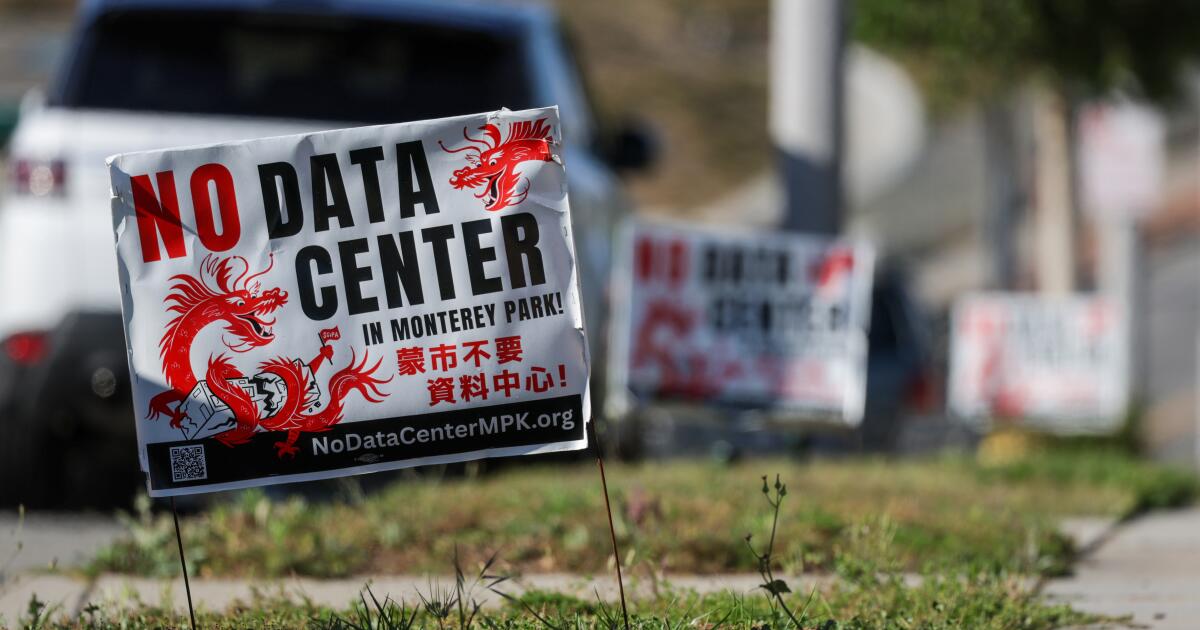
Residents in the city of Monterey Park will be the first in the nation to vote on a permanent ban on data centers Tuesday.
If approved, Measure NDC would prohibit data centers within the city limits and could only be overturned by another vote.
Yard signs saying “No Data Center” in English and Chinese with images of dragons line sidewalks in the San Gabriel Valley city.
As a wave of data center opposition sweeps the country, numerous towns and counties across the U.S. have instituted temporary moratoria and other restrictions on the facilities. But only a handful have instituted indefinite bans, and just four other towns have sent related matters to the ballot.
Supporters are hoping the vote will set a precedent for the rest of the region, where residents are fighting proposals in Vernon and City of Industry.
“This is about as permanent a ban as we can get,” said Steven Kung, co-founder of the group No Data Center Monterey Park. “Winning Measure NDC would send a huge message to the rest of the San Gabriel Valley about how residents don’t want data centers.”
The ballot measure emerged from the fight against a 247,000-square-foot center proposed in 2024 by the Australian-owned investment firm HMC StratCap for a residential area in Monterey Park.
The facility would have sat less than 500 feet away from the nearest home and used three times the electricity of the 60,000-person, predominantly Asian American city.
While the developer touted the potential for jobs and tax revenue, residents expressed concerns about noise and air pollution, rising electricity rates and a potential to lower property values.
The company pulled its plans in late March following public outcry and a March 4 city council vote to extend a temporary data center moratorium and place a ban on Tuesday’s ballot.
In a letter to the city council, HMC StratCap said it would pursue a different use for the land and would not engage in a ballot measure fight.
The city council later banned data centers indefinitely, the first in California to do so, said Mayor Elizabeth Yang. But she’s still been out campaigning for the measure with all four other council members.
“If a council puts in an ordinance, a future council can reverse it too,” said Yang. “With the ballot measure, unbanning it is a lot harder because you need the entire city to vote on it.”
The measure proposes the ban “to protect air quality, drinking water resources, and public health” and “prevent impacts to electricity and water rates.”
While California places third in the country for existing data centers with about 300 facilities, it hasn’t been a hot spot in the recent AI-driven data center boom. High electricity rates, expensive land and regulatory hurdles mean that fewer, and smaller, facilities are currently planned than in Virginia, Texas, Georgia, Illinois or Arizona.
“Most of California’s data centers are small by today’s standards,” said Shaolei Ren, an engineering professor at UC Riverside who studies how to reduce the environmental impacts of data centers. “Ten years ago, they would be medium-sized, but the power demand for new AI data centers has increased a lot.”
The average operating data center demands 45 megawatts, according to the Washington Post, while the average planned one would draw 430 MW. The one proposed for Monterey Park would have required about 50 MW at peak demand.
As proposals crop up in SoCal, they’re met with fierce opposition. Montebello, El Monte and Baldwin Park have all enacted temporary moratoria, and Alhambra recently banned data centers as part of a zoning code update. City of Industry, Vernon, City of Commerce and Santa Fe Springs are moving in the other direction, trying to court developers and streamline data center approvals. Community groups are fighting that.
Outside the San Gabriel Valley, residents of Coachella and Imperial County are showing up in droves to protest local proposals.
Matthew Shaw, a volunteer with the Coalition for Responsible Data Center Development, who recently published a report on opposition to AI data centers, said a vote to ban them in Monterey Park “would lead to copycats, partially because so many groups are just opposed to any data center development at all.”
While there is no formal opposition to Measure NDC, some building trades like Ironworker Local 433 supported the Monterey Park data center when it was still live before city council. Those in the data center industry are lamenting the state of public opinion.
“These are multi-billion-dollar assets that are built by multi-trillion-dollar companies. These things will get done,” said Mehdi Paryavi, chairman of the International Data Center Authority. “My biggest problem is that our industry does not invest enough in community engagement.”
Paryavi said towns that seek to limit data centers are missing out on thousands of jobs generated by data center construction, operations and customers, as well as faster artificial intelligence speeds and better performance.
Kung said local community organizers are “looking at the empirical evidence” and seeing a ban as a win.
“We’ve never seen a city that embraces a data center and is like, ‘Look how our quality of life has increased, look how all the revenue has gone into citywide improvements,’” he said. “That just doesn’t exist.”
-
 News15 minutes ago
California’s primary for governor is undecided as candidates vie to be in the top two
-

 Los Angeles, Ca2 hours ago
California primary election results: governor and L.A. mayor races
-

 Detroit, MI2 hours ago
Another bribery scandal hits Detroit. It involves the People Mover
-

 San Francisco, CA2 hours ago
What’s Worth More Than Cash in San Francisco Real Estate? Anthropic Stock
-

 Dallas, TX2 hours ago
Dallas weighs $500 million‑plus repair plans as City Hall’s future comes up for debate
-

 Miami, FL2 hours ago
Miami biotech executive was followed into his condo by man who allegedly threw him from 25th floor
-

 Boston, MA2 hours ago
What a World Cup ‘fan zone’ is and what Boston fans can expect in 2026
-

 Denver, CO2 hours ago
Defensive lineman Jordan Miller has a tough battle to make the Broncos’ final 53-man roster

