Politics
State of the Race: Six key Senate seats Republicans look to flip in 2024


Senate seats could flip in several states
Fox News congressional correspondent Aishah Hasnie previews some of the key races that could dictate the balance of power for the U.S. Senate in 2024 on ‘Special Report.’
Republicans are gearing up for what could be an epic showdown for majority control of the Senate with several contentious elections around the country later this year.
Democrats control the U.S. Senate with a 51-49 majority, but Republicans are looking at a favorable Senate map in 2024, with Democrats defending 23 of the 34 seats up for grabs. Three of those seats are in red states former Donald Trump carried in 2020 — West Virginia, Montana and Ohio.
Five other seats, one of which is held by an independent, are in key swing states narrowly carried by President Biden in 2020 — Arizona, Michigan, Nevada, Pennsylvania and Wisconsin.
Texas and Florida, where incumbents Ted Cruz and Rick Scott, respectively, are seeking re-election, appear to be the only potentially competitive GOP-held seats up for grabs next year.
‘TOUGHEST UPHILL CLIMB’: RACE FORECASTER REVEALS SHIFT TOWARD GOP IN TOP 2024 SENATE RACE
From left to right: Montana GOP Senate candidate Tim Sheehy; Sen. Jon Tester, D-Mont.; Sen. Tammy Baldwin, D-Wisc.; Sen. Sherrod Brown, D-Ohio; Arizona GOP Senate candidate Kari Lake; and Pennsylvania GOP Senate candidate Dave McCormick. (Getty Images)
Ohio
Longtime Democratic Sen. Sherrod Brown is the only member of his party to win a non-judicial, statewide election in Ohio in the past decade. As Brown runs in 2024 for a fourth six-year term representing Ohio, he is facing heavy targeting by Republicans in the state that was once a premier general election battleground but has shifted red over the past six years.
Trump carried Ohio by eight points in his 2016 presidential election victory and his 2020 re-election defeat. Last year, Trump’s handpicked Senate candidate in Ohio, Sen. JD Vance, topped longtime Democratic Rep. Tim Ryan by six points despite Ryan running what political experts considered a nearly flawless campaign.
Brown, who has served as a congressman, state lawmaker and Ohio secretary of state during his nearly half-century career in politics, has reportedly raked in $5.7 million in the first two months of 2024, giving his campaign $13.5 million on hand.
Two Republicans who ran unsuccessfully against Vance for the 2022 GOP Senate nomination in Ohio — state Sen. Matt Dolan and businessman Bernie Moreno — are in the race to oust Brown.
Dolan, a former top county prosecutor and Ohio assistant attorney general, launched his campaign in January 2023. Dolan, whose family owns Major League Baseball’s Cleveland Guardians, shelled out millions of his own money to run ads for his 2022 Senate bid.
He surged near the end of the primary race, finishing third in a crowded field of Republican contenders, winning nearly a quarter of the vote.
Moreno, a successful Cleveland-based businessman and luxury auto dealership magnate, declared his candidacy in April. An immigrant who arrived in the U.S. legally from Colombia with his family as a 5-year-old boy, Moreno also shelled out millions of his own money to run TV commercials to try and boost his first Senate bid. But he suspended his campaign in February 2022 after requesting and holding a private meeting with Trump.
In July, Ohio Secretary of State Frank LaRose joined the race, launching a much-anticipated Senate campaign. The state’s primary election is scheduled for March 19.
Ohio GOP Senate candidates Matt Dolan, Frank LaRose and Bernie Moreno are vying for their party’s nomination in the state’s March 19 primary. (AP)
Montana
Democrats breathed a sigh of relief when Sen. Jon Tester of Montana announced earlier this year that he would seek re-election in 2024 in a state Trump carried by 16 points in the 2020 presidential election. The Democratic incumbent, who’s running unopposed, had hauled in a formidable $15 million in fundraising as of the end of 2023.
Tim Sheehy, a former Navy SEAL and Purple Heart recipient who notched more than 200 missions in the wars in Iraq and Afghanistan and elsewhere around the globe, launched a Republican Senate bid in late June.
Sheehy, the CEO of Bridger Aerospace, a Montana-based aerial firefighting and wildfire surveillance services company, enjoys the National Republican Senatorial Committee’s (NRSC) backing and received an endorsement from Trump last month.
Sheehy will face off against four other GOP hopefuls, including former Montana Secretary of State Brad Johnson, in the state’s June 4 primary election.
Rep. Matt Rosendale, a hard-right congressman, had initially launched a bid for the Senate seat before withdrawing from the race.
Following his withdrawal, Rosendale, who narrowly lost to Tester in the 2018 Senate election, said he would seek re-election in Montana’s 2nd Congressional District. That plan, however, was halted last week when Rosendale announced he was suspending his House campaign, citing “current attacks” against him.
The campaign for Tester, who’s running unopposed, announced it had hauled in $15 million at the end of 2023. (Getty Images )
West Virginia
With Sen. Joe Manchin, D-W.Va., not seeking re-election, the race for the Senate in West Virginia is looking brighter for Republicans as they seek to flip the seat from blue to red.
Last year, NRSC Chairman Sen. Steve Daines said, “We like our odds in West Virginia.”
Right now, the main action is in the Republican Senate primary, where popular Democrat-turned-Republican Gov. Jim Justice has the backing of the NRSC and Trump. Among Justice’s six Republican challengers, the leading rival for the GOP Senate nomination is GOP Rep. Alex Mooney, who represents the state’s 2nd Congressional District and has received support from the fiscally conservative Club for Growth.
The first Democrat to jump into the race following Manchin’s departure was 32-year-old Zachary Shrewsbury, a native West Virginian and Marine Corps veteran. Two other Democrats — Don Blankenship and Glenn Elliott — are also running.
Manchin announced in November he would not be seeking re-election to his post in the upper chamber, saying in a video posted to X he believes he “accomplished what I set out to do for West Virginia” during his tenure in the Senate. Manchin, who previously served as governor of the state, was first elected to the Senate to represent West Virginia in a 2010 special election.
The state’s primary election is slated to take place May 14.
Rep. Alex Mooney, R-W.Va., left, and Republican West Virginia Gov. Jim Justice, right. (Getty/AP Photo/Chris Jackson)
Wisconsin
In Wisconsin, incumbent Sen. Tammy Baldwin, D-Wisc., is looking to retain her post in the upper chamber and clinch a third term in office.
Baldwin, who announced her candidacy in the race last April, has represented the Badger State in the Senate since 2013. She previously served in the Wisconsin State Assembly and represented the state’s 2nd Congressional District in the House from 1999 to 2013.
Running unopposed, Baldwin has received strong support from her party on a state and national level. However, Republicans are eager to make an attempt to win the seat this cycle.
GOP businessman and real estate mogul Eric Hovde launched his bid for the Senate in February and quickly became a target for Democrats as the party seeks to maintain control of the seat.
The Senate Majority PAC went up with a $2 million ad buy last week targeting Hovde as a “multi-millionaire California banker.” The ad attempted to portray Hovde as an “out-of-touch carpetbagger” whose interests don’t align with those of the Wisconsin constituency.
Recognizing the ad campaign, Mike Berg, the communications director for the NRSC, wrote on X: “How bad are @TammyBaldwin and @SenSchumer panicking about @EricHovde?”
Hovde previously ran in 2012 but lost in the GOP primary to former Gov. Tommy Thompson. Baldwin went on to win the general election that year.
Hovde formally launched his bid for the U.S. Senate in February. (Eric Hovde campaign)
Arizona
With Democrat-turned-independent Sen. Kyrsten Sinema’s announcement that she won’t seek re-election, the spotlight for the Senate race in the battleground state of Arizona has shifted to two prominent candidates — Rep. Ruben Gallego, a Democrat who represents the state’s 3rd Congressional District, and Republican Kari Lake, who previously made a run for governor of the state in 2022.
It was reported earlier this year that Gallego, the top Democrat seeking the Senate seat, had raised $3.3 million in the fourth quarter of 2023. Since launching his bid for the seat in January 2023, Gallego’s campaign reported raising $13 million earlier this year.
Lake, a former TV news anchor who has been endorsed by several leading Senate Republicans and Trump, instantly became the GOP frontrunner when she jumped into the race last October.
Politico reported in January that Lake had “raised $2 million in the roughly 11 weeks after she entered the race, but she quickly spent nearly half that haul,” leaving her with a “little over $1 million in the bank — and $308,000 in debt” to start 2024.
Prior to Lake entering the race, Mark Lamb, a Republican who serves as sheriff for Pinal County, filed paperwork to run for the seat last April. Seven other Republicans are also seeking their party’s nomination for the seat in the state’s July 30 primary election.
From left to right: Republican Pinal County Sheriff Mark Lamb; Rep. Ruben Gallego, D-Ariz.; Sen. Kyrsten Sinema, I-Ariz.; and former Republican Arizona gubernatorial candidate Kari Lake. (Getty Images)
Pennsylvania
The Keystone State, a perennial general election battleground, will likely live up to its reputation once again in 2024 as it holds what will arguably be one of the most competitive and expensive Senate races in the country.
Sen. Bob Casey, a Democrat who served a decade as the state’s auditor general and then treasurer before first winning election to the Senate in 2006, is seeking a fourth six-year term in office.
Casey, who is not expected to face any serious Democratic primary challenge, is the son of a popular former governor.
Republicans appear united behind Dave McCormick, who is making his second straight Senate run. McCormick narrowly lost the state’s 2022 GOP Senate primary election to Dr. Mehmet Oz, who went on to lose in the general election to former Braddock Mayor John Fetterman.
McCormick, a former hedge fund executive, West Point graduate, Gulf War combat veteran and Treasury Department official in former President George W. Bush’s administration, was endorsed by the Pennsylvania GOP in late September, soon after he entered the race.
Casey, a Democrat who first won election to the Senate in 2006, is seeking a fourth six-year term in office. (Bill Clark/CQ-Roll Call, Inc via Getty Images)
Axios reported in January that McCormick had raised $5.4 million in his first quarter as a candidate. Casey’s campaign announced at the beginning of the year that it had raised more than $3.6 million in the fourth quarter of 2023.
McCormick had been courted by national and state Republicans to run, and his candidacy gives the GOP a high-profile candidate with the ability to finance his own race.
The Associated Press contributed to this report.
Get the latest updates from the 2024 campaign trail, exclusive interviews and more at our Fox News Digital election hub.


new video loaded: Steve Hilton Holds Slim Early Lead in California Governor’s Race
transcript
transcript
Steve Hilton Holds Slim Early Lead in California Governor’s Race
Steve Hilton, a Republican and former Fox News host, held a narrow lead in early votes over two Democratic opponents in California’s nonpartisan primary for governor. The top two candidates will advance to the general election in November.
-
“Change is coming to California, and it’s long overdue. I want to just say something from my heart to every single person who’s voted for me. We’re not — We’re not there yet, but it’s looking good.” [cheers] “Tonight, the people of the great state of California, in the greatest nation on earth, have spoken. [cheers] Loudly and proudly. [cheers] And while I take nothing for granted, there are lots of ballots left to be counted, it appears that we are on track to advance to November.” [cheers] “It might take some time to figure out where this is going. We’re going to wait until every ballot is counted. We’re going to give democracy a time to work, and we know we finished really strong.” [cheers]
By Axel Boada
June 3, 2026
Politics
Spencer Pratt surges to runoff in LA mayor’s race after angry voters send message to Karen Bass

NEWYou can now listen to Fox News articles!
Reality television personality Spencer Pratt appears on track to clear a key hurdle in Los Angeles’ mayoral race as he seeks to unseat incumbent Mayor Karen Bass in November.
Bass, who has led the city since 2022 amid a turbulent stretch rocked by her response to wildfires, advanced to a runoff after failing to secure a majority of the vote in Tuesday’s primary election. With no candidate surpassing the 50% threshold, the top two finishers will face off in a November runoff.
The anticipated runoff is a symbolic blow to Bass, who was endorsed by Gov. Gavin Newsom, D-Calif., and former Vice President Kamala Harris and has spent decades serving California in a series of elected Democratic offices.
Pratt, a first-time candidate known for the MTV reality show “The Hills,” was running in second place as of Wednesday morning.
Los Angeles Mayor Karen Bass attends the Women for Bass Phone bank event in the Baldwin Hills area of Los Angeles on June 1, 2026. (Louise Barnsley/Splash for Fox News Digital)
REALITY TV STAR SPENCER PRATT TESTS LA VOTERS’ APPETITE FOR POLITICAL OUTSIDER
“Obviously, God wanted five more months of me exposing the failures of our mayor,” Pratt gloated to reporters as the returns came in Tuesday evening.
Pratt has relentlessly hammered Bass on issues that have long plagued the city, including fire recovery, street homelessness and crime. The insurgent candidate holds Bass personally responsible for devastating wildfires that destroyed more than 18,000 structures in the city, including his Pacific Palisades home.
Pratt’s surge appears to have shut out Los Angeles City Council member Nithya Raman, a former ally of Bass who challenged the incumbent from the left and was once viewed as a threat to her bid for a second term. Raman is a member of the Democratic Socialists of America and has argued for steering the city in a more progressive direction.
Raman has not yet conceded despite running well behind Bass and Pratt as of Wednesday morning.
Pratt, a registered Republican, faces an uphill battle to defeat Bass in November if he advances to the runoff election.
Less than 20% of voters in the heavily Democratic city identify with the GOP, though Los Angeles’ mayoral contest is officially nonpartisan.
Media personality and independent candidate Spencer Pratt, left, pictured alongside LA mayor Karen Bass, right. (Robert Gauthier/Los Angeles Times via Getty Images; Justin Sullivan/Getty Images)
KAREN BASS GRILLED OVER BROKEN HOMELESSNESS PROMISE, BLAMES BUREAUCRACY FOR SLOWED PROGRESS
Rep. Darrell Issa, R-Calif., who represents a San Diego-anchored seat, told Fox News Digital that Pratt has won a following in the mayoral contest due to widespread voter discontent with Bass’ leadership.
“He’s catching fire among ardent historic Democrat voters because Karen Bass has been so ineffective,” Issa said in an interview. “And every time she opens her mouth, she’s talking about more of the same to people who have seen their streets, both crime-ridden and in fact … ineffectively managed.”
Bass, conversely, argues that her leadership is leading Los Angeles in the right direction.
“Los Angeles is at a turning point. After decades of rising homelessness, under-built housing and a shrinking police force, it’s Mayor Karen Bass who finally stepped up to change how City Hall works,” Bass’s website reads.
Los Angeles City Councilmember Nithya Raman appears likely to finish in third place, keeping her out of the November runoff. (Eric Thayer/Getty Images)
CLICK HERE TO DOWNLOAD THE FOX NEWS APP
“Homelessness is down, more housing is being built, and the LAPD is hiring new officers,” it also claims.
Fox News Digital’s Leo Briceno contributed reporting.
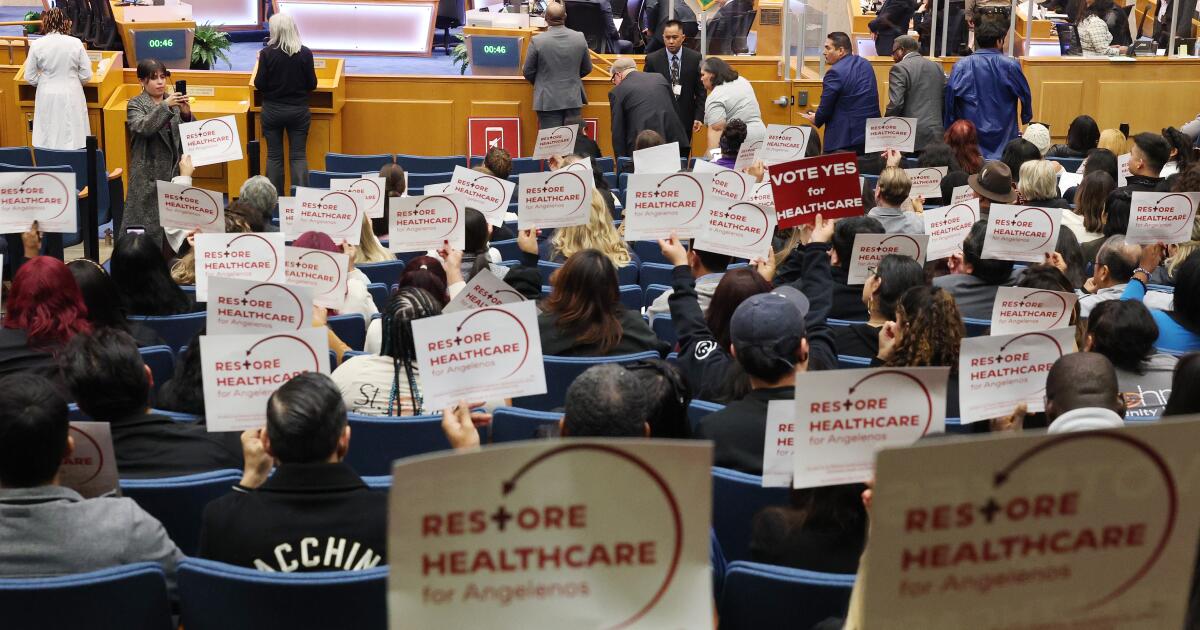
Los Angeles County’s half-cent sales tax to fund healthcare services was trailing Tuesday, with early returns showing a majority of voters rejecting the measure.
The tax — a half-penny of every dollar spent in the county — is meant to prop up local hospitals and clinics that are hemorrhaging funding after recent federal cuts.
The sales tax, which needs a simple majority to pass, would take effect Oct. 1 and last five years. Officials say it would pull in $1 billion annually to help plug the budget holes hitting local hospitals and clinics.
L.A. County health officials anticipate the One Big Beautiful Bill Act, signed into law by President Trump last summer, will slash more than $2 billion from the county’s health services budget within the next three years. Due to eligibility changes, the county will no longer be able to get reimbursements for many Californians who have lost Medi-Cal.
The measure was championed by a coalition of healthcare advocates called Restore Healthcare for Angelenos who warned that mass layoffs and emergency room closures could be imminent if new funding didn’t come fast. The Department of Public Health recently closed seven clinics — a grim sign, supporters said, of service cuts to come.
Voters haven’t rejected a sales tax hike since 2012, when a transportation measure fell just short with 66.1% support. It needed 66.7% to pass.
A majority of county supervisors had supported the new tax proposal, voting 4 to 1 this February to put it on the ballot. But the measure faced significant opposition from local cities, with opponents arguing the sales tax hike would unfairly burden the poorest county residents and encourage people to spend their dollars across the county line.
Supervisor Kathryn Barger, the board’s lone opponent of the tax, said she was concerned it was a “general” tax, meaning the money wouldn’t be earmarked for healthcare costs. Instead, she argued, politicians would have final say over how the money gets spent.
The supervisors have created a plan for spending the tax money, with the largest chunk of the money meant to cover the costs for patients without insurance. The measure also asked voters to sign off on a nine-member oversight committee.
The county currently has a base sales tax rate of 9.75%, and cities impose local taxes on top of that.
-

 Maine8 minutes ago
Maine’s abrupt plan to cut $400M in construction projects roils the industry
-

 Maryland11 minutes ago
Man found dead in South Carolina after shooting ex-girlfriend in Maryland
-

 Michigan16 minutes ago
Gotion wants Michigan township to pay the $23.7M it owes in incentives
-

 Massachusetts23 minutes ago
French-Mediterranean Eatery Charts Opening In Boston
-

 Minnesota26 minutes ago
Dennis Peterson
-

 Mississippi31 minutes ago
MHSAA private schools will have enrollment multiplier starting in 2027-28 season
-

 Missouri38 minutes ago
Water Safety Tips from Missouri State Highway Patrol – Ozark Radio News
-
 Montana41 minutes ago
Forstag secures democratic nomination for Western Montana Congressional District

