The Baltimore Banner thanks its sponsors. Become one.
Virginia
Not so fast. Proposal to relocate Wizards, Capitals to northern Virginia hits roadblock in legislature

:format(url)/cloudfront-us-east-1.images.arcpublishing.com/baltimorebanner/22ZMQT7HMFCSTLGV7QJHVBOVGA.jpg?ssl=1 "Not so fast. Proposal to relocate Wizards, Capitals to northern Virginia hits roadblock in legislature")
RICHMOND, Va. â A proposal to lure the the NBAâs Washington Wizards and NHLâs Washington Capitals to Alexandria, Virginia took another big hit Thursday, when top Virginia lawmakers confirmed the budget they will take up later this week would not include language enabling the deal.
The news does not necessarily mean the end of the road for Gov. Glenn Youngkinâs ambitions of landing Virginia its first major pro sports teams in nearly 50 years through a $2 billion development district featuring a new arena. But it complicates the path forward for a top Youngkin priority that requires legislative approval.
In a news conference at the foot of the Capitol steps, the Republican governor said he believed the Democratic-led General Assembly was poised to make âa colossal mistakeâ and argued that lawmakers should reconsider and restore the project language to the budget before sending it to his desk.
âThey have a chance to stand up and do whatâs right. They have a chance to assess this one-of-a-kind, first-of-its-kind economic development opportunity on the merits of the opportunity,â he said.
State Sen. L. Louise Lucas of Portsmouth, a senior Democrat who used her perch as chair of the Senate Finance and Appropriations Committee to keep the deal out of the pending budget legislation, stood on the Capitol portico as Youngkin spoke, looking down and sometimes smiling.
The dealâs leading opponent and a sharp critic of the governor, Lucas told reporters she remains firmly opposed to the proposal, in large part because of its reliance on bonds backed by the state and city governments.
Both Lucas and Democratic Del. Luke Torian, who chairs the House Appropriations Committee and led negotiations for his chamber, confirmed that the arena-related provisions were removed from the budget legislation, which lawmakers are expected to take up Saturday.
The legislation had been in the hands of a conference committee â a small, bipartisan group of legislators thatâs been meeting behind closed doors to find compromise â after the two chambers passed competing budget bills earlier this session.
The budget was the last vehicle remaining this session for legislation to pave the way for the deal. Two other standalone bills were defeated after Lucas refused to grant them a committee hearing.
Youngkin and other backers have a few ways to try to keep the project alive. If lawmakers send the governor a budget without the arena language, he could pursue an amendment to restore it. Or he could call a special session, starting over with a new bill.
Legislators could also reject the budget and send it back to the conference committee, though Senate Majority Leader Scott Surovell said in an interview thatâs not likely to happen.
Surovell, who said he did not anticipate budget negotiators would be open to more last-minute talks before Saturday, also criticized Youngkin for what he called an unwillingness to consider some top Democratic top priorities.
âThis is a process that requires compromise, and so far the governor has made very little indication that heâs willing to compromise,â said Surovell, who has been more open to the deal than Lucas.
Youngkin rolled out the proposal with great fanfare in December when he and Ted Leonsis, an entrepreneur and the ultrawealthy CEO of Monumental Sports and Entertainment, the Capitalsâ and Wizardsâ parent company, announced that they had reached an understanding.
The Wizards, previously known as the Bullets, played in Baltimore from 1963 to 1973, when the franchise moved to the then-new Capital Centre in Landover, Maryland. They were joined there the following year by the expansion Capitals. In 1997, both franchises left suburban Maryland for a new downtown venue in Washington, now called Capital One Arena.
The competition within the DMV for the Capitals and Wizards comes as the District of Columbia also tries to lure the NFLâs Washington Commanders, who now play in Landover, back to the city. The U.S. House of Representatives last month passed a bill that would allow the District to redevelop the site of the teamâs former home, RFK Stadium, into a mixed-use project that possibly includes a new stadium. Marylandâs congressional delegation opposed the measure amid Gov. Wes Mooreâs efforts to keep the Commanders in Maryland, The Washington Post reported.
The Virginia deal calls for the creation of a $2 billion development, partly financed by public money, in the Potomac Yard section of Alexandria that would include an arena, practice facility and corporate headquarters for Monumental, plus a separate performing arts venue, all just miles from Washingtonâs Capital One Arena, where the teams currently play.
The company said in a statement that it is disappointed but remains âhopeful that the merits of the proposal will eventually get a fair hearing so this important project can advance for our fans, players, employees and the residents of Virginia.â
In Washington, Council Chair Phil Mendelson welcomed the news and expressed hope that the teams would remain in the city, which has made a $500 million offer to renovate Capital One.
âThe Arena and Monumental Sports have been partners with the District for almost 30 years, and a great asset to downtown,â Mendelson said in a statement. âAs a deal in Virginia remains uncertain, the Council continues to be ready to welcome Monumental Sportsâ change of mind.â
Under the Youngkin-negotiated terms, Monumental and the city of Alexandria would contribute some funds up front, but about $1.5 billion would be financed through bonds issued by a governmental entity that lawmakers would set up.
The bonds were to be repaid through a mix of revenues from the project, including naming rights, parking fees and taxes on tickets, concessions and athletes competing at the arena. Proponents say that would more than cover the debt, creating new revenues for the city and state in the projectâs first year. But about a third of the financing would be backed by the âmoral obligationâ of the city and state governments, meaning taxpayers could be on the hook if the project revenues donât come through as expected.
Youngkin, a private equity executive before he ran for public office, emphasized that the state would not be putting in upfront cash and that revenues that âotherwise will not be hereâ would help finance the deal. And he warned that the Senateâs handling of the deal could threaten Virginiaâs business-friendly reputation.
Lucas dismissed that concern and said she had serious worries about âputting taxpayersâ money behind the project of a billionaire.â
She acknowledged that blocking the arena could hurt the chances of securing Youngkinâs support for top Democratic legislative priorities like a measure establishing marijuana retail sales. But she thought the trade-off was worth it.
âI just stood firm on what I believe in my heart to be in the best interest of the Commonwealth. And that was just to say no to the Glenn Dome,â she said using a nickname sheâs given the proposed arena.
Torian, who had carried one of the standalone arena bills, said he was âperhaps a little disappointedâ the arena language didnât survive, but he emphasized other provisions that did, including pay raises for teachers and other public employees and increased spending on certain government services.
Also out of the budget are Youngkinâs proposed tax cuts, he said.
Associated Press writer Denise Lavoie contributed to this report.


RICHMOND, Va. — Jerrod Buford first picked up a paintbrush as a kid, never imagining that same creative outlet would carry him through his darkest days in prison.
Buford, who grew up in Williamsburg, was convicted and arrested as a young man and spent almost a decade behind bars. During that time, he struggled deeply.
“Turning to drugs and alcohol to kind of shadow over emotions,” Buford said. “Looking for acceptance, approval. Not just from my parents, but from friends, from, you name it. I mean, I tried to commit suicide, I don’t even know how many times,” Buford said.
WTVR
It was inside prison walls that art became more than a hobby.
“Throughout my prison time, I learned, the freedom that I desired, I’ve always had it. I got, I found it, in a box,” Buford said.
More than three years after his release, Buford continues to advocate for art as a tool for healing. He describes his work as a gift he feels called to share.
“I received a blessing from God that just allowed me to display what he’s given me,” Buford said.
For Buford, creating art is also a way of processing his past.
“That’s what art has done for me. It’s given me the ability to look at parts of my life, all parts of my life, and find the good and the negative, learn from the negative,” Buford said.
He shares his story and artwork with a wide audience through social media, including live sessions on TikTok, and holds art classes with new communities.
The Story Cafe
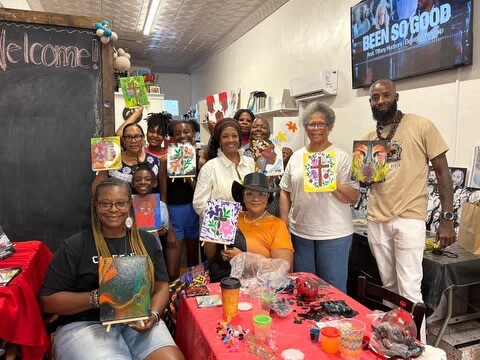
Buford said his mission is to help others find their own path toward healing — whatever form that takes.
“What I strive to do is guide this person to just create, man. Don’t care what people think about your creation, you just need to get it out,” Buford said. “Whether it’s with art, addressing your mental health, getting your life right — just do it.”
CBS 6 is committed to sharing community voices on this important topic. Email your thoughts to the CBS 6 Newsroom.
📲: CONNECT WITH US
Blue Sky | Facebook | Instagram | X | Threads | TikTok | YouTube

This story was initially reported by a journalist and has been converted to this platform with the assistance of AI. Our editorial team verifies all reporting on all platforms for fairness and accuracy. To learn more about how we use AI in our newsroom, click here.

Lovingston, VA (7News) — Good Morning Washington interviews Amanda Beckwith of Virginia Distillery Company- one of the contributing distilleries to the Virginia Spirits Board’s 250th Celebration Trio Pack, a special, exclusive release created to commemorate America’s upcoming 250th anniversary. This limited-edition package features a curated collection of a rum, a gin, and a whiskey, all crafted from scratch by distillers in Virginia to celebrate the rich history and current state of distilling within the Commonwealth.
Beckwith elaborates on VA Distillery Company’s role in the project, noting her focus on Virginia-grown grain to make the bottle of unique whiskey that is included in the Trio Pack. It is also worth noting that the Trio Packs themselves were bottled and produced right here at Virginia Distilling Company!
American single malts are the newest official category of American whiskey, distilled from one grain and from a single distillery. Virginia Distillery Co specializes in this new category of whiskey and crafted their contribution to the Trio Pack with this very specialty. Given the limited remaining availability of the Trio Pack, its historical value and collectible nature, the message it loud and clear encouraging viewers to grab a pack before they are all gone!
BE THE FIRST TO COMMENT
21+ Please drink responsibly, this content is sponsored by Virginia Distillery Company.


Powerball, Mega Millions jackpots: What to know in case you win
Here’s what to know in case you win the Powerball or Mega Millions jackpot.
Just the FAQs, USA TODAY
The Virginia Lottery offers multiple draw games for those aiming to win big.
Here’s a look at June 24, 2026, results for each game:
Powerball
Powerball drawings are held Monday, Wednesday and Saturday at 11 p.m.
13-14-16-21-38, Powerball: 14, Power Play: 2
Check Powerball payouts and previous drawings here.
Saturday, June 27, 2026
Pick 3
DAY drawing at 1:59 p.m. NIGHT drawing at 11 p.m. each day.
Night: 3-1-5, FB: 8
Day: 7-8-8, FB: 4
Check Pick 3 payouts and previous drawings here.
Pick 4
DAY drawing at 1:59 p.m. NIGHT drawing at 11 p.m. each day.
Night: 4-7-2-1, FB: 7
Day: 7-3-4-6, FB: 3
Check Pick 4 payouts and previous drawings here.
Pick 5
DAY drawing at 1:59 p.m. NIGHT drawing at 11 p.m. each day.
Night: 7-5-2-6-9, FB: 0
Day: 6-9-4-0-7, FB: 0
Check Pick 5 payouts and previous drawings here.
Cash Pop
Drawing times: Coffee Break 9 a.m.; Lunch Break 12 p.m.; Rush Hour 5 p.m.; Prime Time 9 p.m.; After Hours 11:59 p.m.
Coffee Break: 12
After Hours: 08
Prime Time: 13
Rush Hour: 01
Lunch Break: 14
Check Cash Pop payouts and previous drawings here.
Cash 5
Drawing every day at 11 p.m.
09-12-15-24-43
Check Cash 5 payouts and previous drawings here.
Bank a Million
Bank a Million draws are held every Wednesday and Saturday at 11 p.m.
18-21-25-33-36-39, Bonus: 13
Check Bank a Million payouts and previous drawings here.
Millionaire for Life
Drawing everyday at 11:15 p.m.
03-04-10-36-37, Bonus: 05
Check Millionaire for Life payouts and previous drawings here.
Feeling lucky? Explore the latest lottery news & results
This results page was generated automatically using information from TinBu and a template written and reviewed by a Center for Community Journalism (CCJ) editor. You can send feedback using this form.
-

 Boston, MA7 minutes ago
Delta flight returns to Logan after smoke scare in cockpit – Boston News, Weather, Sports | WHDH 7News
-

 Denver, CO10 minutes ago
Pat Surtain II Gets More Bad News Amid Broncos’ Uncertainty
-

 Seattle, WA15 minutes ago
The World Cup 2026 Pride Match between Egypt and Iran that Seattle hopes can ‘unite football community’
-

 San Diego, CA22 minutes ago
County Leaders Still Eyeing County-Backed Tax Hike
-

 Milwaukee, WI25 minutes ago
We must have answers before awarding new wastewater contract | Opinion
-

 Atlanta, GA30 minutes ago
Semi-truck, train collide in fiery crash in SW Atlanta
-

 Minneapolis, MN37 minutes ago
Reform, money and trust: Council members’ key criteria for Minneapolis’ next police chief
-

 Indianapolis, IN40 minutes ago
Ciara Myst is Indianapolis’ shapeshifting superstar on social media, too

