Sports
Playing out from the back: Why teams do it and is it worth the risk?


Picture the scene: a team has been awarded a goal kick. The goalkeeper throws the ball to one of two central defenders standing nearby in the six-yard box. One of them puts it down to restart and plays it laterally to the ‘keeper, who receives the pass and rests their studs on the ball as opposition players close in…
That’s just one variation of a way of restarting play that has become extremely common in the last five years, and one that tends to split opinion like it does centre-halves.
To some it’s a tactically and statistically proven method of starting a high-value sequence of play. To others it’s needlessly risky, a fad that may work for Pep Guardiola in the rarified air of the top end of the Premier League but which invariably fails as you get lower down the leagues.
Who’s right? Who’s wrong? How did we get here? And what happens next?
Here — to help answer those questions — is The Athletic’s complete guide to playing out from the back.
How did we get to this point in football’s evolution?
Tactical innovations can come from various sources.
They can arise because of law changes. They can be inspired by individual players interpreting roles in different ways. They can come from revolutionary managers with new ideas. They can emerge because of improvements in the conditions football is played in. And they can grow because football has evolved from being pure recreation to being both big business and a form of entertainment. The history of playing out from the back takes into account all five of these concepts.
First, law changes have been important. The most important change was the introduction of the back-pass law in 1992, which meant goalkeepers could no longer handle balls deliberately played back to them by defenders. It’s bizarre to watch matches from the pre-1992 era today; it’s almost like a different sport.
One of the first red cards for a goalkeeper in the Premier League era came when Sheffield United’s Simon Tracey panicked after receiving a back pass at White Hart Lane and ended up running the ball out of play on the touchline, before hauling down the Tottenham player trying to take a quick throw-in.
This change meant goalkeepers were, for essentially the first time, forced to practice kicking a moving ball. Their improved confidence in possession meant passing the ball out, rather than hammering it downfield, was more viable.
80s goalkeepers just booting it pic.twitter.com/KRrXE3SChv
— Bryan’s Gunn (@bryansgunn) December 7, 2021
There was also a key law change in 2019, which meant that goal kicks no longer had to be played outside the box before another player could touch the ball. Opposition players still have to start outside the box, but goal kicks can now be taken short to a team-mate inside the penalty box, essentially giving goalkeepers and defenders a few seconds’ head-start over their opponents. This has enabled them to play out under (slightly) less pressure.
GO DEEPER
How the humble goal kick became one of the most important passes in football
Second, pitch conditions have improved dramatically over the last couple of decades. Go back to an average mid-1990s Premier League pitch, especially in winter, and you would be mad to attempt to pass the ball across your own box. There was a danger the ball would simply get stuck in the mud — or, at least, not run properly to its recipient.

Stamford Bridge, 2003 (Matthew Ashton/EMPICS via Getty Images)
These days, players can broadly trust the turf and therefore trust their technique to pass the ball properly.
Third, the revolutionary goalkeepers tend to be those who push the boundaries in terms of what they’re capable of in possession. Essentially the goalkeeper has become an 11th outfielder. After the back-pass law change, Peter Schmeichel insisted on being involved in ‘outfield’ drills with the rest of the Manchester United players. A future United goalkeeper, Edwin van der Sar, was often credited with being the first ‘modern’ footballing goalkeeper in his days with Ajax. In recent times, the likes of Claudio Bravo and Andre Onana have been recruited by major clubs on the basis of their ability in possession, but have often looked under-equipped in terms of actual shot-stopping.
Fourth, in terms of managers who have proved particularly influential in terms of playing out from the back, in the Premier League era — and the post-back pass era — things probably start with Mike Walker, manager of Norwich in 1992-93. Walker was, unusually for a manager, a former goalkeeper and recognised the need for ‘keepers to completely adjust their way of playing. In Bryan Gunn, he had a goalkeeper who was particularly adept at using his feet, and Norwich’s free-flowing style worked very well in the new era of football. They were top for a considerable period during the first Premier League season, eventually finishing third.
Arsene Wenger is often credited with transforming Arsenal’s style of play, although arguably the initial revolution came from his predecessor Bruce Rioch, who put a big emphasis on Arsenal playing the ball out from defence and through midfield, rather than playing it long straight away as they had usually done under George Graham. Goalkeeper David Seaman was another who proved calm in possession and was unusual at this point for being able to use both feet effectively.
Brendan Rodgers’ Swansea were hugely courageous in possession upon their promotion to the Premier League in 2011, with goalkeeper Michel Vorm recruited for his footballing skills as much as his shot-stopping ability, while the arrival of Guardiola in 2016 was another key moment. He immediately ditched Joe Hart, considered too old-school to adjust, but his first goalkeeper, Claudio Bravo, took an absurd number of risks on the ball, while also looking uncomfortable at the basics of goalkeeping.

Claudio Bravo was brave in possession but ultimately took too many risks (Laurence Griffiths/Getty Images)
In recent times, Roberto De Zerbi has also proved something of a game-changer, often asking his goalkeeper to stand still with their studs on top of the ball, almost baiting the opposition to move up and close down, creating more space in midfield for Brighton and Hove Albion to pass into.
Fifth, supporters are paying serious money for tickets these days, and expect to be presented with something that is aesthetically pleasing. Tastes vary, of course, and too much playing out under pressure can rile some supporters even more than hoofing the ball long. But, as a general rule, modern supporters don’t want route one football.
They want something more precise and considered. What was once the preserve of Barcelona is now, broadly speaking, the norm for most Premier League clubs — goalkeepers playing short passes to players in and around the edge of the penalty area.
And, of course, that filters down to every level. Everyone wants to play like the footballers you see on television, but we don’t all have the technical skills to pull off one-twos in our own penalty box, and for the risk-and-reward situation to be in our favour. At almost every level now, you see maddening goals conceded by overplaying in deep positions.
Sometimes, just thumping the ball long makes most sense. But in 2024, that approach is barely tolerated.
Michael Cox

GO DEEPER
Premier League goalkeepers keep passing straight to the opposition – what’s going on?
How do you teach (and convince) players to do it?
“That rule change has influenced tactics more than any coach or manager could. And, as the stats will prove, it led to a big spike in teams playing short from goal kicks. It’s almost a little bit embarrassing if you don’t. It’s a real message that you don’t want the ball – and I think that exposes teams.”
An experienced coach at a Premier League club is talking about the 2019 goal kick law, which gave teams a “free” pass, essentially.
Speaking on condition of anonymity so that he can talk openly about his own experiences, the coach recalls a presentation that he put together for a group of players a few years ago (prior to the law change) showing multiple examples of what he describes as “really good teams” punting the ball forward from goal kicks.
Manchester United, at a time when David de Gea was in goal and Romelu Lukaku was up front, were one of those teams.
“And I said, ‘In that moment, no matter who you are, you could have the best striker and goalkeeper in the world, and the best midfielder in the world, that is a 50-50 ball. If we’re saying we really want to dominate the ball, we cannot kick it long and just hope for a 50-50. That’s not valuing possession.’
“So if you’re asking me why we’re doing it, it’s because we want the ball.”

David de Gea was more comfortable hitting the ball long (Michael Regan/Getty Images)
Risk and reward is the phrase you will hear a lot on this subject — and for some coaches (and a lot of fans) the risk is too great. Lose the ball in the first phase of build-up and the consequences can be calamitous. Beat the press, however, and the pitch totally opens up.
That is easier said than done. Playing out from the back requires bravery on the ball and a high level of technical ability too.
Or does it?
“I saw some pretty average players… the execution of what we’re asking a player to do here is very simple,” the Premier League coach adds. “We’re talking about a 10-yard pass, or we’re talking about control and a 15- to 20-yard pass, maybe a one-touch pass. But we’re not talking about something the player can’t do. We’re talking about, does he have the decision-making capacity to make the right choice at that moment?
“Decision making — I think that’s where the good coaching does come in, to really be clear and make it simple and effective for them, and make them believe it.”
Graham Potter’s time in charge at Brighton provides a good case study. His appointment in 2019 is worth revisiting, not least because he took over a group of players who had previously been coached to play a totally different way under Chris Hughton.
Speaking at the 2020 OptaPro Analytics Forum, Tom Worville, who was working as a football writer for The Athletic at the time, pointed to a graph showing how Brighton had taken 75.8 percent of goal kicks short under Potter compared to 6.4 percent under Hughton. Even allowing for the fact that it was the same season that the new goal-kick rule was introduced, the shift was huge.
“I know Brighton were used to it (playing out from the back) in a certain era under Gus (Poyet),” says Dale Stephens, who played for Brighton under Hughton and Potter. “But we’d not seen it for a few years, so it’s almost like re-educating the players and the crowd.”

Potter was an excellent teacher in that respect. A hands-on coach, he married practical work with the theory and, perhaps more than anything, had total conviction in his beliefs. Naturally, that rubbed off on his players.

Potter was keen for his Brighton side to play out from the back (Bryn Lennon/Getty Images)
“He convinced the lads from when he first came in,” Stephens says. “We had a great start and that just builds confidence with the evidence of what you can see on the pitch that it’s working. So the message from the manager and the confidence from him repeating that message day in and day out… because it’s not just something that you can do ad hoc.
“I’ve been in teams that try to do it (play out from the back) because it’s ‘the thing to do’. That never works. There has got to be an idea and a process as to why you’re doing it, and why you’re going to try to do this to get into a better attacking position.”
That idea, or process, will usually involve trying to move up the pitch by creating — and exploiting — a numerical advantage.
Some managers have choreographed moves to play out — passages of play that are rehearsed over and again on the training ground.
Others work more on principles around finding “the free man”, including rotation — the use of inverted full-backs is an example — and third-man movements.
Much, however, depends on the opposition press. At times, the onus is on the team in possession to provoke pressure, whether that be through a bounce pass (a straight one-two), the use of the sole of the foot as bait, or dribbling towards an opponent to commit them.
GO DEEPER
How the sole of the foot sparked a tactical revolution in football
Last season there was a fascinating interview on Sky Sports when Jamie Redknapp, the television pundit and former England international, showed Lewis Dunk a superb passage of Brighton build-up play after a game.
A fascinating insight from Lewis Dunk on how Brighton play out from the back 🔎 pic.twitter.com/AnDeR573Uo
— Sky Sports Premier League (@SkySportsPL) May 4, 2023
Smiling as he watched the footage, Dunk told Redknapp that he hadn’t made the pass that he was supposed to do in that scenario — a comment that said a lot about De Zerbi’s meticulous approach on the training ground and the extent to which principles, or phases of play, become ingrained.
“Graham didn’t necessarily have patterns in terms of, ‘This is the pattern we’re going to try this weekend,’” Stephens explains. “(Instead), he almost gives you alternative solutions. So it is off their (the opposition) pressure: how many players are coming to press your centre-backs? Are they coming right to the box? Are they not pressing? Are they really aggressive on the full-backs?
“Brighton (under De Zerbi) will let the centre-half take the goal kick, pass to the goalkeeper and he will roll his sole on top of the ball, and when he’s doing that he’s looking to see who is coming to press him.

“So it’s not necessarily manufactured patterns. It’s multiple solutions for wherever the press comes from, and what’s happening behind that first line of pressure.”
That could easily end up being a much longer pass from the player whose role has changed more than any other over the last 30 years or so.
“The goalkeeper is in charge of everything now,” Stephens says. “I think we’ve seen it at Brighton with Jason Steele. He’s pumped the ball 60 to 70 yards and they’ve created the attacking transition that way because they’ve (the opponent) gone real high pressure and he’s just gone over the top of them.”

Ederson almost getting caught in possession on his goal line against Liverpool in 2022 (Martin Rickett/PA Images via Getty Images)
Guardiola, whose influence on this whole way of playing is impossible to overstate, has often talked about the importance of players moving up the pitch together in build up.
The Manchester City manager is “a big fan of short passes”, overloading spaces, in particular in central areas, and players staying connected, rather than big distances opening up between them or between the lines — a strategy that also makes it easier to regain possession.
An EFL coach, who has been wedded to playing out from the back across several divisions and different clubs, touches on that theme when he discusses how “our trigger to move is when the opposition releases to the ball carrier” and why it is important not to “miss” players during the build up.
“So if I switch from right to left (in one pass) against a structured press, that team will be able to shuffle by the time the ball travels that distance,” the coach, who asked to remain anonymous, says. “But obviously the more ball speed you have, and the shorter the passes, the harder it is for that team to have a specific trigger.
“So you’re constantly getting people to jump and as they jump — provided you’re passing at the right speed — their jump will be too late because I’ve never seen a player that can run faster than a ball can move. And then you’ll find that spare man, that left-back, without them having the structure to be able to slide and press.”
Potter, Stephens says, was “huge on playing in tight spaces”.
The idea behind that was to draw as many opposition players towards the ball as possible and leave room in behind to exploit, opening up what Stephens describes as “a four-v-four in half a pitch, which is a lot of space, especially if you’ve got dynamic, quick players in wide areas”.
A goal that Swansea scored against Manchester City in an FA Cup quarter-final in 2019, during Potter’s time in charge at the Championship club, provides a good example of both his philosophy and what another coach describes as the “attract to take advantage” premise.
Take a minute out of your day and look at what Swansea have just done to Man City in the #FACup…
A superb team goal to go 2-0 up, what a story! #DontMugOffTheCuppic.twitter.com/pb6qrey1l4
— TNT Sports (@tntsports) March 16, 2019
This goal that Pascal Gross scored for Brighton under Potter at Old Trafford in 2022 talks to the same point — a great example of the philosophy working as it is designed to.
🗣️ “If you ever want to see a goal to sum up the work of Graham Potter and this Brighton team, it’s this.”
Pascal Gross has a second and #BHAFC lead 2-0 against #MUFC at the break.
🎬 @SkySportsPL pic.twitter.com/a2UhHRCXwz
— The Athletic | Football (@TheAthleticFC) August 7, 2022
Stuart James
Mitigating risk and the importance of convincing fans
There are examples of a very different kind, where the ball gets turned over close to goal, a team concedes and supporters despair.
𝘾𝙡𝙞𝙣𝙞𝙘𝙖𝙡 𝙛𝙧𝙤𝙢 𝘾𝙖𝙧𝙫𝙖𝙡𝙝𝙤! 💥
Brilliant pressing from Jaden 👏#hcafc | @McVities pic.twitter.com/ve4IMvIFUQ
— Hull City (@HullCity) February 20, 2024
So, tactically, how do coaches mitigate risk when playing out from the back and what can they do to prepare players for all the external factors — crowd reaction in particular — that impact on the team’s ability to execute what they’ve practised?

The EFL coach who spoke earlier offers an interesting response to those two questions.
“This is the hardest thing — replicating the chaos of match-day on the training pitch. And the chaos of match-day includes fan noise and fan pressure, the weight of expectation — you have to manage all of that,” he explains.
“But, for me, it’s just practice, repetition and recruitment. Recruitment is key, and if you’ve got a clear ideology of how you want to play the game, then it is absolutely vital that you recruit to that ideology.
“As for the risk mitigation, initially that comes from having the ‘plus one’ (a free man), so we’ve still got the numerical advantage — I think that’s really important.
“We try to stay compact centrally as much as we can, and the movement wide to disrupt and stretch the opposition always comes on the ball side. So once we manipulate one side of the pitch, we can be stretched that side but, as best we can, the opposite side is in a structured position inside the pitch, ready for transitions.
“Also, we’ve worked really hard on counter-pressing, just avoiding disappointment, no negative body language, just a fast reaction to swarm the ball. It’s the acceptance of it going wrong, because that instant fast reaction can almost make it right straight away.”
All of which makes you wonder how footballers feel about playing this way.
On the face of it, being encouraged to pass to a team-mate and retain possession should be a lot more enjoyable than chasing second balls off a 70-yard hit-and-hope punt.
That said, with so little margin for error in the first phase of build-up in particular, and a collective groan often the soundtrack to any misplaced pass in that area of the pitch (let alone the prospect of your team then conceding), it must also be stressful trying to play out at times.
“I loved it,” Stephens, the former Brighton midfielder, says. “I just felt we had more control over what we were trying to do rather than percentage balls.

Dale Stephens experienced a tactical revolution in his time at Brighton (Mike Hewitt/Getty Images)
“But it wasn’t really necessarily just possession that we wanted. It was more: can you attack quickly from small spaces to big spaces? And that was Graham’s consistent message.
“Even from throw-ins he’d try to get bodies around the throw-in, so that the opposition would go man for man, and the space would be on the other side of the pitch, and from there you can attack big space.
“It opened my eyes. I was 30 years old and had been playing since I was 17 but I’d never really done it. I was learning so much from Graham and the way he saw football.”
Football is always evolving, though, and a lot has changed since Potter took over at Brighton. The Premier League coach who spoke earlier says that, generally, clubs are much bolder and more aggressive in how they press now — and the quality of the opponent is almost unimportant.
He cites Manchester City as an example and says there was a time when opponents thought, ‘Drop off. Don’t go near City in the build up, they’re too good, they’re going to kill you, they’ll rip you apart.’
“But now you look at a lot of teams and they’ll go and press City when Ederson has got the ball,” he adds.
In fact, in a scenario that would have been unthinkable years ago, teams are now quite happy to press high and leave themselves man-for-man (three-versus-three) on the halfway line.
The coach smiles. “And this is where the game is going and why this is such an interesting topic, because the whole benefit of playing out was that it was all about generating the free man. And that was generated pretty easily because you obviously had your goalkeeper plus one other player, and your front three would pin back four players.
“Basically, you know you have got seven players versus their six, plus your goalkeeper, so eight-v-six. That eight just need to get the ball… in my head, build-up is getting the ball over the halfway line successfully. If you’ve done that, you’re out of the build-up phase.
“Let’s say their six were pressing your seven — forget the ‘keeper for now; now it’s their seven pressing your seven, so the only free man is the goalkeeper.”
Interestingly, what shines through more than anything when talking to coaches on this subject is that the people they worry least about buying into the merits of playing out from the back are the players.
“I think players who have come through the academy system from the 2010 era onwards all understand it,” adds the Premier League coach. “The hardest bit, I think, is convincing the fans. If they’re not on board, the whole thing can quickly fall apart.”
Stuart James

Onana was bought by Manchester United for his on-ball qualities (Clive Brunskill/Getty Images)
Quantifying how it works in the Premier League and beyond
Build-up play is booming these days. That’s as true in London and Liverpool as it is in Las Palmas or Los Angeles. The trend is especially striking in the English Championship, not long ago a bastion of the old long-ball game, now a proving ground for an international talent pool, technically gifted academy graduates and a new generation of coaches schooled in Pep-ish positional play.
But is this fad for futzing around at the back really a good idea? As with most football tactics, that depends on who’s doing it, how and why.

One interesting thing about the Premier League’s playing-out craze is that it’s not restricted to the elite. Over the last six years, the top five teams on the league table have stayed fairly steady in their number of build-ups per game (where a build-up is defined as a possession that includes at least three passes ending in a team’s own third). Meanwhile, the bottom half of the table, once all too happy to hit and hope, are building out about 50 per cent more often than in 2018-19, daring to dream of more watchable football.
But the steepest increase has come from the upper-middle class, teams five through 10 on the table, who are doing twice as many build-ups per game as they did just six years ago. This season, for the first time, the second tier has actually overtaken the first, averaging more build-ups per game than the top five clubs.

What’s going on here? One part of the answer is that, when it comes to playing out of the back, it takes two to tango. Opponents often feel safer falling back into a compact mid-block while Manchester City or Liverpool walk the ball up to midfield, bypassing the build-up phase. When Manchester United or Chelsea start passing the ball around the back, though, they’re more likely to draw pressure.
De Zerbi’s Brighton fall right in the sweet spot for maximum build-up play: they want to be pressed high and opponents are happy to oblige them, since both sides figure the reward of playing the game in Brighton’s half will outweigh their risk. Although Manchester City have more overall possession, Brighton do more build-ups than any team in the Premier League.

But not all build-ups share the same purpose. For Brighton, who want to break from small spaces into big ones, passing around their own half is an attacking tactic. All that press-baiting sole-on-the-ball stuff? The point is to find a short pass into the space behind the first presser, then lay the ball off to a nearby “third man” who’s facing forward so that Brighton can move briskly through the lines.
City, on the other hand, don’t mind taking it slow. Even when they build out of the back, City tend to do it with side-to-side circulation designed to push the defensive lines back rather than pry them apart. This serves a defensive purpose, since passing the ball through pressure in your own half is dangerous, but also an attacking one, as it allows City to move all of their players into the other team’s end and keep the game trapped there.
We can see the stylistic difference by mapping where teams take their touches during build-up possessions. In the graphic below, Brighton’s bright red press-baiting blob in the middle of their own half means they take a lot more build-up touches there than the rest of the league, while City’s red wedge at the other end suggests that even on possessions that start with a few passes in their own third, the goal is to set up a good rest-defence structure and play patiently in the attacking half.

You can see hints of other build-up styles here, too.
Although Liverpool don’t play out of the back that much, when they do they split the difference between City and Brighton, spreading the ball safely across the width of their half before looking to attack quickly with long passes.
With Oleksandr Zinchenko or Takehiro Tomiyasu tucked inside, Arsenal rarely use their left flank in the build-up. They build through the middle but take their time when the ball reaches the wings, where their possessions lean slightly toward Martin Odegaard and Bukayo Saka on the right.
Some talented teams such as Aston Villa, Newcastle and Chelsea are willing to court danger by playing in areas out wide of their own box, where any opponent who wants to press them will have to open large spaces between the lines. Other, perhaps less talented teams such as Brentford and Wolves get stuck out there on the flanks and rarely make it to the final third at all.
Burnley are an especially interesting case. Last season their build-up dominance made them look like the Manchester City of the Championship. But instead of moderating the team’s style when they reached the Premier League, Vincent Kompany has stuck to his principles, resulting in the rare relegation candidate that keep trying to pass their way out of the back even when the results are disastrous.
Which brings us back to the most important part of a good build-up: the players.
It may not look that hard to make a few practised movements and string together some short passes, but doing it at the speed the Premier League demands, against increasingly sophisticated pressing schemes, takes technical and decision-making abilities that can’t be easily coached. A manager may influence the frequency and style of a team’s build-up play but outcomes still depend largely on the players.
The chart below compares the number of passes a team makes in its own third per game against the average expected goal difference in the next 30 seconds after each pass. Brighton do the most passing at the back, of course, but all those dicey combinations in front of their box are nearly as likely to lead to conceding a goal in the near future as to scoring one. It’s the same story for Tottenham, who are playing out of the back a lot more under Ange Postecoglou but also committing more costly mistakes.

In general, the teams that see the best results from their build-ups either have a lot of talent or don’t take a lot of risks. That’s old news. The question the current craze for playing out of the back poses is whether teams have been taking enough risk. Just how much can skill in possession be taught in order to nudge a squad’s probabilities in the right direction? Can improvements in the build-up phase outpace innovation in the press?
Nobody really knows how far football tactics can stretch one way before they’re pulled back in another, but the answers are just a short goalkeeper pass away.
John Muller
(Photos: Getty Images; design: Eamonn Dalton)



CHICAGO — Dodgers superstar Shohei Ohtani was out of the lineup Friday against the White Sox after exiting the game before with discomfort in the back of his left knee.
Manager Dave Roberts said Ohtani had imaging done on the knee and showed “the normal wear and tear.”
“He feels fine-ish,” said Roberts, who hopes Ohtani will be back in the lineup this weekend. Ohtani remains in line to make his next pitching start on Wednesday against the Tampa Bay Rays at Dodger Stadium.
Especially at this point in the season, the Dodgers have incentive to play it safe with Ohtani’s recovery. Pushing him to return early and exacerbating the injury would be a larger blow to a team seeking its third straight World Series championship.
With Ohtani out, left fielder Alex Call was in the leadoff spot, and Santiago Espinal served as the designated hitter.

NEWYou can now listen to Fox News articles!
With the largest World Cup field in the history of the tournament, 32 of the 48 teams will be fighting for a spot in the knockout stage.
66.6% of nations will advance out of the group stage this summer, which is a massive upgrade from 50% in past World Cups. Because of this, sportsbooks have adjusted with less favorable odds.
Prior to the start of the tournament, Spain, Argentina, Brazil, England, and Germany entered with the strongest odds to advance from the group stage, supported by recent major-tournament success and talent-rich rosters.
All five nations are heavily favored at -10000 to advance to the knockout round.
The Spaniards are the defending European Champions while the Argentinians are looking to win back-to-back titles. Germany has not made it out of the group stage in the last two World Cups, but has always been a perennial contender— having won four titles in its history. And then of course there’s Brazil, which has more titles than any country with five.
Now, after the conclusion of the first day of the World Cup, Mexico has joined the group at the top. El Tri has surged to -10000 to advance to the knockout stage after initially being just -1400. Mexico’s huge leap up the oddsboard is a direct result of its dominating 2-0 win over South Africa.
With that in mind, let’s dive into the odds for each team to advance to the knockout stage of the 2026 FIFA World Cup as of June 12.
This page may contain affiliate links to legal sports betting partners. If you sign up or place a wager, FOX Sports may be compensated. Read more about Sports Betting on FOX Sports.
Odds to Advance to Knockout Stage
Spain: -10000 (bet $10 to win $10.10 total)
Argentina: -10000 (bet $10 to win $10.10 total)
Brazil: -10000 (bet $10 to win $10.10 total)
England: -10000 (bet $10 to win $10.10 total)
Mexico: -10000 (bet $10 to win $10.10 total)
Germany: -10000 (bet $10 to win $10.10 total)
Portugal: -5000 (bet $10 to win $10.20 total)
France: -5000 (bet $10 to win $10.20 total)
Belgium:-3500 (bet $10 to win $10.29 total)
South Korea: -2500 (bet $10 to win $10.40 total)
Switzerland: -1800 (bet $10 to win $10.56 total)
Netherlands: -1400 (bet $10 to win $10.71 total)
Morocco: -1000 (bet $10 to win $11 total)
Colombia: -1000 (bet $10 to win $11 total)
Uruguay: -1000 (bet $10 to win $11 total)
Canada: -1000 (bet $10 to win $11 total)
Ecuador: -900 (bet $10 to win $11.11 total)
Norway: -900 (bet $10 to win $11.11 total)
United States: -750 (bet $10 to win $11.33 total)
The U.S. men’s national team is currently -750 to advance from Group D (Photo by Omar Vega/USSF/Getty Images).
Croatia: -500 (bet $10 to win $12 total)
Austria: -500 (bet $10 to win $12 total)
Türkiye: -500 (bet $10 to win $12 total)
Ivory Coast: -500 (bet $10 to win $12 total)
Japan: -500 (bet $10 to win $12 total)
Egypt: -340 (bet $10 to win $12.94 total)
Algeria: -310 (bet $10 to win $13.23 total)
Scotland: -310 (bet $10 to win $13.23 total)
Senegal: -230 (bet $10 to win $14.35 total)
Sweden: -230 (bet $10 to win $1435 total)
Bosnia and Herzegovina: -220 (bet $10 to win $14.55 total)
Paraguay: -205 (bet $10 to win $14.88 total)
Iran: -200 (bet $10 to win $15 total)
Czechia: -165 (bet $10 to win $16.06 total)
Ghana: -140 (bet $10 to win $17.14 total)
Australia: -110 (bet $10 to win $19.09 total)
DR Congo: +100 (bet $10 to win $20 total)
Raúl Jiménez helped propel Mexico to a 2-0 win over South Africa in the opening match of the 2026 FIFA World Cup (Photo by Yair Gonzalez/Jam Media/Getty Images).
Saudi Arabia: +105 (bet $10 to win $20.50 total)
Tunisia: +140 (bet $10 to win $24 total)
New Zealand: +150 (bet $10 to win $25 total)
Uzbekistan: +180 (bet $10 to win $28 total)
Cape Verde: +200 (bet $10 to win $30 total)
Panama: +200 (bet $10 to win $30 total)
Qatar: +275 (bet $10 to win $37.50 total)
South Africa: +320 (bet $10 to win $42 total)
Jordan +350 (bet $10 to win $45 total)
Iraq: +450 (bet $10 to win $55 total)
Haiti: +800 (bet $10 to win $90 total)
Curaçao: +1000 (bet $10 to win $110 total)
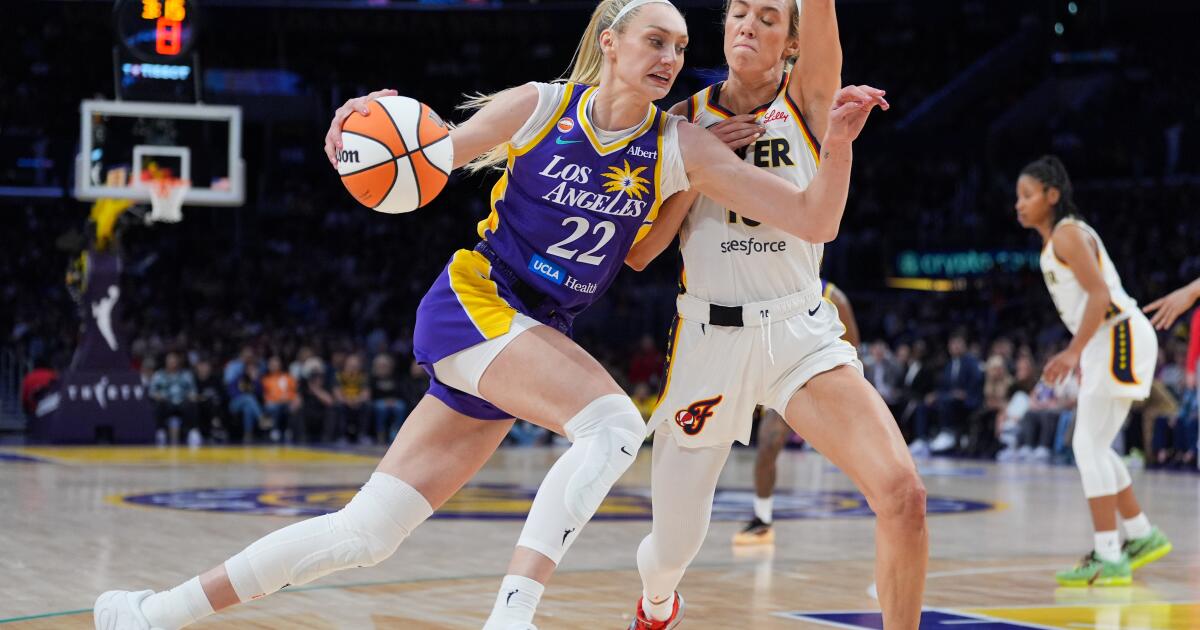
Cameron Brink said she’d appreciate some grace. She really would.
Sparks fans should give her some, because where else is she going to get it?
Certainly not from WNBA refs. Not from opponents with more to play for than ever. Certainly not from the game itself; basketball moves fast, and a bummer can become a bust in a blink.
But Brink, 24, is not on the brink of bust territory, no. Block that thought. Technically, it’s Year 3, but after a torn ACL derailed her as a rookie two summers ago, it’s practically like Year 2 for the former Stanford star. And by design, the WNBA is testing her confidence, her decision-making and her patience as she tries to reestablish herself as one of the WNBA’s best young players.
So, grace.
The recognizable 6-foot-4 forward — she’s the long-blond-haired hooper in the New Balance ads — was the No. 2 overall pick in 2024.
Now she’s her team’s No. 3 option in the post. She’s coming off the bench behind Nneka Ogwumike and Dearica Hamby for the Sparks, who are a modest 6-6 after wins this week over the expansion Portland Fire and the struggling Seattle Storm.
Against the Fire, Brink scored two points and picked up four fouls in nine minutes. Then she went to Seattle and had 15 points in 18 minutes but was pulled with more than five minutes left in the fourth quarter after getting her third, fourth and fifth fouls in 86 seconds. (WNBA players get six fouls before being disqualified.)
For the season, Brink has been called for 49 fouls in 208 minutes. A foul about every four minutes!
They’re silly fouls and they’re phantom calls. Egregious and ticky-tack. Costly and common. A real fouled-up buffet. She sets screens that get scrutinized as if by the most vigilant TSA agent. And sometimes, yes, she’s doing the accidental tripping. Other times, the officials are.
Her reputation precedes her, so everyone gets a superstar’s whistle when being defended by Brink. Opponents bake it into their game plans.
That can’t continue.
All that fouling is hindering Brink’s development because it’s robbing her of important in-game reps — which she needs, foremost, to figure out how to stop fouling.
Sparks forward Cameron Brink, left, blocks the shot of the Tempo’s Laura Juskaite during a game last month.
(Jeff Lewis / Associated Press)
“At the pro level,” said Tara VanDerveer, Brink’s coach at Stanford, “every young player always has a lot of work to do. And I saw her make a three. I see her block shots. She rebounds, she can handle the ball, she’s unselfish, she’s a terrific talent. But there’s always things players need to work on.”
We know what Brink’s thing is.
“She has to be disciplined,” VanDerveer said. “And if you want something so badly, if you want to be an All-Star someday or make the Olympic team, you’ve got to be dependable … and I think anyone can change, if it’s behavior they recognize is not in their best interests or not in their team’s best interests. It’s hard, but it’s something I think people can do.
“That’s what Cam is working on.”
And, VanDerveer added, “I’m really so excited that Nneka is there, because she will give her such great guidance and mentorship.”
And grace. Brink is getting that from Ogwumike — also a former Stanford star, the Sparks legend returned to L.A. this season after two seasons in Seattle — and her other teammates.
“I just do my best to lead by example,” Ogwumike, 35, said. “But then also let [Brink] know that she’s very capable, that she’s more than capable, which is exactly why she’s here with us and it’s exactly why we need her on this team.”

Sparks forward Cameron Brink, wearing a facemask, controls the ball while defended by Sun forward Raegan Beers.
(Joe Buglewicz / Getty Images)
But how long will Brink get grace from the Sparks in the what-have-you-done-for-me-lately business of basketball?
The foul trouble tells us why a win-now team wouldn’t trust her, why the Sparks would give meaningful minutes to two veteran post players ahead of her. Why they wouldn’t prioritize Brink’s development alongside winning as they strive to snap a previously unthinkable five-year playoff drought.
And what about fans? How patient will you all be with a player who was drafted immediately after Caitlin Clark and five spots in front of Angel Reese?
These days, that might depend on what the parlay calls for.
Or, preferably, whether you remember Brink’s first 15 WNBA games. All starts, all signs pointing to stardom. She showed up in 2024 throwing lavish block parties. Her 2.3 blocks per game were message-sending spikes, like what Lisa Leslie used to enthrall Sparks crowds with.
From the jump, she had guys coming to games at Crypto.com Arena wearing her No. 22 jersey and little girls arriving in groups with No. 22 painted on their cheeks and “I love Cam Brink” signs in hand.
And then the torn ACL cost her 25 games of her rookie season and another 25 last season, plus her spot on the United States’ Olympic 3×3 women’s basketball team in Paris in 2024.
She had to start over. Lost a lot of ground. But you see that masked woman stuck on the Sparks’ bench for all but 17 minutes per game?
You can’t miss her. She’s looking uncomfortable in protective facial gear that either hinders her breathing or her peripheral vision, her only options to protect the torn septum she suffered in a victory over the Las Vegas Aces last month.
She’s the one with the 6-8 wingspan who’s averaging 9.2 points, 4.3 rebounds and 1.5 blocks while shooting 52.1% from the field in her limited minutes.
She’s still Cameron Brink. Between fouls, she’s fluid and fast and covers more of the court than almost anyone in the WNBA, able to leap from defending guards to centers in a single bound.
“It’s just looking at every day as a new opportunity to learn and grow and not getting too bogged down when things don’t go exactly as you planned,” Brink told me. “Because more times than not, things are not going to go how you want them to. And that’s life. So I just want to be able to put my best effort out there every single night.
She knows what the Sparks need from her: “To perform, just come on the floor and compete.”
To prove she can stay on the floor to compete.
-

 Technology4 minutes ago
Google wants to release millions of mosquitoes
-
 Business11 minutes ago
Paramount’s $111-billion Warner Bros. acquisition clears key hurdle
-
 Entertainment14 minutes ago
ESPN’s coverage of 2026 NBA Finals is setting ratings records for ABC
-
 Lifestyle19 minutes ago
How to have the best Sunday in L.A., according to Fred Armisen
-
 Politics26 minutes ago
Trump’s quiet crackdown: Fewer ICE raids, harsher rules push immigrants to leave
-
Sports34 minutes ago
Shohei Ohtani held out of starting lineup a day after leaving game with knee inflammation
-

 World44 minutes ago
Pope leaves Spain on plane offered by king after technical glitch
-

 Los Angeles, Ca2 hours ago
MLB to screen Hollywood classic at drive-ins nationwide

