Washington, D.C
Women of the Parks: Washington, D.C., Edition


Check out three national park sites that represent significant stories in women’s history — and in the story of our nation.
Our nation’s capital is packed with national park sites telling the American story, from the iconic landmarks you recognize on the opening credits of your favorite TV political dramas to the lesser-known places where history unfolded and rippled across the country. In all, Washington, D.C., is home to 25 national parks and over 100 national monuments and memorials, yet only a handful tell the stories of women.
Although women make up 50% of the population, their stories are largely obscured here in D.C. and across the National Park System. I’ve written about women of the parks before, and during the course of my research I was stunned how few names were familiar to me, even as a recovering undergraduate gender studies major. It felt unfair that, while growing up, I learned about the same handful of women over and over, as if there were only a few who had ever done something worth talking about — but there are so many if you just look a little harder.
I have made it my personal mission to learn women’s names and support their work. In every national park gift shop, I seek out women authors and bring their work home with me, hoping to learn their stories of strength and perseverance and inspire others who peruse my bookshelves to see that the quantity of women’s contributions is as great as the quality.
Championing their stories is part of what inspired NPCA’s “Women of the Parks” bandana, which we are handing out at this year’s in-person Women’s History Month event. The artwork features more than 40 women who left their mark on our national parks. Some names might be familiar, others might not. I hope this wearable art spurs people to look deeper and see how women shaped our world — and our parks.
This month’s free, family friendly event to celebrate Women’s History Month will be the first of its kind. We’re visiting three D.C. sites that tell the stories of women trailblazers, joined by our partner Wondery Outdoors, a gear and apparel company committed to empowering women in the outdoors. Participants will get behind-the-scenes tours of Belmont-Paul Women’s Equality National Monument, Kenilworth Park & Aquatic Gardens and the Vietnam Veterans Memorial with the nearby Vietnam Women’s Memorial from rangers and experts as we foster community and explore the importance of representation.
Here’s what makes each of these sites significant, not only for women’s history but for the story of our nation.
1. Belmont-Paul Women’s Equality National Monument
Belmont-Paul Women’s Equality National Monument is named for Alice Paul, founder of the National Woman’s Party, and Alva Belmont, who served as the party’s president from 1920-1933. The monument sits on Capitol Hill, next door to the Hart Senate Office Building.
The 200-year-old brick structure is one of the oldest in D.C. and contains history critical to women all over the nation. Descendants of the original owners sold the house to the National Woman’s Party in 1929, and it functioned as headquarters, hotel and second home for some members until the 1990s.
While many people associate the National Woman’s Party with the 19th Amendment, which was ratified in 1920 to give women the legal right to vote, the group’s headquarters on Constitution Avenue became synonymous throughout the 20th century with the women leaders who lobbied from here for the Equal Rights Amendment (ERA) and led international work for women’s equality.
The building’s location is significant: from the second floor, suffragists — and later second-wave feminists fighting for the ERA — could keep a watchful eye on the U.S. Supreme Court, located just across the street. The monument now contains the most complete collection of women’s suffrage and equal rights movement documents and artifacts in the United States.
Alice Paul unfurling banner in 1920
Alice Paul, chair of the National Woman’s Party, unfurls a banner in Washington, D.C., Aug. 18, 1920, to celebrate ratification of the 19th Amendment, which gave women the right to vote.
Library of Congress, photograph by Harris & Ewing
The monument was closed for Great American Outdoors Act-funded renovations for a few years, but it reopened in 2023 with improvements that greatly enhance the visitor experience. New UV window coatings protect the artifacts inside, meaning heavy drapery is no longer needed and visitors can look outside and better understand the site’s location. There’s also a library where visitors can brush up on women’s history or create their own protest banners and sashes.
I found visiting Belmont-Paul to be especially powerful because it is one of the few museum experiences in the country where visitors almost exclusively see women’s faces and names.
2. Kenilworth Park and Aquatic Gardens
Tucked in a residential neighborhood in northeast Washington, Kenilworth Park and Aquatic Gardens is the only national park site devoted to cultivated, water-loving plants. Kenilworth might not exist in its current form today without its steward, Helen Fowler Shaw. In 1889, Shaw’s family started a commercial aquatic garden, which grew from a hobby (today we might call it a side hustle) into a booming business, shipping flowers to as far away as New York and Chicago.
Shaw took over the management of the gardens from her father in 1911. Under her leadership, the business became the country’s largest exporter of cut water flowers, utilizing the area’s ecology to market 63 varieties of plants. Besides having sharp business acumen and horticultural skills, Shaw was the first woman in Washington licensed to drive a truck.
Internationally known as “The Water Lily Lady,” Shaw traveled around the world to bring back new water lilies and lotuses to cultivate.
Shaw opened the property to the public seasonally on Sunday mornings in the 1920s and 1930s, drawing up to 6,000 visitors per day. Shaw and her family resisted the U.S. government’s expansion of Anacostia Park but agreed to sell in 1938 following congressional pressure. Shaw rented her house on the property from the government and lived there until her death in 1957.
The National Park Service agreed to maintain the ponds, and she remained highly involved by training park personnel and giving occasional tours of the grounds.
Today, visitors can wander the ponds, make their way out to a boardwalk overlooking the tidal marshes, and view Shaw’s illustrations, many of which were featured in Shaw Gardens brochures.
3. Vietnam Veterans Memorial and the Vietnam Women’s Memorial
The National Mall, known as “America’s Front Yard,” includes over 100 monuments and memorials spread across 1,000 acres of national parkland. But only a handful of these impressive structures honor the lives and contributions of women. This dominance of men even extends to the architects and artists who brought so many nationally recognized monuments to life. Two newer additions are — so far — the exception.
Maya Lin, then 21, won the largest design competition in American history with her submission for the Vietnam Veterans Memorial in 1981. Originally a class project, her unconventional design featuring the names of 58,000 slain soldiers on 144 panels of polished black granite received criticism and accusations that it was unpatriotic.
The design is markedly different from other memorials on the National Mall — black when others are white, sunk into the ground instead of towering above, no American flags or iconography — yet today it’s the most-visited memorial on the National Mall, with over 5 million annual visitors. There was so much backlash that Lin’s name was not spoken during the unveiling. Fortunately, visitors soon saw how powerful the design was — and remains.
The Vietnam Veterans Memorial includes eight women’s names, all nurses who were killed during the war. A nearby bronze sculpture by Glenna Goodacre honors all 11,500 women who served in Vietnam as physicians, nurses, intelligence analysts, air traffic controllers and communication specialists. The Vietnam Women’s Memorial, dedicated on Veterans Day in 1993, depicts three women caring for a fallen soldier.
Both sites are places of pilgrimage for veterans and their families — and even for women without personal connections to the war.
A ranger I spoke with described how the Vietnam Women’s Memorial has become a hub for small protests against patriarchy or current events that negatively affect women, as well as for gratitude, often in the form of hair elastics and scrunchies left at the foot of the statue.
The ranger said women feel called to this place, especially for its significance as one of the only sites dedicated to women within D.C.
More to explore
If you find yourself in the area, there are three additional women’s history sites worth exploring. The Mary McLeod Bethune Council House National Historic Site tells the story of a woman born into poverty who grew up to start a school for African American girls, serve as advisor to four U.S. presidents and establish the National Council of Negro Women. The Clara Barton National Historic Site reveals the life and legacy of the founder of the American Red Cross and is the first national park site dedicated to a woman. The Chesapeake and Ohio Canal National Historical Park also sheds light on women’s history through the stories of women captains and lock tenders on the Potomac River.
Wondery Outdoors partners with NPCA as an extension of its mission to be a sustainable outdoor lifestyle brand dedicated to liberating women in the outdoors through awareness, resources and the creation of an inclusive outdoors community for women. To support this shared mission, Wondery will donate 3% of the purchase price of each of its Parks of the USA Bucket List Bottles to NPCA.


An Air Force major was arrested in uniform on the steps of the Capitol after he called for the impeachment of President Donald Trump.
U.S. Capitol Police arrested Jason Watson, an active-duty service member, on Wednesday afternoon following remarks at a news conference where he said Trump and Vice President JD Vance should be removed from office.
The event was organized by the Removal Coalition, a group that lobbies members of Congress to impeach Trump, and attended by Rep. Al Green, D-Texas, who has repeatedly introduced articles of impeachment against Trump.
“I’m here with him because Rep. Green is the only member of Congress that has demonstrated the courage and conviction to … force a vote on articles of impeachment,” Watson said at the event. “If Congress followed his example, we could remove the entire Trump administration, but Congress remains unconvinced of the urgency and necessity for them to honor their oaths, so we must persuade them with our unrelenting, uncompromising civil resistance.”
Watson said he is not a Democrat and does not share policy positions with Green, who lost his re-election bid this year. Green’s office did not immediately respond to a request for comment on Watson’s arrest.
Capitol Police said in a statement that it “is generally against the law for the public to demonstrate on the House Steps unless they are with a Member of Congress.”
“Yesterday afternoon, a man was escorted to the House Steps by a Member of Congress,” the statement said. “When the Member of Congress left the area, our officers gave the man lawful orders to stop the illegal demonstration or he would be arrested. The man refused our lawful orders.”
Capitol Police identified the man as Watson, adding that he was arrested on charges of “Crowding, Obstructing, and Incommoding” and that it is legal to protest in other spots on the Capitol grounds.
Service members are subject to stricter laws than the average citizen when it comes to protesting. The Uniform Code of Military Justice prohibits officers from “using contemptuous language towards the President, Vice president, the Secretaries of War and of a military department, Congress, and certain other officials,” according to an Air Force memo last year.
An Air Force spokesperson said in a statement Thursday: “Service members must comply with all laws, regulations and policies governing conduct and the wear of the uniform. All Department of the Air Force personnel are expected to uphold the highest standards of discipline and professionalism, both on and off duty.”
All service members, not just members of the Air Force, are prohibited from participating in “political activities” in uniform.
Watson’s criticism of Trump and Vance focused on the administration’s actions in Venezuela and Iran, calling them “an unconstitutional usurpation of Congress’ authority and a violation of the War Powers Clause.”
“These violations resulted in the deaths of 13 service members and injuries of hundreds more,” he said, referring to the number of U.S. military deaths tied to the Iran war. “For this, the president and vice president must be impeached, convicted and removed.”
Watson also called the administration’s immigration policies and tactics unconstitutional.
The Removal Coalition did not immediately respond to a request for comment, and Watson could not be reached.
President Donald Trump responded to criticism of a financial disclosure that listed $1.4 billion in crypto earnings largely driven by meme coins.
Berk Kutay Gökmen
02 July 2026•Update: 02 July 2026
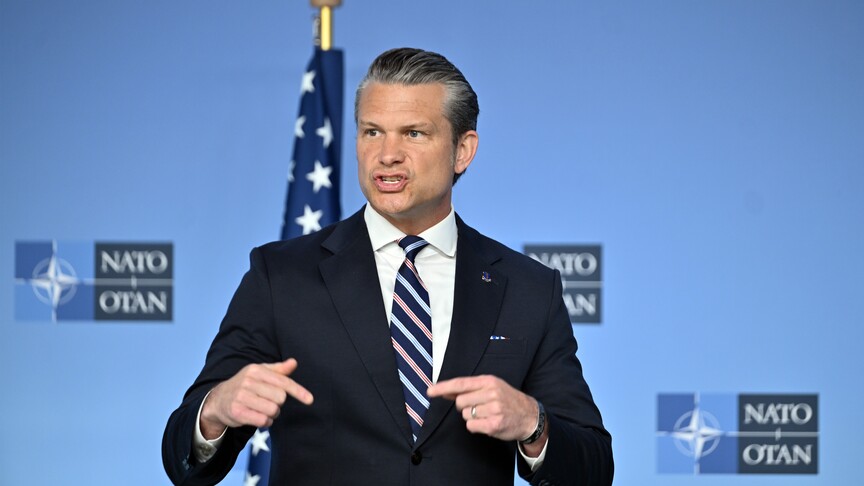
US Defense Secretary Hegseth on Thursday faced protesters while hosting the Trump administration’s DC Safe and Beautiful Task Force ceremony in Washington DC.
During the ceremony at Meridian Hill Park, which saw the gathering of National Guardsmen, dozens of demonstrators gathered near the park to protest Hegseth.
Footage shows the demonstrators chanting a short distance away from where Hegseth and roughly 200 members of the National Guard had gathered in the park
In social media posts, one protester was seen holding a Palestinian flag, while another person was holding a sign that reads “arrest Hegseth.” The protesters want a “Free DC,” according to social media posts.
In his address to the National Guard, Hegseth said that “this background noise is perfect,” referring to the protests.
“It’s the sound of ingrates, of ingratitude—of people who are so blinded by ideology they can’t see law and order and common sense in front of them,” he said.
Meridian Hill Park was repaired by the National Park Service and the Interior Department as part of a larger initiative to restore and enhance federal parks and public spaces throughout the nation’s capital in preparation for America’s 250th anniversary, which falls on this Saturday, July 4.
Though such beautification projects are typically popular with the public, the current initiative has been controversial both for its choice of projects and the use of no-bid contracts to hire firms to do the work, sometimes with disappointing results.
The work aligns with President Donald Trump’s DC Safe and Beautiful Task Force, established by a March 2025 executive order that directs federal agencies to coordinate public safety and beautification efforts across Washington.
Washington, D.C
Metro, DC leaders lay out more details on transit at new Commanders stadium – WTOP News

D.C. officials expressed an urgency Wednesday to begin preparing transit infrastructure for the opening in 2030 of the new Washington Commanders stadium on the old RFK Stadium campus.
D.C. officials expressed an urgency Wednesday to begin preparing transit infrastructure for the opening in 2030 of the new Washington Commanders stadium on the old RFK Stadium campus.
The work will impact far more than the single, cramped Metro station nearby.
During a roundtable discussion with District leaders, Metro General Manager and CEO Randy Clarke laid out the need for improvements to the existing Stadium-Armory Metro stop, and touted a new rapid bus transit line with dedicated lanes.
In tandem, those will be key to getting tens of thousands of people to events at the coming stadium, Clarke said.
“I absolutely believe the first couple of experiences that people have going to a Commanders game, going to some of the first big events, is going to dictate how people feel about taking transit,” D.C. Council member Charles Allen, who chairs the committee that oversees transportation projects, said. “So, we don’t have an option to get it wrong. We have to get it right.”
That’s why Clarke and other District leaders agreed that reaching a memorandum of understanding that lays out the roles, responsibilities and financials of these projects by July 23, the next Metro board meeting, is crucial.
“I think we’re all working towards that, and pretty optimistic,” Clarke said. “Then we’ve got to work really hard on design, we’ve got to work really hard on procurement, we’ve got to work really hard on construction.”
Clarke said the stadium’s ability to attract blockbuster events will depend on the transit agency and its ability to move people in and out of the complex.
“We’re not going to try to get, hosting the Super Bowl, we’re not going to try to host women’s World Cup, we’re not trying to get Taylor Swift and Beyoncé back here. I mean, at the end of the day, Metro is going to be the key to the success. We understand the pressure on us,” he said.
For the Stadium-Armory station, that means renovating the mezzanine and adding elevators to handle the increased demand. Clarke also talked about new street-level infrastructure to help manage the flow inside the station.
“So it’s very Disney-esque, where people feel like they’re constantly moving without actually going too far, if you know what I mean,” Clarke said. “Then we filter them where we need to go. That is a good example of what we need to do at the surface.”
But Metro won’t rely entirely on its trains. The roundtable also discussed what’s been dubbed the Gold Line, which would run buses from Union Station to the stadium.
Construction estimates for bus line are in the $75 million range, District Department of Transportation Director Sharon Kershbaum said
The Gold Line is to run through the heart of the H Street corridor, and transportation leaders said the impact will be everything the streetcar was supposed to be.
“This is now going to be the east-west corridor that we never were able to accomplish on the streetcar,” Kershbaum said.
“This is going to have frictionless service, because it will be center-running. So all of the issues — when a car double-parked and it stopped streetcar service — all of those things, we’ll be immune from. We are going to see the transportation service that was really never ever reached by streetcar achieved with this,” she said.
The vision for the Gold Line goes beyond the handful of weekends when NFL football is played at the stadium, and beyond initial Union Station-stadium route. Transportation officials see the buses eventually traveling between the Benning Road Metro Station and Rosslyn, Virginia.
“We want the Gold Line to solve the cross-town problem we’ve had in this community for a long, long time,” Clarke said.
That means providing access to the convention center and also solving the gridlock that fills up K Street NW every day. Clarke said coming up with dedicated lanes on K Street would actually be the most pivotal part of this new transit line.
“The downtown core of D.C. does not move, especially during p.m. rush hour,” Clarke said. “If you want people in Benning Road that may work, say on K Street, to have better transportation, solving K Street is equally as important, if not more important, because of time savings and reliability.”
Officials did not specify a timeline for the full expansion, but it would not be completed by 2030.
Where it does run, Gold Line buses would travel in the middle lanes, to avoid what caused problems for the Streetcar, which could grind to a halt when cars would double park. Building out the Gold Line would mean more changes to the way cars move along H Street in Northeast.
“You can’t do what you want to do and also keep all the parking,” At-Large Council member Christina Henderson said.
“There’s intersections where we’re going to have to take turns away at certain intersections, maybe parking in certain places,” Clarke said. “In other places parking could be kept, because we’re looking at putting platforms.”
Stadium-related transit construction will run far beyond H Street and the Stadium Armory stop.
“We do want to minimize outages, but there’s going to be significant outages to do this project,” Clarke said.
“It’s all about where we can turn trains around and how to manage that,” he added. “So if we do an outage to Stadium Armory, what that really means is we’re impacting customers from New Carrollton and Largo all the way through the system, and some people that are west of the system that want to go east of Stadium Armory won’t be able to.”
But with the project not even really in the design phase yet, it’s hard to plan out how and when those impacts will happen.
“We’ll be doing obviously overnight work,” Clarke said. “We’ll probably do some, what we call, early outs. Sometimes we’ll start at 10 o’clock at night. We might be able to do some single tracking on certain types of work. Other work is going to be complete shutdowns.”
“And the question is, is that going to be X amount of weekends or is it going to be like a two-, three-, four-week block at a time,” he added. “We’ve got to work through all of that.”
Get breaking news and daily headlines delivered to your email inbox by signing up here.
© 2026 WTOP. All Rights Reserved. This website is not intended for users located within the European Economic Area.
-

 New Hampshire43 seconds ago
N.H. State Police announce unexpected death of 19-year veteran
-

 New Jersey8 minutes ago
Legendary NJ Fourth of July lobster catch created record that will never be broken
-

 New Mexico11 minutes ago
$7K baby bond for each New Mexico child? What the state treasurer is proposing
-

 North Carolina16 minutes ago
Warsaw man extradited back to Duplin County in last year’s lottery ticket probe
-

 North Dakota23 minutes ago
North Dakota’s Vantis BVLOS system now open to UAS operators at no cost – Unmanned airspace
-

 Ohio26 minutes ago
Licking County real estate transfers for June 15-19, 2026, hit $697K
-

 Oklahoma31 minutes ago
Can Missouri football get revenge on Oklahoma? How Sooners shape up
-
Oregon38 minutes ago
Oregon Lottery Pick 4 results for July 2

