Politics
Katie Porter could be a major threat to Adam Schiff in November. But she’s running out of time

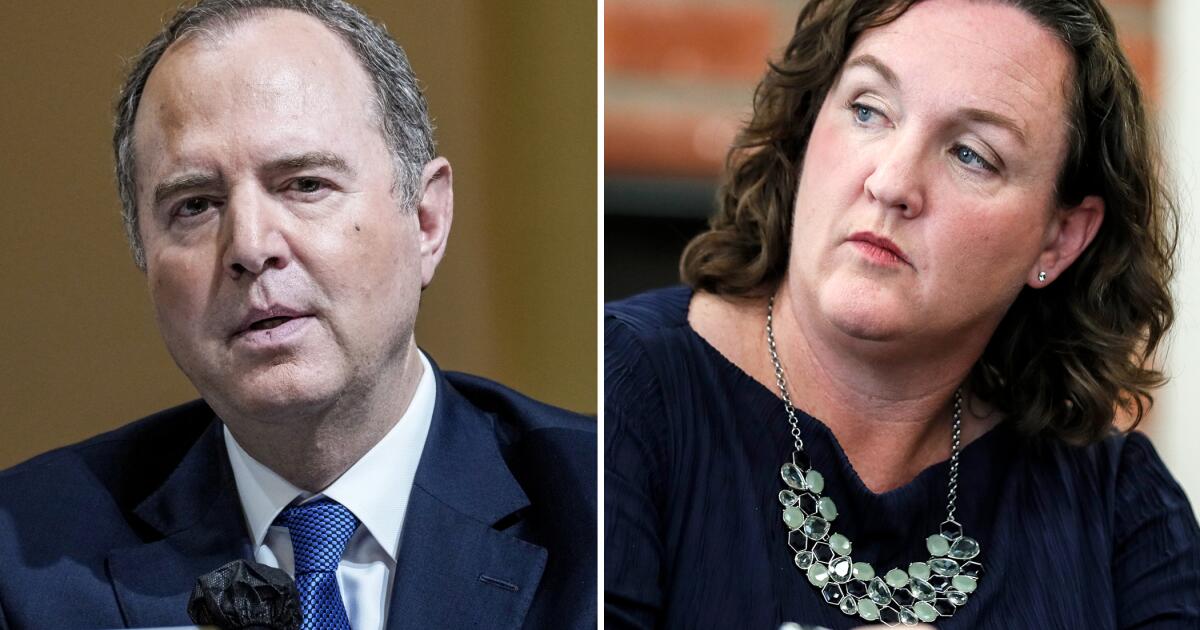
Rep. Katie Porter, famed among Democrats for grilling powerful corporate barons and right-wing ideologues testifying before Congress, faces a serious risk of falling short in Tuesday’s California primary election, which would bring an end to her bid to win the late Dianne Feinstein’s Senate seat in the fall general election.
Along with a once-formidable campaign account depleted by her tough 2022 reelection bid and expected low voter turnout, the Irvine congresswoman must overcome the millions of dollars Democratic rival Rep. Adam B. Schiff of Burbank and his allies have spent boosting GOP candidate Steve Garvey, the former Dodgers All-Star first baseman.
If Garvey and Schiff win the top two spots in California’s open primary, the two would be the only candidates to advance to the November general election — with Schiff being the heavy favorite because of California’s strong Democratic tilt. Political experts say Schiff’s strategy to prop up Garvey is largely driven by the threat he would face in a one-on-one face-off against Porter in the fall election.
“She would give him a hell of a run in the general election — he would look like the establishment Washington, D.C., insider, and she could have contrasted herself with him,” said GOP strategist Kevin Spillane, who is undecided in the race. “That’s pretty remarkable. Schiff’s working harder to get Garvey in the runoff than Garvey is himself.”
Spillane said he could not recall anyone spending as much to buoy a statewide GOP candidate since then-Republican gubernatorial candidate Meg Whitman in 2010. Ad campaigns portray Garvey as a loyalist of former President Trump and the biggest political threat to Schiff, an effort largely expected to increase the former Dodger first baseman’s appeal among Republican voters.
The strategy is partly driven by California’s top-two primary system approved by voters more than a decade ago, which allows only the two candidates who secure the most votes to advance to the general election, regardless of their political party affiliation.
But this year’s Senate contest — a rare open seat for a Californian in the nation’s top legislative body — is also shaped by the records and personalities of the top Democrats in the race.
Schiff and Porter are both liberal Democrats, prodigious fundraisers and well-known voices among cable news show viewers across the nation, but a contest between them in the general election would be much different from their current primary battle.
Schiff, who was elected to Congress as a moderate in 2000, has won over most of the Democratic establishment’s leadership, starting with former House Speaker Nancy Pelosi (D-San Francisco ). He is now best known by many voters as the manager of Congress’ first impeachment trial of Trump over foreign interference in the 2020 election and his vocal role in the 2021 House investigation into Trump’s accountability for the Jan. 6 insurrection at the U.S. Capitol.
Rep. Katie Porter, right, leaves with her son, Luke Hoffman, 18, who is a first-time voter, after casting their ballots at a voting station at University Hills Community Center on Saturday in Irvine.
(Ringo Chiu / For The Times)
Although Porter’s voting record is practically identical to Schiff’s, she has honed a populist patina, blasting corporate leaders during congressional oversight hearings and focusing on issues such as income inequality. The former UC Irvine law professor’s background as a minivan-driving single mother also appeals to moderate voters in her sharply divided suburban Orange County congressional district.
“Part of her persona is that she’s authentic. I think she is trying to connect with normal voters who face the same kitchen table issues she does and talks about as a single mom,” said Thad Kousser, a political science professor at UC San Diego. “That’s part of her appeal and could lead to her getting moderate support in the general.”
Porter’s positioning — combined with Schiff being among the most prominent anti-Trump faces in the nation — could boost Porter in a general election contest because she could win anti-Schiff Republican voters, he added.
“I don’t think she has built up a wall against her with Republicans as he has because he’s been such a prominent figure as a leader of the impeachment. That’s helped him [in the primary] but that’s a double-edged sword” in the general election, Kousser said.
However, Porter’s prospects of reaching the November ballot are, at best, uncertain. A new poll finds her in third place in the primary, and early ballot returns show a sluggish turnout among the voters most likely to support her, compared with Schiff and Garvey.
Garvey and Schiff are in a statistical tie for the top two spots, according to a poll released Friday by UC Berkeley’s Institute of Governmental Studies and the Los Angeles Times. Among likely primary voters, Garvey received the backing of 27%, while Schiff won 25%, within the poll’s margin of error. Porter received the support of 19%, and fellow Democratic Rep. Barbara Lee of Oakland got 8%. Slightly more than 1 in 10 supported other candidates, while 9% said they were undecided.
The mail-in ballots that already have been cast favor Garvey over Porter.
Though there are far more Democratic registered voters in the state than Republicans, GOP voters have cast a greater share of their ballots, 15% compared with 13% of Democrats through Friday, according to a ballot tracker run by PDI, a well-respected political data firm that caters to Democratic and nonpartisan candidates.
Paul Mitchell, a veteran Democratic strategist who is the vice president of PDI, expects low voter turnout in the election, reflecting a lack of enthusiasm driven by the reality that President Biden and Trump have all but secured their parties’ nominations for president.
“It’s just an uninteresting national ballot,” Mitchell said.
Low turnout would help Garvey, since Republicans appear to have a greater propensity to cast ballots in the primary. Plus, if, as multiple polls suggest, GOP voters have consolidated behind Garvey while Democrats are split among multiple candidates, that alone could be enough to help Garvey win one of the top two spots on Tuesday.
Additionally, young people and voters of color — who are more likely to support Porter in the Senate race — are voting with much lower frequency than older, white voters, according to the data.
One caveat is that Tuesday is the first presidential primary California has conducted since it began mailing ballots to every registered voter during the pandemic.
“It’s still too early to tell about turnout, but obviously it’s not trending very high. But every voter gets a ballot sent to them these days,” noted Democratic pollster Ben Tulchin, who is not involved with any candidates in the race. “I expect turnout to be lower for sure but it’s still too early to say how low it’s going to be. Porter seems to be in a tough spot, but I think there is still a chance she can make it through.”
But he added that Porter’s challenges are compounded by how greatly Schiff has outspent her in this race and how much she had to spend in her tight 2022 congressional reelection campaign.
While both of them were among the most prodigious fundraisers in Congress, Schiff entered the race with far more money and has raised more than Porter has since.
More than $65 million has been spent in the race, making it the most expensive Senate contest in California history, according to data firm AdImpact. The firm tweeted Friday morning that 60% of Schiff’s broadcast ads mention Garvey.
Most of these funds have been spent by Schiff and his allies, including independent expenditure committees funded by Native American tribes and cryptocurrency billionaires, not only supporting his Senate bid and attacking Porter but also boosting Garvey’s profile among Republicans.
Broadcast and cable stations have been blanketed by ads about the race, including a Schiff message about Garvey airing on Fox News, despite the candidate calling for a boycott of advertising on the cable station because of its false reporting about the 2020 election.
Speaking on MSNBC in 2023 after entering the Senate contest, Schiff referred to “folks that continue to advertise on stations that deliberately put out lies and deliberately undermine our elections. They become culpable in this too.”
In the last week, Schiff’s campaign spent $390,152 highlighting Garvey’s candidacy on Fox News, according to Democratic media buyer Sheri Sadler, who is not working for any candidate in the race.
The Schiff campaign declined to comment about the candidate’s efforts to boost Garvey.
A Garvey spokesman said the Republican’s improved standing in the polls was the result of Californians becoming “reacquainted” with the retired ballplayer and learning about his priorities.
“With Adam Schiff’s aggressive campaign against Garvey and the latest primary poll results, our predictions are proving accurate,” spokesman Matt Shupe said. “Garvey’s half-century bond with Californians transcend politics, and will prove to be a formidable force in both the primary and general elections.”
The Porter campaign did not respond to a request for comment, but the candidate has repeatedly fundraised off the Schiff campaign’s focus on Garvey.
“If I advance to the general election, there’s a good chance we will win that race,” Porter wrote in one of four email blasts to supporters on Thursday. “That’s why super PACs and the Schiff campaign are doing everything they can to prevent me from advancing, and I won’t BS you: their plan might work.”



new video loaded: Steve Hilton Holds Slim Early Lead in California Governor’s Race
transcript
transcript
Steve Hilton Holds Slim Early Lead in California Governor’s Race
Steve Hilton, a Republican and former Fox News host, held a narrow lead in early votes over two Democratic opponents in California’s nonpartisan primary for governor. The top two candidates will advance to the general election in November.
-
“Change is coming to California, and it’s long overdue. I want to just say something from my heart to every single person who’s voted for me. We’re not — We’re not there yet, but it’s looking good.” [cheers] “Tonight, the people of the great state of California, in the greatest nation on earth, have spoken. [cheers] Loudly and proudly. [cheers] And while I take nothing for granted, there are lots of ballots left to be counted, it appears that we are on track to advance to November.” [cheers] “It might take some time to figure out where this is going. We’re going to wait until every ballot is counted. We’re going to give democracy a time to work, and we know we finished really strong.” [cheers]
By Axel Boada
June 3, 2026
Politics
Spencer Pratt surges to runoff in LA mayor’s race after angry voters send message to Karen Bass

NEWYou can now listen to Fox News articles!
Reality television personality Spencer Pratt appears on track to clear a key hurdle in Los Angeles’ mayoral race as he seeks to unseat incumbent Mayor Karen Bass in November.
Bass, who has led the city since 2022 amid a turbulent stretch rocked by her response to wildfires, advanced to a runoff after failing to secure a majority of the vote in Tuesday’s primary election. With no candidate surpassing the 50% threshold, the top two finishers will face off in a November runoff.
The anticipated runoff is a symbolic blow to Bass, who was endorsed by Gov. Gavin Newsom, D-Calif., and former Vice President Kamala Harris and has spent decades serving California in a series of elected Democratic offices.
Pratt, a first-time candidate known for the MTV reality show “The Hills,” was running in second place as of Wednesday morning.
Los Angeles Mayor Karen Bass attends the Women for Bass Phone bank event in the Baldwin Hills area of Los Angeles on June 1, 2026. (Louise Barnsley/Splash for Fox News Digital)
REALITY TV STAR SPENCER PRATT TESTS LA VOTERS’ APPETITE FOR POLITICAL OUTSIDER
“Obviously, God wanted five more months of me exposing the failures of our mayor,” Pratt gloated to reporters as the returns came in Tuesday evening.
Pratt has relentlessly hammered Bass on issues that have long plagued the city, including fire recovery, street homelessness and crime. The insurgent candidate holds Bass personally responsible for devastating wildfires that destroyed more than 18,000 structures in the city, including his Pacific Palisades home.
Pratt’s surge appears to have shut out Los Angeles City Council member Nithya Raman, a former ally of Bass who challenged the incumbent from the left and was once viewed as a threat to her bid for a second term. Raman is a member of the Democratic Socialists of America and has argued for steering the city in a more progressive direction.
Raman has not yet conceded despite running well behind Bass and Pratt as of Wednesday morning.
Pratt, a registered Republican, faces an uphill battle to defeat Bass in November if he advances to the runoff election.
Less than 20% of voters in the heavily Democratic city identify with the GOP, though Los Angeles’ mayoral contest is officially nonpartisan.
Media personality and independent candidate Spencer Pratt, left, pictured alongside LA mayor Karen Bass, right. (Robert Gauthier/Los Angeles Times via Getty Images; Justin Sullivan/Getty Images)
KAREN BASS GRILLED OVER BROKEN HOMELESSNESS PROMISE, BLAMES BUREAUCRACY FOR SLOWED PROGRESS
Rep. Darrell Issa, R-Calif., who represents a San Diego-anchored seat, told Fox News Digital that Pratt has won a following in the mayoral contest due to widespread voter discontent with Bass’ leadership.
“He’s catching fire among ardent historic Democrat voters because Karen Bass has been so ineffective,” Issa said in an interview. “And every time she opens her mouth, she’s talking about more of the same to people who have seen their streets, both crime-ridden and in fact … ineffectively managed.”
Bass, conversely, argues that her leadership is leading Los Angeles in the right direction.
“Los Angeles is at a turning point. After decades of rising homelessness, under-built housing and a shrinking police force, it’s Mayor Karen Bass who finally stepped up to change how City Hall works,” Bass’s website reads.
Los Angeles City Councilmember Nithya Raman appears likely to finish in third place, keeping her out of the November runoff. (Eric Thayer/Getty Images)
CLICK HERE TO DOWNLOAD THE FOX NEWS APP
“Homelessness is down, more housing is being built, and the LAPD is hiring new officers,” it also claims.
Fox News Digital’s Leo Briceno contributed reporting.
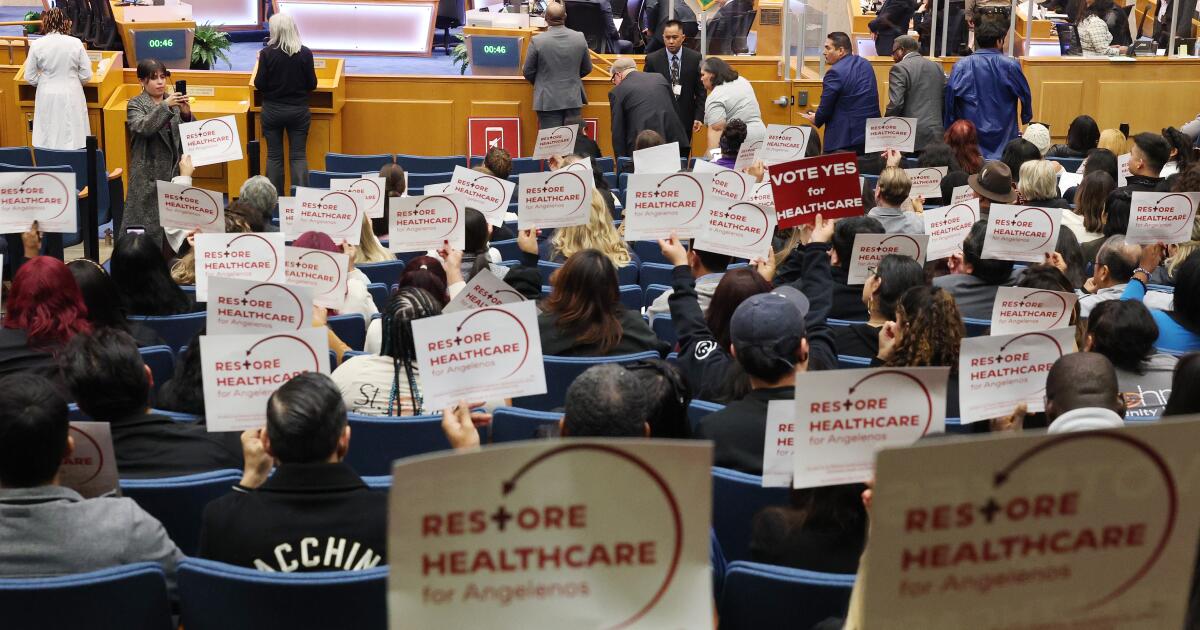
Los Angeles County’s half-cent sales tax to fund healthcare services was trailing Tuesday, with early returns showing a majority of voters rejecting the measure.
The tax — a half-penny of every dollar spent in the county — is meant to prop up local hospitals and clinics that are hemorrhaging funding after recent federal cuts.
The sales tax, which needs a simple majority to pass, would take effect Oct. 1 and last five years. Officials say it would pull in $1 billion annually to help plug the budget holes hitting local hospitals and clinics.
L.A. County health officials anticipate the One Big Beautiful Bill Act, signed into law by President Trump last summer, will slash more than $2 billion from the county’s health services budget within the next three years. Due to eligibility changes, the county will no longer be able to get reimbursements for many Californians who have lost Medi-Cal.
The measure was championed by a coalition of healthcare advocates called Restore Healthcare for Angelenos who warned that mass layoffs and emergency room closures could be imminent if new funding didn’t come fast. The Department of Public Health recently closed seven clinics — a grim sign, supporters said, of service cuts to come.
Voters haven’t rejected a sales tax hike since 2012, when a transportation measure fell just short with 66.1% support. It needed 66.7% to pass.
A majority of county supervisors had supported the new tax proposal, voting 4 to 1 this February to put it on the ballot. But the measure faced significant opposition from local cities, with opponents arguing the sales tax hike would unfairly burden the poorest county residents and encourage people to spend their dollars across the county line.
Supervisor Kathryn Barger, the board’s lone opponent of the tax, said she was concerned it was a “general” tax, meaning the money wouldn’t be earmarked for healthcare costs. Instead, she argued, politicians would have final say over how the money gets spent.
The supervisors have created a plan for spending the tax money, with the largest chunk of the money meant to cover the costs for patients without insurance. The measure also asked voters to sign off on a nine-member oversight committee.
The county currently has a base sales tax rate of 9.75%, and cities impose local taxes on top of that.
-

 Arizona54 seconds ago
Diamondbacks Fans Can Now Vote for Arizona’s All-Stars
-

 Arkansas6 minutes ago
Arkansas DFA Agents seize illegal products in Corning
-

 California13 minutes ago
California may take weeks to finalize primary results. ‘This is normal’
-

 Colorado16 minutes ago
Colorado governor vetoes block on surveillance pricing as other states push for bans
-

 Connecticut21 minutes ago
Afternoon forecast for June 3
-
Delaware28 minutes ago
FOX43 News
-

 Florida31 minutes ago
Rainy stretch continues in South Florida
-

 Georgia36 minutes ago
Prices climb as Georgia gas tax break ends

