Politics
Times investigation spurs complaints seeking federal probe of Kevin McCarthy PAC spending at luxury resort

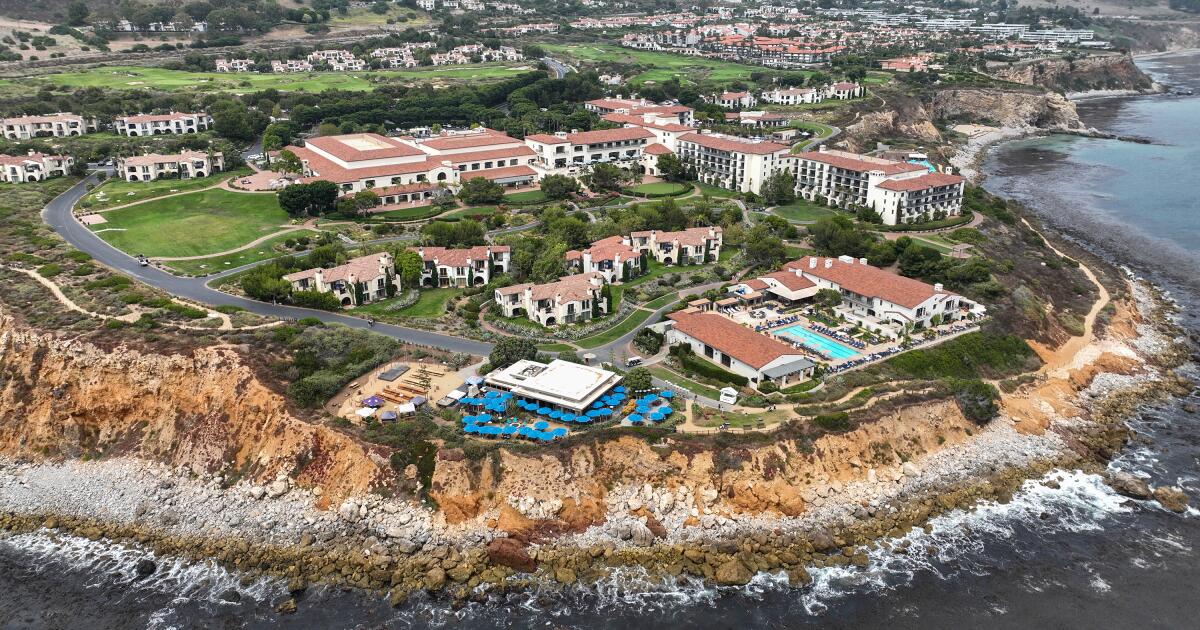
Federal election officials have been asked to investigate whether former House Speaker Kevin McCarthy personally benefited in violation of the law from the nearly quarter of a million dollars his campaign committees spent at a luxury Rancho Palos Verdes resort while he served in congressional leadership.
Complaints filed with the Federal Elections Commission by two workers at the Terranea Resort cite the findings of a Times investigation published in December that showed that two McCarthy committees spent about $240,000 at the seaside hotel and spa during a 2½-year period ending in 2018. The committees reported to the FEC that the expenses were for lodging and catering, and a McCarthy campaign spokesman told The Times they were for “our annual event,” which he also described as a “PAC retreat.”
The five-page complaints, which mirror each other, note that McCarthy did not provide to the FEC or The Times a more detailed explanation of the Terranea outlays, including the number of such retreats.
“Thus, this only adds to the question about the actual use of these funds,” the complaints say, adding that the payments “may have been made, not for legitimate PAC or campaign activities, but to personally enrich” McCarthy. The complaints also name McCarthy’s committees and their treasurer, Jill Thomson.
The McCarthy spokesman, Drew Florio, did not respond to Times requests to interview the former congressman and Thomson or otherwise obtain a comment from them about the complaints. An FEC spokesperson said the agency does not comment on requests for investigations or whether a probe has been launched.
The complaints were filed by Terranea employees Antonio Rodriguez and David Gomez Martinez through a law firm that represents Unite Here Local 11, a labor union that is locked in a battle to organize workers at the resort. Rodriguez and Gomez Martinez are supporters of the unionization campaign.
The two employees state in the complaints that they worked at the resort “in various roles in the banquet and catering departments during the period in which these payments were made and do not have any knowledge or recollection of an event or events hosted by or held on behalf of Congressman McCarthy or his committees at the resort.” The complaints were notarized and signed under penalty of perjury.
They point out that the owners of Terranea, including Robert J. Lowe, founder of the company that developed the resort, have been major financial contributors to McCarthy’s committees. The complaints allege that the donations show that the relationship between McCarthy and the hotel owners is “extremely cozy.”
“The FEC needs to investigate where all this political money is going,” Rodriguez said in an email to The Times. Gomez Martinez declined to comment.
Lowe did not respond to an interview requests made through his corporate office.
The Times investigation found that most of the money McCarthy spent at Terranea came from a thinly regulated leadership PAC he controlled, the Majority Committee PAC. The newspaper also reported that, according to FEC records, the Bakersfield Republican’s leadership PAC shelled out more than $1 million on hotels, private air travel and eateries from 2012 through last June.
That’s more than double the combined total spent by the leadership PACs of the seven other lawmakers who’ve held the top House and Senate positions for their parties during all or part of that period, according to a Times analysis of FEC filings. A historic rebellion led by far-right Republicans ousted McCarthy as speaker in October, and he resigned from Congress in December.
Leadership PACs like McCarthy’s are subject to fewer spending controls than other campaign accounts. The legal guardrails on the PACs are so flimsy that the FEC determined last year that there is no bar on tapping committee money for personal expenses. As a result, lawmakers can use the PACs as slush funds to underwrite sumptuous lifestyles, good government advocates say.
But federal law does prohibit Congress members from spending funds from other campaign accounts on personal uses. About $116,000 of McCarthy’s expenses at Terranea came from one of his campaign committees. Most of that amount — $68,000 — was reported to the FEC as catering and lodging costs.
Altogether, the two McCarthy committees made 20 payments to Terranea from 2015 to 2018, while he served as House majority leader. Most were listed under the expense category of “lodging,” and 11 were in even-numbered amounts, such as $7,500 and $10,000. The reports did not explain why those amounts were in round dollars.
McCarthy’s spending at Terranea particularly stands out among the current and former congressional leaders because so much of the money has been reported as going toward lodging. And there’s no indication in McCarthy’s FEC filings why the Terranea expenses were heavy during the 2 ½-year period and then stopped, although one McCarthy campaign committee reported about $470 in meal expenses there in 2022.
The FEC does not require politicians to disclose on the finance reports many details of spending beyond the recipient, date, amount and general category of the expense. McCarthy’s records do not say who stayed or dined at Terranea courtesy of the committees, and there are no breakdowns for how much the PAC spent per night for a room, and nothing about what type of rooms, or how many, were rented. The records offer few clues as to whether the spending was in connection with specific fundraising events or any other campaign activities.
Florio, the McCarthy spokesman, said in a statement to The Times in October that the “expenses were for lodging, catering, event room rentals associated with the PAC retreat.”
He did not respond to follow-up questions, including those about the number of people who attended any events and the specific costs assigned to each one.
Violations of the law barring personal use of money from campaign accounts that are not leadership PACs have led to criminal convictions of former members of Congress, among them Duncan Hunter, a San Diego County Republican. Former Rep. George Santos (R-N.Y.) was expelled from Congress in December after House investigators determined that he spent tens of thousands of campaign dollars on rent, a sexually explicit website, Botox and luxury goods.
But the regulations for leadership PACs have been ill-defined since the FEC authorized the committees in the late 1970s. Critics contend that the prohibition on personal use of campaign money — outlined under the federal Election Campaign Act — also applies to the leadership committees, but they have been unable to persuade a majority of the FEC to take that position.
In its decision last winter, the FEC ruled 4 to 2 that nothing in the law bars politicians from using leadership PAC money for personal expenses. The decision resulted from a complaint that a leadership PAC for former House member Lou Barletta (R-Pa.) had paid his wife $33,000 in rent for a property that he owns with her.
Advocates for tougher enforcement of campaign finance laws have long accused the FEC of looking the other way when presented with complaints of alleged violations. Among them is Saurav Ghosh, director of federal campaign finance reform for the Washington-based Campaign Legal Center, a nonprofit organization whose mission includes advocating for transparency in election spending.
“The FEC doesn’t enforce the law in most cases,” Ghosh said.
Through the agency’s press office, The Times asked the six commissioners who preside over the FEC to respond to that criticism and received no reply.


new video loaded: Steve Hilton Holds Slim Early Lead in California Governor’s Race
transcript
transcript
Steve Hilton Holds Slim Early Lead in California Governor’s Race
Steve Hilton, a Republican and former Fox News host, held a narrow lead in early votes over two Democratic opponents in California’s nonpartisan primary for governor. The top two candidates will advance to the general election in November.
-
“Change is coming to California, and it’s long overdue. I want to just say something from my heart to every single person who’s voted for me. We’re not — We’re not there yet, but it’s looking good.” [cheers] “Tonight, the people of the great state of California, in the greatest nation on earth, have spoken. [cheers] Loudly and proudly. [cheers] And while I take nothing for granted, there are lots of ballots left to be counted, it appears that we are on track to advance to November.” [cheers] “It might take some time to figure out where this is going. We’re going to wait until every ballot is counted. We’re going to give democracy a time to work, and we know we finished really strong.” [cheers]
By Axel Boada
June 3, 2026
Politics
Spencer Pratt surges to runoff in LA mayor’s race after angry voters send message to Karen Bass

NEWYou can now listen to Fox News articles!
Reality television personality Spencer Pratt appears on track to clear a key hurdle in Los Angeles’ mayoral race as he seeks to unseat incumbent Mayor Karen Bass in November.
Bass, who has led the city since 2022 amid a turbulent stretch rocked by her response to wildfires, advanced to a runoff after failing to secure a majority of the vote in Tuesday’s primary election. With no candidate surpassing the 50% threshold, the top two finishers will face off in a November runoff.
The anticipated runoff is a symbolic blow to Bass, who was endorsed by Gov. Gavin Newsom, D-Calif., and former Vice President Kamala Harris and has spent decades serving California in a series of elected Democratic offices.
Pratt, a first-time candidate known for the MTV reality show “The Hills,” was running in second place as of Wednesday morning.
Los Angeles Mayor Karen Bass attends the Women for Bass Phone bank event in the Baldwin Hills area of Los Angeles on June 1, 2026. (Louise Barnsley/Splash for Fox News Digital)
REALITY TV STAR SPENCER PRATT TESTS LA VOTERS’ APPETITE FOR POLITICAL OUTSIDER
“Obviously, God wanted five more months of me exposing the failures of our mayor,” Pratt gloated to reporters as the returns came in Tuesday evening.
Pratt has relentlessly hammered Bass on issues that have long plagued the city, including fire recovery, street homelessness and crime. The insurgent candidate holds Bass personally responsible for devastating wildfires that destroyed more than 18,000 structures in the city, including his Pacific Palisades home.
Pratt’s surge appears to have shut out Los Angeles City Council member Nithya Raman, a former ally of Bass who challenged the incumbent from the left and was once viewed as a threat to her bid for a second term. Raman is a member of the Democratic Socialists of America and has argued for steering the city in a more progressive direction.
Raman has not yet conceded despite running well behind Bass and Pratt as of Wednesday morning.
Pratt, a registered Republican, faces an uphill battle to defeat Bass in November if he advances to the runoff election.
Less than 20% of voters in the heavily Democratic city identify with the GOP, though Los Angeles’ mayoral contest is officially nonpartisan.
Media personality and independent candidate Spencer Pratt, left, pictured alongside LA mayor Karen Bass, right. (Robert Gauthier/Los Angeles Times via Getty Images; Justin Sullivan/Getty Images)
KAREN BASS GRILLED OVER BROKEN HOMELESSNESS PROMISE, BLAMES BUREAUCRACY FOR SLOWED PROGRESS
Rep. Darrell Issa, R-Calif., who represents a San Diego-anchored seat, told Fox News Digital that Pratt has won a following in the mayoral contest due to widespread voter discontent with Bass’ leadership.
“He’s catching fire among ardent historic Democrat voters because Karen Bass has been so ineffective,” Issa said in an interview. “And every time she opens her mouth, she’s talking about more of the same to people who have seen their streets, both crime-ridden and in fact … ineffectively managed.”
Bass, conversely, argues that her leadership is leading Los Angeles in the right direction.
“Los Angeles is at a turning point. After decades of rising homelessness, under-built housing and a shrinking police force, it’s Mayor Karen Bass who finally stepped up to change how City Hall works,” Bass’s website reads.
Los Angeles City Councilmember Nithya Raman appears likely to finish in third place, keeping her out of the November runoff. (Eric Thayer/Getty Images)
CLICK HERE TO DOWNLOAD THE FOX NEWS APP
“Homelessness is down, more housing is being built, and the LAPD is hiring new officers,” it also claims.
Fox News Digital’s Leo Briceno contributed reporting.
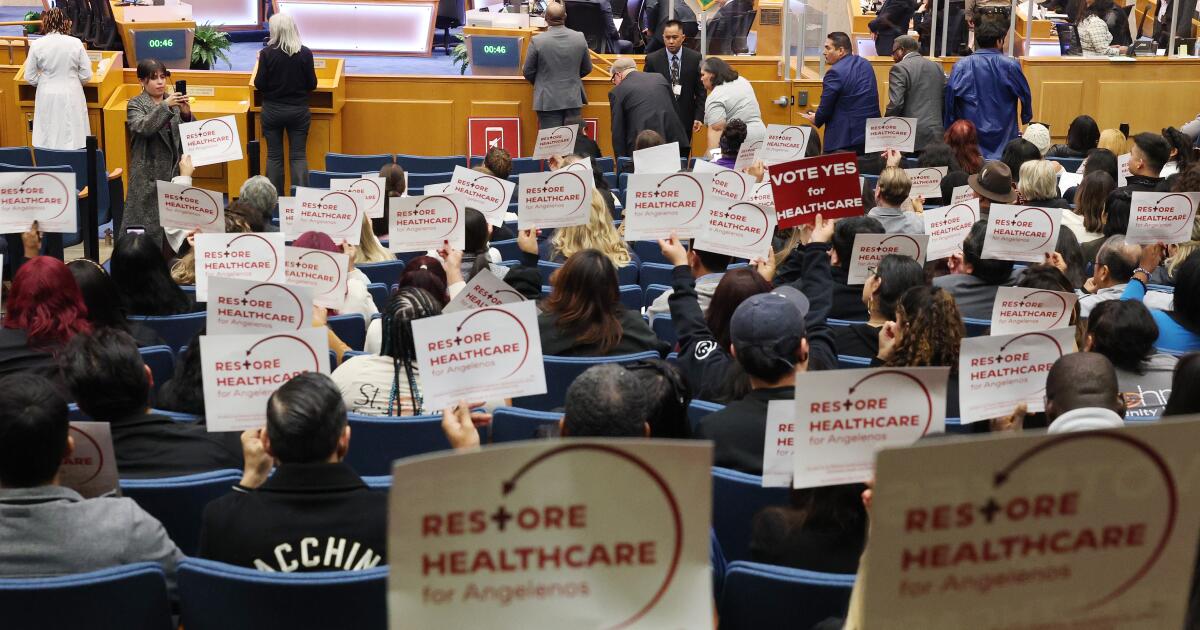
Los Angeles County’s half-cent sales tax to fund healthcare services was trailing Tuesday, with early returns showing a majority of voters rejecting the measure.
The tax — a half-penny of every dollar spent in the county — is meant to prop up local hospitals and clinics that are hemorrhaging funding after recent federal cuts.
The sales tax, which needs a simple majority to pass, would take effect Oct. 1 and last five years. Officials say it would pull in $1 billion annually to help plug the budget holes hitting local hospitals and clinics.
L.A. County health officials anticipate the One Big Beautiful Bill Act, signed into law by President Trump last summer, will slash more than $2 billion from the county’s health services budget within the next three years. Due to eligibility changes, the county will no longer be able to get reimbursements for many Californians who have lost Medi-Cal.
The measure was championed by a coalition of healthcare advocates called Restore Healthcare for Angelenos who warned that mass layoffs and emergency room closures could be imminent if new funding didn’t come fast. The Department of Public Health recently closed seven clinics — a grim sign, supporters said, of service cuts to come.
Voters haven’t rejected a sales tax hike since 2012, when a transportation measure fell just short with 66.1% support. It needed 66.7% to pass.
A majority of county supervisors had supported the new tax proposal, voting 4 to 1 this February to put it on the ballot. But the measure faced significant opposition from local cities, with opponents arguing the sales tax hike would unfairly burden the poorest county residents and encourage people to spend their dollars across the county line.
Supervisor Kathryn Barger, the board’s lone opponent of the tax, said she was concerned it was a “general” tax, meaning the money wouldn’t be earmarked for healthcare costs. Instead, she argued, politicians would have final say over how the money gets spent.
The supervisors have created a plan for spending the tax money, with the largest chunk of the money meant to cover the costs for patients without insurance. The measure also asked voters to sign off on a nine-member oversight committee.
The county currently has a base sales tax rate of 9.75%, and cities impose local taxes on top of that.
-

 South-Carolina3 minutes ago
WATCH: Gov. McMaster signs bill protecting SC police animals
-

 South Dakota10 minutes ago
South Dakota primary results leave Legislature seats in limbo
-
 Tennessee13 minutes ago
Franklin police ticket 13-year-old after e-bike crash, and a new Tennessee law brings more changes July 1
-

 Texas18 minutes ago
National Democrats aim to flip 12 Texas House seats under newly expanded target list
-

 Utah25 minutes ago
Utah’s wonderful women took Kevin O’Leary to school over his…
-

 Vermont28 minutes ago
Hundreds of housing units in the works at closely-watched project in Burlington’s South End – VTDigger
-

 Virginia33 minutes ago
Crews put out house fire in Bristol, Virginia
-

 Washington40 minutes ago
Deputies use drone to catch man wanted for damaging car in Washington County

