Sports
Column: Mike LeDuc honors the greatest three-point shooters in his illustrious coaching career

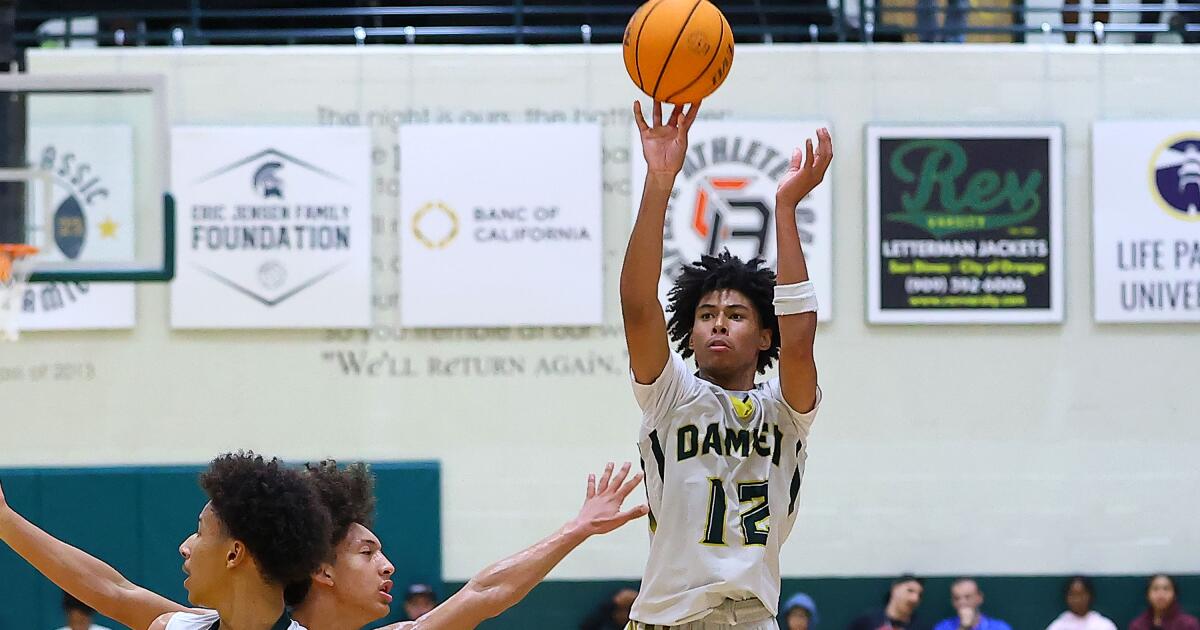
In 44 seasons of coaching high school basketball, and with more than 1,000 victories, Mike LeDuc of Damien has had plenty of top shooters. His team is playing in the Southern California Division 1 regional playoffs, so it’s a good time to ask who is on LeDuc’s top-five list as a three-point shooter.
After lots of pleading, with me pointing out his current three-point shooting star, Xavier Clinton, would be on most lists of coaches, LeDuc revealed his top five.
Broadcast partners Tracy Murray, right, and Josh Lewin prepare to call a UCLA game in 2021. Murray averaged 44 points for Mike LeDuc at Glendora High in 1988-89 and scored a Southern Section record 3,053 points before going on to UCLA and the NBA.
(Ben Bolch / Los Angeles Times)
No. 1 is Tracy Murray. He averaged 44 points for LeDuc at Glendora High in 1988-89 and scored a Southern Section record 3,053 points before going on to UCLA and the NBA. He could make shots from anywhere and would have tried one from half court if LeDuc needed it.
No. 2 is Casey Jacobsen. He scored a record 3,284 points at Glendora from 1996-99 before going on to Stanford and the NBA. He’s 6 feet, 6 inches tall, and his size and skill made him a defensive nightmare in high school.
No. 3 is Josh Giles. Yes, the current Corona Centennial coach was a heck of a shooter at Glendora. Intense, tough and stubborn, he didn’t back down from anyone. In 1996, he made 113 threes.
No. 4 is Adam Jacobsen. The older brother of Casey Jacobsen made 288 three-pointers for Glendora before transferring to Crescenta Valley before making 311 threes in college at Pacific.
No. 5 is Cameron Murray. The younger brother of Tracy Murray scored 2,842 points from 1991-94 at Glendora. Imagine what life was like back in the days when the Murrays were playing games of H-O-R-S-E against each other. There was not enough light left to keep going.
The three-point line came into effect during Tracy Murray’s junior season in 1987-88. LeDuc remembers the Division II state championship game at the Oakland Coliseum Arena in 1989 when Murray was pulling up after one dribble and making threes from beyond the top of the key. He scored 64 points in an 89-83 loss to Menlo Atherton. The points tied the Golden State Warriors’ Rick Barry for most points scored in the arena.
Clinton has kept up the LeDuc scoring tradition. He has 104 threes for Damien this season.
“He’s had a great year,” LeDuc said.
Clinton benefits from Damien’s inside-outside strategy because of 7-footer Nate Garcia. When teams focus on stopping Garcia, Clinton gets the chance to shoot open threes. Let’s see how far Damien goes in the Division I regional playoffs. The Spartans have a home game on Thursday night against Redondo Union.
Nearly 40 years ago, during the 1985-86 basketball season, Jerry Simon was creating buzz at L.A. Marshall High, the school that produced coach Andy Reid of the Kansas City Chiefs. Simon had a 43-point game against Crenshaw. He scored 69 points against Belmont in a game. He averaged 37.8 points in league play and was the City Section 3A player of the year.
His son, Barak, a 5-foot-10 point guard, led Marina to the Southern Section 2A championship, the first in school history. Only a junior, Barak came through with 19 points on Tuesday night in a regional loss to King/Drew, the City Section Open Division champion. He made five threes.
Simon is a special education teacher at Marina. He went to Pennsylvania and played 11 years of pro basketball in Israel, winning a championship.
He returns every year to the Marshall alumni game and takes Barak with him.
Point guard Barak Simon led Marina to the Southern Section 2A championship, the first in school history.
(Don Leach / Daily Pilot)
Now the question is will the son ever breaking dad’s scoring record.
“He claims he’s going to break it,” Jerry Simon said.
One year to go.


Sports
Florida AG launches civil rights investigation into MLB’s warning to Christian pitchers over Pride Night caps

NEWYou can now listen to Fox News articles!
The attorneys general from Missouri and Florida have reacted strongly to the controversy stirred when Major League Baseball warned three San Francisco Giants players about inscribing a Bible verse on their Pride Night caps, and that reaction includes MLB being served with a subpoena that signals the launch of an official investigation.
Florida Attorney General James Uthmeier launched his investigation on Friday by serving MLB with a subpoena to investigate whether it is violating the civil rights of players based on their religious beliefs.
The general purpose and scope of Florida’s investigation “extend(s) to possible civil rights and deceptive and unfair trade practices violations in matters of employment concerning the business practices, policies, and procedures of Major League Baseball,” per the subpoena obtained by Fox News Digital.
In a letter from Uthmeier to MLB Commissioner Robert Manfred, the AG warns that “a pattern or practice of selectively enforcing its rules to benefit favored secular beliefs over disfavored religious beliefs would not only potentially violate Florida civil rights law, but it would also violate the League’s own policies.
MAJOR LEAGUE BASEBALL FACES BACKLASH FOR ITS STANCE ON CHRISTIANS WRITING BIBLE VERSES ON PRIDE CAPS
“And a practice of claiming not to discriminate based on religion while discriminating based on religion could further amount to an unfair or deceptive trade practice in violation of the Florida Deceptive and Unfair Trade Practices Act.”
Florida Attorney General James Uthmeier speaks at a news conference in Orlando on July 15, 2025, where he said U.S. Masters Swimming should not allow transgender athletes to compete against women swimmers or face legal action. Advocates Cassidy Carlisle and Lainey Armistead also attended. (Rich Pope/Orlando Sentinel/Tribune News Service)
Uthmeier is particularly troubled by the fact MLB said its warning had nothing to do with the players’ religious beliefs but rather was strictly because of a violation of the league’s uniform code.
It should be noted MLB said in a follow-up statement to its initial warning to the players that it was merely enforcing its uniform codes and the warning had nothing to do with Giants pitchers Landen Roupp, JT Brubaker and Ryan Walker writing a Bible verse on the team’s Pride Night Cap most of the other players wore.
MLB ACCUSED OF ‘DOUBLE STANDARD’ AFTER CALLING OUT PLAYERS’ BIBLE MESSAGES DESPITE BACKING BLM IN 2020
Uthmeier noted that doesn’t ring true and presented in his letter a handful of examples where MLB has been absolutely fine with players adding to their uniform.
“In 2019, for example, a Cincinnati Reds player wrote on his cap in tribute to a nearby mass shooting,” Uthmeier wrote to Manfred. “And in 2020, MLB evidently added new, sweeping exceptions to its uniform rules by allowing players to ‘support social justice and diversity and inclusion.’ These policy changes included permitting players to add Black Lives Matter patches to their sleeves.
“MLB therefore appears to applaud — even change its rules for — the ideological beliefs it prefers, but targets players who express religious views the League doesn’t like.”
Commissioner of Major League Baseball Robert D. Manfred Jr. speaks at the 2024 MLB Draft presented by Nike at Cowtown Coliseum in Fort Worth, Texas, on July 14, 2024. (Daniel Shirey/MLB Photos via Getty Images)
The Florida subpoena, issued under the Florida Civil Rights Act, demands action from MLB on July 23, 2026, at 9 a.m.. At that time, MLB must deliver to the AG’s office documents including:
- All documents concerning how MLB characterized or classified the June 2026 cap writing, including, for example, whether MLB treated it as religious expression, political messaging, protest, or a violation unrelated to its content.
- All documents concerning what prompted MLB’s review of and warning regarding the June 2026 cap writing, including any complaint, media inquiry, internal escalation, or third-party communication received before the warning issued, and the timing of each relative to the warning.
- All documents concerning the actual June 2026 warnings issued by the MLB to any club.
- All documents, including drafts and internal deliberations, concerning MLB’s decision to issue and publicly announce the June 2026 warnings, and any analysis of whether doing so adhered to the Code or with MLB’s treatment of comparable non-religious expression.
San Francisco Giants pitcher Landen Roupp wrote “Genesis 9:12-16” on his Pride-Night themed hat. (Thearon W. Henderson/Getty Images)
Uthmeier is thus joining Missouri Attorney General Catherine Hanaway, who recently wrote a letter to Manfred asking the commissioner to confirm that no player who has chosen to refrain from “wearing Pride Month paraphernalia or included Bible verses on Pride Month hats” will not be disciplined in any way.
Hanaway’s letter states that if Manfred fails to answer by June 25 or does not confirm that no discipline will be levied, she too will open an investigation of MLB.
CLICK HERE TO DOWNLOAD THE FOX NEWS APP
The two attorneys general have authority over their individual states. But it affects four MLB teams.
Florida is home to two MLB teams — the Tampa Bay Rays and Miami Marlins — while Missouri is home to the St. Louis Cardinals and Kansas City Royals.
FOLLOW ARMANDO SALGUERO ON X: @ARMANDOSALGUERO
Sports
Commentary: Why MLB’s Pride Night cap condemnation isn’t the anti-Christian crackdown conservatives claim

Amid the first days of grief after Alex Vesia and his wife lost their newborn daughter last fall, Vesia noticed something as he watched the World Series on television. He paused the broadcast, then checked the video, then texted another player to make sure.
51.
Dodgers teammates wore his number on their caps. So did players from the Toronto Blue Jays.
“It was awesome,” Vesia said. “It was a very heartwarming moment.”
Moving.
Touching.
And, under baseball’s rules, illegal.
Who knew, really, until this week? Three pitchers from the San Francisco Giants wrote the name of a Bible verse on their Pride Night caps and, amid an uproar, Major League Baseball said it had warned the players that “writing of any kind, with any message” on any playing apparel is not permitted. The issue, the league said in a statement, was not what they wrote on their caps but simply that they wrote on them at all.
Said MLB in the statement: “We have given the same warning numerous times in the past to players for messages such as ‘Dad’, ‘Happy Mother’s Day, I Love Mom’ and names of family members.”
To its credit, the league did not enforce the rule when Vesia’s number started appearing on caps in the World Series. But, if you’re going to draw a line on enforcement, where should you draw it?
In San Francisco, the actions of the Giants’ pitchers were widely condemned.
“They were in for a rude awakening with the response, and it wasn’t just from the gay community,” Giants broadcaster and former pitcher Mike Krukow told KNBR, the team’s flagship radio station. “It was from the Northern California community that supports the gay community.”
In response to media inquiries, and as first reported by Outsports, MLB confirmed it had warned the three players. I asked the league whether warnings had been issued in two other instances in which players had written on their caps, including Clayton Kershaw last year writing the same Bible verse on his Pride Night cap that the Giants’ pitchers wrote this year. MLB declined to comment.
“I got chastised by the league when I put Charlie [Kirk]’s name on my hat last year, because a man was murdered in cold blood,” Dodgers pitcher Blake Treinen told me, “and now these gentlemen who are relievers in San Francisco are getting chastised by the league for putting a Bible verse on their hat. It’s crazy to me.”
Treinen said league officials had told him the rule is strictly enforced.
“I straight up asked Clayton last year, ‘Did they call you when you put that on your hat?’” Treinen said. “He said, ‘No.’”
The Pride caps feature team logos decorated in the colors of the rainbow, a symbol long associated with the gay community. In the Bible verse cited by the pitchers (Genesis 9:12-16), the rainbow represents “the everlasting covenant between God and all living creatures.”
That the league would warn players against writing a Bible verse on their caps ignited a wave of conservative outrage, from Vice President JD Vance to Texas Gov. Greg Abbott.
Missouri Sen. Josh Hawley fired off a letter to MLB commissioner Rob Manfred, alleging apparent discrimination “against baseball players who profess their Christian faith” and threatening the league’s antitrust exemption. Assistant U.S. Atty. Gen. Harmeet Dhillon said on national television that players might be able to file a claim for employment discrimination.
That is complete nonsense. This is what you want: When employees raise an issue to their employer, the employer listens and addresses their concerns.
In 2023, the year after five Tampa Bay Rays players declined to wear rainbow logos for Pride Night, Manfred said the league would no longer compel players to do so.
“We have told teams, in terms of actual uniforms, hats, bases that we don’t think putting logos on them is a good idea just because of the desire to protect players: not putting them in a position of doing something that may make them uncomfortable because of their personal views,” Manfred said then.
Teammates congratulate Freddie Freeman after his walk-off home run gave the Dodgers a 1-0 win on June 5, when the Dodgers held their annual Pride Night. Blake Treinen, the winning pitcher that night, elected to wear his regular Dodgers cap instead of the Pride version.
(Katelyn Mulcahy / Getty Images)
Manfred said the Pride Night celebrations could go on, however a team wished to stage them — or not, in the case of the Texas Rangers, the only one of the 30 MLB teams that declines to hold a Pride Night. And the league still sells Pride gear on its website for all teams, including the Rangers.
In the cases of the Giants and Dodgers, MLB grandfathered each team’s long-running use of a rainbow logo on the cap, with this accommodation to players: If you don’t feel comfortable wearing the Pride cap, just wear your regular cap.
That is what Treinen and outfielder Alex Call did when the Dodgers celebrated Pride Night. That is also what a fourth Giants pitcher did.
“My job is to abide by the rules,” Treinen said. “Ultimately, the only rule we have is to wear our team-issued uniform. So that’s what I chose to do.”
To Treinen, the decision over whether to wear a Pride cap is not about passing judgment on anyone else but about what he sees as the push “to force something on people that you know that is controversial to their faith — and, in fact, straight up against their faith.”
He expressed his support for the Giants pitchers.
“Kudos to those men over there who are standing strong in their faith,” he said. “It’s a sad thing to corner someone and try to make them feel bad about their convictions.”
I respect Treinen for explaining his viewpoint. To me, wearing a Pride cap for one night does not diminish your faith at all. It might sharpen your convictions. More important, it signals a welcome to everyone in the community that buys the tickets and broadcast subscriptions that help pay your salary.
“I think a few people made it about themselves and not about the community,” San Francisco Mayor Daniel Lurie told the Bay Area Reporter.
We always proclaim the life lessons of sports. One of them: Sometimes you have to put the team’s interests ahead of your own.

NEWYou can now listen to Fox News articles!
After its massive 1-0 win over South Korea on Thursday night, Mexico has won Group A and officially clinched a spot in the knockout round.
El Tri will play its Round of 32 game in Mexico City, and will face the third-place finisher in either Group C/E/F/H/I.
This is the fourth time that Mexico has topped the group stage of a World Cup, with the other three coming in 1986, 1994 and 2002.
With the win, Mexico remains unbeaten in World Cup group games at home, going a combined 6-2-0 (W-D-L), with two wins and a draw in 1970 and 1986, and now two wins in 2026.
Before the tournament began, Mexico was listed at +6500 to win the World Cup. Now, after winning its first two games of the tournament, Mexico has surged up the oddsboard to +5000.
Can Mexico build off its first two matches and make a deep run in this tournament? Let’s check out the updated odds for El Tri as of June 19.
This page may contain affiliate links to legal sports betting partners. If you sign up or place a wager, FOX Sports may be compensated. Read more about Sports Betting on FOX Sports.
Team Mexico — Stage of Elimination
Last 32: +125 (bet $10 to win $22.50 total)
Last 16: +135 (bet $10 to win $23.50 total)
Quarterfinals: +600 (bet $10 to win $70 total)
Semifinals: +1600 (bet $10 to win $170 total)
Runner-up: +3000 (bet $10 to win $310 total)
Outright winner: +5000 (bet $10 to win $510 total)
Mexico is currently +5000 to win the 2026 FIFA World Cup after winning Group A (Getty Images).
Mexico’s Past World Cup Results:
1930: Group stage
1934: Did not qualify
1938: Withdrew
1950: Group stage
1954: Group stage
1958: Group stage
1962: Group stage
1966: Group stage
1970: Quarterfinals
1974: Did not qualify
1978: Group stage
1982: Did not qualify
1986: Quarterfinals
1990: Banned
1994: Round of 16
1998: Round of 16
2002: Round of 16
2006: Round of 16
2010: Round of 16
2014: Round of 16
2018: Round of 16
2022: Group stage
2026: TBD
What to know: Mexico has made a habit of being in the running, but never really being in the running. Make sense? Consider this: El Tri made it out of the group stage in seven consecutive World Cups (1994-2018), but never made it past the Round of 16 in any of those years. In 2022, Mexico failed to make it out of the group stage, and it will look to get back to its winning ways in 2026 after a great start to the tournament. With its win Thursday night, Mexico has now advanced to the knockout stage in eight of the last nine World Cups. It is important to note, however, that Mexico has never made it past the quarterfinals at a FIFA men’s World Cup.
-

 World47 seconds ago
On the South Lawn, a UFC fighter’s victory frames an unusual White House scene
-

 Politics13 minutes ago
Video: Demining the Strait of Hormuz
-

 Health28 minutes ago
Video: Wii Bowling Takes Over Tulsa Retirement Homes
-
Lifestyle43 minutes ago
This Pride month, teen flicks are recasting familiar tropes with a queer sensibility
-

 Technology51 minutes ago
NASA selects Eric Schmidt’s rocket company for a 2028 mission to Mars
-

 World58 minutes ago
British Prime Minister Keir Starmer faces potential leadership challenge from newly-elected Andy Burnham
-

 Politics1 hour ago
Reporter’s Notebook: How Trump’s surprise move on DNI confirmation upended key Senate deal on FISA
-

 Health1 hour ago
Weight-loss drugs linked to ‘Ozempic ears’ and other cosmetic complaints, surgeons say

