Connect with us

Entertainment

Spirit Awards ceremony disrupted by protesters as 'Past Lives' takes top prize

Published

on

Spirit Awards ceremony disrupted by protesters as 'Past Lives' takes top prize

In what could be a sign for awards shows to come, the Spirit Awards were severely disrupted on Sunday afternoon by pro-Palestinian protesters.

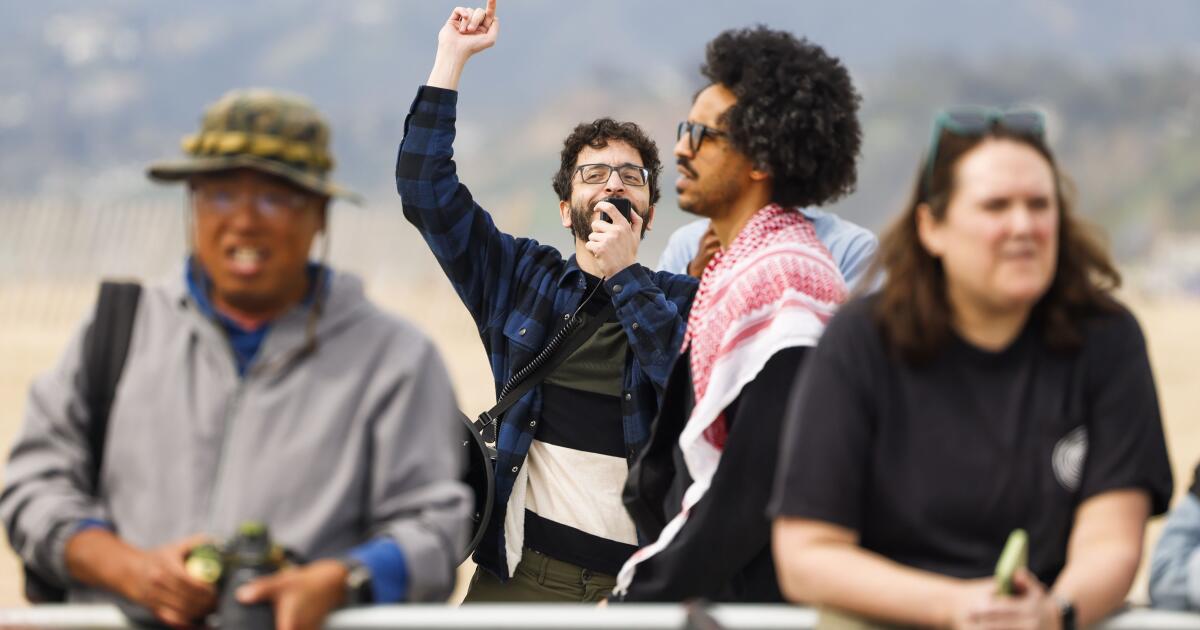
About 40 minutes into the daytime ceremony, which was held in a tent near the beach in Santa Monica, loud sounds could be heard by attending guests. A small group of protesters had assembled on a public sidewalk across from the tent, holding up a loudspeaker that played a pre-recorded looped chant of “Free, free Palestine,” “Long live Palestine” and “Cease-fire now” that could be heard throughout the rest of the show.

Da’Vine Joy Randolph, left, and Anne Hathaway at the Independent Spirit Awards on Sunday.

(Jason Armond / Los Angeles Times)

Advertisement

Nevertheless, the ceremony continued and awards were handed out, with writer-director Celine Song’s “Past Lives” winning for feature and director.

“Past Lives” is also nominated for best picture and screenplay at the Academy Awards. In an interview with The Times before the Spirit Awards ceremony got underway, Song said, “At the heart of it, ‘Past Lives’ is an independent film. It was made independently, and then we also premiered at Sundance, which is really the heart of independent cinema. So to me, this is like being home. Walking in here, I already felt like this is where the movie belongs.”

As often happens, Spirit Awards voters went for films also nominated for Academy Awards; Along with “Past Lives,” Oscar-nominated films such as “American Fiction,” “The Holdovers,” “May December,” “Four Daughters” and “Anatomy of a Fall” all took home Spirit Awards.

Benny Safdie, left, and “American Fiction” screenwriter-director Cord Jefferson at the Independent Spirit Awards on Sunday.

(Jason Armond / Los Angeles Times)

Advertisement

“American Fiction” won for screenplay for Cord Jefferson, who also directed the film, as well as lead performance for Jeffrey Wright. This was the second year the Spirit Awards gave out non-gendered acting awards with 10 nominees, including men and women, for each prize in lead and supporting categories.

Da’Vine Joy Randolph, of Alexander Payne’s “The Holdovers,” won for supporting performance, as did her co-star, Dominic Sessa, for breakthrough performance. Eigil Bryld’s cinematography won as well.

But as the awards show continued, the protesters’ chanting could be heard through acceptance speeches. The protesters were outside on a sidewalk adjoining the beach, on the far side of the tent from where the stage was set up. Event organizers moved a shuttle bus backward and forward in front of the protesters to attempt to block the sound of their loudspeaker. Depending on where one was located inside the tent, they were either loud or unclear. The ceremony was being livestreamed on YouTube, where it was reported that muffled, indistinct noise could be heard on the broadcast.

The protest was noted a few times from the stage, often with a note of confusion as to what was going on. Host Aidy Bryant was beginning a comedy segment not long after the protest erupted and noted, “We are at the beach and people are practicing their freedom of speech.”

Advertisement

Lily Gladstone, center, at the Independent Spirit Awards on Sunday.

(Jason Armond / Los Angeles Times)

Comedian Jimmy O. Yang, while presenting another award, referred to the “heckler” outside and joked that people in the independent film community are “used to getting yelled at.”

Winning the John Cassavetes award for a film made for under $1 million, “Fremont” filmmaker Babak Jalali said, “There are people speaking outside and whatever they’re saying, I think it’s far more important than what I’m about to say.” His words were met with applause.

Advertisement

Prior to the ceremony, Josh Welsh, president of Film Independent, which puts on the Spirit Awards, said that the switch last year from a broadcast partner to livestreaming on YouTube had actually doubled the audience for the show and made it available internationally.

“This is where the community comes together,” Welsh said. “And people I think need that now and really value it.”

Will Ferrell at the Independent Spirit Awards on Sunday.

(Jason Armond / Los Angeles Times)

Advertisement

Accepting the Robert Altman Award for the ensemble of “Showing Up,” filmmaker Kelly Reichardt summed up the afternoon by recalling seeing filmmaker Robert Altman receive a lifetime achievement award in 2003 as war was erupting in Iraq. “And he was pissed.” Reichardt added, gesturing to the disruption outside. “I think he’d have a lot to say, just this weirdness of us being here and celebrating each other and our work, and also, you know: Life goes on outside the tent. Peace.”

Here is a complete list of today’s Spirit Award winners.

FILM CATEGORIES

Best feature
“Past Lives”
Producers: David Hinojosa, Pamela Koffler, Christine Vachon

Director
Celine Song, “Past Lives”

Advertisement

Screenplay
Cord Jefferson, “American Fiction”

First feature
“A Thousand and One”
Director: A.V. Rockwell
Producers: Julia Lebedev, Rishi Rajani, Eddie Vaisman, Lena Waithe, Brad Weston

From left, Greta Lee, Emma Corrin, Andrew Scott, Jeffrey Wright and Elijah Wright at the Independent Spirit Awards on Sunday.

(Jason Armond / Los Angeles Times)

Advertisement

First screenplay
Samy Burch, “May December”

John Cassavetes Award
(for a feature made under $1,000,000)
“Fremont”
Writer-director: Babak Jalal
Producers: Rachael Fung, Chris Martin, Marjaneh Moghimi, George Rush, Sudnya Shroff, Laura Wagner

Breakthrough performance
Dominic Sessa, “The Holdovers”

Supporting performance
Da’Vine Joy Randolph, “The Holdovers”

Jeffrey Wright, left, and Colman Domingo at the Independent Spirit Awards on Sunday.

Advertisement

(Jason Armond / Los Angeles Times)

Lead performance
Jeffrey Wright, “American Fiction

Robert Altman Award
(for an ensemble cast, director and casting director)
“Showing Up”
Director: Kelly Reichardt
Casting Director: Gayle Keller
Ensemble Cast: André Benjamin, Hong Chau, Judd Hirsch, Heather Lawless, James Le Gros, John Magaro, Matt Malloy, Amanda Plummer, Maryann Plunkett, Denzel Rodriguez, Michelle Williams

Cinematography
Eigil Bryld, “The Holdovers”

Advertisement

Editing
Daniel Garber, “How to Blow Up a Pipeline”

International film
“Anatomy of a Fall” (NEON)
Director: Justine Triet

Documentary
“Four Daughters”
Director: Kaouther Ben Hania
Producer: Nadim Cheikhrouha

Someone to Watch
Monica Sorelle, “Mountains”

Truer Than Fiction
Set Hernandez, “unseen”

Advertisement

Producers Award
Monique Walton

Andrew Scott and Anne Hathaway at the Independent Spirit Awards on Sunday.

(Jason Armond / Los Angeles Times)

TELEVISION CATEGORIES

Advertisement

New scripted series
“Beef”
Creator/Executive Producer: Lee Sung Jin
Executive Producers: Steven Yeun, Ali Wong, Jake Schreier, Ravi Nandan, Alli Reich
Co-Executive Producers: Alice Ju, Carrie Kemper

New non-scripted or documentary series
“Dear Mama”
Executive Producers: Lasse Järvi, Quincy “QD3” Jones III, Staci Robinson, Nelson George, Charles D. King, Peter Nelson, Adel “Future” Nur, Jamal Joseph, Ted Skillman, Allen Hughes, Steve Berman, Marc Cimino, Jody Gerson, John Janick, Nicholas Ferrall, Nigel Sinclair

Supporting performance in a new scripted series
Nick Offerman, “The Last of Us”

Lead performance in a new scripted series
Ali Wong, “Beef”

Breakthrough performance in a new scripted series
Keivonn Montreal Woodard, “The Last of Us”

Advertisement

Ensemble cast in a new scripted series
“Jury Duty”
Ensemble Cast: Alan Barinholtz, Susan Berger, Cassandra Blair, David Brown, Kirk Fox, Ross Kimball, Pramode Kumar, Trisha LaFache, Mekki Leeper, James Marsden, Edy Modica, Kerry O’Neill, Rashida Olayiwola, Whitney Rice, Maria Russell, Ishmel Sahid, Ben Seaward, Ron Song, Evan Williams

Entertainment

Who is on Elle Woods’ playlist? ’90s bands like No Doubt and Sleater-Kinney

Published

on

Who is on Elle Woods’ playlist? ’90s bands like No Doubt and Sleater-Kinney
p]:text-cms-story-body-color-text clearfix”>

“I’ve talked about rain on this show more than I have in my entire life,” Kittrell says.

It was a constant consideration, both on set and in the writers room. Weather became a way to distinguish Elle from those around her in Seattle. The locals never carry umbrellas; Elle shows up with a pink one.

“We had a writer from Seattle who always said the city gets a bad rap because of the rain,” Kittrell says. “But the rain is what makes it beautiful — it makes Seattle green.”

Advertisement

Elle entering the halls of Rainier West High School with her pink umbrella.

(Kimberley French / Prime Video)

That philosophy stayed with the writers, later showing up in a line Miles (Jacob Moskovitz), Elle’s crush, says to her, and ultimately leading them to Garbage’s “Only Happy When It Rains” as the show’s theme. “We were like, of course,” says Kittrell. “This is what we’ve been talking about the entire time.”

The song was originally meant to end the pilot. “Then we decided we should just be hearing it in every single episode,” says Neustadter. (The pilot instead uses Radiohead’s “Creep,” which also bookends the series.) The main title sequence, an animated “saga sell” from the studio Shine, tells the story of Elle’s move from Bel-Air to Seattle.

Advertisement

“We’re constantly reminding the audience of the contrast between Elle’s essence and the world she’s now in,” Neustadter adds. “There’s an optimism to ‘Only Happy When It Rains’ that feels very Elle Woods. And the irony of it is so delightful.”

Continue Reading

Movie Reviews

‘Baby Do Die Do’ movie review: In the mood for Mumbai

Published

on

‘Baby Do Die Do’ movie review: In the mood for Mumbai

Monsoon sets in Mumbai with a bang. Rain drops ram the streets in desperation. The relief easily drifts into panic. Sea of umbrellas everywhere but one amongst them at a local station stands out. Wading through the downpour, its red colour drips with a warning. The person holding it exhibits a stone-cold demeanour, as she looks for an old man in the bustling chaos of the train at rush hour. She moves through the crowd inconspicuously and readies her umbrella, which secretly hides a gun as a trigger appears on its handle. She takes a muffled shot and disappears into the ensuing chaos.

The opening scene in Huma Qureshi’s Baby Do Die Do bears an uncanny resemblance to the real horrific killing of a young man in the local train recently, which laid bare the brutality that some people in the city carry within. An argument can escalate soon into homicide and there would be no one coming to rescue. Baby Karmarkar (Qureshi) carries a similar violence in her heart, that rises from the clutches of a city that failed her when she witnessed the death of her twin sister as a child. The city has turned her into a sociopath

The film however, doesn’t always treat the violence with gravity. Its tone is not always sharp and cynical even as it aims to critique the cornerstones of wealth and power on occasions by establishing the link between the builder lobby and mafia. Director Nachiket Samant largely uses the noir as part of the design element, lending a pulpy, comic-bookish layer to the narrative while the thematic undercurrents don’t really get time to marinate. As a result, the rainy undercurrents, moody lighting and dark humour gets dissolved just into style rather than adding complexity to the narrative.

Baby Do Die Do (Hindi)

Director: Nachiket Samant

Duration: 125 minutes

Advertisement

Cast: Huma Qureshi, Chunky Panday, Sikandar Kher, Seema Pahwa, Rachit Singh, Marudhar Shekhawat, Arun Kushwah

Synopsis: A deaf and mute assassin gets softened by love as she vows to take revenge from the man who murdered her twin sister

That being said, there’s more heart in Baby Do Die Do than the combined range of some of the other monotonous films that have come out in recent times. Its disregard for template is quite reassuring as it also aims to subvert genre cliches with a touch of quirk. The film doesn’t forget to have fun while juggling along with the grimness, as seen in an inventive item song which is inserted when Manu (a brilliant Marudhar Shekhawat), an associate of Baby, is tasked with an assassination that takes him to a gay pub in Andheri East. Saqib Saleem (also producer) makes a guest appearance as a sexy, ripped dancer, grooving seductively to a song with the hook line ‘Alpha Q’ repeated all along, creating an edgy innuendo. The gaze is empowering, building a sense of liberation to Saqib’s character, who controls his body and its movements. Rather than being an object of desire, he becomes its subject, withholding the capacity to flirt with anyone he wants, without crossing a boundary. Even the onlookers carry a sense of respect in their eyes as the camera doesn’t become a medium to represent lecherous gazes.

A still from the film

A still from the film
| Photo Credit:
Saleem Siblings/Youtube

All of this inherent loudness compliments the muted worries of Baby, who cannot hear and speak. It is delightful to see her first tryst with love unfold like a silent film as Siddhu (Rachit Singh), a likeable Sikh music teacher is smitten by her beauty. Their love story starts in a bus and later blooms in a cramped apartment, as there’s again a gender reversal at play, with Baby incorporating toughness as Siddhu stays dipped in vulnerabilities. There’s still a lot more to them that remains unexplored as the film has to fixate on the central conflict of Baby’s vengeance, which remains its weakest and most predictable link.

It is only when it digresses from the way that the film shows beguiling promise. Whether it is in smaller sketchy moments like when a character with vitiligo is called black and white in a humourous scene or the dwarf gangster Lucky (Arun Kushwah) immortalised by his brother, Zafar Katkar (Sikandar Kher) by putting his name on the tallest building in the city. The film also allows these dreaded gangster’s tiny moments to breathe, reflecting a common link between all the characters, born and raised on the same soil of Mumbai. Zafar gets into reverie during a violent hold up in a shanty when the distinct smell in the air takes him back to his childhood. He sniffs a blanket and talks of living in the underbellies and wanting to escape that netherworld as others seem to sympathise to his sentiments. All of them become Mumbaikars in that one moment before mayhem, disarmed of other identities when put in a space of mutual co-existence, rooting for the common concerns of roti, kapda and makaan. It is also short-lived for time has shaped each of them differently and they must react to the version that the city has forced them to be in the present.

Huma Qureshi and Chunky Panday in the film

Huma Qureshi and Chunky Panday in the film
| Photo Credit:
Saleem Siblings/Youtube

Kher inhabits this dichotomy with urgency, lending an astounding tragic-comic quality to his screen presence. He is a treat to watch but the screenplay just stops short of taking him to murkier territories while resorting to familiar, convenient turns to reach the resolution. Even Huma remains impressive as she stays silent for the most part and uses her face to translate Baby’s emotional turmoil. The real surprise in the mix comes from the restrained act put on by Chunky Panday, who represents the helpless middle-class Mumbaikar with remarkable honesty.

Advertisement

These are all characters that become much more superior than the immediate storyline which Baby Do Die Do struggles to run along with. Their dreams feel palpable, their anger unresolvable and their beauty merging with the soul of the city. On occasions, their collective aspirations represent the charms of Bombay films of the 70s and 80s by Sai Paranjpye and Basu Chatterjee. Even the twin sisters retribution tale seems to be a reworked ode to older Hindi movies. It is an aesthetic that is hurriedly disappearing from other contemporary city films.

So, although Baby Do Die Do imagines Mumbai as a cyberpunk landscape, it actually prospers while recollecting the unassuming everyday pulse of the metropolis, whether it is in the tale of a shoe polisher, who suffocated to his death on an overcrowded bridge, a peon in the High Court, who got killed by mistake and the mother whose sanity was taken away by the city’s violence. Then, in the compounding mess created by the bigger folks Murjhani and Bhambhani, it is important, like Baby, to be zara hatke, zara bachke. It is after all, Bambai meri jaan.

Baby Do Die Do is currently running in theatres

Published – July 03, 2026 03:10 pm IST

Advertisement
Continue Reading

Entertainment

California designates Bruce Lee Day, first such honor for a Chinese American

Published

on

California designates Bruce Lee Day, first such honor for a Chinese American

Cut to a seedy alley behind a Chinese restaurant in Rome: A dozen mobsters menace a slight young man who suddenly pulls out a pair of nunchucks. He swings the traditional stick-and-chain weapons and makes quick work of his enemies, who fall one by one, groaning in pain.

The comedic, legendary action scene is from the 1972 film “The Way of the Dragon,” written, directed and starring Bruce Lee. The martial arts star was a trailblazer, allowing Asian Americans to see themselves represented in a strong, positive light on-screen.

And now he has secured a place in California history, becoming the first Chinese American in state history to have a day designated in his honor.

Lee was born in 1940 in San Francisco. His mother was of European descent and his father was a Cantonese opera star who was on tour in the city, affording his son birthright citizenship.

Lee grew up in Hong Kong, where he followed his father’s path as a performer, acting in more than a dozen films as a child and studying the close-quarters southern Chinese martial art Wing Chun.

Advertisement

On May 17, 1959, an 18-year-old Lee returned to San Francisco and eventually made his way to Hollywood. He went on to influence an industry that was at the time bereft of Asian American talent, and helped to popularize the genre of martial arts films and ignite Western interest in Hong Kong action cinema.

In recognition of his contributions, state Assemblymember Matt Haney (D-San Francisco) introduced a bill designating May 17 as “Bruce Lee Day” in California. The bill, signed into law Tuesday by Gov. Gavin Newsom, encourages schools and communities to honor Lee’s life and cultural impact.

Haney has described Lee as a “symbol of pride, resilience and possibility for generations who rarely saw themselves reflected with strength and dignity.”

Lee, who saw himself not only as an actor but also as a poet and philosopher, encountered repeated barriers. Up for the main role in the 1970s television series “Kung Fu,” for example, he was rejected in favor of white actor David Carradine.

In 2020, filmmaker Bao Nguyen sought to show how Lee dispelled anti-Asian sentiment and long-held stereotypes of emasculated Asian men in his ESPN documentary “Be Water.”

Advertisement

“The Asian male was the face of the enemy to many Americans,” Nguyen told The Times in 2020. “It was this vicious cycle of society reflecting media and culture, and media and culture reflecting society. There had to be some kind of intervention there and Bruce, in a way, was that intervention. He was the hero that we hadn’t seen before.”

Lee learned much about the systemic oppression that Black Americans faced from his first student, Jesse Glover, who had been a victim of police brutality.

And scholars have pointed out that, although his films had far-from-perfect politics, they touched on themes of fighting oppression. The 1971 movie “The Big Boss” showed Lee battling alongside laborers. “Fist of Fury” saw him opposing Japanese colonialism and discrimination.

Lee died young in 1973, at age 32 — before he was able to witness the full extent of his stardom. He died just one month before the release of “Enter the Dragon,” which was a box-office sensation and is considered a masterpiece of martial arts filmmaking.

Advertisement
Continue Reading
Advertisement

Trending