Entertainment
Happy 95th birthday, Frank Gehry. Let's give you the Disney Hall you really wanted

Over the last two decades, Walt Disney Concert Hall has blazed cultural trails like no place else. We can rightfully talk about the L.A. Philharmonic before and after Frank Gehry built it a hypnotizing new home. We can divide downtown L.A. into pre- and post-Disney. We can go so far as to distinguish orchestral life, not only in L.A. but everywhere, in the same way.
Gehry turns 95 on Wednesday, and the L.A. Phil season, which began with a gala led by Gustavo Dudamel celebrating the architect, has, in ongoing tributes to the hall and in just doing its thing for these nearly five months, readily revealed, week after week, all that Disney is. And, alas, all that Disney inexcusably isn’t. At least not yet. But the best of Disney first.
Building Disney was a long, laborious, contentious, financially dicey process, one for which we’ve never had a full or convincing account. I’ve never gotten straight answers about who did what to whom and when.
In 1987, Ernest Fleischmann, at the time the transformative head of the L.A. Phil, enticed Lillian Disney to give $50 million for a concert hall to be built in honor of her late husband, Walt, as an addition to the Music Center. Fleischmann, who had once hailed the Dorothy Chandler Pavilion, built for the L.A. Phil in 1964 as an acoustic wonder, eventually pronounced it unworthy. It still is, but that’s another story.
Presumably, Fleischmann assured Lillian Disney that this generous sum would be sufficient for the new hall, knowing full well that much more would be needed (ultimately, more like $274 million). Although Fleischmann and Gehry were close friends, Gehry was viewed as far too radical for the conservative classical music establishment, which feared chain-link fences and whatnot. One Music Center board member proposed that the original blueprints for the Chandler be dug up and that they just build “the same damn thing” across the street.
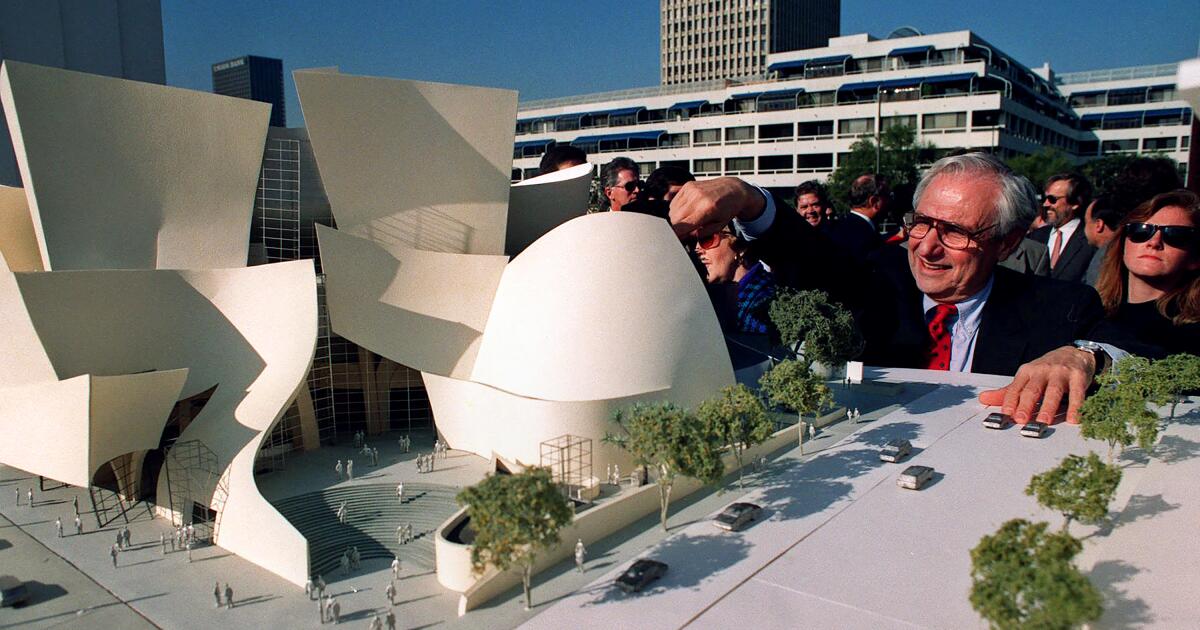
A competition was arranged. Gehry’s model, which was exciting but far more conventional than the masterpiece he ultimately designed, was so superior to the others, especially in its welcoming feeling, that even Gehry’s detractors begrudgingly approved. The four other models, all by distinguished architects, were suspiciously clueless.
I never could get Fleischmann, or anyone else close to the competition, to explain why. Did Fleischmann and others on the jury know all along that Gehry was exactly what the orchestra and the city needed and that the only way to get it was to rig the competition by misleading the other architects? All insisted it was fair. Until evidence proves otherwise, I’m sticking with Fleischmann’s visionary flare eclipsing committee-compromised fair.
The construction site for Disney Hall at 1st Street and Grand Avenue in 1995.
(Carol Cheetham / For The Times)
It would take 16 years to build Disney. Fundraising stalled repeatedly. Gehry’s detractors (including some leading voices at this newspaper) had a field day. The Music Center did not display much enthusiasm.
In the early 1990s, the L.A. riots, the Northridge earthquake and a recession took further wind out of the new hall’s prospective sails. When I arrived at The Times in spring 1996, everyone told me that the hall was moribund. The county, which owns the Music Center and the land on which Disney sits, had built only the parking lot. The county’s supervisors, with the exception of Zev Yaroslavsky, were ready to pull the plug.
But Fleischmann tenaciously hung on. Much later, Esa-Pekka Salonen, then-music director, confessed to me that he had offered his resignation to Fleischmann, in part over his disappointment of the hall’s seeming failure and figuring that maybe another conductor could do more. There was also considerable disgruntlement among board members and patrons over Salonen’s advocacy of new music, despite the fact that he was attracting a younger audience and was increasingly seen as a vital new voice in classical music.
A fundraising deadline loomed, and Fleischmann persuaded Salonen to stick it out a little longer. Just in time, the tide turned, thanks to three fortuitous events. Gehry’s new museum in Bilbao, Spain, wowed the world. A Stravinsky festival that Salonen and the L.A. Phil put on in Paris wowed not only the French but also L.A. Phil board members, including Disney skeptics. The clincher was a series of individual gifts of $5 million each from the publisher of the L.A. Times, then-Mayor Richard Riordan (using his personal money to make what was at the time an anonymous donation) and philanthropist Eli Broad, who then took over the final fundraising.
Disney Hall under construction in 2001.
(Wally Skalij / Los Angeles Times)
Disney opened as an instant icon. It catapulted the L.A. Phil to far greater fame than the orchestra had ever known. It spearheaded the revival of downtown and shaped the identity of DTLA, as it would soon be known.
With Disney, the 21st century orchestra was born. The immediacy of the acoustics, the intimate connection between the musicians and listeners, the warmth and visual allure of the interior — all were thrilling. The new hall invited making and consuming new music seem natural. The interior, shaped a little like a ship, put an audience in the mood for adventure.
For the next two decades, the L.A. Phil went from strength to innovative strength, helped by two progressive music directors, Salonen and, beginning in 2009, Dudamel.
Starting with the “Tristan Project” in 2004, Wagner’s “Tristan und Isolde,” conducted by Salonen with video by Bill Viola and staged by Peter Sellars, Disney Hall inspired a full expansion of the notion of what classical music could be. The symphony orchestra, with traditions that go back more than three centuries, now had a venue ripe for experimenting with emerging technologies and for incorporating other musical genres and traditions, even other art forms — be they painting, sculpture, dance, theater, performance art, poetry, cinema, video. The L.A. Phil became a model of how an institution could matter, and its home became a tourist attraction, a site to see and a place to be.
Artist Refik Anadol designed projections that lighted up Disney Hall to celebrate the L.A. Phil’s centennial in 2018. Gehry’s original plan for the hall called for live images of the orchestra to be projected on the hall during performances.
(Luis Sinco / Los Angeles Times)
We’ve had a taste of that this season in concerts by Dudamel and Salonen with a range of music, old and memorably new.
At the gala, Dudamel conducted Salonen’s quirky “Fog,” a tribute to Gehry, written five years ago for his 90th birthday. It recalled the first time the composer and conductor heard anything played in the hall while it was under construction.
A few weeks later, Salonen led the premiere of “Tiu,” a big orchestral piece celebrating the hall’s 20th anniversary. Based on the Swedish word for 20, but which also can be Finnish for counting eggs or a musical score, Salonen played with the ordering of 20 chords, turning them into a resplendent phantasmagoric series of dances, fanfares, misty harmonic clouds and melancholic melody.
In what has been an informal festival of Salonen’s scores, the Los Angeles Master Chorale — which has also grown into the big time as the other resident company in Disney — joined the L.A. Phil for Salonen’s wild, dada-inspired “Karawane.”
Dudamel premiered two new works by Mexican composer Gabriela Ortiz, the second of which, “Revolución Diamantina” (Glitter Revolution), a five-act ballet score that revolves around the celebrated 2019 feminist march in Mexico City, is relentless in its sonic invention.
Dudamel’s performance of Stravinsky’s “The Firebird,” Salonen’s of Strauss’ “An Alpine Symphony” and Ravel’s “Daphnis and Chloé,” along with Zubin Mehta’s of Mahler’s First Symphony, sounded unlike they might be played by any other orchestra in any other space — namely site specific, an occasion.
Just this month, British composer and part-time Angeleno Thomas Adès introduced his recent “Five Spells From the Tempest.” When Adès conducted the premiere of his second opera, based on Shakespeare’s “The Tempest,” at Royal Opera in 2004, shortly after Disney Hall had opened, the London orchestra sounded lackluster in Covent Garden. The opera seemed a misfire and wasn’t all that more impressive when it went to the Metropolitan Opera in New York. Yet Adès’ 22-minute symphonic condensation of the opera score was a knockout when he conducted at Disney.
So it goes. But Disney has also made us complacent. The sorry fact is that the hall has never been the best it can be, and there seems to be far too little motivation to take the place to its necessary next step, almost as if it were 1996 again.
Downtown has not recovered from the pandemic. The Gehry-designed mixed-used development the Grand opened across the street from Disney in fall 2022 but has yet to come to life, struggling to entice restaurants and retail. It has fixtures in which projectors can be installed to create images on Disney. Gehry originally chose a steel skin suitable for projecting video of whatever concert was occurring at night. That’s never happened. He couldn’t get the Music Center to properly light the building at all.
Gustavo Dudamel conducts the L.A. Phil in a modest orchestra pit for Wagner’s “Das Rheingold” in January. Gehry originally wanted the option of a deeper pit, but it was lost in cost-cutting.
(Allen J. Schaben / Los Angeles Times)
Gehry also designed an orchestra pit for the hall that was cut because of cost. Earlier this year, he got a chance to try out that notion with a shallow, makeshift pit created for a staging of Wagner’s “Das Rheingold,” for which the architect also designed sets that essentially turned the whole hall into glorious installation art. Installing a real pit, acoustically tuned, should be a no-brainer.
There are the other long-proposed modifications that include turning BP Hall, where pre-concert talks are held, into a full-fledged chamber music hall, revamping the outdoor amphitheater into an enclosed jazz club and replacing the 1st Street steps with a glass enclosed bar that Gehry would name the Ernest, in honor of Fleischmann.
But who is even around to make that happen? Downtown feels grim. County supervisors show little interest in the Music Center. The new Colburn School concert hall on 2nd Street that Gehry designed has just begun construction after bureaucratic delays. The project’s crucial plaza, though, has been indefinitely postponed. An arts corridor on Grand Avenue surely would, as Disney proved, spark a new DTLA resurgence, but City Hall is not acting like it cares.
As for the Music Center: Over the second weekend this month, I attended Pina Bausch’s “The Rite of Spring” in the Dorothy Chandler Pavilion and Matthew Bourne’s “Romeo and Juliet” at the Ahmanson Theatre, and I felt like I had wandered back in time.
Bausch’s once supposedly revolutionary Stravinsky ballet, which she choreographed in 1975 when she was just beginning, was included in the first U.S. appearances of her company at the Pasadena Civic Auditorium as part of the 1984 Olympic Arts Festival. Even then, impressive as it was, with magnificently disciplined dancers dashing on a peat-moss floor, it was clear that this was the kind of old-school abstractly modernist ballet that Bausch had outgrown.
Stravinsky’s score to “The Rite” culminated Salonen’s opening night concert for Disney in 2003, and that was all it took to understand what this hall could do. The first recording in Disney was Salonen conducting “The Rite,” and he performed it often enough in the hall, as has Dudamel, that it is a kind of informal Disney theme song.
(Kirk McKoy / Los Angeles Times)
In the Chandler, Bausch’s company played a recording of “The Rite.” Neither the conductor nor the orchestra of the lumbering performance was credited. The recording quality was coarse, and the score was loudly amplified, a solo bassoon in its mysterious high register sounding like a pigeon being tortured. The “Rite” of Disney was terribly wronged.
At the other end of the recently renovated Music Center plaza, bland and lifeless, Bourne brought the 10th of his choreographic productions to the Ahmanson. This take on Prokofiev’s “Romeo and Juliet,” set in a sanatorium with teenagers climbing the walls, has Bourne’s signature clever movement, which can be delightful, and tons of talent onstage.
But how un-Disney to have those gleaming tile walls for a set. Again; the music was recorded, Prokofiev reduced in length and instrumentation, the score sanatorium-sanitized.
In 2018, L.A. choreographer Benjamin Millepied created a site-specific gender-bending version of Prokofiev’s ballet with his L.A. Dance Project for Dudamel and the L.A. Phil. The dance took over Disney — the stage, the seating areas, backstage, the dressing rooms, the garden — as Millepied followed his dancers around with a video camera. Dudamel conducted a soaring performance, and every inch of the hall came to life. Romeo and Juliet weren’t locked away under key, they were among us, their world ours.
That has been the beauty of Gehry’s creation. He wanted it to be our city’s living room, part of our lives. And he left room for more. But we don’t have a Fleischmann. The L.A. Phil is leaderless without a chief executive and with Dudamel’s tenure ending after two more seasons. Who at the Music Center or City Hall can make anything happen? Time is running out. The 2028 Olympics are practically around the corner. Gehry isn’t getting any younger. And it appears that Los Angeles is not getting any wiser.
Frank Gehry looks toward Disney Hall from the Conrad hotel at the Grand across the street.
(Jay L. Clendenin / Los Angeles Times)


The Fetus, 2025.
Directed by Joe Lam.
Starring Bill Moseley, Lauren LaVera, Julian Curtis, Evan Towell, and Ariel Yasmine.
SYNOPSIS:
A couple become pregnant with a half-human, half-demonic fetus with a thirst for blood-and must uncover its terrifying origins before it’s too late.

In The Fetus, Alessa (Lauren LaVera) discovers she has accidentally gotten pregnant by her boyfriend Chris (Julian Curtis), but instead of this being a cause for celebration Alessa tells Chris that they must visit her father Maddox (Bill Moseley) instead of going to a hospital as Maddox insisted she do that if she ever got pregnant. Chris has his own reasons for not wanting a baby and goes along with her, but Maddox is not an easy man to get to know as he is blind and suffering from PTSD as a result of being in Vietnam.
However, there are bigger stakes here than just trying to impress your girlfriend’s father as it is revealed that Alessa’s baby is the result of a pact Maddox made with a demon decades before, and that his blindness was due to him not sacrificing Alessa to that demon. Now he has a second chance to appease the demon with the vampiric tentacle monster that keeps appearing to suck the blood of anyone who isn’t kin, and Chris has to step up and decide whether he wants to be a father or not.

Or something like that, as The Fetus is a little confused by its own mythology. Taking its cue from Larry Cohen’s It’s Alive!, The Fetus is a low-budget indie affair that has its star names to thank for lifting it up and out of the bin marked ‘utter nonsense’ and into the realms of watchable nonsense. What’s the difference? Well, there is no way to try and sell it as a serious horror movie as the premise is totally daft, the visuals give it the look of a Megadeth music video from the 1990s and it ties itself up in knots trying to tell us who needs to be sacrificed and why (although neither become very clear by the end of it), but Bill Moseley has made enough of these types of schlocky horror movies to know exactly what he’s doing and how to pitch it, plus Lauren LaVera has enough clout with modern horror audiences to give it some appeal and she proves once again why she is one of the best scream queens of recent times (although she is better than this movie), and so the combination of these two actors gives The Fetus more weight than it would have had if two lesser-known actors were in the roles.
Julian Curtis as Chris also lends an air of comic relief, although when the plot is as silly as it is you cannot help but deliver your lines with that sort of sarcastic smirk on your face (”You can’t get pregnant overnight” – well, she did and no one questions it). He plays off against Bill Moseley very well and, if nothing else, his character is the one that has the biggest arc, and if you wanted to dig deeper and salvage some sort of message about nature versus nurture, what it means to be a father, telling your girlfriend when the condom splits and that type of thing then it is there, but don’t stress too much if you just want to watch vampiric tentacles coming out from between Lauren LaVera’s legs because that is really what everyone is here for rather than social commentary.

The Fetus works because everyone involved knows exactly what kind of movie they are making, and that movie is a low-budget black comedy about a demonic baby with naff-but-passable effects and three lead performers who bounce off each other very well. Going into it expecting The Exorcist or The Omen levels of filmmaking quality is only going to lead to anger and disappointment, and you can’t really be angry at a movie that has a man sticking his you-know-what into a fiery hole in the floor to conceive a baby. Temper your expectations and go into The Fetus prepared to enjoy 84 minutes of diabolical baby B-movie hilarity and you’ll have a good time… maybe.
Flickering Myth Rating – Film: ★ / Movie: ★ ★ ★
Chris Ward
https://www.youtube.com/watch?v=embed/playlist

In New York, the Brooklyn Bridge went up in flames briefly during a fireworks display. In Washington D.C., stormy weather delayed a grievance-filled speech by President Trump.
And here in Los Angeles? On Saturday night, tens of thousands of Angelenos joined voices peacefully at the L.A. Memorial Coliseum to sing along with Chris Stapleton as the country star compared a lover to Tennessee whiskey.
A unifying cultural figure beloved by both liberals and conservatives, Stapleton was the headlining act at a Fourth of July benefit concert that also featured Smashing Pumpkins, Chaka Khan, Maren Morris and Queen Latifah. (I’d be surprised if those five names had previously appeared together in the same sentence.) The show, with tickets priced at $17.76, was presented by America250, a bipartisan commission that Congress created in 2016 to plan celebrations for the country’s 250th birthday; proceeds went to Feeding America, which calls itself the largest domestic hunger-relief organization in the United States.
-
Share via
“No politics — just purpose” is how America250 Chair Rosie Rios described the night in remarks from the stage, and it wasn’t hard to interpret the distinction she was seeking to draw between her group and Freedom 250, Trump’s rival semiquincentennial initiative that organized Saturday’s windblown event on the National Mall (not to mention an earlier concert by Vanilla Ice that was called off due to the threat of rain).
But here’s the thing: Compared with the president’s celebration, where he complained about his treatment by the justice system and suggested we should refer to his current term as his third, the show at the Coliseum really did feel like a politics-free zone — the somewhat rare occasion these days when folks from different walks of life come together just to listen to music and drink overpriced micheladas.
Said Stapleton not long into his set: “I won’t waste time talking.”
America250’s success was hardly a sure thing. Despite the relatively low price, tickets moved slowly in the weeks before the concert; one guy I talked to Saturday told me he’d paid six bucks for a discounted pass. Yet to my eyes the Coliseum was close to full by the time Stapleton came on.
The country singer was as solid and soulful as always, snarling gently through “Bad as I Used to Be,” then trading loving harmonies with his wife, Morgane, in “Millionaire.” He closed with “Tennessee Whiskey,” of course — a trusty yet somehow un-shopworn piece of Americana that’s earned a place on the shelf next to Ray Charles’ “Georgia on My Mind” and Willie Nelson’s “Angel Flying Too Close to the Ground.”
Smashing Pumpkins was perhaps a stranger fit for an explicitly patriotic event — “The world is a vampire,” frontman Billy Corgan sneered in “Bullet With Butterfly Wings” — yet the band sounded sharp and punchy in the ’90s alt-rock hits that have brought zoomers and even Gen Alpha kids into its audience.
Billed not inaccurately on the concert’s poster as “the legendary Chaka Khan,” the 73-year-old funk doyenne flexed her vocal chops in jammy renditions of “Ain’t Nobody” and “Tell Me Something Good” and got people hoisting their drinks for “I’m Every Woman.” Morris, who’d flown in from New York after attending her pal Taylor Swift’s wedding on Friday night, made an improbably smooth segue between her and Zedd’s synthed-up “The Middle” and the rustic “My Church.”
As the show’s host, Queen Latifah dispensed uplifting thoughts about American idealism throughout the evening but also got a slot of her own to do her classic “U.N.I.T.Y.” with help from a rambunctious drum line. It’s an unapologetic message song about demanding respect, and what was moving about hearing it here is that nobody seemed put off by that idea.
I’ll wave a flag for that.
Here are more photos from Saturday’s concert:
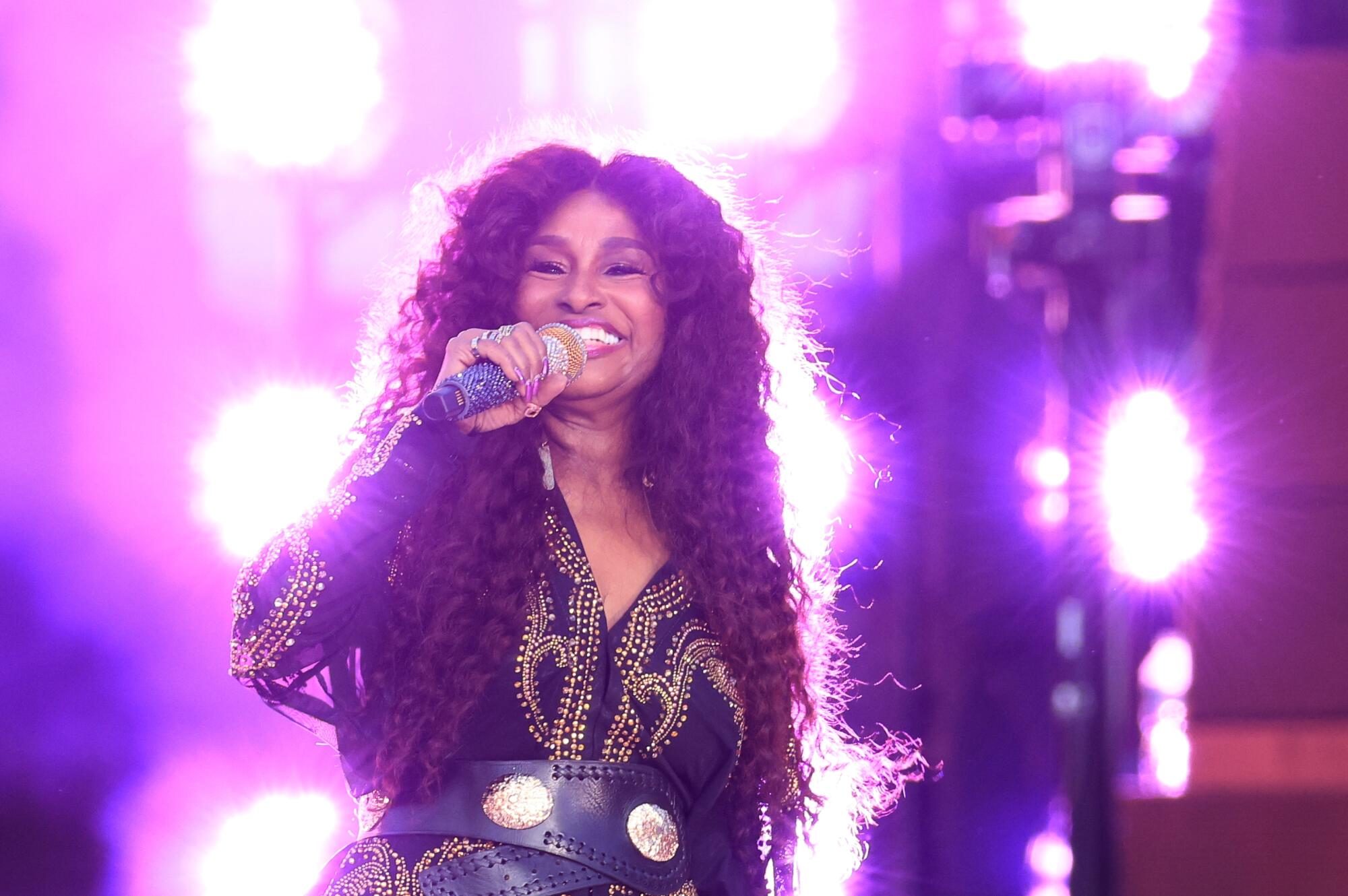
Chaka Khan performs.
(Myung J. Chun / Los Angeles Times)

Queen Latifah hosted the show.
(Myung J. Chun / Los Angeles Times)

A couple in patriotic garb share a kiss.
(Myung J. Chun / Los Angeles Times)
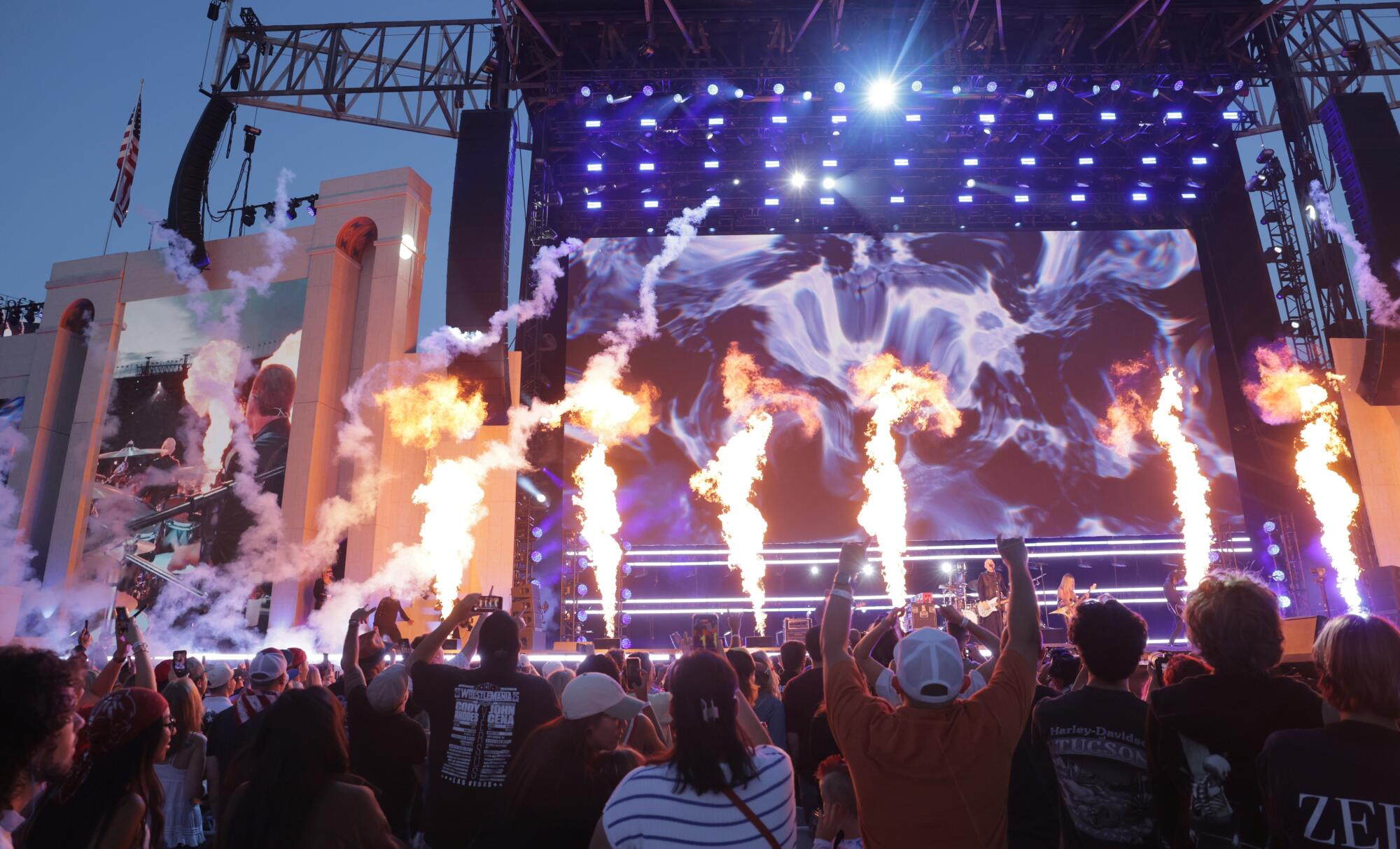
Smashing Pumpkins performs.
(Myung J. Chun / Los Angeles Times)
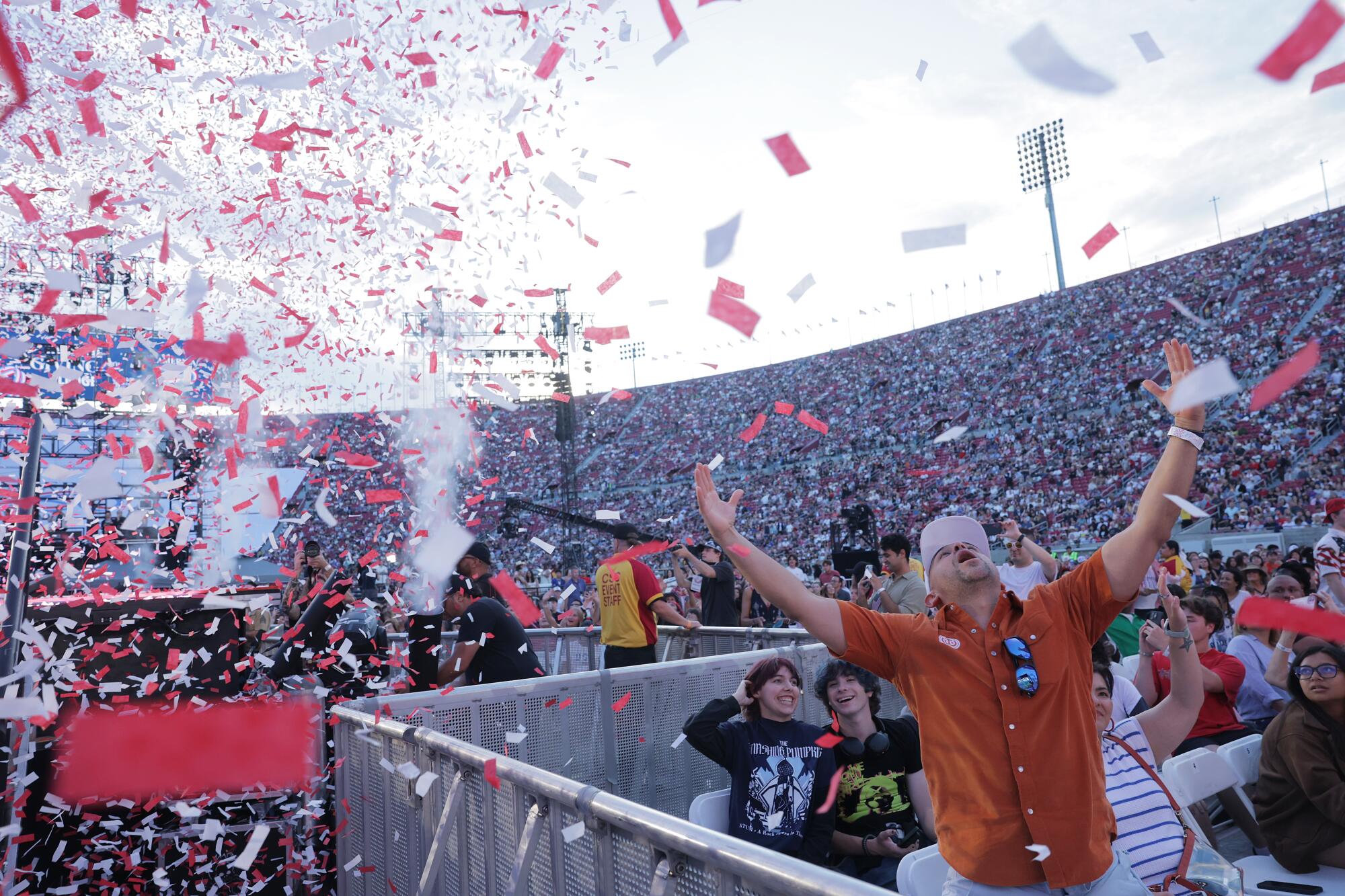
A concertgoer enjoys confetti.
(Myung J. Chun / Los Angeles Times)

Maren Morris performs.
(Myung J. Chun / Los Angeles Times)

It’s a good year when we get movies like Remarkably Bright Creatures and The Sheep Detectives at the same time. If there’s one type of emotional draw we’ll never say no to when it comes to the fiction we consume, it’s wholesome. The kind of movies and TV shows that leave you with a bit more hope than you expected. The kind of stories that make you believe that humanity isn’t as broken as it really is.
The Sheep Detectives is essentially tailor-made for anyone who loves a good whodunnit that’s rich with nuance and humor. The clever decision to shift the genre into something both kids and adults could appreciate together is no small feat, and that’s largely where its mass appeal lies. Murder is a heavy subject to deal with—as is grief—yet this story makes sitting with the weight of both a little easier. It could kickstart a number of thoughtful conversations while it simultaneously delivers plenty of laughs along the way.
For adults, there’s also a huge appeal in the casting—the voice actors especially. Anyone who knows me knows that Ted Lasso is the kind of show I’ll always put first, so hearing Brett Goldstein voice a sheep is the kind of A+ decision that’s effortless to appreciate. Hugh Jackman, Nicholas Galitzine, Molly Gordon, Nicholas Braun, Emma Thompson, Julia Louis-Dreyfus, Bryan Cranston, Bella Ramsey, Regina Hall, Rhys Darby, Patrick Stewart, Hong Chau, and the whole cast do an exceptional job as well, making every moment of The Sheep Detectives thoroughly entertaining.

It’s hard to imagine anyone coming out of the movie not thinking it’s one of the best things we’ll watch all year, and that’s a high compliment considering 2026 is full of gems like Project Hail Mary and the upcoming The Odyssey. It’s the exact kind of movie we could all use, but more than anything, the kind of story we could use more of. If there’s any sort of sequel, sign me up. Let’s make it a trilogy. Give us more of the sheep.
The cinematography is gorgeous, the writing is sharp, the performances are thrilling, and the message is a gem worth holding onto. The Sheep Detectives is the kind of feel-good treasure that does an excellent job of reminding us why movies like this will always matter. There’s a thoughtful message about how grief is meant to be shared and why it’s so important to carry those who’ve passed with us. Yes, it’d be convenient to forget our pain by sheer mental willpower, but we aren’t meant to do that. As humans and as animals, I imagine that the good, bad, and ugly are all part of what makes life beautiful, and that’s a comforting message to sit with.
The concept of a whodunnit featuring sheep solving a murder sounds so wild on paper, yet everything about it results in the kind of movie that should signal to Hollywood we want more creative approaches to what’s familiar. There’s a reason The Muppets are so popular, and we shouldn’t be afraid of making things that sound a bit too whimsical on paper. In other words, The Sheep Detectives embraces the whimsy, and it’s exactly what makes it so delightful.
The Sheep Detectives is now streaming on Prime Video.
First Featured Image Credit: ©Amazon MGM Studios
Related
-

 New York5 minutes ago
How a Museum Security Guard and Artist Lives on $51,000 in Parkchester
-

 Los Angeles, Ca8 minutes ago
Heat advisory issued as Southern California temps near triple digits this week
-

 Detroit, MI28 minutes ago
Detroit Battery Safety Provider Reaches to the Skies with Med Hawk
-

 San Francisco, CA38 minutes ago
A Locals-Approved Modern Guide to Fisherman’s Wharf: Seafood, Beer Gardens + Iconic Bay Views
-

 Dallas, TX43 minutes ago
New glitzy Houston steakhouse Juliet opens next to Delilah this summer
-

 Miami, FL50 minutes ago
Allapattah man faces charges over armed robbery after crash in Miami’s Liberty City
-

 Boston, MA53 minutes ago
Somehow, This is a Fitting, Confusing End to Jaylen Brown’s Boston Celtics Career
-

 Denver, CO58 minutes ago
Denver Broncos 2026 schedule

