Entertainment
The best moments of the 2024 BAFTA Awards that you might've missed — on-screen and off

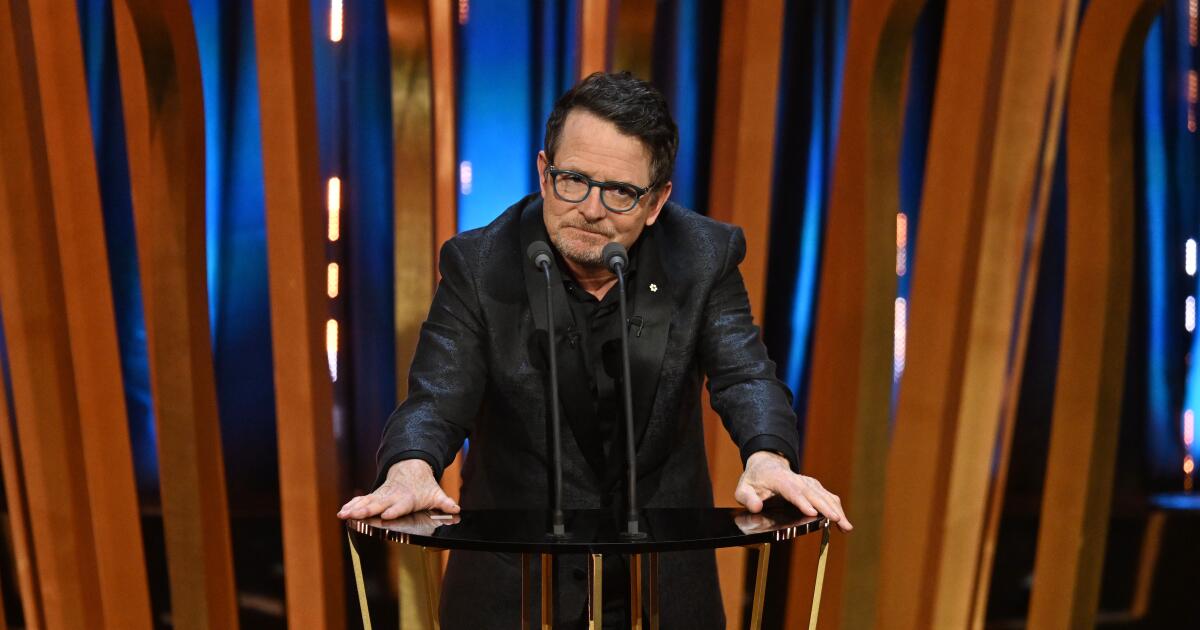
The 77th annual British Academy Film Awards have confirmed what pundits already know: “Oppenheimer” is the film to beat this year at the Oscars. Christopher Nolan’s opus scored for best film and director during tonight’s ceremony, held for the second year at London’s Royal Festival Hall. But while many of the winners were well-predicted, not everything that took place was quite so expected.
The BAFTAs satisfied with an amiable host, a pronounced focus on diversity and a celebration of British productions, including Jonathan Glazer’s “The Zone of Interest,” which, oddly, won both outstanding British film and film not in the English language (a first). The two-hour ceremony that aired on the BBC — as well as on BritBox streaming in the U.S. — was an edited version of what actually occurred in the room. What viewers at home didn’t see was plentiful, particularly as the cameras tended to focus on the nominees.
Here’s what happened behind the scenes of the BAFTAs.
A bit of housekeeping
After BAFTA attendees were properly lubricated at the pre-drinks reception, Royal Festival Hall staff had the unenviable task of herding them into the theater, where many continued to drink champagne out of paper cups. One of the last to be seated was Prince William, who arrived solo this year as the Princess of Wales is still recovering from recent surgery.
Before the show was properly underway, a few rules were laid out to the audience. One of most important notes (which was later ignored) was no clapping during the in memoriam segment. Another: “A camera could be looking at you even though you can’t see it.”
Sara Putt, Chair of BAFTA, then gave a short off-air speech, noting that the organization’s aim is to “champion talent, exceptional storytelling and make the screen industries a more equitable and sustainable place.” She referenced the recent WGA and SAG strikes, but noted a year of “stellar storytelling” from the film industry.
“It’s definitely been the most talked about awards season in years,” she said to applause. “Turbo-boosted by ‘Barbenheimer,’ audiences rediscovered cinema, seeking out the talked about films and discovering some lesser known gems.”
The real Bark Ruffalo
The BAFTAs were hosted by David Tennant.
(Joe Maher / BAFTA / Getty Images for BAFTA)
Scottish actor David Tennant (probably best known stateside for his vivid incarnation of the Doctor in “Doctor Who”) represents a younger, hipper host for the BAFTAs, which usually lean on stately icons to shepherd the evening along. He proved his comedic prowess with an opening bit about being obligated to dog-sit for Michael Sheen’s dog, Bark Ruffalo. After attempting to wrangle Dame Judy Dench and Tom Hiddleston into doing it for him, Tennant brought the dog along to the ceremony, arriving in the theater with a small white pup and its accessories in tow. To his (feigned) surprise, Sheen was in the front row, seated next to the “Saltburn” cast.
After handing Sheen the dog, Tennant joked that Bark Ruffalo was “actually being played by Andy Serkis” — who presented the first prize for original screenplay. “Playing Bark Ruffalo was, for me, a career highlight,” Serkis said on a roll, adding that many people will know the dog from “The Bone of Interest” and “Paw Things.”
The dog vanished backstage after the opening bit and, in fact, was not Sheen’s dog at all. Bark Ruffalo is actually a Maltese named Lilliput, who may be the first dog to get BAFTA accreditation, according to her manager Paula Stewart.
“Poor Things” sweep
Emma Stone and “Poor Things” had a good night, winning five awards including leading actress.
(Kate Green / BAFTA / Getty Images for BAFTA)
Early on, it became clear that Yorgos Lanthimos’ “Poor Things” had a grip on BAFTA voters, particularly in the crafts categories. The film triumphed in the second category bestowed, for special visual effects, to deafening applause and went on to win for costume design, makeup and hair and production design.
Many of the winners enthused about Lanthimos’ creative, risk-taking vision in their acceptance speeches, although the director himself didn’t win. Makeup artist Nadia Stacey credited Lanthimos for letting her team “go crazy,” while costume designer Holly Waddington described the film as an “experiment like no other.” Although BAFTA members don’t always vote in line with Academy, “Poor Things” just might prevail over “Barbie” at the Oscars.
Mr. Who?
Nick Mohammed appeared in character as his stage and TV character Mr. Swallow.
(Kate Green / BAFTA / Getty Images for BAFTA)
Fans of “Ted Lasso” may be aware of Nick Mohammed’s character, Mr. Swallow, but non-British audiences likely had no idea what was happening when the actor emerged onstage in roller skates. His appearance, billed as an interlude for the audience, brought a few jokes — and a perfect bathroom break. The theater literally thudded with the sound of high heels as attendees flooded out while Mohammed offered his own housekeeping notes, including a directive to “vacate in height order” in case of emergency. “We’re about 10 percent of the way through,” he told the crowd, most of whom were still on their way back from the toilets.
#BAFTAsNotSoWhite
Da’Vine Joy Randolph accepts the BAFTA award for supporting actress for her work in “The Holdovers.”
(Joe Maher / BAFTA / Getty Images for BAFTA)
BAFTA has come under fire in recent years for its lack of diversity, both in terms of nominees and winners. Last year, the entire winners pool was white, despite a major reform in 2020 to ensure more diversity in the acting categories and for the award of best British film. Finally, that effort paid off. Da’Vine Joy Randolph won supporting actress for “The Holdovers.” Through tears, she praised her character, noting “Mary is so much bigger than me. She showed us all what is possible when we look behind the differences.”
Later, Yasmin Afifi’s “Jellyfish and Lobster” won best British short film, Cord Jefferson scored a notch for “American Fiction’s” adapted screenplay (surprisingly beating Nolan) and Savanah Leaf’s “Earth Mama” was celebrated as outstanding debut by a British writer, director or producer. But it was writer and archivist June Givanni, honored with the outstanding British contribution to cinema award, who highlighted the importance of recognizing diverse voices — and earned a standing ovation from Ryan Gosling.
Another measure of change was the sign-language interpreter, who was filmed in one of the theater boxes for broadcast on the BBC throughout the ceremony. Less successful was an accessibility ramp, which was touted as an inclusive addition to ensure all winners could get up to the stage (there was also a set of stairs). Because the ramp was in front of the “Oppenheimer” cast and crew, many of its winners, including editor Jennifer Lame, hopped up the ramp awkwardly before giving their speeches. By the time Cillian Murphy won his leading actor award, he gracefully detoured to the stairs.
Politically inclined
In one of the evening’s most emotional moments, Samantha Morton accepted the BAFTA’s Fellowship Award, the highest accolade given, and spoke about her own childhood, dedicating her prize to “every child in care, or who has been in care, who is suffering or didn’t survive.”
(Kate Green / BAFTA / Getty Images for BAFTA)
The presenters and winners kept their political statements to a minimum this year, with almost no references to global events and literally none about the British government. But “The Zone of Interest” producer Jim Wilson, accepting the award for film not in the English language alongside director Jonathan Glazer, took the opportunity to reflect on the film’s themes in parallel with current conflicts.
“A friend wrote me after seeing the film the other day that he couldn’t stop thinking about the walls we construct in our lives which we chose not to look behind,” Wilson said. He added that “we should care about innocent people being killed in Gaza or Yemen in the same way we think about innocent people killed in Mariupol or in Israel.” The cheers from the audience were so loud Wilson repeated the line, saying, “Thank you for recognizing a film that asks you to think in those spaces.”
Last year, director Daniel Roher’s “Navalny” won for documentary, prompting Tennant to reference the film and the recent death of its subject, Alexey Navalny, before bringing Taylor Russell out to announce this year’s winner. Accepting the award, “20 Days in Mariupol” filmmaker Mstyslav Chernov took the moment to draw attention to the present situation in Ukraine. “The only comfort for me is that we give voice to Ukrainians,” he said, somberly. “We keep reminding the world of what’s happening there.”
Later in the evening, Samantha Morton received the BAFTA Fellowship, the British Academy’s highest honor. Morton’s “Minority Report” co-star Tom Cruise paid tribute to her during a clip recapping her storied career, but it was Morton’s speech that caught the audience’s attention. Morton, who grew up in foster care, used the platform to recognize children growing up in poverty, recalling her own experience of being “cold” and “hungry.”
“Film changed my life, it transformed me and it led me here today,” she said, noting that watching Ken Loach’s essential 1969 drama “Kes” in school allowed her to see herself on-screen. “I dedicate this award to every child in care, or who has been in care, who is suffering or didn’t survive.” As Morton choked up, so did those in the crowd.
In memoriam
The aforementioned rule about not clapping during the in memoriam segment? The audience attempted to be respectful as Hannah Waddingham sang a beautiful rendition of “Time After Time.” However, a few guests clapped and cheered when Tina Turner flashed on-screen. For everyone else: respectful silence.
Most supportive actors
Sophie Ellis-Bextor, center, performs her hit “Murder on the Dance Floor” during the EE BAFTA Film Awards.
(Joe Maher / BAFTA / Getty Images for BAFTA)
Speaking of Gosling, the “Barbie” standout may not have won supporting actor, but he was certainly the most supportive of the night. Gosling, seated in the front row near Prince William, spent the evening cheering on his fellow nominees and offering standing ovations for many. He was one of the first to stand for “The Holdovers” star Randolph and he offered Emma Stone a congratulatory squeeze as she passed by to accept the award for leading actress.
Across the aisle, “Saltburn” star Archie Madekwe was similarly supportive. He and director Emerald Fennell leapt to their feet after Sophie Ellis-Bextor’s dynamic performance of “Murder on the Dancefloor” and he was visibly excited for “How to Have Sex” breakout Mia McKenna-Bruce when she was named the EE BAFTA Rising Star.
The biggest standing ovation of the night came at the show’s end as Tennant announced that Michael J. Fox would present the award for best film — much to the surprise of the audience. The entire room got on their feet as Fox was wheeled onstage and then stood behind the podium. It felt genuinely celebratory — and generous, particularly as the actor’s documentary, “Still: A Michael J. Fox Movie,” lost to Oscar frontrunner “20 Days in Mariupol.”
The afterparty
Following the three-hour ceremony, attendees made their way to more than 150 dinner tables inside Southbank Centre. Each was decorated with a themed centerpiece for one of the nominated films (the press table was “Poor Things”). Many people stayed for the official afterparty, held in the building next door, where the highlight was a saxophone player wearing a dog mask who accompanied the DJ’s selections. The song that really got the crowd going though? “Murder on the Dancefloor,” of course.
A complete list of tonight’s winners
Best Film: “Oppenheimer”
Director: Christopher Nolan, “Oppenheimer”
Leading Actress: Emma Stone, “Poor Things”
Leading Actor: Cillian Murphy, “Oppenheimer”
Supporting Actress: Da’Vine Joy Randolph, “The Holdovers”
Supporting Actor: Robert Downey Jr., “Oppenheimer”
Outstanding British Film: “The Zone of Interest”
Outstanding Debut by a British Writer, Director or Producer: “Earth Mama”
Film Not in the English Language: “The Zone of Interest”
Documentary: “20 Days In Mariupol”
Animated Film: “The Boy And The Heron”
Adapted Screenplay: Cord Jefferson, “American Fiction”
Original Screenplay: Justine Triet and Arthur Harari, “Anatomy of a Fall”
Original Score: Ludwig Göransson, “Oppenheimer”
Costume Design: Holly Waddington, “Poor Things”
Production Design: Shona Heath, James Price and Zsuzsa Mihalek, “Poor Things”
Special Visual Effects: Tim Barter, Simon Hughes, Dean Koonjul and Jane Paton, “Poor Things”
Makeup & Hair: Nadia Stacey, Mark Coulier and Josh Weston, “Poor Things”
Editing: Jennifer Lame, “Oppenheimer”
Cinematography: Hoyte van Hoytema, “Oppenheimer”
Casting: Susan Shopmaker, “The Holdovers”
Sound: Johnnie Burn and Tarn Willers, “The Zone of Interest”
British Short Animation: “Crab Day”
British Short Film: “Jellyfish and Lobster”
EE Rising Star: Mia Mckenna-Bruce

Movie Reviews
‘Jean-Michel’ Review: Jean-Michel Basquiat Finally Gets the Fantastic Documentary He Deserves

“Jean-Michel” is the Jean-Michel Basquiat documentary we’ve been waiting for — the fantastic one he deserves. Over the years, there have been a sprinkling of films built around Basquiat, like the boho vérité snapshot “Downtown 81” (2000) or “Boom for Real: The Late Teenage Years of Jean-Michel Basquiat” (2018), which captured the period in the late ’70s after he’d broken with his family, when he was a scene-maker cultivating the seeds of his art and fame. Both those films are heady time capsules, and so, in a different way, is Julian Schnabel’s “Basquiat” (1996), a biopic — starring the hypnotic Jeffrey Wright — that was way ahead of the curve in recognizing the poetic sway of Basquiat’s art and image.
But “Jean-Michel,” directed by Quinn Whitney Wilson and Viridiana Lieberman (it just premiered at the Tribeca Festival and was bought by Netflix), is the first movie to penetrate the Basquiat mystique and give you a full-scale portrait of who he was: New York child of privilege, driven prodigy, bohemian scavenger, downtown rock star, thrill-seeking junkie, media celebrity, meditative soul, spiky and timeless art genius. It’s the first Basquiat film to be made in cooperation with his family, who provided the archive — home movies, photographs, sketches, notebooks — that fills in Basquiat’s life as never before.
When the family estate cooperates in a biography, it can mean the rough edges are sanded off — that you’re getting a burnished, officially approved portrait. But that’s not what happens in “Jean-Michel.” I’m sure there are sordid details that were left on the cutting-room floor (and it’s jarring that the movie leaves out his relationship with the artist Suzanne Mallouk), but the film is bracingly direct about who Basquiat was, his many dimensions and contradictions. He was a singularly charismatic and, by most accounts, ingratiating person, so it’s not like the film has to fudge that, but he could also be moody and jealous and ruthless (at an opening at the Whitney, he used a pen to deface one of Schnabel’s paintings). He was like a planet revolving around himself, and the film does justice to the light and dark sides of that orbit.
The closest thing “Jean-Michel” has to an agenda is to undercut a stubbornly persistent dimension of the Basquiat legend: that he was a “primitive” genius who rose up out of the streets. It’s important to say that we have this image, in part, because it was cultivated by Basquiat himself. But the media dug the myth a little too much; their consuming embrace of it carried a racist undertone, as if Basquiat could only be understood as a derelict version of virtuosity.
It’s true, of course, that he started off as an underground graffiti artist who named himself SAMO (for “same old shit”) and ultimately crossed over to the gallery world. And it’s true that he went through a self-styled homeless period. But “Jean-Michel” fills in the ground floor of his life — that his father, Gerard, a Haitian immigrant who became a New York businessman, and his mother, Matilde, a fourth-generation Puerto Rican, raised him and his two younger sisters in a Brooklyn brownstone that the family owned. They were a close-knit clan, and Jean-Michel was doted on by his mother. He attended private school and wanted to be a cartoonist. But he’s described by his adult sisters, Lisane and Jeanine, as a ball of unruly energy who couldn’t settle down in class; he was too much of a rebel dreamer.
His life took a turn after he was hit by a car (at age 7), and his parents divorced. (In the film, the prospect of losing his family devastated the young Jean-Michel.) Matilde, who had cultivated the love of art in him, declined into mental illness once she was on her own, and his father was basically a 1950s straight-arrow who wanted to shoehorn Jean-Michel into the American Dream. Jean-Michel was having none of that, so in his teens, stoked by the post-punk fervor of the late ’70s, he ran away from home. It’s crucial to note that this was happening at a moment, at least in New York, when squatting had become hip. Madonna did it too, and she and Basquiat had a fling as she was on the verge of fame.
What’s striking about Basquiat’s creativity, which the documentary captures with a seductive, voluminous presentation of the development of his art, is that he was a fountain that never turned off. We see samples of his art as a child, and there’s no question that as he got older he deliberately hung onto and refined elements of that blotchy, scalding style; he saw the expression of his childhood self as the ultimate freedom. Yet by the time he’d reached his teens (he began painting at 15), and was selling postcards on the street for a few dollars, his work had begun to acquire the vibratory quality that made it seem like you were staring at psychological X-rays. “There is no filter,” says one observer. “You’re looking inside his brain.” That’s exactly the talismanic quality of Basquiat’s paintings. He used mixed media (words, collage, geometric piping, icons like the repeated use of a crown, erupting scrawls) to make it feel like you were downloading his soul in its distilled form. The paintings were incantations, shot through with rapture and anxiety, threaded with a secret coded history of the culture. Basquiat looked into himself and saw the world — of Black experience, and of American experience — and then reflected that world back to us.
Growing up, Jean-Michel Basquiat chose to be a drifting bohemian, but the nightclub culture that became his second home was starting to interact with the media in a new way. We see clips of Basquiat on “TV Party,” the New York cable public-access show, where he sat around with people like Christ Stein and Fab 5 Freddy. For a while, his hair is shaved into a widow’s-peak dagger, but what’s disarming about his presence is how gentle and gregarious it is. We see interview segments where he lets his guard down, and also ones where he reveals himself by revealing next to nothing. He’s notably more wary in the interviews he began to give when he was getting famous. One takes place in his loft studio, and as the interviewer nudges him with questions about a painting, all tethered to a kind of racist skepticism (Why did you make that choice? Is it all arbitrary?), Basquiat fends off the cluelessness by creating an aura of invincibility around himself very much like that of Bob Dylan in the mid-’60s.
If you go to see a Jean-Michel Basquiat retrospective (and this movie has the effect of one), it’s astonishing to confront everything he painted, and the maturity of it, all before he died at the age of 27. It’s no hype to say that he can remind one of Picasso. There is only one Picasso, but Basquiat had that kind of fecund imagination, that endlessly varied and prolific joy. He worked fast, and took refuge in his work much as Picasso did. By the time he became buddies with Andy Warhol, Jean-Michel was the one doing the inspiring. The movie colors in their friendship, which we can see was quite close; they each got something out of the other, but it’s also clear that they adored each other. That’s why Warhol, after decades of not painting by hand, was moved to start again, in what became a collaborative project. The critics hated it, and they were too harsh; they couldn’t process the dual authorship, and by then they had turned, almost reflexively, on Warhol. The bad response soured the friendship….and then Warhol died. This left Jean-Michel without the mentor who had been a fulcrum for him.
He returned to his family, showing up in Brooklyn in a limo one day, handing out money, but in a way he was lost. Jennifer Goode, a girlfriend of his from 1984 to 1988, tells the story of his heroin addiction (she was his partner in junk), and how they would go to Hawaii so that he could get clean. They travelled extensively for his art openings around the world, and Jean-Michel would power through when he was someplace where he couldn’t get drugs. He should have gone to rehab, but he was deeply private, like Philip Seymour Hoffman, who also felt himself to be invincible and used heroin to self-medicate his way into an early grave. The film presents some evidence that Basquiat, near the end, was losing interest in art (he talked about wanting to become a writer). But I don’t believe that. He lived and breathed painting; it’s hard to conceive of him abandoning it. The paintings, of course, now sell for so much that they have put him on that rarefied level, along with Van Gogh and Francis Bacon and Picasso. There are still Basquiat doubters who think that’s a travesty. Don’t listen to them. Decide for yourself by seeing “Jean-Michel.”
Entertainment
Of course, Supergirl can have pierced ears. James Gunn explains it again for those who forgot ‘Superman’
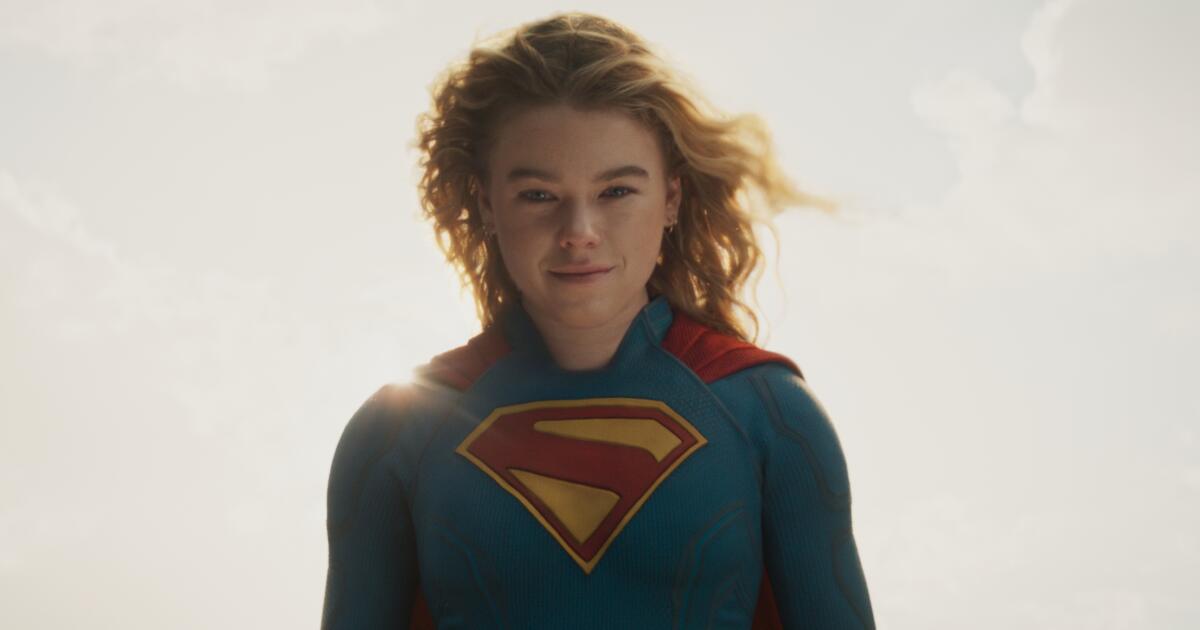
DC Studios co-chief James Gunn took to social media Monday to settle a debate once and for all: Of course, Supergirl can have pierced ears.
“Supergirl,” the upcoming superhero film starring Milly Alcock as the last daughter of Krypton, Kara Zor-El, has been the target of questioning from online detractors. One overblown gripe that some have mentioned on social media after zeroing in on Supergirl’s earlobes in promotional images is how a superpowered alien refugee known for her invulnerability and unbreakable skin could have any body jewelry.
“As explained in Superman, the same way she gets drunk — she goes to a planet with a red sun,” Gunn wrote on Threads. “Not to mention she was raised on a chunk of Krypton so didn’t even experience super powers until her teens.”
As the filmmaker mentions, Alcock’s iteration of Kara made her DC Universe debut in his 2025 movie, “Superman.” After the clearly inebriated Girl of Steel crashes into her cousin’s Fortress of Solitude to pick up her dog, Krypto, Superman notes that Kara “likes to go and party on other planets … with red suns.” This is because, as Superman explains, Kryptonians have enhanced power on Earth because of its yellow sun. This is also Kryptonian lore that has been established in comic books.
A recently released “Supergirl” clip also shows Superman first meeting his cousin after her pod lands on Earth. The footage shows Kara’s superpowers kicking in for the first time.
Directed by Craig Gillespie, “Supergirl” will follow the eponymous Kryptonian as she is celebrating her 23rd birthday. According to the film’s logline, Kara’s encounter with “an unexpected and ruthless adversary” leads her to “reluctantly join forces with an unlikely companion on an epic, interstellar journey of vengeance and justice.”
The movie’s cast also includes Matthias Schoenaerts, Eve Ridley, David Krumholtz, Emily Beecham, David Corenswet and Jason Momoa. “Supergirl” will hit theaters June 26.

Hello, dear reader! Do you like what you read here at Omnivorous? Do you like reading fun but insightful takes on all things pop culture? Do you like supporting indie writers? If so, then please consider becoming a subscriber and get the newsletter delivered straight to your inbox. There are a number of paid options, but you can also sign up for free! Every little bit helps. Thanks for reading and now, on with the show!
Warning: Full spoilers for the film follow.
Like many other people, I was quite simply blown away by Obsession, Curry Barker’s horror film that’s taken the world and the box office by storm. It’s one of those films that held me rapt from the very beginning and, as its plot unfolded and as the horrors piled up on each other, I kept wondering just what was going to happen next and how much further things were going to go off the rails. Like the best horror, it’s a rather simple story–Michael Johnston’s Bear pines for his friend Nikki (Inde Navarrette) and makes a wish on a novelty toy for her to love him more than anyone else, with predictably disastrous consequences–and it’s in its simplicity that its power rests. It speaks to so many of the issues plaguing us today, particularly surrounding young men, and it’s the kind of film I’ll be thinking about and wrestling with for months.
The moment Bear breaks that little toy stick and invokes his wish, Nikki seems to become a totally different person. She’s no longer the fierce, independent spirit he fell in love with. Instead, her entire existence revolves around him and her desperate (and increasingly terrifying) need to impress him. As Bear soon learns, obsessive love–of precisely the kind he’s harbored for Nikki all these years–can be a very unpleasant thing when it’s inflicted by some sort of supernatural entity. When you wish for someone to love you more than anyone else in the world, you have to contend with the fact that obsession destroys.
This is the kind of horror film that truly gets under your skin and into the back of your mind, lodging there and refusing to leave. In part, this is because Barker has a keen sense of suspense and framing, with the narrative and the camera working in tandem to keep us, like Bear, uncertain about what’s going to happen next. I was particularly struck by the way that Nikki’s appearance changes the moment that stick breaks. She’s repeatedly backlit–whether by the lights of her own porch or the stoop to Bear’s house–which means we see her the same way Nick does: as a sort of menacing dark presence, only her eyes gleaming in the light. Bear, of course, is too oblivious–and too blinded by his overwhelming “love” for Nikki–to sense that something might be amiss, at least not until it’s too late.
I lost count of the number of times in this film where I gripped the edges of my seat, absolutely dreading what was going to happen next, and it must be said that a great deal of the film’s terror comes from Inde Navarrette’s truly electrifying and captivating performance. She gives us just enough in the first few moments before Nikki’s possession for us to get a sense of who she is as a person before the horrors unfold. As her alternative self becomes ever more unhinged in her devotion to Bear–watching him while he sleeps at night, screaming at him to love her, staying in one place all day so as not to risk his anger (and covering herself with urine and vomit in the process)–we find ourselves missing who she once was and wondering how much of her original self is left.
There’s also something insidiously brilliant about the way the film toys with our affiliation as viewers. On the one hand, Johnston’’s performance as Bear makes him ever-so-slightly sympathetic, at least up until a point (though young men fruitlessly pining after women who don’t want them always involves a certain level of creepiness). Things change, though, when he calls the help number on the toy and hears the real Nikki screaming in torment while her alternative self continues her absolute devotion to Bear. It’s at this point that our sympathies with him–assuming they ever existed at all–start to curdle into hostility. When, a short time later, the real Nikki surfaces briefly to beg him to kill her so she can be freed from her horrible existence, the only thing Bear can think to do is to ask why she couldn’t have loved him, before leaving her behind. It was at this point that I leaned over to my viewing partner and whispered, “he has to die.” I said this not just because the narrative required it but also because, in the film’s own logic, Bear has earned his eventual fate. It takes quite a brave film to turn its hero into a villain, and I give Barker a lot of credit for making this choice.
When it comes to the film’s message, however, I’m a little torn. Now, we all know that horror, perhaps more than any other genre, is a genre predicated on saying something, whether explicitly or implicitly. Horror films work on us because they tap into the things we collectively fear or are anxious about, whether it’s immigration, bodily autonomy, or race relations in the US. On the surface, at least, Obsession seems to be arguing that young men’s obsession with viewing women as nothing more than emotional appendages to their desires, and to a certain degree it succeeds, at least if one starts to see Bear as the villain of the piece. However, the film also falls into a double-bind of its own creation, because at the end of the day this is still Bear’s film: we’re sutured into his POV, we see Nikki as a source of horror and terror through his eyes, and he ultimately gets to escape the mess of his own creation through dying.
It’s also more than a little revealing that the film’s most gruesome acts of violence are acted out on the very bodies of the women with whom we are, according to the film’s narrative and political logic, supposed to be identifying. Bear’s friend Sarah (Megan Lawless) suffers especially egregiously in this regard, when an enraged Nikki bludgeons her to death, the camera leaving nothing to the imagination as, once again, a woman’s mutilated body is offered up as spectacle. It’s also worth noting that Nikki’s body also bears the wounds of her possession, whether it’s standing in one place all day or, in a gut-wrenching moment, when the real Nikki stabs herself in an effort to free herself from her imprisonment and torment. As so often in the movies, women’s bodies bear the punishment for men’s cruelty and desires.
What, then, are we to make of the ending? Yes, Bear has died (somewhat inadvertently) by his own hand, a fitting punishment, perhaps, for the suffering his selfishness has caused. But what of Nikki? She might finally be liberated from the possession Bear’s thoughtless wish inflicted upon her, but she’s the one left to pick up the pieces of both her shattered life and the bodies strewn around her. I highly doubt the legal system is going to be very understanding of her plight, since last I checked “an evil toy made me do it” isn’t a valid legal defense. At best, she can look forward to a life in either an institution or prison, forced to live with the trauma of her imprisonment in her own body, her murder of two of her friends (she also shoots Ian, the fourth member of the friend group, during the climax), and the fact that one of her best friends took control of her body and kept doing it even when he knew what he was doing.
So, I must admit that I’m a bit more mixed about Obsession than I thought I would be. While I think it’s remarkably effective and terrifying and horrifying as a piece of horror cinema, the ends to which it puts those sensations leaves me feeling rather cold. But then, perhaps I’m being unfair. The double bind of patriarchy–and the ubiquity of patriarchal methods of meaning-making within cinema–means that it’s almost impossible to show the toll that it takes on women without indulging in the very system itself. If nothing else, then, Obsession reminds us that horror films still have much to say and, if they manage to make us think and force us to grapple with the deep issues of our time, then all the better.
-

 Detroit, MI20 seconds ago
Man arrested for concealing gun in baby stroller
-

 San Francisco, CA8 minutes ago
Fatal stabbing leads to fines at SF hospital
-

 Dallas, TX15 minutes ago
Additional Mosquito Samples in Dallas, Carrollton Test Positive for West Nile Virus
-

 Miami, FL18 minutes ago
A Greg Dulcich breakout – The Splash Zone 6/9/26
-

 Boston, MA23 minutes ago
Officials investigating death of child in South End – Boston News, Weather, Sports | WHDH 7News
-

 Denver, CO30 minutes ago
Denver Parks and Recreation begins work to rebuild historic bandshell destroyed in fire
-

 Seattle, WA33 minutes ago
Chelsea Gray Top Points vs. Seattle Storm
-

 San Diego, CA38 minutes ago
Reds still looking for answers as losing streak hits 5 in San Diego

