Politics
Opinion: We know how voters feel about Trump and Biden. But how do the experts rank their presidencies?

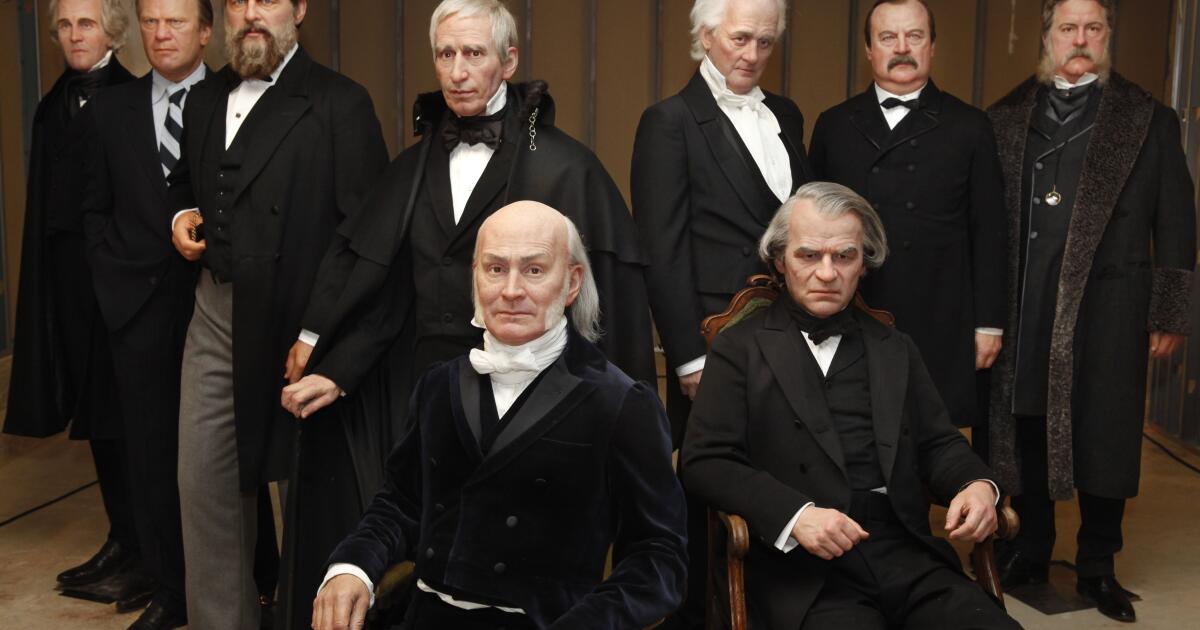
Presidents Day occurs at a crucial moment this year, with the presidency on the cusp of crisis as we inexorably shuffle toward a rematch between the incumbent and his predecessor. It’s the sort of contest we haven’t seen since the 19th century, and judging by public opinion of President Biden and former President Trump, most Americans would have preferred to keep it that way.
But the third installment of our Presidential Greatness Project, a poll of presidential experts released this weekend, shows that scholars don’t share American voters’ roughly equal distaste for both candidates.
Biden, in fact, makes his debut in our rankings at No. 14, putting him in the top third of American presidents. Trump, meanwhile, maintains the position he held six years ago: dead last, trailing such historically calamitous chief executives as James Buchanan and Andrew Johnson. In that and other respects, Trump’s radical departure from political, institutional and legal norms has affected knowledgeable assessments not just of him but also of Biden and several other presidents.
The overall survey results reveal stability as well as change in the way scholars assess our nation’s most important and controversial political office. Great presidents have traditionally been viewed as those who presided over moments of national transformation, led the country through major crises and expanded the institution of the presidency. Military victories, economic growth, assassinations and scandals also affect expert assessments of presidential performance.
The presidents at the top of our rankings, and others like ours, reflect this. Hallowed leaders such as Abraham Lincoln, Franklin Delano Roosevelt and George Washington consistently lead the list.
Our latest rankings also show that the experts’ assessments are driven not only by traditional notions of greatness but also by the evolving values of our time.
One example is the continuing decline in esteem for two important presidents, Andrew Jackson and Woodrow Wilson. Their reputations have consistently suffered in recent years as modern politics lead scholars to assess their early 19th and 20th century presidencies ever more harshly, especially their unacceptable treatment of marginalized people.
More acutely, this survey has seen a pronounced partisan dynamic emerge, arguably in response to the Trump presidency and the Trumpification of presidential politics.
Proponents of the Biden presidency have strong arguments in their arsenal, but his high placement within the top 15 suggests a powerful anti-Trump factor at work. So far, Biden’s record does not include the military victories or institutional expansion that have typically driven higher rankings, and a family scandal such as the one involving his son Hunter normally diminishes a president’s ranking.
Biden’s most important achievements may be that he rescued the presidency from Trump, resumed a more traditional style of presidential leadership and is gearing up to keep the office out of his predecessor’s hands this fall.
Trump’s position at the bottom of our rankings, meanwhile, puts him behind not only Buchanan and Johnson but also such lowlights as Franklin Pierce, Warren Harding and William Henry Harrison, who died a mere 31 days after taking office.
Trump’s impact goes well beyond his own ranking and Biden’s. Every contemporary Democratic president has moved up in the ranks — Barack Obama (No. 7), Bill Clinton (No. 12) and even Jimmy Carter (No. 22).
Yes, these presidents had great accomplishments such as expanding healthcare access and working to end conflict in the Middle East, and they have two Nobel Prizes among them. But given their shortcomings and failures, their rise seems to be less about reassessments of their administrations than it is a bonus for being neither Trump nor a member of his party.
Indeed, every modern Republican president has dropped in the survey, including the transformational Ronald Reagan (No. 16) and George H.W. Bush (No. 19), who led the nation’s last decisive military victory.
Academics do lean left, but that hasn’t changed since our previous surveys. What these results suggest is not just an added emphasis on a president’s political affiliation, but also the emergence of a president’s fealty to political and institutional norms as a criterion for what makes a president “great” to the scholars who study them.
As for the Americans casting a ballot for the next president, they are in the historically rare position of knowing how both candidates have performed in the job. Whether they will consider each president’s commitment to the norms of presidential leadership, and come to rate them as differently as our experts, remains to be seen.
Justin Vaughn is an associate professor of political science at Coastal Carolina University. Brandon Rottinghaus is a professor of political science at the University of Houston.


new video loaded: Steve Hilton Holds Slim Early Lead in California Governor’s Race
transcript
transcript
Steve Hilton Holds Slim Early Lead in California Governor’s Race
Steve Hilton, a Republican and former Fox News host, held a narrow lead in early votes over two Democratic opponents in California’s nonpartisan primary for governor. The top two candidates will advance to the general election in November.
-
“Change is coming to California, and it’s long overdue. I want to just say something from my heart to every single person who’s voted for me. We’re not — We’re not there yet, but it’s looking good.” [cheers] “Tonight, the people of the great state of California, in the greatest nation on earth, have spoken. [cheers] Loudly and proudly. [cheers] And while I take nothing for granted, there are lots of ballots left to be counted, it appears that we are on track to advance to November.” [cheers] “It might take some time to figure out where this is going. We’re going to wait until every ballot is counted. We’re going to give democracy a time to work, and we know we finished really strong.” [cheers]
By Axel Boada
June 3, 2026
Politics
Spencer Pratt surges to runoff in LA mayor’s race after angry voters send message to Karen Bass

NEWYou can now listen to Fox News articles!
Reality television personality Spencer Pratt appears on track to clear a key hurdle in Los Angeles’ mayoral race as he seeks to unseat incumbent Mayor Karen Bass in November.
Bass, who has led the city since 2022 amid a turbulent stretch rocked by her response to wildfires, advanced to a runoff after failing to secure a majority of the vote in Tuesday’s primary election. With no candidate surpassing the 50% threshold, the top two finishers will face off in a November runoff.
The anticipated runoff is a symbolic blow to Bass, who was endorsed by Gov. Gavin Newsom, D-Calif., and former Vice President Kamala Harris and has spent decades serving California in a series of elected Democratic offices.
Pratt, a first-time candidate known for the MTV reality show “The Hills,” was running in second place as of Wednesday morning.
Los Angeles Mayor Karen Bass attends the Women for Bass Phone bank event in the Baldwin Hills area of Los Angeles on June 1, 2026. (Louise Barnsley/Splash for Fox News Digital)
REALITY TV STAR SPENCER PRATT TESTS LA VOTERS’ APPETITE FOR POLITICAL OUTSIDER
“Obviously, God wanted five more months of me exposing the failures of our mayor,” Pratt gloated to reporters as the returns came in Tuesday evening.
Pratt has relentlessly hammered Bass on issues that have long plagued the city, including fire recovery, street homelessness and crime. The insurgent candidate holds Bass personally responsible for devastating wildfires that destroyed more than 18,000 structures in the city, including his Pacific Palisades home.
Pratt’s surge appears to have shut out Los Angeles City Council member Nithya Raman, a former ally of Bass who challenged the incumbent from the left and was once viewed as a threat to her bid for a second term. Raman is a member of the Democratic Socialists of America and has argued for steering the city in a more progressive direction.
Raman has not yet conceded despite running well behind Bass and Pratt as of Wednesday morning.
Pratt, a registered Republican, faces an uphill battle to defeat Bass in November if he advances to the runoff election.
Less than 20% of voters in the heavily Democratic city identify with the GOP, though Los Angeles’ mayoral contest is officially nonpartisan.
Media personality and independent candidate Spencer Pratt, left, pictured alongside LA mayor Karen Bass, right. (Robert Gauthier/Los Angeles Times via Getty Images; Justin Sullivan/Getty Images)
KAREN BASS GRILLED OVER BROKEN HOMELESSNESS PROMISE, BLAMES BUREAUCRACY FOR SLOWED PROGRESS
Rep. Darrell Issa, R-Calif., who represents a San Diego-anchored seat, told Fox News Digital that Pratt has won a following in the mayoral contest due to widespread voter discontent with Bass’ leadership.
“He’s catching fire among ardent historic Democrat voters because Karen Bass has been so ineffective,” Issa said in an interview. “And every time she opens her mouth, she’s talking about more of the same to people who have seen their streets, both crime-ridden and in fact … ineffectively managed.”
Bass, conversely, argues that her leadership is leading Los Angeles in the right direction.
“Los Angeles is at a turning point. After decades of rising homelessness, under-built housing and a shrinking police force, it’s Mayor Karen Bass who finally stepped up to change how City Hall works,” Bass’s website reads.
Los Angeles City Councilmember Nithya Raman appears likely to finish in third place, keeping her out of the November runoff. (Eric Thayer/Getty Images)
CLICK HERE TO DOWNLOAD THE FOX NEWS APP
“Homelessness is down, more housing is being built, and the LAPD is hiring new officers,” it also claims.
Fox News Digital’s Leo Briceno contributed reporting.
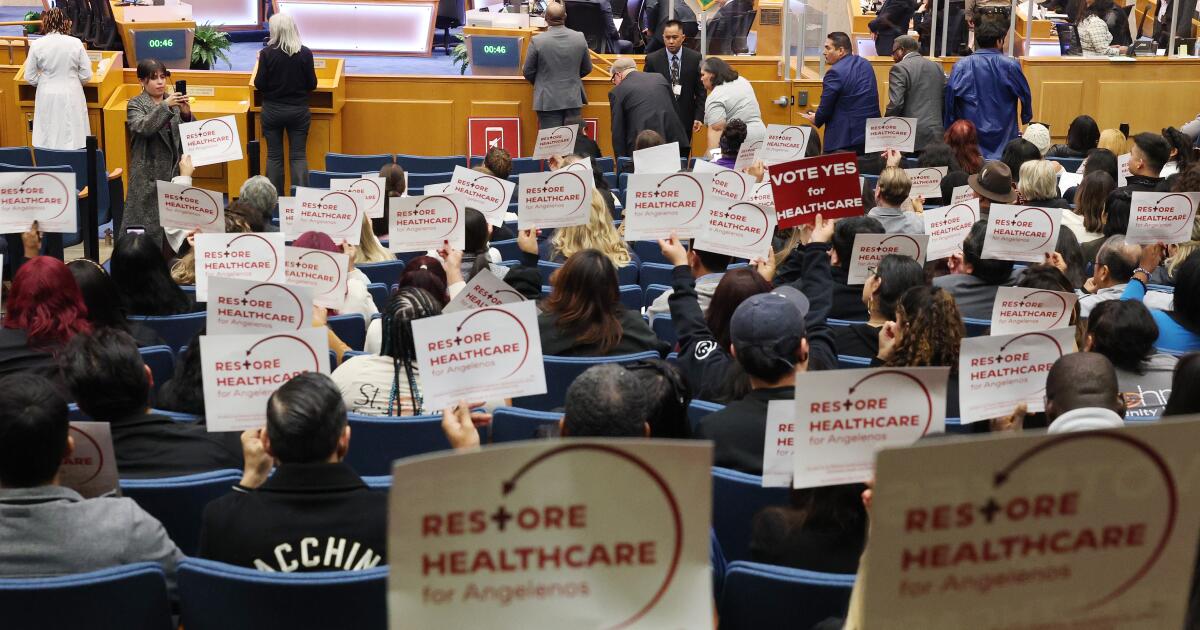
Los Angeles County’s half-cent sales tax to fund healthcare services was trailing Tuesday, with early returns showing a majority of voters rejecting the measure.
The tax — a half-penny of every dollar spent in the county — is meant to prop up local hospitals and clinics that are hemorrhaging funding after recent federal cuts.
The sales tax, which needs a simple majority to pass, would take effect Oct. 1 and last five years. Officials say it would pull in $1 billion annually to help plug the budget holes hitting local hospitals and clinics.
L.A. County health officials anticipate the One Big Beautiful Bill Act, signed into law by President Trump last summer, will slash more than $2 billion from the county’s health services budget within the next three years. Due to eligibility changes, the county will no longer be able to get reimbursements for many Californians who have lost Medi-Cal.
The measure was championed by a coalition of healthcare advocates called Restore Healthcare for Angelenos who warned that mass layoffs and emergency room closures could be imminent if new funding didn’t come fast. The Department of Public Health recently closed seven clinics — a grim sign, supporters said, of service cuts to come.
Voters haven’t rejected a sales tax hike since 2012, when a transportation measure fell just short with 66.1% support. It needed 66.7% to pass.
A majority of county supervisors had supported the new tax proposal, voting 4 to 1 this February to put it on the ballot. But the measure faced significant opposition from local cities, with opponents arguing the sales tax hike would unfairly burden the poorest county residents and encourage people to spend their dollars across the county line.
Supervisor Kathryn Barger, the board’s lone opponent of the tax, said she was concerned it was a “general” tax, meaning the money wouldn’t be earmarked for healthcare costs. Instead, she argued, politicians would have final say over how the money gets spent.
The supervisors have created a plan for spending the tax money, with the largest chunk of the money meant to cover the costs for patients without insurance. The measure also asked voters to sign off on a nine-member oversight committee.
The county currently has a base sales tax rate of 9.75%, and cities impose local taxes on top of that.
-

 Maryland8 seconds ago
Man found dead in South Carolina after shooting ex-girlfriend in Maryland
-

 Michigan5 minutes ago
Gotion wants Michigan township to pay the $23.7M it owes in incentives
-

 Massachusetts12 minutes ago
French-Mediterranean Eatery Charts Opening In Boston
-

 Minnesota15 minutes ago
Dennis Peterson
-

 Mississippi20 minutes ago
MHSAA private schools will have enrollment multiplier starting in 2027-28 season
-

 Missouri27 minutes ago
Water Safety Tips from Missouri State Highway Patrol – Ozark Radio News
-
 Montana30 minutes ago
Forstag secures democratic nomination for Western Montana Congressional District
-

 Nebraska35 minutes ago
Three-Time Nebraska State Champion Eje Kim Sends Commitment to Yale for 2027

