Politics
Opinion: We know how voters feel about Trump and Biden. But how do the experts rank their presidencies?

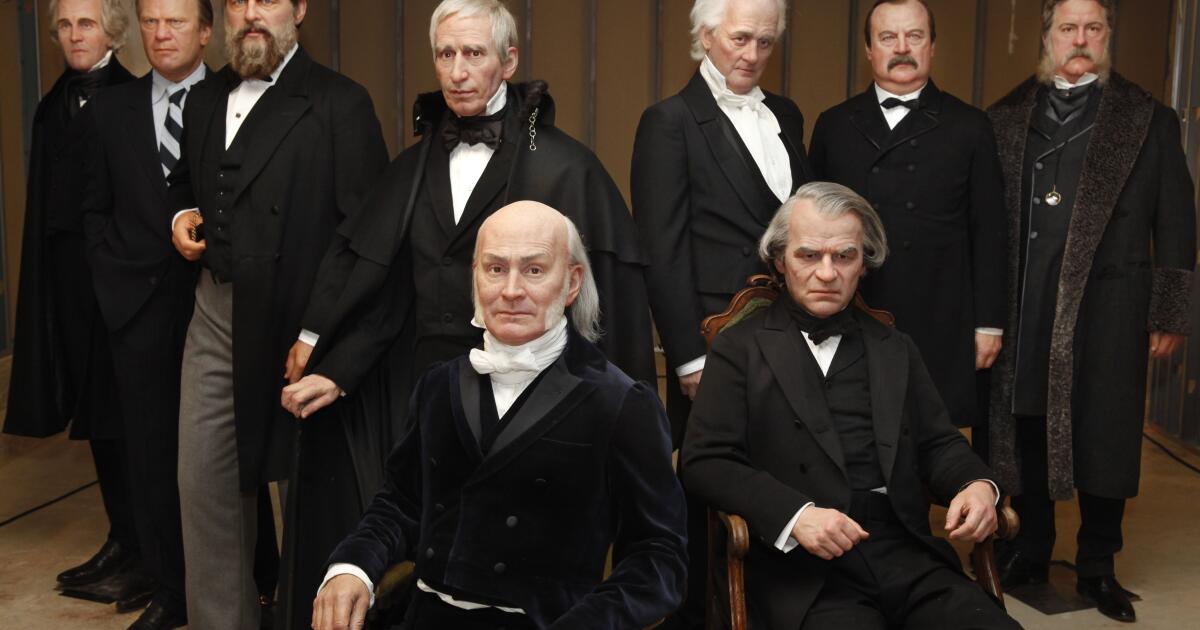
Presidents Day occurs at a crucial moment this year, with the presidency on the cusp of crisis as we inexorably shuffle toward a rematch between the incumbent and his predecessor. It’s the sort of contest we haven’t seen since the 19th century, and judging by public opinion of President Biden and former President Trump, most Americans would have preferred to keep it that way.
But the third installment of our Presidential Greatness Project, a poll of presidential experts released this weekend, shows that scholars don’t share American voters’ roughly equal distaste for both candidates.
Biden, in fact, makes his debut in our rankings at No. 14, putting him in the top third of American presidents. Trump, meanwhile, maintains the position he held six years ago: dead last, trailing such historically calamitous chief executives as James Buchanan and Andrew Johnson. In that and other respects, Trump’s radical departure from political, institutional and legal norms has affected knowledgeable assessments not just of him but also of Biden and several other presidents.
The overall survey results reveal stability as well as change in the way scholars assess our nation’s most important and controversial political office. Great presidents have traditionally been viewed as those who presided over moments of national transformation, led the country through major crises and expanded the institution of the presidency. Military victories, economic growth, assassinations and scandals also affect expert assessments of presidential performance.
The presidents at the top of our rankings, and others like ours, reflect this. Hallowed leaders such as Abraham Lincoln, Franklin Delano Roosevelt and George Washington consistently lead the list.
Our latest rankings also show that the experts’ assessments are driven not only by traditional notions of greatness but also by the evolving values of our time.
One example is the continuing decline in esteem for two important presidents, Andrew Jackson and Woodrow Wilson. Their reputations have consistently suffered in recent years as modern politics lead scholars to assess their early 19th and 20th century presidencies ever more harshly, especially their unacceptable treatment of marginalized people.
More acutely, this survey has seen a pronounced partisan dynamic emerge, arguably in response to the Trump presidency and the Trumpification of presidential politics.
Proponents of the Biden presidency have strong arguments in their arsenal, but his high placement within the top 15 suggests a powerful anti-Trump factor at work. So far, Biden’s record does not include the military victories or institutional expansion that have typically driven higher rankings, and a family scandal such as the one involving his son Hunter normally diminishes a president’s ranking.
Biden’s most important achievements may be that he rescued the presidency from Trump, resumed a more traditional style of presidential leadership and is gearing up to keep the office out of his predecessor’s hands this fall.
Trump’s position at the bottom of our rankings, meanwhile, puts him behind not only Buchanan and Johnson but also such lowlights as Franklin Pierce, Warren Harding and William Henry Harrison, who died a mere 31 days after taking office.
Trump’s impact goes well beyond his own ranking and Biden’s. Every contemporary Democratic president has moved up in the ranks — Barack Obama (No. 7), Bill Clinton (No. 12) and even Jimmy Carter (No. 22).
Yes, these presidents had great accomplishments such as expanding healthcare access and working to end conflict in the Middle East, and they have two Nobel Prizes among them. But given their shortcomings and failures, their rise seems to be less about reassessments of their administrations than it is a bonus for being neither Trump nor a member of his party.
Indeed, every modern Republican president has dropped in the survey, including the transformational Ronald Reagan (No. 16) and George H.W. Bush (No. 19), who led the nation’s last decisive military victory.
Academics do lean left, but that hasn’t changed since our previous surveys. What these results suggest is not just an added emphasis on a president’s political affiliation, but also the emergence of a president’s fealty to political and institutional norms as a criterion for what makes a president “great” to the scholars who study them.
As for the Americans casting a ballot for the next president, they are in the historically rare position of knowing how both candidates have performed in the job. Whether they will consider each president’s commitment to the norms of presidential leadership, and come to rate them as differently as our experts, remains to be seen.
Justin Vaughn is an associate professor of political science at Coastal Carolina University. Brandon Rottinghaus is a professor of political science at the University of Houston.


NEWYou can now listen to Fox News articles!
The House has officially shipped a colossal bipartisan housing package to President Donald Trump, and lawmakers are hoping that, at the very least, he doesn’t veto it.
Trump was supposed to sign the 21st Century ROAD to Housing Act last week, but his last-minute decision to ghost the signing ceremony with House Speaker Mike Johnson, R-La., and Senate Majority Leader John Thune, R-S.D., put into question whether the bill was dead.
His refusal to sign the bill, which passed with overwhelmingly bipartisan support in both chambers, was to leverage the Safeguarding American Voter Eligibility (SAVE) America Act, which doesn’t currently have the votes to succeed in the Senate.
WARREN TELLS TRUMP TO ‘SIGN THE DAMN BILL’ AS BIPARTISAN HOUSING PACKAGE REMAINS STALLED IN WASHINGTON
Trump has refused to sign the 21st Century ROAD to Housing Act. (Shawn Thew/EPA/Bloomberg via Getty Images)
Trump appears to be in no hurry to sign the bill, despite Republicans who are hungry for a win in the affordability fight ahead of the midterm elections.
“It’s so unimportant … compared to the SAVE America Act,” Trump told reporters in the Oval Office on Monday. “I think the SAVE America Act is exactly what it says. It’s saving America from crooked elections.”
“Here’s what I would like to sign, much more than a bill that — big deal, it’s a yawn,” he continued. “Some people say it’s wonderful. To me, compared to the SAVE America Act, just about everything is a big yawn.”
GOP INFIGHTING OVER TRUMP’S VOTER ID BILL ERUPTS AS TOP SENATOR CALLS STRATEGY ‘FANTASY’
It’s legislation that is loaded with nearly 60 provisions from both sides of the aisle in both chambers that’s designed to make it easier for homes to be built and for younger Americans to buy their first home. It also includes a ban on hedge funds buying up housing stock that Trump pushed Congress to include during the State of the Union earlier this year.
Sen. Elizabeth Warren, D-Mass., one of the architects behind the bill in the upper chamber alongside Sen. Tim Scott, R-S.C., charged that Congress handed the bill to Trump “on a silver platter.”
“When you ask me what happens next, if he cared about the American people, he’d have already signed the damned thing, and we’d be underway,” Warren said on WCVB’s “On the Record” on Sunday.
But Trump doesn’t have to put his signature on the bill for it to become law.
IRATE REPUBLICANS ACCUSE TRUMP OF HANDING DEMOCRATS A WIN AFTER BLOWING UP HOUSING PACKAGE
The Senate advanced a massive, Trump-backed housing package geared toward lowering the costs of homes and supercharging the housing supply. Sen. Elizabeth Warren, D-Mass., pitched it as legislation to prevent America from becoming a “nation of renters.” (Jemal Countess/Getty Images for Protect Borrowers; Anna Moneymaker/Getty Images)
The Constitution grants presidents the ability to veto a bill within 10 days of it being transferred over to the White House. In that scenario, Congress could override a veto of the housing package.
It’s happened before under the Trump administration. In early 2021, Congress overrode Trump’s veto of the annual National Defense Authorization Act — a massive Pentagon funding authorization package that some House Republicans are trying to use as a vehicle to pass the SAVE America Act.
But during that 10-day period, if Trump doesn’t sign the bill, it would automatically become law. That’s unless Congress completely adjourns, in which case a “pocket veto” could happen. The Senate is currently in recess and the House is scheduled to leave town by week’s end, but neither count as a full adjournment.
CLICK HERE TO DOWNLOAD THE FOX NEWS APP
Johnson, who spent the last few days meeting with Trump at the White House about the housing bill and the SAVE America Act, said: “I hope he does sign it.”
“If he doesn’t, it’s still law,” Johnson said. “We’ll still celebrate it, but he’s trying to make a point, and I think he’s making it very effectively. And the fact that you all ask me every three steps down the hallway illustrates that he has achieved the desired objective, and that is to make SAVE America the number one thing, because if we don’t get that right, everybody’s concerned about what happens next.”

Britain’s culture minister may challenge Paramount Skydance’s takeover of Warner Bros. Discovery — presenting a potential speed-bump to David Ellison’s plan to wrap up his $111-billion deal by September.
Earlier this month, Paramount secured the U.S. Justice Department’s blessing to buy the Warner assets, which include CNN, HBO, Cartoon Network, Animal Planet and the Warner Bros. film and TV studios in Burbank.
Paramount also must win the approval of British and European regulators, who are known for drilling deeply into media matters because of their influence on society.
Britain’s Competition and Markets Authority took a preliminary step this month by opening an investigation into Ellison’s proposed merger.
On Tuesday, Lisa Nandy, Britain’s Secretary of State for Culture, Media and Sport, notified Parliament that she was inclined to intervene in the blockbuster deal.
In a written statement, Nandy cited her ability to weigh in on “public interest grounds,” due to concerns about maintaining a competitive media market in Britain.
“The UK’s move to intervene in the Paramount–WBD deal confirms what we’ve been saying for months. The real regulatory risk was never in the US — it’s in Europe,” Forrester VP Research Director Mike Proulx said Tuesday in a statement.
While Nandy cautioned she has not made “a final decision on intervention at this stage,” she has invited Paramount and Warner Bros. to respond to her concerns by July 6.
June 2026 photo of Culture, Media and Sport Secretary Lisa Nandy arriving at Downing Street for the weekly Government cabinet meeting in London.
(Alishia Abodunde/Getty Images)
Paramount did not offer immediate comment.
The company owns CBS News, children’s channel Nickelodeon and Channel 5, one of the largest over-the-air television broadcasters in the United Kingdom.
Warner Bros. Discovery owns CNN, Cartoon Network and TNT Sports, which broadcasts the Olympics, Champions League and Premier League soccer matches.
“I am conscious that the proposed acquisition is global in nature,” Nandy wrote in her statement. “In reaching this decision, my focus has been, and will remain, on the UK public interest and the range of services available to UK audiences, including Channel 5, TNT Sports, Cartoon Network, Nickelodeon, and CNN International, as well as Paramount+ and HBO Max.”
If Nandy decides to intervene, the Office of Communications, known as Ofcom, would launch an assessment of the deal. Britain’s Competition and Markets Authority also would determine how the merger might reshape the competitive landscape.
Teams from the two companies have been huddling for months to plan for the melding of the two operations as soon as Paramount receives all of its regulatory approvals.
Australia, New Zealand, China, Saudi Arabia, Ukraine, Serbia, France and Italy have already given their approvals to the deal.
Saudi Arabia’s Public Investment Fund is planning to contribute $10 billion to help the billionaire Ellison family pull off the merger, which would make the Saudi royal family a significant, although passive, equity owner. In addition, the royal families of Qatar and Abu Dhabi have agreed to each contribute $7 billion in equity financing.
The Federal Communications Commission must evaluate the foreign ownership stakes due to Paramount’s holding of CBS broadcast licenses. U.S. antitrust regulators already have concluded the combination would not violate federal anticompetition laws.
Approval had been expected because President Trump — who has friendly ties with Ellison and his father, tech billionaire Larry Ellison — favors the deal.
Trump has been eager for changes at CNN.
The U.S. government stopped short of asking Paramount to make concessions or divestitures. Many expect that Paramount may have to reconfigure its children’s television holdings abroad due to the proposed combination of two large players — Nickelodeon and Cartoon Network.
Nandy suggested that Britain also should scrutinize the impact of combining two major streaming services HBO Max, a Warner property, with Paramount+.
HBO programming, including “Game of Thrones,” “Boardwalk Empire,” and “Succession,” has long been popular in Britain.
A coalition of state attorneys general, led by California Atty. Gen. Rob Bonta, also is expected to challenge the deal, in part, due to concerns about news media consolidation. Bonta’s office has said the matter remains under review.
Opposition to the deal has been building in the U.S. for months. A group of Hollywood activists — led by actors Jane Fonda and Mark Ruffalo — have spearheaded a “block the merger” campaign that now has support from more than 5,000 entertainment workers.
The group’s open letter calls on Bonta to take action to thwart the Ellison expansion effort. Paramount’s Chief Legal Officer Makan Delrahim has blasted the campaign, calling it “fear-mongering” and a partisan distortion of antitrust law.
Forrester’s Proulx noted differences in attitudes toward the deal among the various constituencies.
“For US consumers, this merger has become a proxy fight about political influence and control of media,” Proulx said. “In the UK, it’s being treated as a structural competition issue where regulators, not consumers, will decide how this deal plays out and how long it takes.”
Politics
Fetterman unleashes on ‘dirtbag’ wing of Dems after far-left victories: ‘Orgy of socialism’

NEWYou can now listen to Fox News articles!
Sen. John Fetterman, D-Pa., unloaded on his own party on Sunday evening, blasting a series of victories for progressives he called “anti-America.”
“Big night for the dirtbag left,” Fetterman said, referring to New York’s recent primaries, where two members of the Democratic Socialists of America (DSA) won primaries.
“I’ve said the party is becoming an orgy of socialism. Clearly anti-America, anti-Western Civilization,” Fetterman said.
Fetterman’s striking calls give a rare look at how some moderates may view the developments on their far-left flank that have dominated the party’s momentum in recent months, sparking concern that their high visibility is dragging the party further and further left.
FETTERMAN WARNS DEMOCRATS ‘DRIFTING FIRMLY INTO COMMUNISM’ AFTER SOCIALIST PRIMARY WINS
Sen. John Fetterman, D-Pa., speaks to reporters outside the Senate Chamber during votes on Nov. 10, 2025, on Capitol Hill in Washington, D.C. (Andrew Harnik/Getty Images)
His comments come on the heels of a handful of key progressive victories.
In Maine, Graham Platner, a controversial Democratic candidate for U.S. Senate, has attracted controversy for denying knowledge of the meaning behind a Nazi-linked tattoo, for off-color comments about race and calling himself a “communist” in a deleted Reddit post.
In New York, one DSA member, Claire Valdez, won a primary on a platform of abolishing ICE and a Green New Deal-style approach to climate change. Similarly, Darializa Avila-Chevalier, another DSA candidate, beat out incumbent Rep. Adriano Espillat, D-N.Y., a high-ranking Democrat and the chair of the Congressional Hispanic Caucus.
WINNERS AND LOSERS EMERGE AFTER SOCIALIST EARTHQUAKE ROCKS NYC PRIMARIES
Graham Platner, Democratic Senate candidate for Maine, speaks at a primary election night event at the Blue Hill YMCA in Blue Hill, Maine, on June 9, 2026. Platner won the party’s Senate primary after a campaign marked by accusations of past misbehavior and voter concerns. (Graeme Sloan/Bloomberg via Getty Images)
Both Chevalier and Valdez had the backing of New York Mayor Zohran Mamdani, himself a socialist.
The wins have captured national attention and drawn criticisms from Republicans who have pointed to their success as emblematic of the direction of the Democratic Party.
Fetterman, who has not shied away from confrontations, has been one of the few Democrats to express alarm about the kind of candidates carrying the party’s banner.
“I mean, you look at some of the things that people have said. Abolish prison, abolish the border, abolish ICE, I mean these crazy people — I have colleagues in my caucus that refuse to even call this out,” Fetterman said.
FETTERMAN REACTS TO MAMDANI’S REFUSAL TO ACCEPT SUPREME COURT’S IMMIGRATION RULING
U.S. Sen. John Fetterman, D-Pa., walks through the Senate Subway during the Senate War Powers vote on April 22, 2026, in Washington, D.C. (Heather Diehl/Getty Images)
CLICK HERE TO DOWNLOAD THE FOX NEWS APP
“Between P-hustle in Maine and some of the other winners in New York, they should form their own party and run on all the things that they’ve had to delete on social media,” Fetterman said, referring to Platner.
“That’s where our party has moved,” he added.
-

 Iowa2 minutes ago
Iowa judges take ICE to task over ‘astonishing conduct’ and violations of court orders
-

 Kansas9 minutes ago
Kansas man sentenced to 18 years for child exploitation and pornography production
-
 Kentucky11 minutes ago
Cumberland Falls’ renowned moonbow draws visitors from across the country to Kentucky
-

 Louisiana16 minutes ago
Louisiana summers are getting hotter and more humid, researchers say
-

 Maine24 minutes ago
Cooling centers to open in Maine as heat, air quality advisories take effect Wednesday
-

 Maryland26 minutes ago
Teen allegedly hits off-duty officer, crashes into Maryland home
-

 Michigan32 minutes ago
Michigan mayor’s 7-year-old nephew found dead in Menands, New York, authorities say
-

 Massachusetts39 minutes ago
Missing Massachusetts cat miraculously found underneath owners’ new bathtub — after disappearing for 30 hours

