Business
Dozens of packaged foods recalled in listeria outbreak. Here's what you need to know


After federal inspectors found potentially deadly bacteria in samples of its products, Modesto-based Rizo Lopez Foods Inc. recalled all of its packaged goods this month, including various types of cotija cheese, yogurt and sour cream.
The bacterium in question, Listeria monocytogenes, can cause listeriosis, a foodborne infection that is often innocuous but occasionally lethal. According to the U.S. Food and Drug Administration, one particular genetic strain of the bacterium has been tied to infections dating back to June 2014.
The agency investigated the string of infections in 2017 and 2021 and found a probable link to queso fresco and similar cheeses, but it couldn’t tell which company or companies had sold the products. Then in January, health officials found the same strain of listeria in a sample of Rizo Bros Aged Cotija. Tests by the FDA at Rizo Lopez Foods’ manufacturing plant also found a sample with that strain, prompting the company to voluntarily recall its entire product line.
Since then, numerous manufacturers of packaged foods that contained Rizo Bros cheeses have recalled their products. These include salads and prepared meals from Dole, Trader Joe’s, Von’s, Costco, Albertsons and Bristol Farms.
Only 26 infections linked to this strain have been reported to the U.S. Centers for Disease Control and Prevention, but the CDC says that many people who contract listeria don’t report it. The agency interviewed 22 of the people infected, and 16 said they’d eaten queso fresco, cotija or similar cheeses.
Considering the number of products that Rizo Lopez has sold and the small number of reported cases, the odds of someone falling dangerously ill seem slim. Nevertheless, the FDA recommends that people check their refrigerators and freezers for recalled products and throw away any they find.
Here’s what you need to know about the disease and the recent recalls.
What is listeria?
Technically, the term refers to the bacteria, but it often is used instead to refer to listeriosis, the illness. Unusually hardy, the bacteria can survive refrigeration and even freezing, the Mayo Clinic says.
Potential breeding grounds for the bacteria are moist environments, soil, water, decaying vegetation and animals, the FDA says. Food can pick up the bacteria by coming into contact with contaminated surfaces or environments; pets who eat contaminated foods can also spread it through the home.
What are the symptoms of a listeria infection?
According to the Mayo Clinic, “healthy people rarely become ill from listeria infection.” If you do feel symptoms, they may start like a stomach bug, with vomiting and diarrhea beginning up to 24 hours after eating contaminated food and lasting one to three days. But this kind of illness is rarely diagnosed, the CDC says, because laboratories do not usually look for listeria when testing patients’ stool samples.
The threat is that the infection will spread beyond the stomach, becoming invasive.
According to the CDC, for those who are pregnant, the symptoms of invasive listeriosis are usually like the flu — fever, muscle aches and fatigue — but tend to be mild, if they appear at all. But the risk to a fetus is dire; infection during pregnancy “usually leads to miscarriage, stillbirth, premature delivery, or life-threatening infection of the newborn,” the CDC says.
For those who aren’t pregnant, the symptoms can be serious. They include fever, headache, muscle aches, stiff neck, confusion, loss of balance and seizures. Almost 5% of the non-pregnant people who come down with invasive listeriosis die, according to the CDC.
Who is most at risk?
Because of the danger to fetuses and newborns, pregnant women are a prime risk group. But so are people with weaker immune systems, because of either their age or a medical condition or treatment regimen that lowers their body’s natural defenses.
The CDC warns that people 65 and older are four times more likely to contract listeriosis than others are. People with cancer are 10 times more likely, and people who need dialysis are 50 times more susceptible.
How is listeria transmitted?
It’s a foodborne disease, which means you get it from eating something contaminated with the bacteria. And those are found most often in unpasteurized dairy products and improperly processed meats, the Mayo Clinic says.
How can you avoid getting infected?
First and foremost, the CDC advises not to eat any of the dairy products manufactured by Rizo Lopez Foods or its customers. In other words, check the recall list (see below, but also check for updates at the FDA’s listeria outbreak web page) and don’t consume those products.
If you had any of those products in your refrigerator or freezer, you should sanitize any surfaces or containers that they touched, following the FDA’s guidelines for safe handling and cleaning. Otherwise, the hardy listeria bacteria will troop across surfaces to contaminate other products.
Where have listeria infections been reported?
The 26 cases tracked by the CDC are primarily spread across the southern and western United States. The largest number of cases — 8, or 30% of the total — have been in California. Arizona and Colorado have each seen four cases, Texas and Tennessee each have two reported cases, and six other states each have one.
Which products have been recalled?
Rizo Lopez has recalled nearly 60 products, most of which are Mexican cheeses and cremas under the brand names Tio Francisco, Rizo Bros, Casa Cardenas and Campesino.
In addition, the Rizo Lopez recalled product line includes:
- Cotija cheese, 16-ounce packages by Food City
- Cotija Enchilado cheese, 16-ounce packages by Food City
- Crema Mexicana, 16-ounce packages by Food City and Santa Maria, and at retail deli counters by San Carlos
- Fresco cheese at deli counters by San Carlos, El Huache and La Ordena
- Oaxaca cheese, 16-ounce packages by Food City, and at retail deli counters by San Carlos
- Panela cheese, 16-ounce packages by Food City, and at retail deli counters by San Carlos, Dos Ranchitos and La Ordena
- Queso Crema, 16-ounce packages by Food City, and at retail deli counters by San Carlos
- Queso Fresco, 10- and 12-ounce packages by Don Francisco, 14-ounce packages by Rio Grande, 16-ounce packages by Food City, and at retail deli counters by San Carlos, Santa Maria and Dos Ranchitos
- Ricotta cheese, part skim and whole milk varieties, 15-ounce packages by 365 by Whole Foods Market
But wait, there’s more. The FDA on Wednesday released a list of 16 recalled processed food items made in part with dairy products from Rizo Lopez. The brands on the list were Bright Farms, Campesino, Casa Cardenas, Dole, Don Francisco, Don Pancho, Dos Ranchitos, El Huache, Food City, Fresh & Ready Foods, Fresh Express, H-E-B, Jack & Olive, La Ordena, Marketside, Maverick Foods, President’s Choice, Ready Pac Bistro, Rio Grande, Rizo Bros, Rojo’s, San Carlos, Santa Maria, Sprig & Sprout, the Perfect Bite Co., Tio Francisco, Trader Joe’s, and 365 by Whole Foods Market. Some of the 16 items were sold by multiple brands.
Some supermarkets also sold unbranded taco kits, wraps and meals that included recalled Rizo Lopez cheeses. These were Albertsons, Bristol Farms, Carrs-Safeway, Costco, Eagle, Lucky, Pavilions, Randalls, Safeway, Save Mart, Shaw’s, Sprouts, Star Market, Stater Bros. Markets, Tom Thumb and Vons.



Dear Mr. Pelley:
I meant what I said in my letter last week to the 60 Minutes team: joining 60 Minutes is the honor of my career and I am grateful to be working alongside the people who have contributed to the most important television journalism brand this country has ever produced. While I’m new to 60 Minutes, I’ve devoted my career to investigative journalism and storytelling. I started this job excited to collaborate and to benefit from the wisdom and experience of the 60 Minutes veterans, with you among them. For that reason, one of the first things I did in my new role was call you to talk and invite you to dinner. It is a profound disappointment that you rejected that overture and chose ambush instead. Yesterday, you hijacked my first meeting with staff to disparage me, my qualifications, and my intentions with remarkable incivility and contempt. I welcome a diversity of viewpoints and respectful debate among the team, but this was nothing of the sort. Yesterday’s performative display of hostility enacted in front of the staff instead of in a civil, private conversation-demonstrated that you have no interest in contributing to the future success of the show, or approaching my new tenure with a mind open to collaboration and progress. I am here to deliver first-in-class news programming, not to make headlines about newsroom drama. I am eager to work alongside those who share this goal.
Despite yesterday’s misconduct, I had hoped that in sitting down with you today we could find a path forward together. You made clear that you are not interested in such a path.
Your antipathy to the future of the show has come through loud and clear. And I have heard you. I therefore write on behalf of CBS News, Inc. (“CBS”) to inform you that your employment with CBS is terminated for cause effective immediately. Enclosed is your formal termination letter.
Sincerely,
Nick Bilton
Executive Producer, 60 Minutes

The co-founder of Aspiration, Joseph Sanberg, was sentenced to 14 years in prison on Monday after defrauding investors and lenders of over $248 million.
The startup, an eco-friendly digital banking company boasting fossil fuel-free investments, carbon offsets for gas purchases, and a debit card with cash-back benefits for shopping at clean companies, was founded by Sanberg and Andrei Cherny. Cherny left the company in 2022 and has not been charged.
Sanberg, an Orange County native, pleaded guilty to wire fraud in October after being arrested in March last year. Aspiration subsequently filed for bankruptcy and liquidated all of its assets by July.
Sanberg and venture capitalist Ibrahim AlHusseini, who also faces charges, together forged a series of bank statements in order to obtain loans. From 2020 to 2021, the pair forged AlHusseini’s bank statements to show millions of dollars in assets in order to obtain millions of dollars from lenders.
Additionally, they forged a letter from their audit committee stating that $250 million in funds were available, when in reality Aspiration had less than $1 million. The amount of loans defrauded exceeded $248 million.
In 2021, Sanberg artificially inflated Aspiration’s 2021 revenue by $44 million by recruiting 27 fake customers to sign letters of intent pledging tens of thousands of dollars per month for tree planting services. Sanberg himself funded the contracts and used the inflated revenue numbers to obtain more loans.
The charges sparked an NBA investigation into salary cap allegations due to Aspiration’s connections with Clippers owner Steve Ballmer.
Ballmer personally invested $60 million in Aspiration, all of which was lost. He is now the target of a civil lawsuit alleging his participation in the scheme. Ballmer denies the allegations.
The team announced a $300-million sponsorship deal with Aspiration, and Clippers player Kawhi Leonard signed a four-year, $28-million marketing contract with the company, which reportedly performed no duties. The issue has raised concerns about how players are circumventing the NBA’s salary cap.
The team lost the $300-million sponsorship deal and an additional $20 million paid for carbon offset purchases.
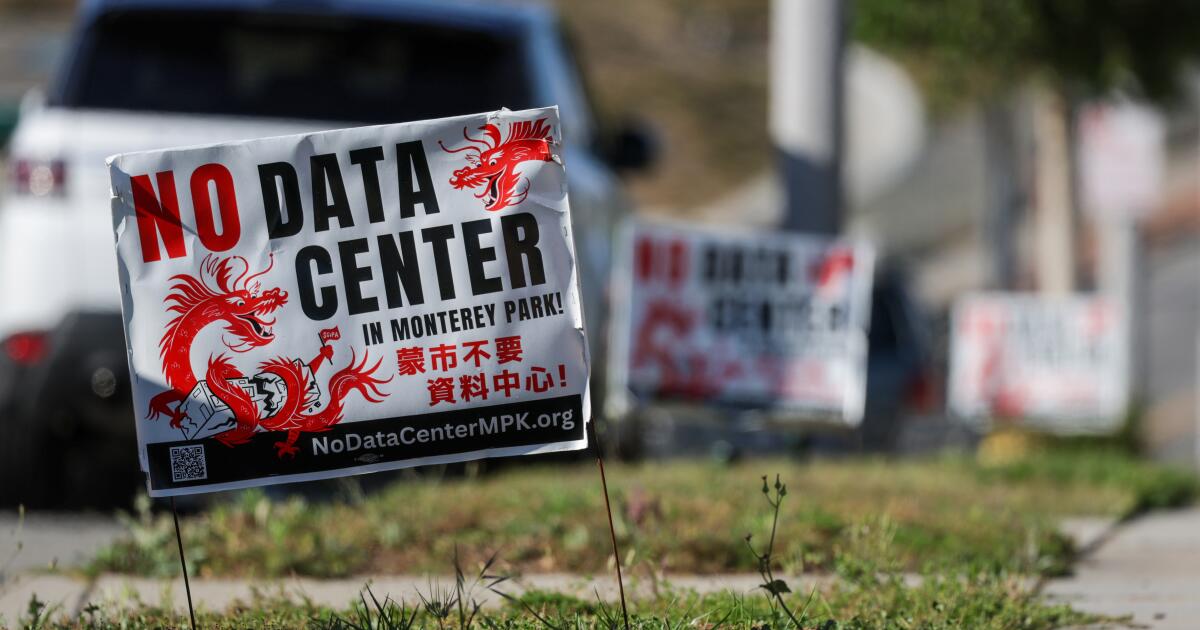
Residents in the city of Monterey Park will be the first in the nation to vote on a permanent ban on data centers Tuesday.
If approved, Measure NDC would prohibit data centers within the city limits and could only be overturned by another vote.
Yard signs saying “No Data Center” in English and Chinese with images of dragons line sidewalks in the San Gabriel Valley city.
As a wave of data center opposition sweeps the country, numerous towns and counties across the U.S. have instituted temporary moratoria and other restrictions on the facilities. But only a handful have instituted indefinite bans, and just four other towns have sent related matters to the ballot.
Supporters are hoping the vote will set a precedent for the rest of the region, where residents are fighting proposals in Vernon and City of Industry.
“This is about as permanent a ban as we can get,” said Steven Kung, co-founder of the group No Data Center Monterey Park. “Winning Measure NDC would send a huge message to the rest of the San Gabriel Valley about how residents don’t want data centers.”
The ballot measure emerged from the fight against a 247,000-square-foot center proposed in 2024 by the Australian-owned investment firm HMC StratCap for a residential area in Monterey Park.
The facility would have sat less than 500 feet away from the nearest home and used three times the electricity of the 60,000-person, predominantly Asian American city.
While the developer touted the potential for jobs and tax revenue, residents expressed concerns about noise and air pollution, rising electricity rates and a potential to lower property values.
The company pulled its plans in late March following public outcry and a March 4 city council vote to extend a temporary data center moratorium and place a ban on Tuesday’s ballot.
In a letter to the city council, HMC StratCap said it would pursue a different use for the land and would not engage in a ballot measure fight.
The city council later banned data centers indefinitely, the first in California to do so, said Mayor Elizabeth Yang. But she’s still been out campaigning for the measure with all four other council members.
“If a council puts in an ordinance, a future council can reverse it too,” said Yang. “With the ballot measure, unbanning it is a lot harder because you need the entire city to vote on it.”
The measure proposes the ban “to protect air quality, drinking water resources, and public health” and “prevent impacts to electricity and water rates.”
While California places third in the country for existing data centers with about 300 facilities, it hasn’t been a hot spot in the recent AI-driven data center boom. High electricity rates, expensive land and regulatory hurdles mean that fewer, and smaller, facilities are currently planned than in Virginia, Texas, Georgia, Illinois or Arizona.
“Most of California’s data centers are small by today’s standards,” said Shaolei Ren, an engineering professor at UC Riverside who studies how to reduce the environmental impacts of data centers. “Ten years ago, they would be medium-sized, but the power demand for new AI data centers has increased a lot.”
The average operating data center demands 45 megawatts, according to the Washington Post, while the average planned one would draw 430 MW. The one proposed for Monterey Park would have required about 50 MW at peak demand.
As proposals crop up in SoCal, they’re met with fierce opposition. Montebello, El Monte and Baldwin Park have all enacted temporary moratoria, and Alhambra recently banned data centers as part of a zoning code update. City of Industry, Vernon, City of Commerce and Santa Fe Springs are moving in the other direction, trying to court developers and streamline data center approvals. Community groups are fighting that.
Outside the San Gabriel Valley, residents of Coachella and Imperial County are showing up in droves to protest local proposals.
Matthew Shaw, a volunteer with the Coalition for Responsible Data Center Development, who recently published a report on opposition to AI data centers, said a vote to ban them in Monterey Park “would lead to copycats, partially because so many groups are just opposed to any data center development at all.”
While there is no formal opposition to Measure NDC, some building trades like Ironworker Local 433 supported the Monterey Park data center when it was still live before city council. Those in the data center industry are lamenting the state of public opinion.
“These are multi-billion-dollar assets that are built by multi-trillion-dollar companies. These things will get done,” said Mehdi Paryavi, chairman of the International Data Center Authority. “My biggest problem is that our industry does not invest enough in community engagement.”
Paryavi said towns that seek to limit data centers are missing out on thousands of jobs generated by data center construction, operations and customers, as well as faster artificial intelligence speeds and better performance.
Kung said local community organizers are “looking at the empirical evidence” and seeing a ban as a win.
“We’ve never seen a city that embraces a data center and is like, ‘Look how our quality of life has increased, look how all the revenue has gone into citywide improvements,’” he said. “That just doesn’t exist.”
-

 Arkansas1 minute ago
Arkansas driver’s licenses and state IDs now available in Apple Wallet
-

 California8 minutes ago
California’s race for governor and other key primaries remain unsettled as vote count continues
-

 Colorado11 minutes ago
Colorado community reels after police say driver with revoked license hits three pedestrians, killing one
-

 Connecticut16 minutes ago
Night forecast for June 2
-

 Delaware23 minutes ago
Thomas Jefferson University to run Delaware’s first medical school
-

 Florida26 minutes ago
Man accused of kidnapping woman at Wawa in Central Florida
-

 Georgia31 minutes ago
5 things to know about Georgia mosquito problem amid heat, drought
-

 Hawaii38 minutes ago
Hawaii weather: USGS revised 4.6 magnitude earthquake off Kona coast, south swell, passing showers

