Sports
How the PWHL’s youngest player is adjusting to a new league — and a new language


OTTAWA — Nearly 6,000 miles away from her hometown in Hokkaido, Japan, Akane Shiga was being asked about the weather.
Mike Hirshfeld, general manager of Ottawa’s PWHL team, was sitting with Shiga and coach Carla MacLeod in the team office at TD Place Arena, speaking to the 22-year-old forward and Japanese national team member through her interpreter.
“She’s looking at me like, ‘What is he talking about?’” Hirshfeld said about the playful preamble to an important bit of news ahead of the PWHL’s final roster deadline.
Because what Hirshfeld really wanted to know was how Shiga felt about spending the winter in Ottawa, as a member of the newest pro team in Canada’s capital.
When he told Shiga that she’d made the team, “her face just lit up,” Hirshfeld said.
“I feel very honored to be given this opportunity,” Shiga told The Athletic through her interpreter, Madoka Suzuki.
GO DEEPER
Six teams, one draft and a lot of Ikea furniture: How the PWHL was made in six months
The moment was the culmination of a hockey journey that saw Shiga travel across the world for her chance to play professional hockey in North America. Despite her credentials — an Olympian and four-time member of Japan’s World Championship team — she was not selected in the 15-round PWHL Draft in September. Unswayed, Shiga flew to Ottawa alone in November, with no guarantee of a contract, to try out for the team.
Her skating ability, quick release and hockey IQ impressed Ottawa’s braintrust and earned Shiga a one-year contract.
Now, she is a historic player in a historic league embarking on a singular path: Shiga is the youngest player in the PWHL and the only Japanese-born player.
This season Shiga is adjusting to her first year as a professional hockey player, and simultaneously adapting to life in a new country and learning a new language.
“To know the courage it took for her to fly over here on her own and walk into an environment where she didn’t speak the language and she didn’t know anyone,” MacLeod said. “To know at that moment that she had gambled on herself and she earned her opportunity — that’s what sport is all about.”
Where Shiga grew up in Hokkaido — the northernmost and second-largest island in Japan — hockey is, at the very least, an option. Some might call it Japan’s hockey hotbed, with most of the national team players coming from the northern region.
“If you want to play hockey, it’s accessible,” Shiga said through her interpreter. “But it’s not a sport that everyone picks to play like it is in Canada.”
In Tokyo, on the other hand, where Suzuki — who was hired to serve as Shiga’s interpreter in November and plays hockey at Carleton University in Ottawa — is from, “you’re kind of a weirdo if you’re playing hockey,” he said with a laugh.
According to the IIHF, there are only 1,281 registered female hockey players in Japan, with a national population of about 124 million. There are more indoor rinks in Canada (2,860) and registered female players in the state of Florida (1,517).

Shiga is the star of the Japanese women’s national team, and in 2021 she became the first Japanese player to score against Team USA. (Dennis Pajot / Getty Images)
Shiga, though, found hockey skating on an outdoor rink with her sister, Aoi, when she was six years old and she “never looked back.” When she was 13, in 2014, Shiga watched a Japanese women’s hockey team play at the Olympics for the first time in her life — and for the first time since Japan was the host nation in 1998. “It had a big impact on my career,” she said.
MacLeod, now Shiga’s coach in Ottawa, was an assistant coach for Japan at the time.
“I know what ’98 meant to me as a young Canadian kid when I saw those women on TV and I knew that that dream could then be mine,” said MacLeod, who went on to win two Olympic gold medals with Team Canada. “To know that a piece of that moment is within her and helping her to inspire that next group and helping her to achieve her dreams is pretty special.”
Shiga’s dream was realized only one year later when she made the Japanese under-18 team for the 2015-16 Division 1 world championships. She was one of the youngest players at the tournament and scored two goals and four points to lead Japan to a gold medal, and promotion to the top tier U18 world championships in 2016-17.
“I didn’t think I was ready to make the jump that soon,” Shiga said. “But I was very excited to get the news.”
She’s been a member of the Japanese national program ever since, playing on four under-18 teams, four senior world championships and qualifying for the 2022 Olympics. In 2019, Shiga made the switch from defense to forward because her coach, Yuji Iizuka thought she could help provide more offense for the team.
And he was right.
In 2021, Shiga was one of the breakout stars of the women’s world championships in Calgary, Alta. She scored the opening goal against Hungary in a critical 4-1 win for Japan to make it to the quarterfinals. She became the first Japanese player ever to score against Team USA — and she did it twice. Then, she scored the game-winning goal against Czechia to secure Japan’s best finish (sixth) at women’s worlds. Her four goals tied for fifth among North American stars like Natalie Spooner and Hilary Knight. It was one more than Canada’s Captain Marie-Philip Poulin had in the tournament.
“She’s a very important part of the team’s success,” Iizuka told IIHF.com “Our teams have always had trouble scoring, so to find someone who can put the puck in the net is very important.”
After years of adding to her reputation as one of the most talented players outside North America — including a trip to the 2022 Beijing Olympics — it was only natural that Shiga’s name popped up when the PWHL Ottawa front office decided to prioritize bringing in international talent.
“Obviously there’s a natural tether for me to the international game, and I’ve been lucky to see how talented these players are around the world. So for us it was an easy decision to say, Let’s bring in some international players and see how they do,” MacLeod said. “If they can make it, great. And if they don’t, at least we know that too. But we didn’t want to leave that uncertainty.”
According to Shiga, Ottawa was the only team to call when PWHL free agency opened in September.
At training camp, Shiga quickly impressed.
“I would say two days in, we knew we had something,” Hirshfeld said. “Her skating is off the charts. So is her hockey IQ. I remember Claude Julien (the former NHL coach) was here one day and he was like, ‘Who is that?’”
“Her skill with the puck catches everyone’s attention because she can maneuver things in a small space that a lot of people can’t,” MacLeod explained. “The puck comes off her stick faster than you anticipate and with a velocity that you’re not sure where that’s all coming from because she’s such a petite player. And she can do it in a phone booth.”
There was chatter amongst the Ottawa players ahead of camp about a player from Japan trying out for the team. Some national team players would have been familiar with Shiga’s game from world championships or the Olympics. But others, like defender Zoe Boyd, were being introduced to her for the first time.
She recalls a moment early into training camp where Shiga danced around in the offensive zone and sent a slapshot zinging past her face, bardown and in.
“Holy crap, this girl is legit,” Boyd thought at the time. “She’s the real deal.”
“Surprised isn’t the right word to describe it,” she explained. “We’re just amazed by Akane, her play, and what an amazing person she is — in spite of not being able to fluently speak English.”
When Madoka Suzuki answered the phone on a Thursday afternoon, he was in the car taking Shiga home from one of their errands.
“Had to do some banking,” he said. “Applying for credit cards and stuff.”
Bringing Shiga to Ottawa introduced the issue of the language barrier. The PWHL has 14 players from overseas — hailing from countries such as France, Hungary, and Czechia — but most of those players speak at least some English. Shiga did not, so Ottawa knew they’d need an interpreter to make her feel more comfortable and confident at tryouts.
The team started with a call to the Japanese Embassy, who provided a list of names, but those interpreters would cost around $300 per hour. “No one can afford that,” Hirshfeld said, laughing.
The team tried calling the universities in the city and connected with Stacey Colarossi, the coach of Carleton’s women’s hockey team, who referred Hirshfeld to Suzuki, a 24-year-old from Japan and a forward on the men’s hockey team.

Madoka Suzuki, left, with his sister, Chihiro, and Akane Shiga. Suzuki is employed by the PWHL’s Ottawa team as Shiga’s interpreter, though he has also been helping her adjust to life in Canada. (Photo courtesy of Madoka Suzuki)
As it turned out, Suzuki’s sister, Chihiro, played on the national team with Shiga last year and had already alerted her brother that Shiga had made the move to Ottawa and might need a friend in town. So, when Hirshfeld made the call with a job offer, Suzuki quickly accepted.
The day Shiga arrived in Ottawa, Suzuki was at the airport to pick her up and bring her to the team hotel. When the team skates, Suzuki is on the ice translating instructions for drills, or messages from the coaching staff. He attends team meetings and games, too, as his schedule allows. If Suzuki has class — he’s a psychology major at Carleton — or is on the road with his hockey team, he will join meetings or interviews over the phone.
“He understands the teachings from the coaching side and obviously as he’s translating, is giving her information that’s helping her grow and fit within the team side of things,” MacLeod said. “He’s really invaluable when it comes to Akane and Akane feeling included.”
“We love having Madoka around,” said defender Jincy Roese (née Dunne). “I feel like he’s just one of the girls — as much part of this team as any one of us.”
Suzuki’s work with Shiga goes beyond the rink. After Shiga made the Ottawa team, she had to fly to Hungary to play in the 4 Nations tournament for Team Japan. While she was there, Suzuki found a realtor to start looking for apartments for Shiga and got all the paperwork done so that when she returned they could find her a place to live as quickly as possible. He’ll take her to the bank to get an account or credit card set up, or to Ikea to buy furniture, or to get food at a restaurant or grocery store.
“A lot of the ‘work’ I’m doing is more as a friend than anything,” he said. “She’s made it super easy on me too. She’s very enjoyable to work with.”
Suzuki moved to Canada from Japan with his mom and sister in 2014, when he was 14 years old. He spoke English and had family with him, but he still remembers the difficult adjustment to a new place and new culture.

Akane Shiga and Madoka Suzuki, pictured with Suzuki’s former billet family. (Photo courtesy of Madoka Suzuki)
“I’m glad I could help her out this way, because otherwise it’s quite the journey to get your feet going up here,” he said.
Shiga has been using the Duolingo app to learn English. Her teammates have been helping her learn, too. Suzuki will sometimes step back and just let Shiga try to talk without needing the translation. If he’s not around, teammates will use Google Translate if Shiga needs help.
“She’s really quiet right now, but that’s to be expected,” said Roese. “But you see it there, she’ll speak a little more, she’ll get a little more involved in conversation. You can tell she’s starting to follow along more.”
Roese has learned some Japanese to help break the language barrier where she can. And MacLeod still knows a few words from her time as an assistant coach with Team Japan.
“I know the word ‘koko’ (which means here in Japanese), or I know the word hurry or no hesitation,” she said. “There’s certainly something small, small nuggets that obviously I was fortunate enough to pick up when I worked with them for two years. Not enough to actually be smart, but enough to maybe help in moments.”
Shiga’s teammates “love her,” Hirshfeld said. And several have taken her under their wing to make her feel comfortable and included on the team.
Boyd and her roommate Kristin Della Rovere will drive Shiga home from the rink, or take her to a teammate’s house if there’s a get-together. They’ve gone for bubble tea and have promised to have Shiga over once she’s settled in so she can see Boyd’s cat, Sam.
Shiga loves cats and has two back home in Japan named Pickle and Churro. “I miss the cats more than anyone,” she said with a laugh.
“I can’t imagine what it must be like to come to a country where nobody speaks your language,” Boyd said. “So naturally I just wanted to make sure that she understands things — like everybody did.
“But Akane is hilarious. Even though she can’t speak English very well, she still makes the funniest jokes and gets her point across. It’s been a pleasure to hang out with her and be a teammate with her.”
On the ice, Shiga is still adjusting to her first professional season. Through six games, Shiga hasn’t registered a point yet, but nobody in Ottawa is looking at the scoresheet.
“We’re not even worrying about that,” said Hirshfeld. “She’s getting used to the speed and physicality of this league, but I know she’s got the hockey IQ to work through it. She’s a great skater, which I think is a great advantage in this league. We’re very optimistic.”
Shiga has impressed in games with her skating and hands in tight with the puck. MacLeod says she works hard in practice and has already seen Shiga’s game grow in Ottawa. It seems like only a matter of time before she scores her first PWHL goal.
“I’ve never seen somebody that can rip the puck like she can,” Roese said. “Just bardown from anywhere.”
Shiga is also one of the most popular players in Ottawa. “I think she got the second loudest cheer after (Brianne) Jenner,” MacLeod said about the home-opener intros.
The Ambassador of Japan to Canada attended Ottawa’s home opener. There have been several Shiga signs spotted in the stands, and plenty of fan mail sent to her home — something Shiga says started after she played in the Olympics.
“She’s 22 years old,” MacLeod said. “Think of all the variables: youngest in the league, playing in a country, in a league that’s not native tongue to her, and she just keeps rising. What an incredible human being.”
Shiga hopes her sister, a 24-year-old defender playing in Switzerland, can join the league next season. The two were signed to play together with the Buffalo Beauts in the PHF before the league folded last season. More than anything, she hopes more players from Japan can follow in her footsteps.
“To be able to pave the path for younger players and give them someone to look up to — to say, you can be from Japan and play hockey — is a huge honor,” she said. “And I’m just very excited for what the future holds.”
(Illustration: John Bradford / The Athletic; Photos: Courtesy of Madoka Suzuki; Minas Panagiotakis / Getty Images)



NEWYou can now listen to Fox News articles!
It’s a two of a kind for Golden Tempo.
The winner of last month’s Kentucky Derby, who sat out the Preakness Stakes, forfeiting a shot at the Triple Crown, took home the victory at the 158th Belmont Stakes in New York on Saturday.
Renegade opened up as the morningline 2-1 favorite, similar to the Derby, followed by Chief Wallabee at 3-1 and Golden Tempo at 9-2.
The racing post is pulled down the front stretch for a race at Saratoga Race Course. (Gregory Fisher/Imagn Images)
Just like the Derby, Golden Tempo was well at the back of the pack but began to make his move at the final turn. At one point, Golden Tempo was neck-and-neck with Commandment, but Golden Tempo was able to get away from the pack in the final stretch.
This was the second consecutive year in which the Derby winner skipped out on the Preakness to tune up for the Belmont. Last year, Sovereignty won the Kentucky Derby before not traveling to Pimlico Race Course and then taking home the Belmont.
Golden Tempo (9) with Jockey Jose Ortiz crosses the finish line to win the 158th running of the Belmont Stakes horse race, Saturday, June 6, 2026, in Saratoga Springs, New York. (AP Photo/Yuki Iwamura)
CHERIE DEVAUX REFLECTS ON MAKING KENTUCKY DERBY HISTORY AS FIRST FEMALE TRAINER TO WIN THE RACE
“We made our decision, he won today, and we’re happy about that,” trainer Cherie DeVaux said after the race.
Saturday’s Belmont Stakes marked the third consecutive, and final, year in which the race took place at Saratoga Race Course in Upstate New York, as Belmont Park finishes up renovations.
Due to the change in course since 2024, the race ran at 1 ¼ miles instead of its usual mile-and-a-half. Saratoga is home to the annual Whitney, Travers, and Jim Dandy Stakes.
A sign at Saratoga Race Course for the 2026 Belmont Stakes. (Will Waldron/Albany Times Union via Getty Images)
This year’s Belmont did not feature any horses from the Preakness Stakes three weeks ago and just four from the Kentucky Derby in early May: Renegade, Commandment, Chief Wallabee, and Golden Tempo.
All four of them finished in the top four.
Follow Fox News Digital’s sports coverage on X, and subscribe to the Fox News Sports Huddle newsletter.
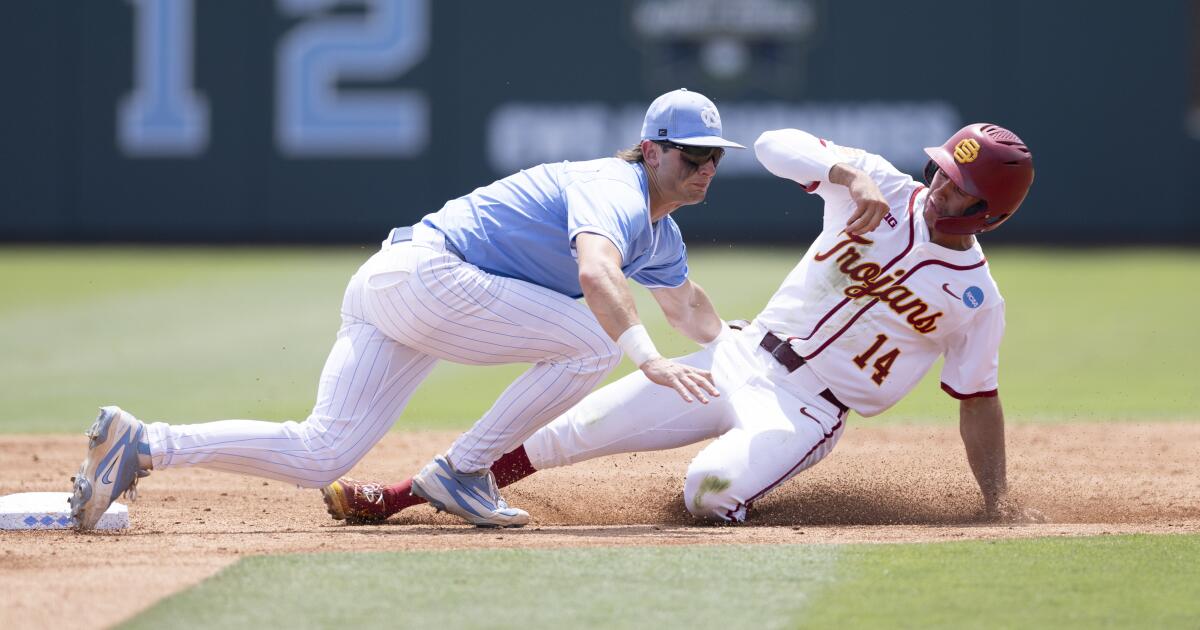
CHAPEL HILL, N.C. — Grant Govel was good, but Jason DeCaro was almost perfect.
USC baseball lost 4-0 in Game 2 of the NCAA Chapel Hill Super Regional, meaning its quest to break a 25-year College World Series drought will come down to a single game on Sunday.
North Carolina (49-12-1) turned to DeCaro with its season on the line, the seventh career NCAA tournament start for the veteran right-hander. DeCaro delivered a complete-game masterpiece, allowing just two hits — singles in the first and fifth innings — with eight strikeouts and one walk on a career-high 117 pitches.
“Obviously it was all about Jason DeCaro,” USC coach Andy Stankiewicz said. “He threw a heck of a game. He spotted his fastball and his breaking ball, we couldn’t get inside of it and couldn’t get through it. A very nice performance obviously by him, but the good thing is, we have tomorrow.”
Outside of giving up a solo home run to Colin Hynek in the second inning, Govel had a strong performance for USC (48-17). After throwing 153 pitches across two appearances in the NCAA regionals, including 64 pitches in Monday’s clinching win over Texas A&M, he gave up just five hits and struck out three over five innings and 83 pitches.
His final pitch was a crucial one, inducing an inning-ending double play with runners on the corners to hold the game at 1-0.
“Physically good,” Govel said when asked how he felt after making 236 pitches over a nine-day span. “I think having a good defense around me the entire time was very helpful. The solo shot didn’t really affect me. I’ve had a lot of homers hit off me this whole entire year. Competing with their guy — hats off to him, he pitched a hell of a game — felt good. The game just didn’t fall where we wanted it to.”
But for all of Govel’s great work, the day was all about DeCaro’s dominance.
North Carolina pitcher Jason DeCaro delivers against USC in Game 2 of the NCAA Chapel Hill Super Regional on Saturday.
(Kara Durrette / For The Times)
North Carolina found success against the Trojans’ bullpen in the sixth. Erik Paulsen hit a 339-foot home run over the left-field corner wall to double the Tar Heels’ lead, just the second home run given up by USC’s Sax Matson all season. The Tar Heels added two more on sacrifice flies in the sixth and seventh innings, but failed to drive in more with the bases loaded in the seventh and ninth innings.
“We pitched well enough to keep ourselves close and give ourselves a shot,” Stankiewicz said. “But at the end of the day, it was just all about DeCaro.”
DeCaro got better as the game continued, retiring the final 10 USC batters. It was a dominant pitching performance, but thanks to USC’s comeback win Friday, the Trojans still have life.
North Carolina coach Scott Forbes confirmed either Folger Boaz or relief ace and National Collegiate Baseball Writers Assn. Stopper of the Year Award finalist Caden Glauber will start Game 3. Stankiewicz did not name a starting pitcher for the decisive game.

Regardless, it will be all hands on deck.
“We’ll need everybody,” Stankiewicz said. “We can’t go too long with too many.”
The game will start at noon PT on ESPN. The Trojans won four elimination games last weekend and they’ll need one more to complete its mission to Omaha.
“We tell our guys Sundays are always important,” Stankiewicz said. “This is probably the most important Sunday that they’ll ever play.”
The biggest afternoon of Trojans baseball in a quarter of a century awaits.
Sports
Maxx Crosby plans to attend America 250 UFC fight, talks White House, Fernando Mendoza, Tom Brady and Olympics

NEWYou can now listen to Fox News articles!
Las Vegas Raiders star Maxx Crosby told Fox News Digital he plans on attending the UFC fight at the White House on June 14 to celebrate America’s 250th anniversary.
“I’ve never been to the White House,” Crosby said. “I’m excited, I like history…
“It’s incredible that we all have an opportunity to celebrate our country and just be part of a historic event… we live in the greatest country in the world and it should be celebrated.”
Maxx Crosby of the Las Vegas Raiders walks on the sideline before a game against the Denver Broncos at Allegiant Stadium in Las Vegas, Nev., on Dec. 7, 2025. (Chris Unger/Getty Images)
For Crosby, as a highly successful NFL star, the celebration represents an opportunity to recognize the freedoms and opportunities he appreciates most as an American.
“You have an opportunity every day to chase your passion,” Crosby said. “Everyone comes from different backgrounds, but in this country you have a choice every day to chase what you love and what you aspire to do. People don’t say the American Dream for no reason. It’s the greatest country because it’s opportunity. It’s a land of opportunity.”
Crosby also revealed who he’s rooting for at the event.
“I think everyone knows how much I love Justin Gaethje,” Crosby said. “Justin Gaethje is one of the greatest fighters to ever do it, and he’s an absolute legend. He’s also a great friend, so I’ll definitely be biased for him. I want to see him go to the White House and do his thing for sure.”
The fight, slated for the South Lawn, came about after Donald Trump casually leaned over to Dana White during a live UFC match and suggested they “do a fight at the White House”. White immediately agreed, and logistics were set in motion days later.
“Dana White is like family to me. He always does it big, and he always does it the biggest and best way. He’s always going to put on an incredible show,” Crosby said.
“I’ve met Trump a couple times, and he’s been incredible to me,” Crosby later added. “I know Dana [White] thinks nothing but the world of him and has a lot of respect for him. But you know we’ve met a couple times, and he’s always been great to me. So, going to the White House, and being there, is going to be a lot of fun for sure.”
Playing flag football for Team USA at the 2028 LA Olympics
Crosby also said he would welcome the opportunity to represent the United States in flag football when the sport makes its Olympic debut at the 2028 Los Angeles Games.
“Oh, no doubt,” Crosby said when asked whether he would consider playing. “I think it’d be incredible.”
While Crosby noted that his family has roots in the Balkans, he made clear where his allegiance would lie if given the opportunity to compete on the international stage.
TEAM USA FLAG FOOTBALL STAR WANTS OPPORTUNITY TO MAKE OLYMPIC TEAM AMID NFL PARTICIPATION
Las Vegas Raiders defensive end Maxx Crosby stands on the field after a loss to the Philadelphia Eagles at Lincoln Financial Field in Philadelphia, Pa., on Dec. 14, 2025. (Eric Hartline/Imagn Images)
“My mom’s side, I’ve got a Yugoslavian background, so I’ve got some Serbian and Albanian in me over there,” Crosby said. “I’m sure they’d give me a call as well, so it’d be an interesting decision.”
Still, the Raiders star said his heart remains with the country where he was born and raised.
“Everyone knows my heart’s here,” Crosby said. “This is the country I’ve been raised in, born and raised, so yeah, it would definitely be special.”
Crosby was also asked whether he would try to recruit Raiders minority owner Tom Brady to play quarterback for Team USA if he joined the Olympic squad.
“I don’t think he would do that,” Crosby said with a laugh. “I think he’s retired and there’s a lot of great quarterbacks right now. But I wouldn’t be mad at Tom Brady coming back. It’s a great time.”
Getting Fernando Mendoza ready for the NFL
Crosby also had high praise for quarterback Fernando Mendoza, who is adjusting to life at the NFL level after a successful college career.
“He’s a young guy and he’s coming in off an incredible season and an incredible college career,” Crosby said. “But when you get to the NFL, you’ve got to start from square one.”
The veteran defensive end said Mendoza has impressed him with his willingness to learn and fit into the locker room.
“I think he’s done an incredible job of just being one of the guys, being humble, being a sponge, just learning from everybody and asking questions,” Crosby said.
WHO IS FERNANDO MENDOZA? THE NFL DRAFT SENSATION NO ONE COULD HAVE PREDICTED
Las Vegas Raiders quarterback Fernando Mendoza warms up during a rookie minicamp at Intermountain Health Performance Center in Henderson, Nev., on May 2, 2026. (Candice Ward/Imagn Images)
But Crosby won’t be taking it easy on the fresh-faced rookie in practice.
“There’s no taking it easy,” Crosby said with a laugh. “We play this game one way, and I’m going to go out there and do what I do. It’s going to help him in the long run and making him better. I want to push all my teammates. That’s how teams improve — by pushing each other and making each other better on a daily basis.”
While many young quarterbacks are immediately compared to established NFL stars, Crosby said Mendoza should be given the opportunity to carve out his own identity.
“A lot of times people try to make comparisons,” Crosby said. “People just need to allow Fernando to be Fernando. I think he’s going to be a really special player.”
Playing for Tom Brady
Crosby also spoke about the unique opportunity to play for an organization that includes NFL legend Tom Brady as a minority owner.
“Tom has had one of the greatest careers, if not the greatest career, of anybody,” Crosby said. “He’s an incredible player and won at the highest level.”
Tom Brady looks on before the game between the Los Angeles Chargers and the Washington Commanders at SoFi Stadium on Oct. 5, 2025. (Jayne Kamin-Oncea/Imagn Images)
While Brady isn’t involved in the day-to-day operations of the franchise, Crosby said having someone with his experience around the organization is a valuable resource.
“Anybody you get around an organization that has done it at that level, I think is a positive,” Crosby said. “He’s not there all the time, but he is a resource for people in that building. I think his winning mindset is only a plus.”
Crosby only played Brady once before Brady retired.
“I wish we could have had a couple more swings at it,” Crosby said.
A big partnership
Crosby’s appearance with Fox News Digital came as part of a partnership with SAXX Underwear, a brand he said immediately caught his attention for more than one reason.
“Obviously, everyone knows I make a living sacking quarterbacks, so the name alone drew me in,” Crosby joked. “The double X was a bonus, too.”
But beyond the name, Crosby said he became a fan of the product itself. Crosby said the product has become part of his everyday routine.
“I literally wear it every single day,” Crosby said. “I wear it during workouts, I wear it around the house, I literally wear it everywhere I go.”
CLICK HERE TO DOWNLOAD THE FOX NEWS APP
Still, while Crosby wears it to workouts, he won’t be wearing it during games.
“It’s not NFL certified yet,” he said. “But I wear it to the games, for sure.”
-

 Los Angeles, Ca47 minutes ago
Protests mark 1-year anniversary of federal agents storming L.A.’s Fashion District
-

 Detroit, MI1 hour ago
Hundreds gather for rally against gun violence on Detroit’s east side
-

 San Francisco, CA1 hour ago
San Francisco unveils iconic Pink Triangle to kick off Pride Month
-

 Miami, FL1 hour ago
Miami Dolphins Discussion: Could He Be The One
-

 Dallas, TX1 hour ago
Dallas Hoops Journal Podcast: James Barlowe Details Mavs’ NBA Draft Options
-

 Boston, MA1 hour ago
NBA insider believes Giannis Antetokounmpo’s intrigue in Celtics ‘is real’
-

 Denver, CO2 hours ago
Denver weather: More hot weather Sunday
-

 Seattle, WA2 hours ago
PHOTOS: West Seattle High School alums gather for 2026 All-School Reunion

