Politics
Column: Steve Garvey stands out in California Senate debate. Not in a good way

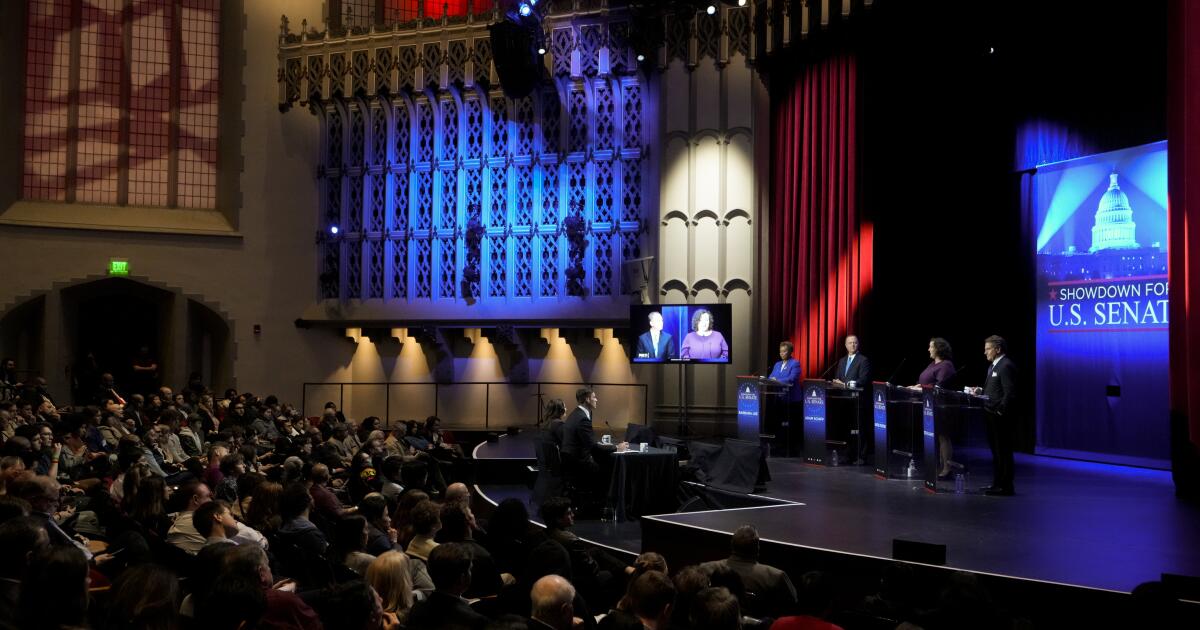
When you agree 90% or more of the time with your political opponents, how do you differentiate yourself?
That was the challenge facing three Democrats who took the stage for the first statewide televised debate of California’s highly competitive, vastly expensive U.S. Senate contest.
The answer: Seize on those relatively few differences and emphasize them loudly and repeatedly. Add a strong overlay of anecdote and personal narrative. Throw an occasional elbow, for good measure.
If you’ve closely followed the Senate race, you would have easily recognized the Democratic contestants who assembled Monday night on a red, white and blue soundstage on the campus of USC.
If you haven’t, it didn’t take long to get their gist.
A deliberate Rep. Adam B. Schiff told how he personally took on former President Trump as a leading congressional tormentor and is a doer, not just a talker.
A passionate Rep. Barbara Lee offered her history as a progressive with a long history in Sacramento and Washington and the lived experience of a single Black mother who was once homeless and raised her children with the help of food stamps.
A vociferous Rep. Katie Porter pressed her case as a scourge of corporate interests who wants to shake up Washington and is not one of those promise-much, achieve-little career politicians. (Like Schiff and Lee, she averred, each with more than 20 years in Congress. Porter was elected in 2018.)
Standing out wasn’t difficult for the lone Republican among them, Steve Garvey, the former baseball great and (it was abundantly clear) a political novice.
Garvey would be irrelevant in the Senate race but for the state’s election system, in which the two top finishers in the March 5 primary advance to November’s general election, regardless of party. That makes the jostling for second place nearly as important as the fight for the top spot.
Garvey has little to no chance of winning the Senate seat, given the enfeebled state of the GOP in California and its poor image among the state’s Democratic-leaning electorate. But by consolidating Republican support — the party has 5 million-plus registered voters in California, more than the population of many states — Garvey could easily reach November’s runoff.
His appearance Monday night was a political debut of sorts, and a shaky one at that.
Garvey is caught in a dilemma, trying to appease the Trump-loving Republican base without alienating the far greater number of Californians who loathe the ex-president. Even the most nimble politician would have a hard time managing that feat, and Garvey proved himself anything but.
He voted twice for Trump and, after being repeatedly pressed Monday night for an answer, strongly intimated he would do so again. Garvey, however, refused to directly say as much, instead offering this: “At the end of the day, it’s all a personal choice. As my personal choice, I will make it in the sovereignty of wherever it is and that’s my personal choice.”
He also stumbled when asked about the abortion issue. Although Garvey personally opposes the procedure, he said he would support reproductive rights as a U.S. senator. “The people of California have spoken and I pledge to support that voice,” he said.
The debate co-moderator, Politico’s Melanie Mason, then followed up by asking whether Garvey would similarly abide by the will of most Californians who strongly support stricter gun laws and oppose Trump’s return to office.
More word salad.
“Well I have my opinions, obviously,” Garvey said. “And with common sense and compassion and ability of consensus. You know, I look at all the issue. I think I’m fair.”
Throughout the night, Garvey was vague on most issues and just plain confusing on others. At one point he suggested the solution to California’s housing affordability crisis was cutting excessive Washington spending and opening up “the pipes of gas and oil” to reduce energy costs.
Will the performance cost Garvey with voters? That’s not clear.
He displayed an affable, aw-shucks style reminiscent of the political hero he name-checked, Ronald Reagan, who easily survived his share of gaffes by delivering them in a similarly soothing, avuncular style.
Will earmarks decide the Senate contest?
It was one of the main points of contention among the Democrats, with Porter forswearing the practice — in which lawmakers direct federal funding to specific, often pet projects — and Lee and Schiff both defending the process.
“Earmarks,” Porter insisted, “is just a fancy word for politicians substituting their personal interest … for what our needs are.”
“I believe in earmarks,” Lee said. “I believe in not being derelict in my duty.”
Will the war between Hamas and Israel prove decisive? (Elections are rarely decided on foreign policy.)
Lee’s early call for a cease-fire in Gaza set her apart from both Schiff and Porter, and she reiterated that Monday night. “The only way to keep Israel secure is through a permanent cease-fire,” Lee said.
Schiff disagreed. Hamas is “still holding over 100 hostages, including Americans. I don’t know how you can ask any nation to cease fire when their people are being held by a terrorist organization.”
“Cease-fire is not a magic word,” Porter said. “You can’t say it and make it so.”
Listen closely, and there were other differences.
Lee and Porter both favored a system of government-run, universal healthcare. Schiff said he favored “Medicare for all,” but allowing those who preferred their private healthcare to keep it.
The debate was the first of three scheduled televised sessions.
Maybe the next two will do more to establish some yawning differences among the leading Democrats. Otherwise, the Senate contest seems likely to be decided more on matters of style than substance.
And, this being California, which candidate has the needed bankroll to reach the millions of voters who won’t pay attention to any of their debates.

Politics
Jared Kushner’s overseas luxury resort project faces anti-corruption investigation amid violent protests

NEWYou can now listen to Fox News articles!
Albanian anti-corruption prosecutors are investigating changes to the protected status of a coastal wetland where a luxury resort project linked to Jared Kushner, the son-in-law of U.S. President Donald Trump, has drawn environmental opposition and protests, according to Politico.
SPAK, Albania’s special anti-corruption prosecution office, has opened a probe into changes made to the status of the Vjosa-Narta protected landscape in Zvërnec, Politico reported. The coastal wetland area is home to flamingos, Mediterranean monk seals, and sea turtle nesting sites, Politico reported.
IVANKA TRUMP BREAKS DOWN IN EMOTIONAL INTERVIEW TALKING ABOUT HER MOTHER IVANA’S DEATH, OTHER CHALLENGES
Jared Kushner and Steve Witkoff participate in a charter announcement for President Donald Trump’s Board of Peace initiative in Davos, Switzerland, on Jan. 22, 2026. (Denis Balibouse/Reuters)
In 2024, Kushner publicly discussed plans for his firm, Affinity Partners, to develop luxury tourism projects in Albania, including in the Zvërnec area. Earlier this year, he visited the area with his wife, Ivanka Trump.
Albanian Prime Minister Edi Rama recently confirmed to Politico that talks were ongoing between the government and Kushner over the deal, which is expected to include roughly 10,000 hotel rooms and villas.
EUROPEAN CAPITAL ROCKED BY VIOLENT PROTESTS AS GOVERNMENT CORRUPTION PROBE FUELS UNREST
Albanian Prime Minister Edi Rama speaks during a press conference following the EU-Albania Intergovernmental Conference in Brussels, Belgium, on May 26, 2026. (Daniel Gnap/NurPhoto)
“I want to make Albania a country that is a destination to be envied in the region, and this project is part of this effort,” Rama said Monday.
Fox News Digital has reached out to Affinity Partners and SPAK for comment.
Protests by Albanian citizens and nonprofit groups began in May when large, barbed-wire-topped fences were erected at the proposed site, preventing locals and tourists from accessing the beach. On Sunday, protesters assembled outside government offices to demand an end to the project as well as Rama’s resignation.
Jared Kushner speaks during the inaugural meeting of the Board of Peace at the Donald J. Trump Institute of Peace in Washington, D.C., on Feb. 19, 2026. Kushner is facing pushback in Albania over a luxury development project. (Chip Somodevilla/Getty Images)
CLICK HERE TO DOWNLOAD THE FOX NEWS APP
Following Sunday’s protests, footage emerged showing private security guards appearing to assault and drag a protester along a cliff. Some guards allegedly threatened other demonstrators who were attempting to remove fences and halt construction.
The licenses of two private security companies were revoked following the incident. Meanwhile, around 15 protesters have been charged, and the local police chief has been stripped of his duties.

After the polls close in California on Tuesday, NBC News chief data analyst Steve Kornacki will just be getting started.
Since December, the khaki-clad vote-counting guru has been going live and uninterrupted on streaming platforms to provide results and analysis of every special election and even some state Senate contests.
The stream — called the Kornacki Cam — provides unadulterated number crunching without any pundits weighing in. Rather than getting updates that last a few minutes, Kornacki provides continuous real-time results until the last available total is counted.
“This all happens in full view,” Kornacki said Monday in a phone interview. “The audience gets to see the whole thing. They get to see the buildup, the anticipation, the payoff.”
In the 10 Kornacki Cam sessions streamed by NBC News so far, 19 million viewers have sampled them across all platforms. The coverage — consisting of Kornacki, his Big Board, his producer and a Stedicam operator — is available on YouTube, NBCNews.com, the NBC News app and the division’s social media accounts on Instagram, Facebook and TikTok.
The Kornacki Cam will focus on the primaries for Los Angeles mayor, California and several congressional districts, shortly after the state’s polls close at 8 p.m. Pacific. NBC News has its own decision desk, which the network said has called the results of 70% of the 2026 elections ahead of the Associated Press.
In a Monday chat with The Times, here are the trends Kornacki says he’ll be looking for on the night.
Polling in mayoral races is typically pretty unreliable. What do you make of the contest based on what you’ve seen?
You don’t always have super-competitive mayoral elections and they’re not all created equal. It’s not quite like a presidential election so you just don’t have a wealth of data to draw on for expectations either.
I’ve seen the polling you’ve seen. It suggests that of the three candidates (Mayor Karen Bass, reality TV star Spencer Pratt and City Council member Nithya Raman), Bass is in the best position to get into the runoff. It also suggests that Spencer Pratt has had the most positive movement in the last month or so of the campaign. But we go in knowing there will be volatility and I’m open to any and all possibilities.
Spencer Pratt is an unusual candidate who has been able to take up a lot of oxygen in the race. Is there a hidden vote for him that people might not be eager to admit to pollsters?
You can look at the city and know where to look for whether Pratt is having a big night. The San Fernando Valley is gonna be more than a third of the vote, probably close to 40%. If he gets in the general election, he wants to be winning there by a big margin. If it’s not happening there for Pratt, I don’t think it’s happening anywhere else. Karen Bass is going to rely on central and South L.A., with probably a third of the vote coming out of those two places. Those should be her bulwarks. The Westside, I think could be more of a toss-up. There’s a fair chunk of the vote there.
We don’t do a ton of mayoral races around the country. So we’re still trying to figure out exactly how detailed we’re going to be able to zoom in, at the neighborhood level and the precinct level.
Turnouts usually are low for Los Angeles mayoral races. Will this year be different?
This mayoral race has received a lot more national attention than 2022. So my thought is that the turnout would be higher, just based on that. But this is something that is resonating nationally because Pratt has that celebrity factor. The number was 646,000 (total votes) for 2022. So that’s something we’ll be following — are we trending over or under that?
And what will be the best indicators for the gubernatorial race?
The place that I kind of got circled here is Orange County. In the last two sort of major statewide elections, it was the first to report out (its) vote. At 8:06 p.m local time in California, in 2024, Orange County reported out half of its vote, right? So you’re getting, you know, you’re getting hundreds of thousands of votes, potentially, from this enormous county within, potentially within 10 minutes of polls closing. There were a couple others — the Central Valley, and we got a good chunk of Merced and Fresno quickly.
So how long are we going to have to wait for a result on Tuesday night?
One of the other things that just surrounds everything in California, whether it’s the mayor’s race, or governor’s race, or anything else, is nothing is definitive in the first hour or so after the polls close. We’re probably realistically looking at a days or even weeks-long process of getting all the vote counted.
I know it drives many people nuts. Without editorializing on that, it’s just a fact that they can get out of about two-thirds of their vote on election night, and if the races aren’t clear and definitive, then you’re generally in for a pretty long haul.
We do know in California that they’re not going (to count) nonstop until they get a result. They’re going to then start doing updates as they process and count the remaining vote by mail, which is usually a considerable pile in a lot of these places. The vote by mail in California can continue coming in for seven days after the election.
So do you think your coverage reflects a shift in what the consumer wants? We already know how fragmented the audience is. Are there now enough political junkies who want the pure uncut stuff?
I’ve been doing this about 20 years, and when I would tell people that I reported on politics for a living, they either moved away from me or changed the subject. And now, you know, I found the last, you know, 10 years or something, has just totally changed. People come up to me, even if they don’t know I work in politics, and they want to talk politics. Everybody seems into it whatever side they’re on.

new video loaded: Judge Decides to Keep Charlie Kirk Hearings Open to Public
transcript
transcript
Judge Decides to Keep Charlie Kirk Hearings Open to Public
Utah district judge, Tony Graf, rejected the defense’s bid to close the hearings in the Charlie Kirk murder case. The defendant, Tyler J. Robinson, is accused of fatally shooting Mr. Kirk, the conservative activist.
-
A party seeking to close a preliminary hearing must show that adverse publicity traceable to the opening hearing poses a realistic likelihood of prejudice to a fair trial. Public access to the judicial — to judicial proceedings also serve in an important role in maintaining confidence in the fairness and transparency of the judicial process. This court finds these showings have not been made here.
By Meg Felling
June 1, 2026
-

 Atlanta, GA3 minutes ago
Atlanta Braves News: Mauricio Dubon, Hurston Waldrep, Week Ahead, More
-

 Minneapolis, MN10 minutes ago
Person found fatally shot inside car in Mill Ruins Park in Minneapolis, police say
-

 Indianapolis, IN13 minutes ago
Garfield Park Conservatory will combine nature and crafts in June
-

 Pittsburg, PA18 minutes ago
2025 Steelers Offseason Recall: Garrett shutdown as Pittsburgh bullied Browns in Week 6 | Steel City Underground
-

 Augusta, GA25 minutes ago
Augusta neighbors voice concerns over proposed data center pause
-

 Washington, D.C28 minutes ago
Memorial to honor journalists like Don Bolles, killed in pursuit of truth
-

 Cleveland, OH33 minutes ago
Fire crews battle Cleveland duplex blaze, ammunition heard popping inside
-
 Austin, TX40 minutes ago
Austin OKs $2.35 billion of revenue bonds, eyes GO bond election

