West
RFK Jr catches waves with surfing legend Kelly Slater for birthday while campaigning in Hawaii

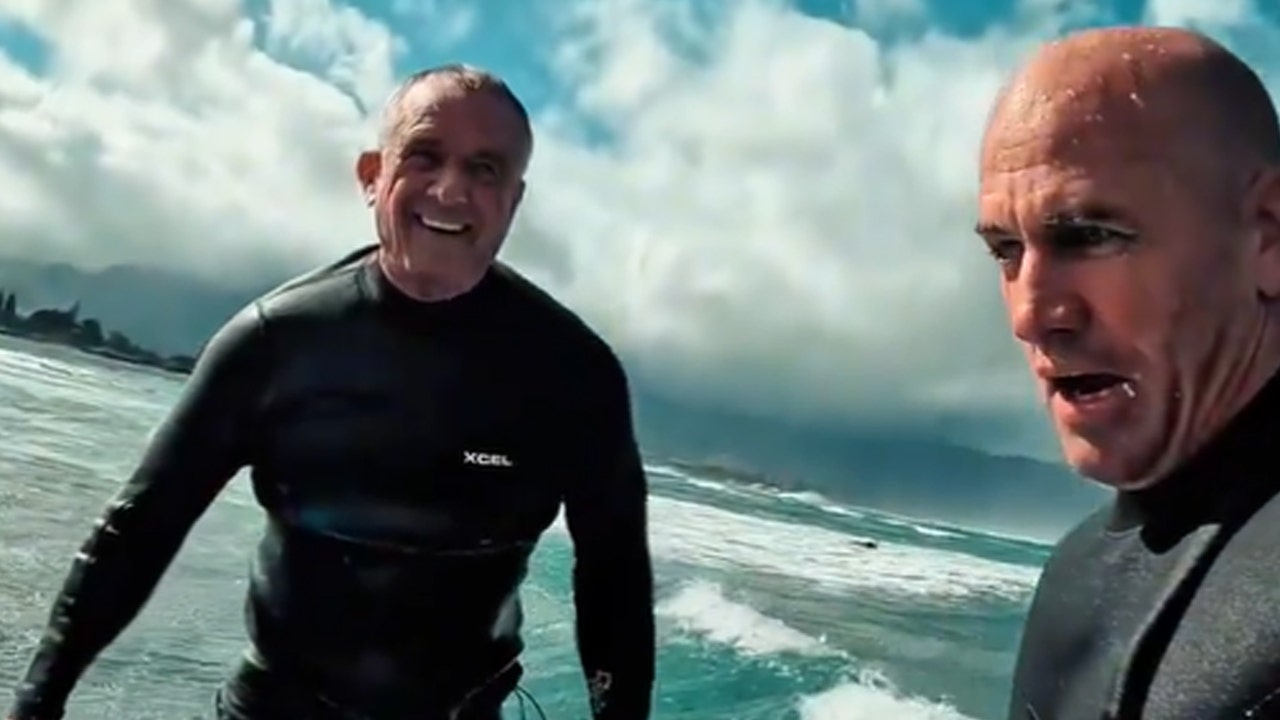
Independent presidential candidate Robert F. Kennedy Jr., caught some waves with surfing legend Kelly Slater for his birthday while campaigning in Hawaii.
Kennedy posted the video of him surfing with Slater, and surf rock playing in the background on X, formerly Twitter.
“Best birthday present ever: Catching waves with 11-time world surf champion [Slater] on North Shore, Pua’ena Point,” Kennedy wrote on Wednesday.
RFK JR SCORES ENDORSEMENTS FROM 3 HIGH-PROFILE ATHLETES
Independent presidential candidate Robert F. Kennedy Jr., caught some waves with surfing legend Kelly Slater for his birthday while campaigning in Hawaii. (@RobertKennedyJr/@KellySlater/X)
Kennedy made the post amid his visit to the Aloha State, where he held a rally in his bid for president.
The independent candidate is challenging President Biden and the eventual Republican presidential nominee for the Oval Office.
Kennedy has been making his rounds throughout the country and in the media as he has pushed forward with his campaign and has garnered support from several celebrities.
Rock and roll legend Eric Clapton raised a whopping $2.2 million for Kennedy at a Los Angeles fundraiser in September, his campaign said.
Slater is one of several high-profile athletes who have also endorsed Kennedy in his independent bid for president. (@RobertKennedyJr/@KellySlater/X.)
Kennedy’s campaign said it raised $1 million while the remaining $1.2 million went to a political action committee supporting the Democrat’s presidential bid.
Slater is one of several high-profile athletes who have also endorsed Kennedy in his independent bid for president.
Independent presidential candidate Robert F. Kennedy Jr., went surfing with Kelly Slater while campaigning in Hawaii. (@RobertKennedyJr/@KellySlater/X)
In November, a trio of former professional athletes announced that they were throwing their support behind Kennedy to take the White House.
NBA legend and 1992 “Dream Team” Olympian John Stockton, Green Bay Packers Hall of Fame member Ken Ruettegers and three-time North American Enduro mountain biking champion Kyle Warner are all endorsing Kennedy for president.
John Stockton, Ken Ruettegers, Robert F. Kennedy Jr. (Getty Images)
The athletes said that they like the cut of Kennedy’s jib — all three pointed to what they say are the independent candidate’s genuineness, honesty and openness to conversations about policies as reasons they support him.
Stockton said he believes that Kennedy “has been put on this planet for just this moment in time” and that there’s “a real need for him and his leadership.”
“There’s a need for very smart people in these positions that have integrity that [is] off the charts, that have the stamina and strength to be able to speak and be a leader 24/7, not just on occasion or on blips,” Stockton said.
Read the full article from Here


SALT LAKE CITY — A law designed to prevent so-called “dumpster babies” is now 25 years old — and one of the individuals it was designed to save is now close to the same age.
Utah‘s Newborn Safe Haven law was designed to give pregnant moms a safe alternative where they could leave a baby they could not or would not be able to care for. The original sponsors of the bill say they don’t know how many children have been saved over the years, but one of them, Sam Peterson, was on hand to mark Monday’s special anniversary.
He said the law means everything to him.
“It is something that has given me my life! It’s my privilege to be a part of this law,” Sam said.
He stood next to his mother, Heather Peterson, who said she gets emotional talking about the law allowing her and her husband to adopt Sam.
“We feel like a miracle happened. We feel like you came to us in the most amazing way and you have an amazing story and we think it’s important that other people hear it,” she said.
Heather and Sam agreed that the Newborn Safe Haven allowed them to become a family.
It was a bill originally sponsored by former Utah Senator Patrice Arent a quarter century ago. Arent said she felt compelled to act after hearing too many stories about so-called “dumpster babies.”
“Babies that had been left to die in unsafe places like dumpsters or public toilets,” Arent explained, “Or even someone who left their baby in a drawer in their bedroom in Cottonwood Heights. I heard these stories and I just knew I had to try to find a way to provide a safe alternative.”
So Arent, a Democrat, worked with former Republican lawmaker John Valentine to sponsor and help pass Utah’s Newborn Safe Haven law.
Arent said it was a true bipartisan collaboration.
“It allows our birth parents to legally give up custody of an infant. It’s anonymous and it’s in a hospital. There will be no questions asked, and the baby then ends up in a safe, loving home,” she said.
Less than a year after the law went into effect, Sam’s birth mother left him at a Utah hospital. Heather said she and her husband adopted him three days later. Sam is now 24.
“We are living proof that Safe Haven works, because we didn’t know anything about his birth mom… It was like he just dropped out of heaven,” Heather said.
Sam said he is eternally grateful.
“It’s given me a family, it’s given me friends, it’s given me an opportunity to go to college. Day three, I was with my mom, and so she will always be my mother, and I will always cherish that,” he said.
Sam said he will be graduating next year from BYU with an engineering degree.
The Washington Lottery offers several draw games for those aiming to win big.
Here’s a look at June 1, 2026, results for each game:
Winning Powerball numbers from June 1 drawing
02-42-47-57-58, Powerball: 14, Power Play: 3
Check Powerball payouts and previous drawings here.
Winning Cash Pop numbers from June 1 drawing
11
Check Cash Pop payouts and previous drawings here.
Winning Pick 3 numbers from June 1 drawing
8-6-0
Check Pick 3 payouts and previous drawings here.
Winning Match 4 numbers from June 1 drawing
07-08-09-18
Check Match 4 payouts and previous drawings here.
Winning Hit 5 numbers from June 1 drawing
03-10-28-32-33
Check Hit 5 payouts and previous drawings here.
Winning Keno numbers from June 1 drawing
04-05-08-14-16-17-23-24-27-28-31-32-38-43-45-47-51-58-65-66
Check Keno payouts and previous drawings here.
Winning Lotto numbers from June 1 drawing
05-09-10-15-21-26
Check Lotto payouts and previous drawings here.
Winning Powerball Double Play numbers from June 1 drawing
02-07-35-44-57, Powerball: 25
Check Powerball Double Play payouts and previous drawings here.
Feeling lucky? Explore the latest lottery news & results
Are you a winner? Here’s how to claim your lottery prize
All Washington Lottery retailers can redeem prizes up to $600. For prizes over $600, winners have the option to submit their claim by mail or in person at one of Washington Lottery’s regional offices.
To claim by mail, complete a winner claim form and the information on the back of the ticket, making sure you have signed it, and mail it to:
Washington Lottery Headquarters
PO Box 43050
Olympia, WA 98504-3050
For in-person claims, visit a Washington Lottery regional office and bring a winning ticket, photo ID, Social Security card and a voided check (optional).
Olympia Headquarters
Everett Regional Office
Federal Way Office
Spokane Department of Imagination
Vancouver Office
Tri-Cities Regional Office
For additional instructions or to download the claim form, visit the Washington Lottery prize claim page.
When are the Washington Lottery drawings held?
- Powerball: 7:59 p.m. PT Monday, Wednesday and Saturday.
- Mega Millions: 8 p.m. PT Tuesday and Friday.
- Cash Pop: 8 p.m. PT daily.
- Pick 3: 8 p.m. PT daily.
- Match 4: 8 p.m. PT daily.
- Hit 5: 8 p.m. PT daily.
- Daily Keno: 8 p.m. PT daily.
- Lotto: 8 p.m. PT Monday, Wednesday, and Saturday.
- Powerball Double Play: 8:30 p.m. PT Monday, Wednesday and Saturday.
This results page was generated automatically using information from TinBu and a template written and reviewed by a Washington editor. You can send feedback using this form.

GILLETTE, Wyo. — Two of the Republican candidates for Wyoming governor, Megan Degenfelder and Brent Bien, went head to head in Campbell County this evening. They both highlighted differences in some areas but agreed on energy, public lands, government oversight, abortion and election security.
Degenfelder, Wyoming’s superintendent of public instruction, introduced herself as “a Wyoming ranch kid whose parents clawed their way into the middle class” and said she believes Wyoming is “worth fighting for” because she believes the Wyoming people’s lives are at stake.
Bien, a retired Marine Corps colonel and combat veteran, pointed to his military career and leadership experience.
“My whole adult life has been about leadership, about principled conservative leadership,” he said. “My objective is to restore principled conservative leadership, accountability and discipline to Cheyenne.”
Nuclear energy
Both candidates supported Wyoming’s role in energy production but opposed bringing outside nuclear waste into the state.
“I do not want Wyoming to be … the permanent repository for spent nuclear fuel. I will not allow that to happen on my watch,” Bien said.
Degenfelder said Wyoming should consider nuclear power as part of its energy future but added, “If it works for us to be able to have nuclear as part of the portfolio, then it has to be right for Wyoming and that is ensuring that we do not accept anyone else’s waste, period.”
Public lands
The candidates also opposed privatization of public lands.
“No one loves public lands more than I do,” Degenfelder said. “You start selling that to the highest bidder, Wyoming loses who we are.”
Bien said he is “absolutely opposed” to federal lands being sold to private interests.
“If they do decide to dispose of it, then we as the state of Wyoming should get first-right refusal at no cost,” he said.
Attorney general and judicial appointments
When asked what each would be looking for in an attorney general and judicial appointment, both candidates called for conservative leadership.
Bien said he would seek an attorney general from outside state government.
“I want a clean set of eyes to look at what everything’s been that’s been going on,” he said. “I want someone who will put people first and it will put Wyoming first.”
Degenfelder said she wants stronger advocacy from state agencies.
“I want a bulldog in not just the attorney general’s office, but in all state agencies,” she said. “I want an attorney general that is so aligned to my mission and vision and what I believe that there’s an amicus brief on my desk the next morning after an action takes place.”
Immigration
Both candidates supported stronger immigration enforcement.
Bien explained he wanted to cooperate with ICE “to the fullest extent possible” and to make sure immigrants who are not in the United States legally would be sent out of the state.
Degenfelder said illegal immigration is already affecting communities in Wyoming.
“If you’re here legally, you got nothing to worry about. If you aren’t, it’s time to go home,” she said.
Energy development and green energy
Energy policy generated some of the sharpest comments of the night.
Degenfelder argued renewable energy projects should compete without government support.
“I’m also an economist and so I’ll tell you the way that you kill these green energy, you make them play on the same playing field,” she said. “No more tax subsidies, no more handouts, ensuring the regulatory environment is just as equal.”
Bien took a firmer stance against renewable development.
“Folks, there’s no place in Wyoming for this green energy,” he said. “I want these things bonded up front and where we’re not paying for these like we did all the gas wells. The answer for me is absolutely, unequivocally no.”
Economic development
Degenfelder argued government should focus on infrastructure such as water and sewer systems rather than directing economic development.
“Government does not create jobs. Private business does,” she said.
Bien echoed that sentiment.
“The only business that government has in business is simply to get out of the way. It’s to cut taxes. It’s to deregulate,” he said. “Right now, we’re turning into state capitalism where we have our own state government picking winners and losers.”
Government audits
Both candidates supported increased auditing of state government.
“This state has not done a full-blown budgetary audit since 1989,” Bien said. “Whoever’s belly-aching loudest is going to get audited first.”
Degenfelder agreed.
“We should be auditing every single state agency, every single budget line all the time,” she said. “Government is a beast, and you need someone in there who can tame it and who knows how to do it.”
Abortion
Abortion was another topic where both candidates expressed strong opposition.
“Life starts at conception and there are no exceptions,” Degenfelder said. “We are now one of the most openly abortion states in the country because of that ruling by the Supreme Court. We’re working against the devil here.”
Bien also opposed abortion.
“Folks, for me, there are no exceptions. Life does begin at conception,” he said.
Election integrity
Bien advocated for hand-counting ballots.
“I am very much a proponent of hand tabulation being the primary method of counting all cast paper ballots and I will push that way,” he said.
Degenfelder called for paper ballots statewide.
“Every single ballot should be a paper ballot,” she said, adding that she supports “banning dropboxes.”
Republican platform
Both candidates pledged support for the Wyoming Republican Party platform.
“80% is a no-brainer, and we need to require that out of our elected officials,” Degenfelder said.
Bien said he expects to be held to “100%” of the platform.
“The party’s been co-opted. You have to have an ‘R’ behind your name to win in this state,” he said.
Candidate priorities
During a segment where candidates selected their own discussion topics, Degenfelder highlighted school choice, career and technical education, removing pornography from school libraries and protecting Wyoming’s water rights.
Bien focused on education and agriculture, criticizing student proficiency rates and proposing policies aimed at strengthening Wyoming’s agricultural industry, including declaring agriculture critical infrastructure and reducing regulations on small butcheries.
Technology and education
Although technology and its place within education was not discussed during the debate, County 17 asked both Degenfelder and Bien their thoughts regarding student technology in schools.
Bien said technology is being used too much in classrooms and is making it harder for students to think on their own.
“What it’s doing is it’s dumbing down our kids,” Bien said. “Our kids aren’t learning how to critically think anymore. They go straight to one of the AI things and it generates an answer for them.”
Degenfelder said she backed a bill to ban cellphones during instruction time.
“I supported a bill that came through the legislature a couple of years ago that actually would ban cell use during instructional time, and I stand by that,” Degenfelder said. “I think that it’s appropriate to take cellphones out of classrooms, and what we find is that kids thrive.”
Closing statements
In closing remarks, Bien emphasized his experience as an outsider candidate.
“I am the only outsider in this race, but I am the only one who’s got an inordinate amount of leadership experience,” he said. “Folks, you deserve a government that you can trust.”
Degenfelder pointed to her endorsements from President Donald Trump and U.S. Rep. Harriet Hageman.
“I get asked a lot, ‘How did you get the Trump endorsement?’” Degenfelder said. “The answer is really simple. I earned it.”
Alongside other candidates, Bien and Degenfelder will be competing for support in Wyoming’s Republican gubernatorial primary Aug. 18.


Related
-

 Pennsylvania1 minute ago
A gap in Pennsylvania law has put fire companies and county treasurers at odds over online raffles
-

 Rhode Island8 minutes ago
RI Day of Portugal parade names 2026 grand marshals
-

 South-Carolina11 minutes ago
Anderson County voters to weigh in on Statehouse races. Who’s on ballot?
-

 South Dakota16 minutes ago
South Dakota Community Foundation encourages nonprofits to apply for funding
-

 Tennessee23 minutes ago
Gov. Bill Lee wraps up America 250 tour after visiting all 95 Tennessee counties
-

 Texas26 minutes ago
Women’s College World Series championship series set: Texas to rematch Texas Tech
-
Utah31 minutes ago
Adoptee shares gratitude as Utah’s Safe Haven law turns 25 years old
-

 Vermont38 minutes ago
Burlington Trout Parade celebrates kids raising fish, learning nature

