Entertainment
Hollywood has been on a mystery binge. Now, pick a murder of your choice

The mystery story is a relatively recent innovation, whether dated from Edgar Allan Poe’s 1841 short story “Murders in the Rue Morgue,” with its amateur detective C. Auguste Dupin, or Wilkie Collins’ 1868 novel “The Moonstone,” which established many of the conventions still in use today, or even the 1887 debut of Sherlock Holmes, so popular that his creator, Arthur Conan Doyle, could not kill him. But the form has made up for lost time, with mystery series filling entire bookstores and invading every other storytelling platform — theater, film, radio and perhaps most prolifically, television, where it has held fast while other genres have come and gone. It’s fantastically adaptable. Comedy, tragedy, cozy, gritty, formulaic, metafictional, historical, futuristic, highbrow, lowbrow, middle brow — something for every taste.
The advantage of a mystery, from a broadcaster or streamer’s perspective is that no matter the quality, viewers, once even a little invested, will stick around until the end just to find out who did it, or how they did it, or why they did it, even though the solution may be the least interesting aspect of the tale; often, if not inevitably, it will be a version of something you have seen before, there being a relatively few reasons people kill one another, and ways to do it, and to establish a phony alibi. This doesn’t really matter much, because above all, a mystery is an armature on which to hang a bunch of distinct, disparate characters, without the necessity of character development. (Though that is certainly allowed.) And because in this world, familiarity counts as novelty.
Although the mystery is evergreen, we seem to be in a period of expansion. Why? The pop psychologist in me would suggest in a world without answers to crises in the near and the long term, they propose successful solutions, based on demonstrable facts, arrived at through human intelligence. Tension is released instead of ongoing. And villains typically, though not always, get their comeuppance.
The critic in me, on the other hand, would observe that in follow-the-leader Hollywood, success breeds imitation, or repetition. On the big screen we have lately had Rian Johnson‘s “Knives Out” and “Glass Onion” and Kenneth Branagh‘s Hercule Poirot adaptations. On television, we’ve seen “A Murder at the End of the World,” Agatha Christie for the 2020s; Natasha Lyonne’s “Columbo”-inspired “Poker Face” (created by Johnson); “Dark Winds,” set in the 1970s, starring Zahn McClarnon as a Navajo tribal police chief; the satirical yet tightly structured “The Afterparty,” with Tiffany Haddish as its eccentric gumshoe. Even “Wednesday” was a mystery story, with Charles Addams’ dour teen its dark Nancy Drew, played by Jenna Ortega. And the starry comedy “Only Murders in the Building” is getting a secondary airing on ABC — strike-related, but whatever — after three seasons on Hulu, with a fourth to come.
In the space of a single week, four prestige major mysteries of different flavors, each with its particular pleasures, have premiered or are about to. There is “Night Country,” the fourth season of “True Detective” (HBO, Sunday) — I would call it long-awaited, but I’m not sure anyone expected to see it again — set within a sunless Arctic Circle, with Jodie Foster and Kali Reis its philosophically contrary investigators; “Monsieur Spade” (AMC, Sunday), from Scott Frank (“The Queen’s Gambit”) and Tom Fontana (“Oz”), which finds Dashiell Hammett‘s detective, played by Clive Owen, living in the south of France two decades after “The Maltese Falcon”; the fanciful, oceangoing “Death and Other Details” (Hulu, Tuesday) with Mandy Patinkin as the “world’s greatest detective,” maybe; and “Criminal Report” (Apple+, now streaming), in which London police detectives Cush Jumbo and Peter Capaldi clash over a possible miscarriage of justice.
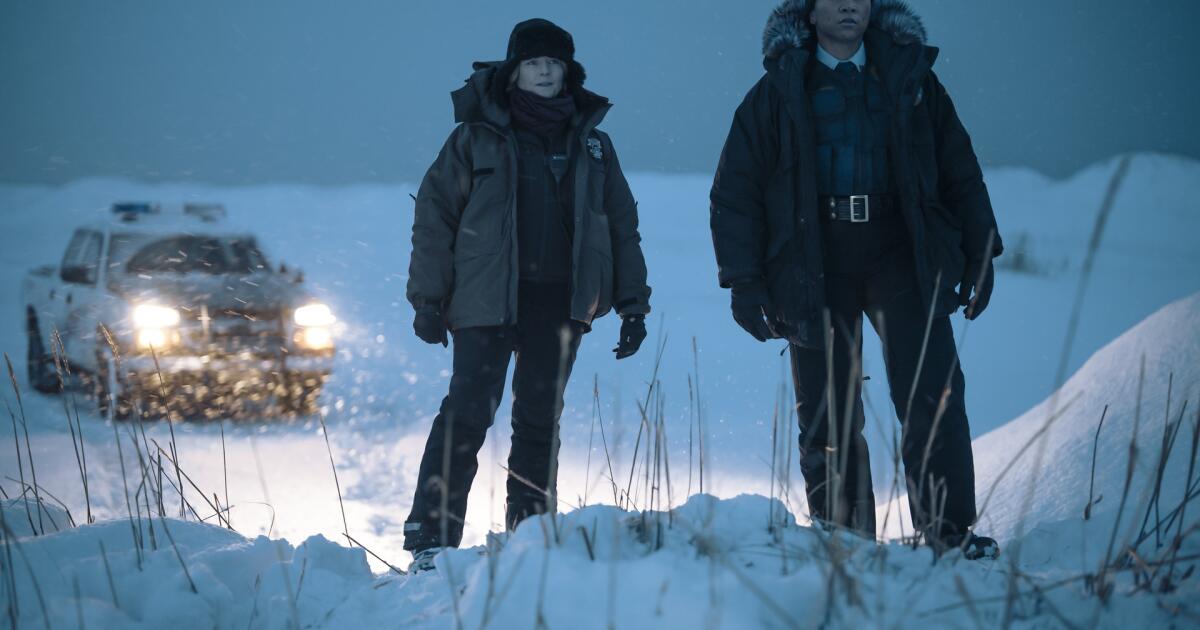
Kali Reis, left, and Jodie Foster in HBO’s “True Detective: Night Country.”
(Michele K. Short/HBO)
The excellent “True Detective: Night Country” leads this pack. The anthology series, created by the novelist Nic Pizzolatto, began as an HBO-brand elevation of the police procedural, a metaphysical whodunit in which the dialectical double act of Matthew McConaughey and Woody Harrelson, a refined version of the odd-coupling seen in “Beverly Hills Cop” and countless other cop adventures — was the real subject of the show, or in any case, the reason for its success. The current season, created, directed and mostly written by the Mexican writer and director Issa López (“Tigers Are Not Afraid”), seems fashioned to follow closely in the footsteps of the first, but now those footsteps are tracking through the snow.
There are the same scenes of the principals driving and talking and the presentation of differing points of view, one more empirical, one more spiritual. There is the recurring, sometimes chilling presence of a mysterious folk symbol, “older than the ice probably.” And there is one reference so specific that it can only be described as fan service.
Set in the fictional Alaskan small town of Ennis, the story begins on the day of the last sunset before night moves in for six months, and runs through Christmas and New Year’s. Snowbound crime shows are nothing new, but given the demands and costs of production, they are uncommon, and special. And there’s something beautifully unsettling about all the darkness surrounding this isolated town, an environment that, without the proper gear, will kill you, and where it always seems to be the same time of day, or night.
“Tigers Are Not Afraid” was a horror film shot through with magic realism, and both those elements find a home in “Night Country.” Indeed, it begins more like a horror movie than a crime show, with a herd of suddenly stampeding reindeer, and then a delivery man discovering that the scientists at a remote research station, whose exact business no one seems to know, have all disappeared, leaving the legend “WE ARE ALL DEAD” written on a white board. (There is no actual on-screen violence in the show, but plenty of shocking images and an ongoing sense of dread. (You breathe a sigh of relief whenever someone enters a space where the lights are on and people are around.)
A severed tongue discovered on the site seems to link the disappearance to the unsolved murder of an Indigenous midwife and activist. It piques the interest of trooper Evangeline Navarro (Reis), who brings her suspicions to Ennis police chief Liz Danvers (Foster). Navarro and Danvers, physical and philosophical opposites, though they share a consuming doggedness, have a lot of old business, which will be revealed through the season, and explain much — though not everything will be explained. Foster is every bit as good as anyone who has paid her the least bit of attention since the Disney days would expect her to be; but Reis, a boxer only recently turned actor, is terrific as well.
Echoing the investigators’ conversations about the living and the dead, God and the beyond, the show plays along the lines of the natural and the supernatural, without fully throwing in with either — it leaves some things mysterious and open to discussion; that Rose (Fiona Shaw), the local bohemian, actually sees her dead husband, is merely a fact in this world, but at the same time people do things for human reasons. This isn’t a story of demons.
Ennis is one of those small isolated communities where everyone knows everyone or knows someone who does, but at the same time is afflicted by a general air of loneliness and disconnection. Even as the investigation proceeds, by fits and starts, we are involved in various well-drawn (or sketched) family and relationship and community dramas. Danvers’ teenage stepdaughter (Isabella Star LaBlanc) wants to explore her Indigenous heritage, much to Danvers’ unexplained displeasure; deputy Peter Prior (Finn Bennett) is devoted to his boss and his job to the point of endangering his marriage, and his relationship with his underling policeman father (John Hawkes); Navarro’s younger sister Julia (Aki Niviâna) has mental health issues. And this is certainly not the first mystery story in which corporate interests — the local mine — are set against the needs of the people. (See: “Dark Winds.”) It has political resonance, but it’s also the most commonplace element in a largely extraordinary series.
Clive Owen as Sam Spade in AMC’s “Monsieur Spade.”
(Jean-Claude Lother/AMC)
“Monsieur Spade” begins in the mid-1950s, as the San Francisco detective attempts to deliver the daughter of the late Brigid O’Shaughnessy — the femme fatale Spade delivers to justice at the end of the “The Maltese Falcon,” who, in this world, has subsequently gone free and later died — to her father in a small town in the south of France. The story then jumps ahead into the early 1960s; Spade, who has traded his suit and fedora for polo shirts and sunglasses, is now a French-speaking, amiable member of the community, a rich widower who fills his bags at the farmers market, pets local dogs and swims naked in his swimming pool. Teresa (Cara Bossom), the daughter, is a sullen, clever, dangerously independent teenager living in a convent, where Spade pays for her keep. And then things get nutty, with six murdered nuns, a mad monk and an Algerian golden child over whom various parties fight for possession. (The Algerian War has recently concluded, and it’s an issue here.)
Owen is the right age and shape and can do the accent, but it does seem odd not to have cast an American actor in this quintessentially American role. Unlike Raymond Chandler’s Philip Marlowe, and most every other literary detective, Spade’s fame is based on a single book and film, which makes Humphrey Bogart inseparable from the character, even as it’s unfair to reckon another actor against him. (It’s impossible to imagine Bogart submitting to a prostate examination on-screen, as Clive Owen does here, though that is, of course, the point.) Owen studied Bogart’s speech patterns for the role, but he lacks his music; his portrayal is oddly static, his delivery so dry as to be almost monotonal. His Spade is forever cracking wise, but few of his remarks register as funny, either to this viewer or his interlocutors. (“Do you know where the word ‘sabotage’ comes from?” “The dictionary.”) It occurred to me that this might be intentional, to signify his being a man out of his time or place, but that feels like overthinking; the effect in any case is to render the character oddly inert, as busy as the screenplay keeps him. Still, the angrier or more frustrated or active Spade grows, the more effective Owen becomes, which does pep up the later episodes.
And, as in “The Maltese Falcon,” he is only one of a colorful cast of characters, including an impressive Bossom, a very appealing Denis Ménochet as the local police chief, who merits a series of his own; Louise Bourgoin as Marguerite, a Juliette Gréco-esque singer with whom Spade co-owns a bar; and Matthew Beard and Rebecca Root as Spade’s new British neighbors who don’t seem for a moment to be who they claim and might loosely be termed the Sydney Greenstreet and Peter Lorre of the piece. Whatever the demerits of Owen’s performance, it isn’t fatal to an enjoyable series; he gets the job done, and is particularly good in his scenes with Bossom, whose Teresa he regards with paternal annoyance. And the series departs on a final shot and line so lovely it’s worth the getting there.
Violett Beane and Mandy Patinkin in Hulu’s “Death and Other Details.”
(Michael Desmond/HULU)
“Death and Other Details” is a Christie-style country house mystery in which the country house is a sort of bespoke ocean liner, chartered by the Collier family, who are using the occasion to pitch a business deal to Chinese investors, with whom various Colliers also have personal relationships. (It’s a cavalcade of personal relationships.) Among the travelers are Imogene Scott (Violett Beane), the Colliers’ ward, who as a child saw her mother blown up in a car in the Colliers’ driveway, and Rufus Coteworth (Patinkin), a detective who reneged on his promise to the girl to find the killers. In the course of the series, the two will go, I don’t need to tell you, from adversaries to collaborators. There is a lot of hanky-panky going on among the main characters — the ship is filled with extras who have no influence on the story — and a little romance and a lot of relationship issues, which means you do not have to wait long for a sex scene. The series hops around a lot in time and memory — Rufus and Imogene appear as witnesses in one another’s flashbacks — and is not perfectly plausible, in big and little ways, but its energy and reveals upon reveals make that moot. Patinkin, in an indefinable accent, is his usual Big Presence, but Beane holds her own, and the arrival of Linda Emond as Interpol agent Hilde Eriksen pays constant comic dividends.
Peter Capaldi and Cush Jumbo in Apple TV+’s “Criminal Record.”
(Apple TV+)
The absorbing “Criminal Record” takes us to modern-day London, and has that quality of crisp reality peculiar to British series (see also: “Slow Horses”); it’s not a documentary feel, but there are few layers of cinematic gloss separating the view from the viewed, and as a result one feels closer to the characters, the action and the environment. The locations are appropriate; the details of a police station and the institutional bureaucracy feel exactly right. The series has a persuasive immediacy.
The story begins with an anonymous call to the police from a woman, fearing for her life from a violent boyfriend, in the course of which she tells the operator that he’s claimed responsibility for a murder for which another man sits in prison. This falls into the lap of Detective Sergeant June Lenker (Jumbo), who runs with it farther than any of her associates would like, particularly the original investigator, Detective Chief Inspector Daniel Hegarty (Capaldi), a respected officer who clearly has something to hide and, remembering the case, describes the convicted Errol Matthis as “the poor man’s O.J.” (“Excuse me?” asks Lenker, to no response.) He’s calm and collected; she’s impulsive and patient, with a tendency to alienate her colleagues, bend and break rules and a disinclination to wait for backup — support is always too many minutes away — charging into dangerous situations with sometimes bad results.
The narrative proceeds with the usual red herrings, flurries of action and suspense and unsuspected revelations, some of which are telegraphed long before the moment they’re meant to take us by surprise. Answers will be forthcoming, but, as with “True Detective,” the real mystery resides within individuals, and how they are with one another — not only the relationship between Lenker and Hegarty, working sometimes together, and sometimes against each other, but between parents and children and partners. And Capaldi and Jumbo work beautifully together. There’s no mystery in that.

Entertainment
Don Was produced the Rolling Stones, Bob Dylan and Ozzy. At 73, he found his voice in Detroit — and the Dead

The bass legend and superproducer Don Was didn’t expect to be covering Curtis Mayfield’s Civil Rights-era anthem “This Is My Country” on the road in 2026. But lately, the chaos in the United States made the song seem regrettably apropos.
“It wasn’t supposed to still feel potent. It was supposed to be something that served a moment,” said Was, who included the defiant single on his 2025 album “Groove In the Face of Adversity.”
“It’s shocking to be here in 2026 and, whatever distance we traveled from 1966 until now, to see it all get reset,” Was said. “That song’s a more powerful statement now than it was then. It was inconceivable that it would still be relevant — this is supposed to be the utopian age of Aquarius. This is not the way it was supposed to turn out.”
Was remembers the tumult, violence and hope that came out of that era in his hometown of Detroit. The city’s music, famed for rough-hewn virtuosity from blues to soul to techno, is the spring that waters “Adversity.” It is, remarkably, the 73-year-old’s first solo album after a career spanning the pioneering electro-pop band Was (Not Was) and deep producer relationships with the Rolling Stones, Bob Dylan and Bonnie Raitt.
He also spent years in Bob Weir & Wolf Bros with the late Grateful Dead founder, and will play from the Dead’s landmark “Blues for Allah” on his tour that stops at Lodge Room on July 7.
With a backing band of studio killers dubbed the Pan-Detroit Ensemble, “Adversity” has an expansive modern atmosphere, yet a lived-in, filament-bulb quality in the playing that carries through funk, jazz, rock and R&B. It’s largely a covers record, but you wouldn’t know it from the depth of the revisions — veering from the Yusef Lateef standard “Nubian Lady” to Hank Williams’ “I Ain’t Got Nothin’ But Time,” closing with funk group Cameo’s “Insane.”
“I’ve been carrying it around in my head for 30 years,” Was said. “This first album to me is really a handshake, a ‘nice to meet you,’ this jambalaya of Detroit sounds.” While much of the source material comes from elsewhere, the cumulative mood is extremely personal to an artist who has spent his life helping the greats find true expression.
“I’ve come to admire artists who are willing to go in deep inside their most personal thoughts for the sake of helping the listener understand their own lives,” he said. “To help them deal with the trauma of being human — especially in these times, man.”
Tops on that list is the late Grateful Dead founder Bob Weir — who died in January at 78 — as a model for a band staying fearless and uncompromising. Was, still heartbroken about the loss of his friend and bandmate, recalled their first time on tour.
“When Bobby called asking me to play bass with the Wolf Bros, I thought at the very least, this is going to be a master class in losing self-consciousness and forgetting about fear,” Was said. “If the band stumbled, the audience wouldn’t walk out. They appreciated the fact that you were trying to do something new for them. Then there’d be a couple moments every night with an incredible exchange between the musicians and you can feel the audience becoming a member of the band.”
Playing the Dead’s “Blues for Allah” on this tour — an LP rooted in Middle Eastern scales, pirouetting time signatures and improvisational telepathy — put him in communion with his old friend.
“I used to think that songs like ‘King Solomon’s Marbles’ were just jams and conversations on the spot. But when we really got into it, there’s a form underneath and you can take tremendous liberty with that form,” Was said.
Was’ production career was built on a similar principle.
His early band Was (Not Was) remains a visionary electro-pop act with subtle, salient politics. “Out Come the Freaks” is a favorite on Pride month dance floors — “If you just wanted to do poppers and dance all night, it worked, and if you wanted to think about the government careening out of control, it worked too,” Was said of the band’s club material.
The late Ozzy Osbourne sang on the band’s international hit “Shake Your Head,” alongside a winking, very game Kim Basinger. The actor was a replacement after Madonna backed out, leaving the proto-rave tune one of the era’s most unlikely collaborations.
He recalled Ozzy fondly. “In 1975, this folk group I was in booked us to open for Black Sabbath at the Toledo Sports Arena, playing for a bunch of 14-year-old white boys on amphetamines,” Was said. “They weren’t having it. I’ve heard the tape of that show, and the drummer was bleeding from being hit by so many bottles that we had to stop playing. That was my first exposure to Ozzy, so I was a little afraid to do the session, but he was up for an adventure.”
Don Was and the Pan-Detroit Ensemble
(Gemma Corfield)
A Stones confidant and producer from 1994’s “Voodoo Lounge” up until 2023’s “Hackney Diamonds” (where Andrew Watt took the helm), Was had nothing but praise for the band, and still admits to a twinge of fandom in their presence.
“There’s never been a day in the studio with the Rolling Stones where I didn’t look around the room and go, ‘Oh my God,’” he said. “I’ve known Mick for over 30 years, but the last time they played L.A. at SoFi Stadium, Mick came walking down that stage and I was like, ‘Wow, there he is, it’s 1965 again.’”
With Dylan, he recalled the mercurial genius’ impish side. “I was producing Dylan, and George Harrison came in to play guitar. Bob was messing with him, Bob pushed the engineer aside and he ran the tape machine. George had never heard the song before, didn’t know what key it was in, and Bob just starts the tape. George played a respectable solo, but clearly it was rough. Bob, just to be funny, stopped the machine and said ‘That’s it, perfect.’ George turns to me and said, ‘What do you think, Don?’ And Bob goes, “Yeah, what do you think, Don?’ I’m looking at these two guys and time slowed down. I remembered trying to sell my car to get a ticket to go to New York to see the Concert for Bangladesh. Now they’re asking me what I think. I was paralyzed.”
“A voice appeared in my head,” he said, “Telling me, ‘He’s not paying you to be a fan.‘ So I said to George, ‘It was good, man. Let’s see if we can beat it.’ You can’t allow the iconography to dictate the outcome in the studio. You have to put that aside.”
As president of Blue Note Records, the estimable jazz label he’s led for more than a decade, Was relentlessly looks forward. He’s released restless modern records by Domi & JD Beck, Fathers, Makaya McCraven and Julian Lage (the hotshot jazz guitarist now playing with Dylan). He’s refreshingly optimistic about challenging music in streaming’s ruthless economy.
“Don’t make music for the delivery system,” Was said. “I don’t think about streaming, I think about touching people. If you do that, nothing has changed fundamentally in the music business. If your purpose is to get under people’s skin and make them feel something, that’s the same job it was for Mozart. How people listen can keep changing, but I don’t think the palette of human emotion changes, and that’s who you’re addressing.”
Was came from a working-class industrial city, making music reflective of Detroit’s technological upheaval and economic neglect. “Adversity” is a beacon to keep playing in spite of everything.
“I think that the salvation of musicians is that no matter what happens, what technological advancements come along, there’s still nothing like the experience of being in the same room as people who are playing together,” Was said. “It’s always been tough, man. It’s harder these days to buy a Ferrari as a musician, but I don’t know that that’s necessary. I have total confidence that the opportunity is there for anybody who is willing to give the audience a meaningful experience.”

When I spend time around fellow writers, regardless of their achievements, conversation is much the same as in any other context. When I watch groups of fictional writers in films, they are continually striving to outdo one another, to show off their brilliant intellects. It’s a constant process of trying too hard, and it’s exhausting. To his credit, Dustin Hoffman, who plays established literary genius David in this torrid tale of family conflict, doesn’t come across this way, rising above the clumsy script thanks to his patient approach. The same cannot be said of the other actors, all of whom have proved their talent elsewhere yet seem seduced by the notion that this is how intelligent people behave.
The plot here is fairly simple, and not without potential. David’s son Jacob (Tom Sturridge) is a copywriter and successful creator of jingles, but after his wife Elise (Alison Brie) wins a major award, he starts getting insecure, wanting to prove that he can make it as a proper literary type. The obvious way to do this seems to be to write a biography of David, but David has no interest in engaging with this. He provides a number of reasonable justifications for this. Underlying them is the fact that we all tend to frame ourselves in different ways for different people. What one might be willing to say to the great anonymous public is not necessarily something one might feel able to say to one’s son.

This stalemate is broken by the arrival of John (André Holland, fresh from the similarly awkward – but smarter – The Dutchman), an old friend of Jacob whom David remembers fondly. At Elise’s instigation, a secret deal is made: John will look after the increasing fragile older man during the day and, in the process, extract his stories from him, giving them to Jacob for his book. John agrees to this because he needs the money Jacob offers him, and it seems like a sweet deal. It immediately sets up a power imbalance, however.
Complicating matters further are John’s past as a literary protégé who failed to fulfil his promise; the fact that he was once in a relationship with Elise, whose dissolution she regrets; and the pressure that she’s under to match her great success, from an agent who subscribes to the popular but rather tedious belief that inspiration is most easily found in bad behaviour.
Another way writers in films differ from those in the real world is that for them, critical success comes with money, so they don’t have to write very much. A good deal of this film is spent listening to them whine about how hard it is, as if under the misapprehension that it’s not really a form of work. Sturridge is particularly unfortunate; between this and Jacob’s whining about issues with his parents, he doesn’t get much else to do. Brie has a little more to work with as the film flirts with the idea that we’re caught up in Elise’s imaginary scenarios, but this doesn’t really convince. Holland manages to salvage something, but it’s only Hoffman who is really able to interject some energy into proceedings – ironic given that he spends a lot of his scenes in a haze of cannabis smoke.
It’s not terrible. Writer/director Alex Vlack frames scenes nicely enough and all the technical work is carried out to a good standard. There’s just little reason for viewers to invest. Like its characters, it’s intent on trying to communicate cleverly, but has very little to say.
Reviewed on: 04 Jul 2026

Comedy saved Teruko Nakajima’s life.
In 2016, Nakajima received psychiatric care at Cedars-Sinai Medical Center, diagnosed with depression, PTSD and suicidal ideation. Her doctors searched for ways to manage her stress by exposing her to various activities, including video games, serene Icelandic landscapes and an aerial silks performance. The last brought her anxiety down, revealing that the arts were the answer. Her doctor prescribed the arts, comedy specifically, so she went to the Upright Citizens Brigade for class.
She found a calling and a safe space in comedy.
“I didn’t know I was born a comedian,” Nakajima said. “Finally, I really felt I was accepted as a comedian, validated for who I am.”
Nakajima shares her healing journey to the stage in “Made in America,” which just had an encore performance at UCB on Tuesday after its award-winning run in 2022 (it is also available for streaming on UCB’s website through Tuesday). The one-woman show arrives in time for the United States’ 250th anniversary on Saturday, documenting Nakajima’s search for the American dream as a first-generation Japanese American woman. “Made in America” premiered in 2022 at the Hollywood Fringe Festival during Joe Biden’s presidency and following the Jan. 6 United States Capitol attack. In 2026, its musings on identity and belonging pierce through today’s political landscape shaped by Donald Trump’s second presidency.
“I wanted to let people know this is an American story,” she said.
“Made in America” is about Nakajima’s life. It begins in her mother’s womb. She felt so safe there, she yearned to return. Growing up, she experienced an emotionally and physically abusive life at home, recalling her father breaking furniture and her mother’s alcohol-induced belittling comments. But her name, Teruko, translates to a “shining child.” Thus, she proclaims in the show, “I’m a superstar!”
The beauty in “Made in America” is Nakajima’s ability to find the humor in her trauma. When the show transitions to her life in America, she talks about her life as a dominatrix in New York City and her struggles with romance in Los Angeles. Her comedic jabs at the American economy and humorous reflections juxtapose somber moments of stillness in the midst of her struggles. This balance puts her life into perspective, revealing a positive personality beneath a dark saga.
Nakajima performs “Made in America” at Upright Citizens Brigade Theater.
(Nick Rasmussen)
“I look very happy-go-lucky and cheerful, but actually, I am a very dark person because I have a dark history,” she said. “I always wanted to leave my story behind. I wanted to leave my mark in this world before I died, so I needed to make something.”
The first class Nakajima took at UCB was John Flynn’s storytelling course. There, she started building pieces of the show without realizing it. As they added up, the idea for a show surfaced. After class one day, she asked Flynn to direct it. Flynn, who has been teaching at UCB in New York and L.A. for about 20 years, agreed.
“She disarms people,” Flynn said. “There’s something about her that is just so unique and so delightful that you won’t forget her.”
Flynn first met her at his storytelling open mic. She walked in with her emotional support dog Titi (also known as Tiny Teruko), wearing her signature red heart-framed glasses, without lenses. Soon, these glasses would make him double over in laughter when she performed and cried, dabbing her eyes with tissue through the frame.
“When you start to learn her story and the experiences she’s had, it is amazing that she is so positive,” he said. “She’s such a sort of undeniable positive energy that she just radiates all the time, which is so compelling and why people are so drawn to her.”

Revived at UCB amid Trump’s second term and the nation’s 250th birthday, Nakajima’s show doubles as a defiant immigrant love letter to America — and a refuge for audiences feeling alone.
(Nick Rasmussen)
Nakajima puts all of herself into the show. Aside from comedy, she has been a cheerleader in Japan, a salsa dancer in New York and a sculptor on the side — she loves sculpting MLB players’ butts; Derek Jeter is her favorite. In the show, she folds these aspects of her life into a single story, dancing from section to section. Comedy is more than just laughs; it’s storytelling.
“I am so good at cheering people up, since I was very little,” she said. “I had no competition with others because I’m the one and only. Nobody looks like me.”
Together, Flynn and Teruko parsed through her life stories to give the show an arc. For Flynn, it’s like carving away at what is already there to create something fun and cohesive, like a sculpture. “What’s fun about directing one-person shows like this is that it’s usually just two people in a room putting something together,” Flynn said.
Bringing the show back this year, the work gets sharper and tighter, but the biggest shift is in its conclusion. Once optimistic about the future of life in America, the show now has a stronger desire to make change. There was a sense of hope in 2022 for women like Nakajima, an immigrant who sought safety in a new country and struggled with abuse from her family and strange men. Today, as Trump’s immigration policies lean on deportation and discrimination, she simply wants to be seen.
“America, thank you for not giving up on me,” Nakajima said toward the end of the show. She is proud to be American, not just because she gets to have the same nationality as her dog Titi, but primarily because of the new life it offered her. America promised happiness. Whether it actually comes is another story, but in this one, the promise itself gave her a sense of purpose.
“After the show, people come to me in person and through messages,” she said. “A lot of people said, ‘I felt like I am not alone.’ That gives me so much hope and unity. I feel safe and like I have something to look forward to because I’m not the only one.”
Flynn realized how much he took for granted while working on the show with Nakajima. “I think, even though these are scary times and things seem to be going in directions that aren’t the best, there are still great people, and there’s something that is still there and is not dying and is still fighting,” Flynn said.
When she began her acting journey, Nakajima thought she’d turn to drama, but there’s something more unguarded in comedy.

Nakajima holding up her dog Titi during a performance of “Made in America.”
(Nick Rasmussen)
“I’m very authentic and invincible through comedy,” she said.
By the end of “Made in America,” Nakajima is no longer trying to find her way back to her mother’s womb. She is confident in her place in the world. She remembers that she is a star. She brings out her dog Titi, who was hidden on stage throughout the entire performance, and shares that UCB gave her a new outlook on life. Comedy breaks away her stresses and allows viewers to be vulnerable with her.
“I always wanted to feel safe,” she said. “I never had that. Finally, I found a safe space, and then I realized that I’m actually important. I’m actually worthy. I’m so happy right now to be able to express myself through comedy because it’s the truth.”
-

 Lifestyle28 minutes ago
Sunday Puzzle: Five plus two, two plus five
-

 Technology40 minutes ago
Xbox is a disaster
-

 World43 minutes ago
World leaders, dignitaries pay tribute to America on historic 250th birthday
-

 Politics48 minutes ago
Expert who fled Cuba warns of ‘vicious cycle’ that will lead to ‘communists in double digits’ in Congress
-

 Health55 minutes ago
July 4 heat delays America 250 celebration as State Fair guests share love of USA
-

 Sports58 minutes ago
Toronto Maple Leafs top pick Gavin McKenna reveals that he’s changing his jersey number
-

 Technology1 hour ago
China’s robot-run hotel opens to public in 2027
-
 Business1 hour ago
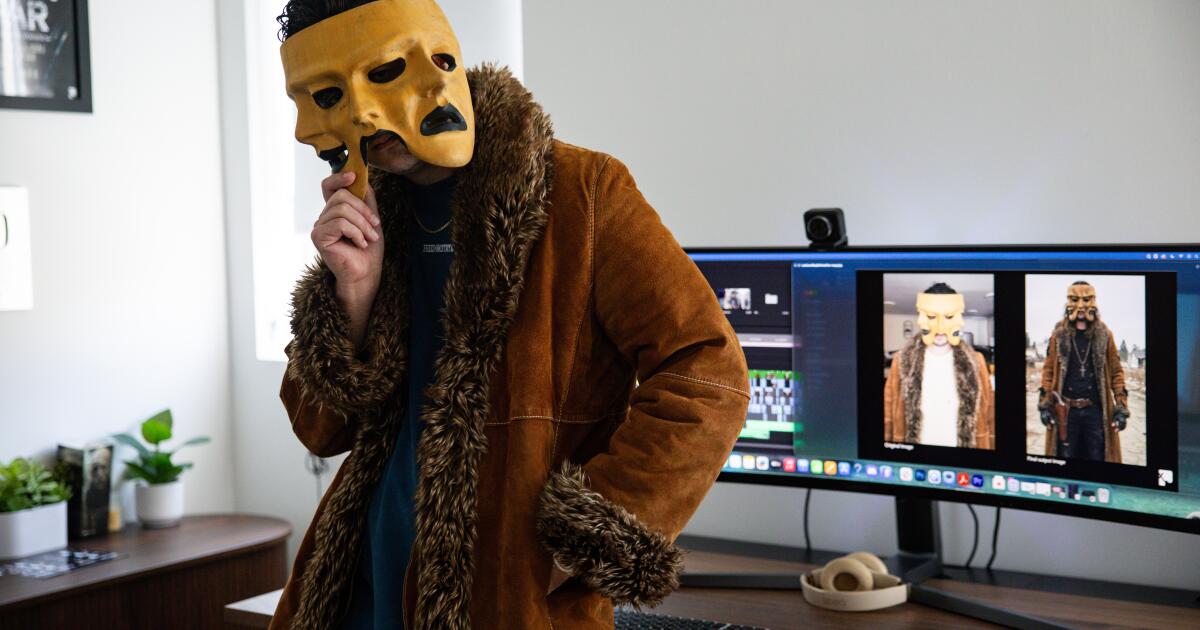
China-backed AI tool behind fake Brad Pitt fight making Hollywood inroads

