Business
Election deepfakes and high-profile bankruptcies: Here's what AI will bring in 2024


If 2023 was the year that AI finally broke into the mainstream, 2024 could be the year it gets fully enmeshed in our lives — or the year the bubble bursts.
But whatever happens, the stage is set for another whirlwind 12 months, coming in the wake of Hollywood’s labor backlash against automation; the rise of consumer chatbots, including OpenAI’s GPT-4 and Elon Musk’s Grok; a half-baked coup against Sam Altman; early inklings of a regulatory crackdown; and, of course, that viral deepfake of Pope Francis in a puffer jacket.
To gauge what we should expect in the new year, The Times asked a slate of experts and stakeholders to send in their 2024 artificial intelligence predictions. The results alternated between enthusiasm, curiosity and skepticism — an appropriate mix of sentiments for a technology that remains both polarizing and unpredictable.
Regulators will step in, and not everyone will be happy about it.
When a surgeon or a stockbroker goes to work, they do so with the backing of a license or certification. Could 2024 be the year we start holding AI to the same standard?
“In the next year, we may require AI systems to get a professional license,” said Amy Webb, chief executive of the Future Today Institute, a consulting firm. “While certain fields require professional licenses for humans, so far algorithms get to operate without passing a standardized test. You wouldn’t want to see a urologist for surgery who didn’t have a medical license in good standing, right?”
It’d be a development in line with political changes over the last few months, which saw several efforts to more conscientiously regulate this powerful new technology, including a sweeping executive order from President Biden and a draft Senate policy aimed at reining in deepfakes.
“I’m particularly concerned about the potential impact [generative AI] could have on our democracy and institutions in the run-up to November’s elections,” Sen. Chris Coons (D-Del.), who co-sponsored the deepfakes draft, said of the coming year. “Creators, experts and the public are calling for federal safeguards to outline clear policies around the use of generative AI, and it’s imperative that Congress do so.”
Regulation isn’t just a domestic concern, either. Justin Hughes, a professor of intellectual property and trade law at Loyola Law School, said he expects the European Union will finalize its AI Act next year, triggering a 24-month countdown for broad AI regulations in the EU. Those would include transparency and governance requirements, Hughes said, but also bans on dangerous uses of AI such as to infer someone’s ethnicity and sexual orientation or manipulate their behavior. And as with many European regulations, the effects could trickle down to American firms.
Yet the rising calls for guardrails have already triggered a backlash. In particular, a movement known as effective accelerationism — or “e/acc” — has picked up steam by calling for rapid innovation with limited political oversight.
Julie Fredrickson, a tech investor aligned with the e/acc movement, said she envisions the new year bringing further tensions around regulation.
“The biggest challenge we will encounter is that using [tools that] compute IS speech and that raises critical constitutional issues here in the United States that any regulatory framework will need to deal with,” Fredrickson said. “The public must make our government understand that it cannot make trade-offs restricting our fundamental rights like speech.”
Authenticity will grow more important than ever.
Imagine being able to know with certainty whether that vacation photo your friend just posted on Instagram was taken in real life or generated on a server farm somewhere.
Mike Gioia, co-founder of the AI workflow startup Pickaxe, thinks it might soon be possible. Specifically, he predicts Apple will launch a “Photographed on iPhone” stamp next year that would certify AI-free photos.
Other experts agree that efforts to bolster trust and authenticity will only grow more important as AI floods the internet with synthetic text, photos and videos (not to mention bots aimed at imitating real people). Andy Parsons, senior director of Adobe’s Content Authenticity Initiative, said he anticipates the increased adoption of “Content Credentials,” or metadata embedded in digital media files that, almost like a nutrition label, would record who made something and with what tools.
Such stopgaps could prove particularly important as America enters a presidential election year — its first in history that will take place amid a torrent of cheap, viral AI media.
Bill Burton, former deputy press secretary for the Obama administration, predicted: “The most viewed and engaged videos in the 2024 election are generated by AI.”
The steam engine of innovation will keep chugging along …
Last year brought substantial advances in AI technology, from the launch of mainstream products — ChatGPT, deemed the fastest-growing consumer app in history, released its fourth version — to continued breakthroughs in AI research and development.
Many AI insiders think that pace of innovation will continue into the new year.
“Every business and consumer app user will be using AI and they won’t know it,” said Ted Ross, general manager of the City of Los Angeles Information Technology Agency. “I predict that artificial intelligence features and high-visibility [generative] AI platforms, such as ChatGPT, will rapidly integrate into existing business and consumer applications with the user often unaware.”
Other developments could be more niche but no less impactful. Some experts predict a rise in leaner and more targeted alternatives to the “large language models” that underlie ChatGPT and Grok. The AI itself could get better at self-improvement, too.
“There hasn’t been a lot of tooling that targets speeding up AI research,” said Anastasis Germanidis, chief technology officer of the synthetic video startup Runway. “We’ll likely see more of those tools emerge in the coming year,” including to help write or debug code.
… Unless the bubble bursts.
The AI market is frothy right now, but not everyone thinks the glory days can last.
“A hyped AI company will go bankrupt or get acquired for a ridiculously low price” at some point in 2024, Clément Delangue, chief executive of the open source AI development community Hugging Face, wrote in a recent tweet.
Eric Siegel, a former Columbia University professor and the author of “The AI Playbook: Mastering the Rare Art of Machine Learning Deployment,” has struck an even warier tone.
“There will be growing consternation as the lack of a killer [generative] AI app becomes increasingly apparent,” Siegel told The Times, referencing an app that would drive widespread adoption of AI. “Disillusionment will ultimately set in as today’s grandiose expectations fail to be met.”
Eventually, he warned, we could even enter an “AI Winter,” or a period of declining interest — and investment — in the technology.
But that is probably still a few years away, he added: “The current ‘craze’ has built incredible momentum, and that momentum will continue to be fueled as new impressive-looking and potentially valuable capabilities continue to pop up.”
Even the skeptics, it seems, anticipate a banner year for AI.



Dear Mr. Pelley:
I meant what I said in my letter last week to the 60 Minutes team: joining 60 Minutes is the honor of my career and I am grateful to be working alongside the people who have contributed to the most important television journalism brand this country has ever produced. While I’m new to 60 Minutes, I’ve devoted my career to investigative journalism and storytelling. I started this job excited to collaborate and to benefit from the wisdom and experience of the 60 Minutes veterans, with you among them. For that reason, one of the first things I did in my new role was call you to talk and invite you to dinner. It is a profound disappointment that you rejected that overture and chose ambush instead. Yesterday, you hijacked my first meeting with staff to disparage me, my qualifications, and my intentions with remarkable incivility and contempt. I welcome a diversity of viewpoints and respectful debate among the team, but this was nothing of the sort. Yesterday’s performative display of hostility enacted in front of the staff instead of in a civil, private conversation-demonstrated that you have no interest in contributing to the future success of the show, or approaching my new tenure with a mind open to collaboration and progress. I am here to deliver first-in-class news programming, not to make headlines about newsroom drama. I am eager to work alongside those who share this goal.
Despite yesterday’s misconduct, I had hoped that in sitting down with you today we could find a path forward together. You made clear that you are not interested in such a path.
Your antipathy to the future of the show has come through loud and clear. And I have heard you. I therefore write on behalf of CBS News, Inc. (“CBS”) to inform you that your employment with CBS is terminated for cause effective immediately. Enclosed is your formal termination letter.
Sincerely,
Nick Bilton
Executive Producer, 60 Minutes

The co-founder of Aspiration, Joseph Sanberg, was sentenced to 14 years in prison on Monday after defrauding investors and lenders of over $248 million.
The startup, an eco-friendly digital banking company boasting fossil fuel-free investments, carbon offsets for gas purchases, and a debit card with cash-back benefits for shopping at clean companies, was founded by Sanberg and Andrei Cherny. Cherny left the company in 2022 and has not been charged.
Sanberg, an Orange County native, pleaded guilty to wire fraud in October after being arrested in March last year. Aspiration subsequently filed for bankruptcy and liquidated all of its assets by July.
Sanberg and venture capitalist Ibrahim AlHusseini, who also faces charges, together forged a series of bank statements in order to obtain loans. From 2020 to 2021, the pair forged AlHusseini’s bank statements to show millions of dollars in assets in order to obtain millions of dollars from lenders.
Additionally, they forged a letter from their audit committee stating that $250 million in funds were available, when in reality Aspiration had less than $1 million. The amount of loans defrauded exceeded $248 million.
In 2021, Sanberg artificially inflated Aspiration’s 2021 revenue by $44 million by recruiting 27 fake customers to sign letters of intent pledging tens of thousands of dollars per month for tree planting services. Sanberg himself funded the contracts and used the inflated revenue numbers to obtain more loans.
The charges sparked an NBA investigation into salary cap allegations due to Aspiration’s connections with Clippers owner Steve Ballmer.
Ballmer personally invested $60 million in Aspiration, all of which was lost. He is now the target of a civil lawsuit alleging his participation in the scheme. Ballmer denies the allegations.
The team announced a $300-million sponsorship deal with Aspiration, and Clippers player Kawhi Leonard signed a four-year, $28-million marketing contract with the company, which reportedly performed no duties. The issue has raised concerns about how players are circumventing the NBA’s salary cap.
The team lost the $300-million sponsorship deal and an additional $20 million paid for carbon offset purchases.
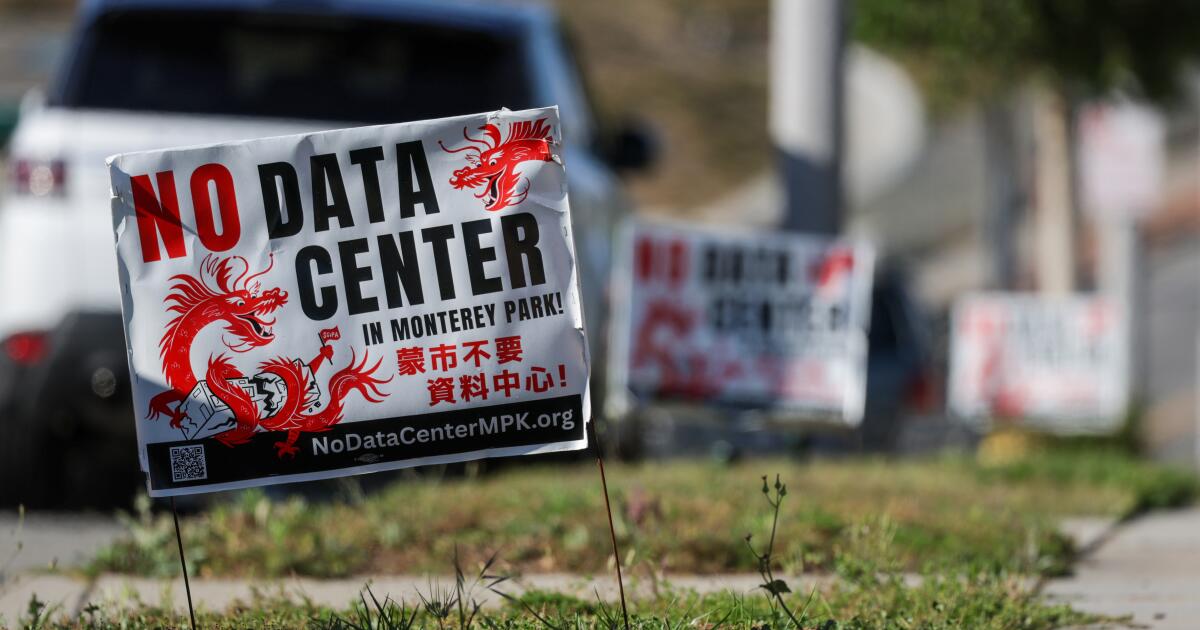
Residents in the city of Monterey Park will be the first in the nation to vote on a permanent ban on data centers Tuesday.
If approved, Measure NDC would prohibit data centers within the city limits and could only be overturned by another vote.
Yard signs saying “No Data Center” in English and Chinese with images of dragons line sidewalks in the San Gabriel Valley city.
As a wave of data center opposition sweeps the country, numerous towns and counties across the U.S. have instituted temporary moratoria and other restrictions on the facilities. But only a handful have instituted indefinite bans, and just four other towns have sent related matters to the ballot.
Supporters are hoping the vote will set a precedent for the rest of the region, where residents are fighting proposals in Vernon and City of Industry.
“This is about as permanent a ban as we can get,” said Steven Kung, co-founder of the group No Data Center Monterey Park. “Winning Measure NDC would send a huge message to the rest of the San Gabriel Valley about how residents don’t want data centers.”
The ballot measure emerged from the fight against a 247,000-square-foot center proposed in 2024 by the Australian-owned investment firm HMC StratCap for a residential area in Monterey Park.
The facility would have sat less than 500 feet away from the nearest home and used three times the electricity of the 60,000-person, predominantly Asian American city.
While the developer touted the potential for jobs and tax revenue, residents expressed concerns about noise and air pollution, rising electricity rates and a potential to lower property values.
The company pulled its plans in late March following public outcry and a March 4 city council vote to extend a temporary data center moratorium and place a ban on Tuesday’s ballot.
In a letter to the city council, HMC StratCap said it would pursue a different use for the land and would not engage in a ballot measure fight.
The city council later banned data centers indefinitely, the first in California to do so, said Mayor Elizabeth Yang. But she’s still been out campaigning for the measure with all four other council members.
“If a council puts in an ordinance, a future council can reverse it too,” said Yang. “With the ballot measure, unbanning it is a lot harder because you need the entire city to vote on it.”
The measure proposes the ban “to protect air quality, drinking water resources, and public health” and “prevent impacts to electricity and water rates.”
While California places third in the country for existing data centers with about 300 facilities, it hasn’t been a hot spot in the recent AI-driven data center boom. High electricity rates, expensive land and regulatory hurdles mean that fewer, and smaller, facilities are currently planned than in Virginia, Texas, Georgia, Illinois or Arizona.
“Most of California’s data centers are small by today’s standards,” said Shaolei Ren, an engineering professor at UC Riverside who studies how to reduce the environmental impacts of data centers. “Ten years ago, they would be medium-sized, but the power demand for new AI data centers has increased a lot.”
The average operating data center demands 45 megawatts, according to the Washington Post, while the average planned one would draw 430 MW. The one proposed for Monterey Park would have required about 50 MW at peak demand.
As proposals crop up in SoCal, they’re met with fierce opposition. Montebello, El Monte and Baldwin Park have all enacted temporary moratoria, and Alhambra recently banned data centers as part of a zoning code update. City of Industry, Vernon, City of Commerce and Santa Fe Springs are moving in the other direction, trying to court developers and streamline data center approvals. Community groups are fighting that.
Outside the San Gabriel Valley, residents of Coachella and Imperial County are showing up in droves to protest local proposals.
Matthew Shaw, a volunteer with the Coalition for Responsible Data Center Development, who recently published a report on opposition to AI data centers, said a vote to ban them in Monterey Park “would lead to copycats, partially because so many groups are just opposed to any data center development at all.”
While there is no formal opposition to Measure NDC, some building trades like Ironworker Local 433 supported the Monterey Park data center when it was still live before city council. Those in the data center industry are lamenting the state of public opinion.
“These are multi-billion-dollar assets that are built by multi-trillion-dollar companies. These things will get done,” said Mehdi Paryavi, chairman of the International Data Center Authority. “My biggest problem is that our industry does not invest enough in community engagement.”
Paryavi said towns that seek to limit data centers are missing out on thousands of jobs generated by data center construction, operations and customers, as well as faster artificial intelligence speeds and better performance.
Kung said local community organizers are “looking at the empirical evidence” and seeing a ban as a win.
“We’ve never seen a city that embraces a data center and is like, ‘Look how our quality of life has increased, look how all the revenue has gone into citywide improvements,’” he said. “That just doesn’t exist.”
-
Tennessee8 seconds ago
TN Lottery Mega Millions, Cash 3 Morning winning numbers for June 2, 2026
-

 Texas5 minutes ago
3 things to watch as Texas, Texas Tech begin Women's College World Series Final
-

 Utah12 minutes ago
Three-star OL Sire Stewart commits to Utah – KSL Sports
-
Vermont15 minutes ago
VT Lottery Mega Millions, Gimme 5 results for June 2, 2026
-

 Virginia20 minutes ago
Virginia Lottery Mega Millions, Pick 3 Night results for June 2, 2026
-

 Wisconsin30 minutes ago
Wisconsin Lottery Mega Millions, Pick 3 results for June 2, 2026
-

 West Virginia35 minutes ago
West Virginia Virtual Academy celebrates second graduating class
-
 Wyoming42 minutes ago
Wyoming mountain bike hotspot Curt Gowdy wants to know how it can improve

