Wyoming
Wyoming History: Casper Double-Murderer Shot Down By Sheriff In…


CASPER — Big, bold headlines and at least seven front-stories in the Casper Daily Tribune tell the tale of the day in 1924 a cloud of evil “unspeakably shocked” and “profoundly grieved” the Oil City.
A well-known and well-connected businessman gunned down his 10-year-old son and pretty wife, dumped their bodies in the North Platte River and headed east to Douglas. There, he was confronted by a familiar face in a hotel corridor during the early morning hours of a Sunday 100 years ago.
Following an exchange of gunfire, the Converse County sheriff walked away alive and the businessman, Fred Van Gorden, was dead.
“It is difficult for those who knew the affable Fred Van Gorden in life to realize that he committed the act that he did,” the Casper Daily Tribune editorialized March 17, 1924, two days after his gruesome crimes. “Were he in possession of his reason, we all know he would not have done it.
“It is not charity to the dead to believe he was temporarily insane, it is simply believing the truth. … Fred Van Gorden was in no manner so deeply involved that he could not have been saved by friends, had they but known.”
A Casper real estate and insurance agent, Van Gorden appeared to be the guy you wanted to know. He served on the Casper City Council, was an upstanding member of the First Presbyterian Church, a Mason and member of the Kiwanis Club.
Fred was married to Pearl. They had grown up in the same town in Iowa, married, moved to Nebraska, where they had a son, Arthur.
Arrival In Wyoming
In 1914, the couple moved to Douglas and lived there for a year.
During their time there, they likely came to know Albert “Al” Peyton, who had served a term as sheriff from 1912-1913, and in 1914 was operating a grocery store.
In 1915, the young family headed west to Casper and Fred Van Gorden got a job at the Golden Rule Store, which sold clothing. He later worked for Webel Commercial Co. and was in charge of the ladies’ department. When the company sold out, Van Gorden started his own company in May 1921.
His first office was in the Daily Tribune’s basement, then he moved to an office at the Rialto Theater. He specialized in real estate transactions, bond selling and insurance.
In 1924, the couple lived in a new house they recently had built on a city lot at 412 S. Grant St. Their previous little home sat in the back part of their lot. Arthur had a collie dog.
They were living the American dream.
Van Gorden was active in his church. He was listed as a contact for men who wanted to know more about a “brotherhood class” at the church, according to a Jan. 20, 1924, article in the Casper Sunday Tribune. Van Gorden also appeared in the paper the previous year on April 29, as a captain of the church’s building fund.
Sheriff, Again
Meanwhile in Douglas, the former grocer Peyton had run for sheriff again in 1922 and was elected.
He was well-known for helping people in the community and trying to keep a lid on the illegal activity surrounding the Prohibition era. A biography written by his wife and published in “Pages From Converse County’s Past” recall how he was involved in several raids and received a written commendation from the town council in Lost Springs for putting two stills out of business.
Peyton would also lead efforts to find the victims of the Cole Creek train wreck in late September 1923, spending a week scouring the North Platte River for bodies, several of them friends. He caught pneumonia for his efforts.
But appearances can be deceiving.
Van Gorden, 42, saw his financial debts and woes closing in by March 1924.
Friends told the Daily Tribune that his mortgage was beyond his means, and it was known in the community that his business was not thriving. Van Gorden had told his wife the house was paid for, but in reality he had a mortgage of $5,400, friends told the newspaper.
At Van Gorden’s business, he had received $6,100 from Casper businessman R.J. Fuchs to invest in first mortgages. According to the Daily Star Tribune, Van Gorden faked signatures on mortgages that represented $4,122 of Fuchs’ investment.
Fuchs discovered the forgeries and his attorneys gave Van Gorden an opportunity to make good on the money without ruining him in the community.
Meanwhile, the paper reported Van Gorden also owed $2,500 to insurance companies and had been threatened with a March 15 deadline for payment or a warrant for his arrest on suspicion of embezzlement would be issued.
Van Gorden had told Fuchs earlier March 15 at a meeting that he had raised the money to make his forgeries good. He asked Fuchs for a few more hours to get him the money.
Van Gorden had allegedly asked other creditors as well to meet him in his Rialto Theater office at 4 p.m. on that Saturday.
Evil Manifests
Instead, late that afternoon at his 412 S. Grant St. residence, Van Gorden called to his son, Arthur, who was outside playing with his dog.
Van Gorden asked Arthur to come down into the basement. As the son looked to his father, Van Gorden lifted up a .45-caliber revolver and shot Arthur once in the head and once in the heart.
Van Gorden also shot and killed the dog, likely to keep it from barking at the loss of its master.
About 6, Pearl came home from a women’s group meeting, probably driving into the garage. She also was called down to the basement.
Evidence there would later show she was shot in the head. The bullet passed through and a fragment ended up in a hallway that was found by law enforcement.
In the basement, Van Gorden tried to clean up the blood stains, wrapped his wife’s body in a man’s overcoat and tried to fit the bodies into the back of his Chevrolet sedan. He drove out of the garage, closed the door from the inside leaving blood-stained fingerprints.
As he drove away, a neighbor would later told police she thought she saw Pearl Van Gorden sitting in the back seat and wondered if the couple had an argument.
Prior to leaving the house, a desperate man had penned a series of notes.
“Van Gorden wrote a brief note to W.B. Cobb, his attorney, saying he ‘could not stand the gaff any longer and asked him to settle his affairs,’” the Daily Tribune reported March 17, 1924. The note was marked “special delivery.” It was dropped off at the post office shortly before 7 p.m.
A note to an insurance adjuster in Denver asked him to take over Van Gorden’s business.
Disposing Of The Bodies
After driving down the Yellowstone Highway, he turned off on the road that led to the city dump and a recently constructed North Platte River bridge.
He dumped the bodies in frigid waters, leaving blood stains on the bridge. Van Gorden then drove to Douglas.
Meanwhile, the special delivery note arrived for attorney Cobb at about 9 p.m. Cobb alerted police, thinking his client was planning to kill himself.
Casper Police and Natrona County deputies discovered the apparent murder scene in the basement. Blood spray was on walls, boys’ overshoes clotted blood, and the ashes of burned clothing in the basement furnace.
They also found a bed stripped of sheets and a holster hanging on the wall without a pistol in it. Bloody keys were found in a box outside the garage door.
A notice was put out for police to be on the lookout for Van Gorden’s Chevrolet.
Van Gorden arrived in Douglas about 12:45 a.m. and parked his car at the Overland garage. He told an attendant he would pick it up at 6 a.m.
“The garage attendant noticed that there was blood all over the car and that the rear cushion has been removed,” the Casper Sunday Tribune reported March 16, 1924. “He notified the sheriff who took charge of the matter at once.”
The Natrona County Sheriff had notified Peyton that Van Gorden might be headed his way.
The Confrontation
The Douglas County Budget reported March 18, 1924, that Van Gorden registered at the Labonte Hotel under an assumed name.
News accounts relate Peyton had checked boarding houses throughout the town, and when he ascertained Van Gorden was at the hotel, the sheriff took a room next to him. When the murderer stepped out into the hall at 3 a.m., Peyton opened his door and ordered Van Gorden to surrender.
“Van Gorden fired at Peyton and missed, and a bullet from Peyton’s gun dropped Van Gorden,” the Budget reported. “Van Gorden was well-known in Douglas, having been employed here several years ago.”
Peyton’s wife wrote in her family’s biography that at 5 a.m. that morning she received a call that there had been a shooting. She was terrified her husband had been shot.
“It was seven o’clock before the family discovered that Al had killed Fred Van Gorden, who had murdered his wife and son in Casper,” Lena Peyton wrote. “Van Gorden was a Camp Perry marksman who fired first; AI thought that it was a miracle that he had survived. AI did not like to kill anything and the shock of the shootout in the LaBonte Hotel caused him much suffering.”
Meanwhile, Natrona County authorities had searched gullies and bridges for bodies and stopped at 2 a.m. on Sunday. They resumed later that morning and discovered the blood-stained bridge and, using grappling hooks, recovered both Pearl and Arthur Van Gorden’s bodies.
Funerals for Van Gorden’s wife and son were held Tuesday, March 18, 1924, at First Presbyterian Church. Their bodies were put on an afternoon train and sent to Greenfield, Iowa, for burial.
The murderer’s body was placed on the same train when it reached Douglas and was sent with them. Funerals for the family were held in Iowa.
The Casper Daily Tribune would again editorialize on Van Gorden in its Wednesday, March 19, 1924, edition. The tone of the editorial was less sympathetic.
“There is a lesson imparted in the Van Gorden tragedy, old as time. … It has to do with honesty and uprightness in daily transactions,” the editor wrote. “Had Fred Van Gorden adhered to his earlier training and not wandered off into the unfamiliar field of double-dealing, there would be a more cheerful story to tell today. When he ceased to be square, his troubles multiplied, and climaxed in horrible tragedy.”
Dale Killingbeck can be reached at dale@cowboystatedaily.com.

Wyoming
Wyoming Cultural Trust Fund awards $529K in grants, including several Fremont County projects


CHEYENNE, Wyo. — Wyoming is a state known for cowboys, rodeos, and beautiful plains, but is also known for being the first territory to grant women the right to vote, something historian Jennifer Helton explored in her Suffrage Stories presentation.
Helton was invited to highlight Wyoming’s remarkable role in the fight for women’s suffrage as part of the museum’s special America 250 Discover & Discuss series on Jun 18, but the recorded version was just released. This is a part of Cheyenne Frontier Days Old West Museum’s goal of exploring Cheyenne and the greater state of Wyoming’s history.
Helton’s presentation not only celebrates Wyoming’s role in suffrage, but also how the state’s pioneering women helped shape the future of voting rights across the nation.
Born and raised in Wyoming, Jennifer Helton left the state at age 18 to attend college, “which left a giant, Wyoming-sized hole in my heart,” Helton said, “and the way that I fill that hole is by conducting research on women’s suffrage.”
Upon realizing that most people outside of the state of Wyoming did not know the West’s progressive role in suffrage, she became obsessed with bridging this knowledge gap and researching the history of suffrage.
“My kids would tell you it’s an obsession, not just an interest or a hobby,” Helton said. “They always joke that I have three kids, the two of them and then Esther Morris.”
During her presentation, Helton’s admiration for Esther Morris was apparent due to her trailblazing nature as suffragist, her courage to stand up to torch-bearing mobs, and abolitionist activities.
Interestingly enough, her sons were also instrumental in shaping Wyoming’s history. E.A. Slack is known as the “Father of Frontier Days” and citizens of Wyoming can thank Robert C. Morris for Cheyenne’s public library, as he brought the Carnegie Public Library System to Wyoming.
.
” data-large-file=”https://i0.wp.com/capcity.news/wp-content/uploads/2026/06/image-2.png?fit=780%2C863&ssl=1″ alt=”” class=”wp-image-170117″ style=”aspect-ratio:0.90332473687879;width:464px;height:auto” srcset=”https://i0.wp.com/capcity.news/wp-content/uploads/2026/06/image-2.png?resize=925%2C1024&ssl=1 925w, https://i0.wp.com/capcity.news/wp-content/uploads/2026/06/image-2.png?resize=271%2C300&ssl=1 271w, https://i0.wp.com/capcity.news/wp-content/uploads/2026/06/image-2.png?resize=768%2C850&ssl=1 768w, https://i0.wp.com/capcity.news/wp-content/uploads/2026/06/image-2.png?resize=780%2C864&ssl=1 780w, https://i0.wp.com/capcity.news/wp-content/uploads/2026/06/image-2.png?resize=400%2C443&ssl=1 400w, https://i0.wp.com/capcity.news/wp-content/uploads/2026/06/image-2.png?resize=706%2C782&ssl=1 706w, https://i0.wp.com/capcity.news/wp-content/uploads/2026/06/image-2.png?w=960&ssl=1 960w, https://i0.wp.com/capcity.news/wp-content/uploads/2026/06/image-2-925×1024.png?w=370&ssl=1 370w” sizes=”auto, (max-width: 780px) 100vw, 780px”/><figcaption class=) Photo of Esther Morris, the first female justice of the peace (Cheyenne Frontier Days Old West Museum). Credit: Cheyenne Frontier Days Old West Museum (Jennifer Helton Presentation) / Cheyenne Frontier Days Old West Museum
Photo of Esther Morris, the first female justice of the peace (Cheyenne Frontier Days Old West Museum). Credit: Cheyenne Frontier Days Old West Museum (Jennifer Helton Presentation) / Cheyenne Frontier Days Old West Museum
Throughout the course of her presentation, Helton revealed the results of her research by tracing the course of American history in order to highlight the intersection between Wyoming, women, and winning the right to vote.
The talk also highlighted incredible Black women such as Lucy Phillips and Nancy Phillips, some of the first Black women to vote.
As America celebrates its 250th anniversary, the museum invites visitors to explore the stories of trailblazers like the nation’s first woman justice of the peace Esther Morris, the first woman governor, the first Black women to vote, and many other extraordinary leaders who made history.
The museum is hosting its special America 250 exhibit and allows visitors to discover the stories, artifacts, and moments that connect the community to the nation’s history. The exhibit even features six U.S. presidents who visited Cheyenne or Cheyenne Frontier Days, and is currently running at the museum. For those who cannot attend, lectures such as this are filmed and provided online.
As Helton closed her lecture, she read the words of Esther Morris, “I say do all the good you can while you do live.”
“Because women like Esther Morris, like Theresa Jenkins, had the courage to stand up and do all the good that they could in their lives we are all able to live the lives that we are living today,” Helton said.
“So, we should be grateful to them, and I think we should also be asking ourselves what is it that we need to be doing so that future generations can preserve the same opportunities we have, and perhaps more.”
Watch Jennifer Helton’s full presentation at the link provided here.
To learn more about historian Jennifer Helton visit jenniferhelton.org.
.
” data-large-file=”https://i0.wp.com/capcity.news/wp-content/uploads/2026/06/image-3.png?fit=780%2C519&ssl=1″ alt=”” class=”wp-image-170141″ srcset=”https://i0.wp.com/capcity.news/wp-content/uploads/2026/06/image-3.png?resize=1024%2C681&ssl=1 1024w, https://i0.wp.com/capcity.news/wp-content/uploads/2026/06/image-3.png?resize=300%2C200&ssl=1 300w, https://i0.wp.com/capcity.news/wp-content/uploads/2026/06/image-3.png?resize=768%2C511&ssl=1 768w, https://i0.wp.com/capcity.news/wp-content/uploads/2026/06/image-3.png?resize=1536%2C1022&ssl=1 1536w, https://i0.wp.com/capcity.news/wp-content/uploads/2026/06/image-3.png?resize=1200%2C799&ssl=1 1200w, https://i0.wp.com/capcity.news/wp-content/uploads/2026/06/image-3.png?resize=780%2C519&ssl=1 780w, https://i0.wp.com/capcity.news/wp-content/uploads/2026/06/image-3.png?resize=400%2C266&ssl=1 400w, https://i0.wp.com/capcity.news/wp-content/uploads/2026/06/image-3.png?resize=706%2C470&ssl=1 706w, https://i0.wp.com/capcity.news/wp-content/uploads/2026/06/image-3.png?w=1605&ssl=1 1605w, https://i0.wp.com/capcity.news/wp-content/uploads/2026/06/image-3-1024×681.png?w=370&ssl=1 370w” sizes=”auto, (max-width: 780px) 100vw, 780px”/><figcaption class=) Jennifer Helton’s information (Cheyenne Frontier Days Old West Museum).
Jennifer Helton’s information (Cheyenne Frontier Days Old West Museum).
Related
Wyoming
At 6,000-year-old crossing, Gov. Gordon OKs Wyoming’s first-ever designated pronghorn migration route – WyoFile

SUBLETTE COUNTY—Gov. Mark Gordon heralded Wyoming’s first-ever designation to protect a pronghorn migration corridor — a more than 2 million-acre web of habitat — at Trapper’s Point, which he called a “wonderful passageway.”
“How incredibly valuable it is that you are standing here today,” Gordon told the crowd, “to witness this remarkable moment.”
Gordon commemorated the moment with his feet planted on the narrow bulge of high country that splits the Green and New Fork rivers. Thousands of years ago, the site was a well-used hunting ground for Native Americans — it’s the earliest known killing and processing site for pronghorn in North America. Now it boasts a wildlife overpass.
No pronghorn were to be seen during the especially windy Friday afternoon gathering, which attracted 75 attendees from nearby Pinedale and other western Wyoming communities.
Now Trapper’s Point is officially classified as a “bottleneck” for the Sublette Pronghorn Herd — one of 13 such bottlenecks. That classification is supposed to prevent any surface-disturbing activity, with the intent that pronghorn can keep passing through Trapper’s Point for generations to come.

Protecting the ability of the fleet-footed, tawny-and-white ungulates to migrate is a “key factor” in sustaining their population, Wyoming Game and Fish Director Angi Bruce said.
“This becomes even more important in severe winters or extreme droughts,” Bruce said. “Pronghorn are long overdue for recognition.”
Pronghorn in Sublette, Teton, Sweetwater and Lincoln counties travel a long road — some migrate more than 200 miles to escape harsh winters, trekking south into the lower Green River Basin, a semi-arid sweep of sagebrush steppe between Pinedale and Rock Springs. Then in the spring, they retrace those paths, returning to summer ranges, lush with verdant vegetation, even going as far as Grand Teton National Park.
There was also a long road of bureaucracy to get to this point.
Nearly three decades of effort preceded the formal designation of the migration routes used by the Sublette Pronghorn Herd, which is the farthest-traveling and among the largest pronghorn herds in the West.
Jackson Hole biologists long knew that the valley’s pronghorn left in the winter. But details were hazy on where they went and how they got there until around the turn of the century. Using data from tracking collars, biologists like Joel Berger, Steve Cain, Hall Sawyer and Doug Brimeyer helped delineate the route.

In 2008, a Bridger-Teton National Forest plan amendment established a portion of the path as the nation’s first designated wildlife migration corridor.
Popularized by its branding as the “Path of the Pronghorn,” the route has received press in national publications like High Country News and the New York Times.
But the southern reaches of the migration through the energy-rich Green River Basin have faced major political opposition since the early 2000s. Wyoming first attempted to protect those travel corridors in 2019, under a policy administered by the Wyoming Game and Fish Department. That effort was halted after a coalition of industry trade groups and counties protested.
Then, in early 2020, Gordon revamped the migration policy with an executive order. Still, the Sublette Pronghorn Herd proposal gathered dust, even as development threatened the route.
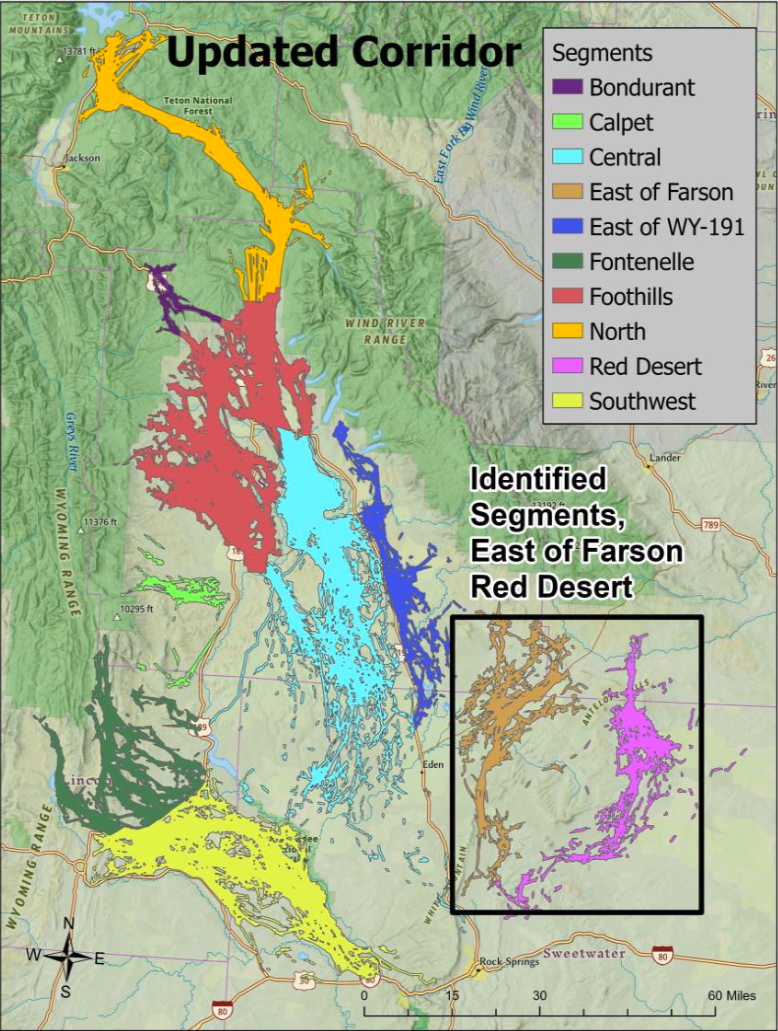
Game and Fish revived efforts to protect the migration in late 2023 and early 2024. Biologists pulled together one of North America’s most comprehensive migration datasets, benefiting from approximately two decades of GPS collar information collected from more than 400 pronghorn.
Some controversy followed the process until near the end. There was a debate about whether to designate the migration’s two easternmost segments, in the Red Desert and east of Farson. The Game and Fish Department proposed excluding the routes, but was overridden by its commission. Then Gordon upended that decision, excluding the two segments.
Vetting the migration corridor through a Gordon-appointed working group was the second-to-last step in the designation process.
“Today’s designation demonstrates that voluntary, locally driven conservation works,” said Robb Slaughter, who chaired the group, during the commemoration at Trapper’s Point.
Time will tell if that’s the case. Wyoming’s migration policy is, by design, permissive of development. Private land is exempt from protections, and designation is not an assurance that new stressors won’t be added to the landscape.

“Today is not the end of the process,” Slaughter said. “It’s the beginning of the next chapter. Continued monitoring, adaptive management, research, and cooperation will ensure these recommendations remain effective as conditions change.”
But Friday was the end of the migration designation process. The governor’s informal OK — no signature was needed — was the last step, said Sara DiRienzo, the governor’s deputy policy advisor.
Wildlife advocates celebrated the moment.
“This is historical,” Bruce said. It’s the first effort to protect the full length of a pronghorn migration corridor in the nation, she said.
-
 Politics1 minute ago
Asylum seekers may be turned away at the southern border, Supreme Court rules
-
 Sports11 minutes ago
Kyle Tucker and Dalton Rushing rebound with consecutive homers, Dodgers rout Padres
-

 World23 minutes ago
Serbian Vučić says he will resign in weeks and calls early elections
-

 News46 minutes ago
Trump-backed Rep. Julia Letlow wins Louisiana Senate primary runoff
-

 New York2 hours ago
Metropolitan Diary Challenge Day 1: What Is Your N.Y. Story?
-

 Los Angeles, Ca2 hours ago
LASD releases video of man shot by deputy after allegedly charging them with knife
-

 Detroit, MI2 hours ago
Rick Mahorn returns to coaching Detroit basketball with BIG3 Amps
-

 San Francisco, CA3 hours ago
Suspect arrested after shooting near San Francisco Pride events, police say

