Wyoming
‘Carried by runner’ — Wyoming’s outsized role in the first American ascents on Everest – WyoFile


The American climbers sent the bad news the fastest way they could. In this instance 62 years ago today, it was “carried by runner.”
From Everest’s basecamp, where the mountaineers were preparing to climb the world’s highest peak, a Nepali courier set off at a trot. He carried a message as he wended his way across the fractured detritus below the Khumbu Glacier. His calloused feet padded down the shadowed valley where gravity and time wear the mountain’s granite, gneiss and limestone.
He ran down trails worn smooth by a million soles, following the Lobuche Kosi and Imja Kosi rivers that mill boulders into flour. He jogged by mani stones, past rope bridges, loped by the storied Sherpa villages of Lobuche, Pheriche and Dingboche.
In about 15 miles, the messenger climbed out of the shadows to the hillside hamlet of Tengboche, a holy crossroads between Nepal’s capital Kathmandu and Qomolangma, Sagarmatha — Everest. As the courier arrived, Jackson Hole alpinist David Dornan was inhaling the clear Himalayan air, perhaps scented by a Sherpa’s yak-dung fire or incense drifting from the Tengboche Monastery.
Dornan was on an expedition to the Sherpa homeland, an expedition separate from the American climbers’. He was building a school and waterworks with Sir Edmund Hillary who, with Tenzing Norgay, had been the first to climb Everest 10 years earlier in 1953.
But seven of the 19 Americans who were just up-valley from Tengboche had worked professionally in Wyoming’s Teton Range. That was Jackson Hole native Dornan’s back yard, and Dornan knew and had worked with a bunch of them.
“I instinctively knew that it was Jake.”
David Dornan
The messenger arrived apace at Tengboche, an ethereal world ornamented with Tibetan totems, a world almost touching the heavens. Here temple lions with the eyes of God guard the monastery entrance. A golden spire juts from a bedazzling white stupa. Dozens of prayer flags flutter in the breeze. Inside the lamasery, saffron-robed monks and devotees spin prayer wheels that hold scrolls of Tibetan-script mantras.
In this rare aura, Dornan scanned the top of the world.
“It was a clear, beautiful day, and I was just totally absorbed looking at the mountains and being where I was,” Dornan said. Then came the runner’s dispatch.
“An American had been killed.”
Which American?
But which American?
There were 19. Seven of them had climbed professionally in the Tetons, as had Dornan, a mountain guide with the Exum guide service.
Was it a Teton veteran? Was it Barry Corbet, the handsome Dartmouth dropout and skier; Willi Unsoeld, the gregarious Peace Corps volunteer who would sprout a national forest of a beard, or Jake Breitenbach, the tow-headed mountaineer who wore his alpine beanie at a rakish angle?
Could it be Dick Pownall, or David Dingman, two more of Dornan’s fellow Exum guides from the Tetons? It could be Richard Emerson, Grand Teton National Park’s chief climbing ranger. Or possibly Tom Hornbein, a Colorado climber, ranger and anesthesiologist who worked with search-and-rescue teams at Grand Teton one summer and had designed the expedition’s oxygen masks.
“I had a rare intuition,” Dornan said. “Jake did have some history of bad luck; he was never able to summit Mount Owen, for example. Once guiding the Grand Teton, he was hit by lightning, “actually knocked out,” Dornan said. “There were other stories where the mountain turned against him.”
“I instinctively knew,” Dornan said, “that it was Jake.”
John Edgar Breitenbach was only 27 when a tower of ice collapsed and entombed his body among the crevasses of the Khumbu Glacier on the first climbing day of the American’s 1963 expedition to Everest. Born in Aberdeen, Washington, in 1935, he graduated from Oregon State College, as it was then known, majoring in mathematics.
Heaven in Jackson Hole
He moved to the climbing crucible of Jackson Hole in the mid 1950s and guided clients up the 13,775-foot high Grand Teton in the summer. There, he met and married Mary Louise McGraw, a transplant from the East Coast. She was Lou to those who knew her, Mary Louise McGraw Breitenbach, M.Ed., of Harvard, to the rest of the world.
“He was blonde and beautiful and adventuresome, and so [Lou] loved all those things about him,” said Joseph Piccoli, Lou Breitenbach’s second husband.
In the Jackson Hole winter, Breitenbach was one of a corps of young skiers and alpinists establishing a ski hub at the base of Snow King Mountain that they hoped would sustain a year-round life in the mountains. Corbet had built the A-frame Alphorn Lodge at the base of the “Town Hill” and ran it with his wife Muffy Moore. Lou Breitenbach ran a restaurant, the White Cupboard, next door. Jake Breitenbach bought and operated a ski shop nearby. “We were all pretty young and trying to find our way,” Moore said.

In a cowboy town, the alpinists with their sun glasses and ski sweaters stood out. “I was impressed with these guys,” said Rod Newcomb, who arrived in Jackson Hole around that time and eventually became a guide and co-owner of the Exum guide service. One of Breitenbach’s gang would walk around town in an overstuffed expedition jacket from a groundbreaking climb of Denali, Newcomb said, “and everybody knew who he was.”
Breitenbach himself “was humorous and inventive and had a gaiety of spirit,” said Corbet’s wife Moore. “He was just a delightful person to be around,” even as he fended off depression, something he did best by climbing a mountain.
The Jackson Hole cadre skied where nobody had skied, camped in the snow on extended alpine traverses and probed the corners of the Teton range in summer. “What a gift that was,” Moore said, “having your own personal paradise to spend the winter months in. “Jackson in those years really was just heaven. Young as we were, we even recognized that at the time.
“And then Everest came along,” she said, “and kind of ended it all.”
What Jake wanted
The American mountaineers regrouped on the Khumbu Glacier after Breitenbach died on March 23, 1963.
“These things happen instantaneously,” Corbet said in a taped message he made at the 18,000-foot base camp 10 days after Breitenbach’s death. “And while we were all stunned for a couple of days, we’ve all come back, and we’re doing battle with the mountain again.”
The team would forge on, “just as Jake would have wanted us to,” Corbet said.
Forge on they did, as plotted by expedition leader Norman Dyhrenfurth, a Swiss-American mountaineer who had assembled the team and its bankroll. Dyhrenfurth secured key National Geographic backing only after traveling to Jackson Hole to hand pick team members from the Tetons. At the time, the range was one of a handful of American climbing centers, a town with a mountaineering colony.

“There was a harmonic convergence between a Swiss-American climber [Dyhrenfurth], this sweet spot of climbing here [in the Tetons] and the possibility that America could actually head off to Everest,” said Brot Coburn, a Wilson resident, Nepal historian and author of “The Vast Unknown: America’s First Ascent of Everest.”
The peak had only been climbed once, perhaps twice before (a Chinese ascent was contested). Dyhrenfurth was bent on putting an American on top, whatever logistics it took.
“So Norman came to the Tetons and he saw the right stuff — Willi Unsoeld, Dick Pownall, Barry Corbet and Jake Breitenbach,” Coburn said, ticking off some of the Teton climbers who would join the team.
“These were scrappy, energetic, innovative climbers. They were more than ready and willing to take on challenges.”
Dyhrenfurth, however, knew where the butter was on his sliced American bread. Above all, he needed a photograph of an American on the top of the world, perhaps hoisting an ice axe with a flag, maybe even a National Geographic banner. That image was best secured by following Hillary and Tenzing’s 1953 line up Everest’s South Col route.
Although that route has little rock climbing, there’s a corniced ridge near the top and a stinger in the tail — the near vertical Hillary Step a snowball’s throw below the summit. Plus, it’s bitterly cold, there’s scant air to breathe and what oxygen is available rips past in the jet stream.
Towering Jim Whittaker, a Seattle volcano climber, was among the Dyhrenfurth contingent and with Sherpa Nawang Gombu became the leader’s choice for the first summit team. Despite the distinction an Everest ascent held, Teton climbers were decidedly unexcited about following Hillary and Norgay’s 10-year-old footsteps.
Beatnicks on belay
Here’s maybe why.
“The young Teton climbers were, perhaps as a function of their youth, their adventuresomeness and their audacity, also intrigued by some of the cultural changes that were just beginning to happen at that time,” Coburn said. “During that period, beatnik sensibilities and creativity was leading into anti-establishment types of thinking, and definitely, these Teton climbers had that.
“They knew that they were different from the rest of straight 1950s American culture,” Coburn said. “They knew they were outliers, almost outlaws in a way, and so they differed from the approach of the National Geographic and the volcanos climbers, rather fundamentally.”

The Teton group also had “mixed mountaineering” skills, Coburn said. They took on, professionally, steep rock bands and serrated ridges, snow gullies walled by granite faces, glaciers and their deadly crevasses. They handled rucksacks of gear — ropes, ice axes, carabiners, pitons, crampons.
Importantly, they hauled those loads to untrammeled places. “They were knocking off new routes like crazy,” Coburn said. They yearned to explore.
On the weeks-long hike into Everest’s base camp, rebellious chatter, especially among what Unsoeld called the Teton Tribe, began. As they approached Everest, one mountain feature looked strikingly familiar. Unsoeld saw the Grand Teton, Hornbein saw Colorado’s Longs Peak, albeit on a larger scale.
This rocky spine jutted above the expedition’s planned 21,350-foot-high advanced base camp. A combination of snowfields, ramps, a huge couloir and an unavoidable Yellow Band of rock — all unexplored mountain — rose 7,678 feet to the summit.
Unsoeld and Hornbein “just had this bug,” said Renny Jackson, Teton guidebook author and former Teton Park climbing ranger, “‘Let’s go check something else out.’”
“They were out for a new experience, and that’s definitely why they were up for the West Ridge,” former Exum owner Newcomb said. “It had never been climbed. It would be a first ascent.”
“We wanted to make America proud and [show we] were as good as the Europeans,” Dornan said of the expedition. “For the first time, they had to start respecting American climbers.”
The West Ridge was a plumb, albeit high on the tree. Nevermind that the climb would require trespassing into China during the heat of the Cold War. The Teton climbers were social bandits in any case. And who would be watching?
Wyoming’s outsized role
On May 1, the mismatched “big Jim and little Gombu,” made good on their Mutt-and-Jeff diversities and climbed Hillary and Tenzing’s South Col route to the 29,028-foot summit [Everest’s elevation is refined somewhat regularly]. Now the West Ridgers were able to claw supplies to their side of the mountain to support their audacious plot, an effort that had caused friction.
“They were denied the resources that they needed,” Dornan said, “not only in personnel, but supplies. It was nasty.”
They spent weeks ferrying loads to a high camp where two of them would climb the last of the West Ridge, meet a second American South Col team on the top, and descend that easier side of the mountain. It would be the first traverse of the peak.
Remarkably, the first ascent of Everest’s West Ridge would be an almost exclusive endeavor of climbers who had been Teton pros. Among those, Breitenbach was gone and Teton guide Pownall, “very beat up,” from the icefall collapse.

But Teton ranger Emerson hauled loads up the route. Exum guide Dingman was there, too, with Corbet, Unsoeld and Hornbein. Fifteen Sherpas lent heavy support. At Corbet’s insistence, Unsoeld and Hornbein would be the West Ridge summit team.
Corbet, perhaps the strongest of the lot, said later his hardest day in the mountains was when he humped a load up through the huge gash, later named the Hornbein Couloir, to Unsoeld and Hornbein’s high camp 5W at an elevation of 27,250 feet. The supply team left the tented summit pair to spend a night sleeping with oxygen.
On May 22, Unsoeld and Hornbein set off, abandoning their camp for a one-way journey. “The going was a wonderful pleasure,” Hornbein wrote in “Everest, The West Ridge,” “almost like a day in the Rockies.” They summited at 6:30 p.m. and found the footprints of Barry Bishop and Lute Jerstad who had been there hours before. Lower down the South Col route, the four bivouacked for the night in the black void.
The groundbreaking effort cost. National Geographic photographer Bishop lost toes to frostbite. It’s said that Unsoeld also lost nine, but that’s inaccurate. After they came off, he preserved them in a jar and would show them off to his students.
Om mani padme hum
“When someone you know dies young, they remain frozen in time in your memory,” a climber with the social-media handle “rgold,” wrote about Breitenbach on a climbing thread. “He remains forever a golden-haired boy with a smile that could light up the countryside.”
To the world, Breitenbach would always be as the camera caught him, tossing what Coburn called “a mischievous shock of Dennis the Menace blond hair,” drawing elegantly on a cigarette, dashing around a mountain town in Teton toggery behind the wheel of a new Volvo.
Those images stop on May 23, 1963, when Breitenbach’s partners cut his rope where the twisted nylon disappeared under tons of ice. It was the end of a star-crossed affair with the mountains. From that time, the Khumbu Glacier ground unsentimentally on. Seven years later, in 1970, the Khumbu disgorged Breitenbach’s remains.
“There wasn’t much to speak of,” Piccoli said. “They identified him from his clothing.”
Bishop went to Nepal and buried Breitenbach above Tengboche.
Meantime, Lou Breitenbach packed a box of memorabilia including Jake’s letters, condolence notes from around Wyoming and other things and shipped them to the American Heritage Center at the University of Wyoming. More recently, the family of Breitenbach’s friend, Frank Ewing, pulled a cache of about 500 Breitenbach slides from a closet and revived tales of the golden years.
Forty years after Breitenbach’s death, Piccoli convinced Lou Breitenbach to leave Jackson Hole and visit Tengboche. It wasn’t an easy trek. Lou, 66 at the time, battled dysentery, but soldiered on. She passed paddy and pagoda, even a trailside mystic who told her she would live to 83, to arrive at the Buddhist friary.
“She made it all the way to a puja ceremony performed by the monks at the monastery,” Piccoli said. There, she heard the drone of long Tibetan horns, the auspicious ring of Tingsha cymbals, the lamas deep-throated incantations.
“They were burning incense and setting up rice cakes and all kinds of stuff and reading from the scriptures,” Piccoli said. “It was an amazing little ceremony.”
Lou Breitenbach strived to live to her 84th birthday but died in Jackson Hole in 2020, two weeks shy of it. Just as the trailside soothsayer said. But she had managed to visit Jake’s grave, just above the monastery and look down on the site where Jake penned his last letter to her.
“Thyanboche, March 14, 1963,” he scrawled.
He described the carefree path of an adventurous young man in an exotic milieu that the world would soon wash over. A few days before, down the trail at Namche Bazaar, “it turned into quite a night for three of us who ended up eating wild goat and drinking chang in some Sherpa’s house … lots and lots of very good chang.”
Breitenbach looked toward the mountain, too.
“We’ve been divided into two groups now – one for the South Col and the other for an attempt on the West Ridge,” Breitenbach wrote. “Barry [Corbet] and I are both on the West Ridge and happy about it.
“The fact that we’re going to try the West Ridge is definite, but is still not to be public knowledge,” the letter reads. “Attempting this route reduces our chance of climbing the mountain at all and makes it most unlikely that any of us going on the West Ridge will see the summit. Nevertheless, the opportunity of trying a new route cannot be passed up.”
He closed after five pages as the Himalaya became moody.
“The afternoon clouds are coming up now,” Breitenbach wrote. “I probably won’t have another chance to write until base camp. I miss you very much – Love, Jake.”
A standard 4 by 9 1/2 inch envelope, addressed to Mrs. J.E. Breitenbach and marked with red, white and blue airmail slashes around its edges carried the letter to the United States. A line drawing of Mount Everest, Lhotse and Nuptse graces the envelope’s bottom, right corner. “American Mount Everest Expedition 1963” is printed on the envelope in three places. “Hotel Royal, Kathmandu, Nepal” is the return address.
Another inscription is stamped at an angle.
“CARRIED BY RUNNER”

Sources: American Alpine Journal; Jackson Hole News&Guide; The Breitenbach Collection at the American Heritage Center, University of Wyoming; James Ramsey Ullman’s, “Americans on Everest,” and other historical material.
Related

Wyoming
Wyoming Cultural Trust Fund awards $529K in grants, including several Fremont County projects


CHEYENNE, Wyo. — Wyoming is a state known for cowboys, rodeos, and beautiful plains, but is also known for being the first territory to grant women the right to vote, something historian Jennifer Helton explored in her Suffrage Stories presentation.
Helton was invited to highlight Wyoming’s remarkable role in the fight for women’s suffrage as part of the museum’s special America 250 Discover & Discuss series on Jun 18, but the recorded version was just released. This is a part of Cheyenne Frontier Days Old West Museum’s goal of exploring Cheyenne and the greater state of Wyoming’s history.
Helton’s presentation not only celebrates Wyoming’s role in suffrage, but also how the state’s pioneering women helped shape the future of voting rights across the nation.
Born and raised in Wyoming, Jennifer Helton left the state at age 18 to attend college, “which left a giant, Wyoming-sized hole in my heart,” Helton said, “and the way that I fill that hole is by conducting research on women’s suffrage.”
Upon realizing that most people outside of the state of Wyoming did not know the West’s progressive role in suffrage, she became obsessed with bridging this knowledge gap and researching the history of suffrage.
“My kids would tell you it’s an obsession, not just an interest or a hobby,” Helton said. “They always joke that I have three kids, the two of them and then Esther Morris.”
During her presentation, Helton’s admiration for Esther Morris was apparent due to her trailblazing nature as suffragist, her courage to stand up to torch-bearing mobs, and abolitionist activities.
Interestingly enough, her sons were also instrumental in shaping Wyoming’s history. E.A. Slack is known as the “Father of Frontier Days” and citizens of Wyoming can thank Robert C. Morris for Cheyenne’s public library, as he brought the Carnegie Public Library System to Wyoming.
.
” data-large-file=”https://i0.wp.com/capcity.news/wp-content/uploads/2026/06/image-2.png?fit=780%2C863&ssl=1″ alt=”” class=”wp-image-170117″ style=”aspect-ratio:0.90332473687879;width:464px;height:auto” srcset=”https://i0.wp.com/capcity.news/wp-content/uploads/2026/06/image-2.png?resize=925%2C1024&ssl=1 925w, https://i0.wp.com/capcity.news/wp-content/uploads/2026/06/image-2.png?resize=271%2C300&ssl=1 271w, https://i0.wp.com/capcity.news/wp-content/uploads/2026/06/image-2.png?resize=768%2C850&ssl=1 768w, https://i0.wp.com/capcity.news/wp-content/uploads/2026/06/image-2.png?resize=780%2C864&ssl=1 780w, https://i0.wp.com/capcity.news/wp-content/uploads/2026/06/image-2.png?resize=400%2C443&ssl=1 400w, https://i0.wp.com/capcity.news/wp-content/uploads/2026/06/image-2.png?resize=706%2C782&ssl=1 706w, https://i0.wp.com/capcity.news/wp-content/uploads/2026/06/image-2.png?w=960&ssl=1 960w, https://i0.wp.com/capcity.news/wp-content/uploads/2026/06/image-2-925×1024.png?w=370&ssl=1 370w” sizes=”auto, (max-width: 780px) 100vw, 780px”/><figcaption class=) Photo of Esther Morris, the first female justice of the peace (Cheyenne Frontier Days Old West Museum). Credit: Cheyenne Frontier Days Old West Museum (Jennifer Helton Presentation) / Cheyenne Frontier Days Old West Museum
Photo of Esther Morris, the first female justice of the peace (Cheyenne Frontier Days Old West Museum). Credit: Cheyenne Frontier Days Old West Museum (Jennifer Helton Presentation) / Cheyenne Frontier Days Old West Museum
Throughout the course of her presentation, Helton revealed the results of her research by tracing the course of American history in order to highlight the intersection between Wyoming, women, and winning the right to vote.
The talk also highlighted incredible Black women such as Lucy Phillips and Nancy Phillips, some of the first Black women to vote.
As America celebrates its 250th anniversary, the museum invites visitors to explore the stories of trailblazers like the nation’s first woman justice of the peace Esther Morris, the first woman governor, the first Black women to vote, and many other extraordinary leaders who made history.
The museum is hosting its special America 250 exhibit and allows visitors to discover the stories, artifacts, and moments that connect the community to the nation’s history. The exhibit even features six U.S. presidents who visited Cheyenne or Cheyenne Frontier Days, and is currently running at the museum. For those who cannot attend, lectures such as this are filmed and provided online.
As Helton closed her lecture, she read the words of Esther Morris, “I say do all the good you can while you do live.”
“Because women like Esther Morris, like Theresa Jenkins, had the courage to stand up and do all the good that they could in their lives we are all able to live the lives that we are living today,” Helton said.
“So, we should be grateful to them, and I think we should also be asking ourselves what is it that we need to be doing so that future generations can preserve the same opportunities we have, and perhaps more.”
Watch Jennifer Helton’s full presentation at the link provided here.
To learn more about historian Jennifer Helton visit jenniferhelton.org.
.
” data-large-file=”https://i0.wp.com/capcity.news/wp-content/uploads/2026/06/image-3.png?fit=780%2C519&ssl=1″ alt=”” class=”wp-image-170141″ srcset=”https://i0.wp.com/capcity.news/wp-content/uploads/2026/06/image-3.png?resize=1024%2C681&ssl=1 1024w, https://i0.wp.com/capcity.news/wp-content/uploads/2026/06/image-3.png?resize=300%2C200&ssl=1 300w, https://i0.wp.com/capcity.news/wp-content/uploads/2026/06/image-3.png?resize=768%2C511&ssl=1 768w, https://i0.wp.com/capcity.news/wp-content/uploads/2026/06/image-3.png?resize=1536%2C1022&ssl=1 1536w, https://i0.wp.com/capcity.news/wp-content/uploads/2026/06/image-3.png?resize=1200%2C799&ssl=1 1200w, https://i0.wp.com/capcity.news/wp-content/uploads/2026/06/image-3.png?resize=780%2C519&ssl=1 780w, https://i0.wp.com/capcity.news/wp-content/uploads/2026/06/image-3.png?resize=400%2C266&ssl=1 400w, https://i0.wp.com/capcity.news/wp-content/uploads/2026/06/image-3.png?resize=706%2C470&ssl=1 706w, https://i0.wp.com/capcity.news/wp-content/uploads/2026/06/image-3.png?w=1605&ssl=1 1605w, https://i0.wp.com/capcity.news/wp-content/uploads/2026/06/image-3-1024×681.png?w=370&ssl=1 370w” sizes=”auto, (max-width: 780px) 100vw, 780px”/><figcaption class=) Jennifer Helton’s information (Cheyenne Frontier Days Old West Museum).
Jennifer Helton’s information (Cheyenne Frontier Days Old West Museum).
Related
Wyoming
At 6,000-year-old crossing, Gov. Gordon OKs Wyoming’s first-ever designated pronghorn migration route – WyoFile

SUBLETTE COUNTY—Gov. Mark Gordon heralded Wyoming’s first-ever designation to protect a pronghorn migration corridor — a more than 2 million-acre web of habitat — at Trapper’s Point, which he called a “wonderful passageway.”
“How incredibly valuable it is that you are standing here today,” Gordon told the crowd, “to witness this remarkable moment.”
Gordon commemorated the moment with his feet planted on the narrow bulge of high country that splits the Green and New Fork rivers. Thousands of years ago, the site was a well-used hunting ground for Native Americans — it’s the earliest known killing and processing site for pronghorn in North America. Now it boasts a wildlife overpass.
No pronghorn were to be seen during the especially windy Friday afternoon gathering, which attracted 75 attendees from nearby Pinedale and other western Wyoming communities.
Now Trapper’s Point is officially classified as a “bottleneck” for the Sublette Pronghorn Herd — one of 13 such bottlenecks. That classification is supposed to prevent any surface-disturbing activity, with the intent that pronghorn can keep passing through Trapper’s Point for generations to come.

Protecting the ability of the fleet-footed, tawny-and-white ungulates to migrate is a “key factor” in sustaining their population, Wyoming Game and Fish Director Angi Bruce said.
“This becomes even more important in severe winters or extreme droughts,” Bruce said. “Pronghorn are long overdue for recognition.”
Pronghorn in Sublette, Teton, Sweetwater and Lincoln counties travel a long road — some migrate more than 200 miles to escape harsh winters, trekking south into the lower Green River Basin, a semi-arid sweep of sagebrush steppe between Pinedale and Rock Springs. Then in the spring, they retrace those paths, returning to summer ranges, lush with verdant vegetation, even going as far as Grand Teton National Park.
There was also a long road of bureaucracy to get to this point.
Nearly three decades of effort preceded the formal designation of the migration routes used by the Sublette Pronghorn Herd, which is the farthest-traveling and among the largest pronghorn herds in the West.
Jackson Hole biologists long knew that the valley’s pronghorn left in the winter. But details were hazy on where they went and how they got there until around the turn of the century. Using data from tracking collars, biologists like Joel Berger, Steve Cain, Hall Sawyer and Doug Brimeyer helped delineate the route.

In 2008, a Bridger-Teton National Forest plan amendment established a portion of the path as the nation’s first designated wildlife migration corridor.
Popularized by its branding as the “Path of the Pronghorn,” the route has received press in national publications like High Country News and the New York Times.
But the southern reaches of the migration through the energy-rich Green River Basin have faced major political opposition since the early 2000s. Wyoming first attempted to protect those travel corridors in 2019, under a policy administered by the Wyoming Game and Fish Department. That effort was halted after a coalition of industry trade groups and counties protested.
Then, in early 2020, Gordon revamped the migration policy with an executive order. Still, the Sublette Pronghorn Herd proposal gathered dust, even as development threatened the route.
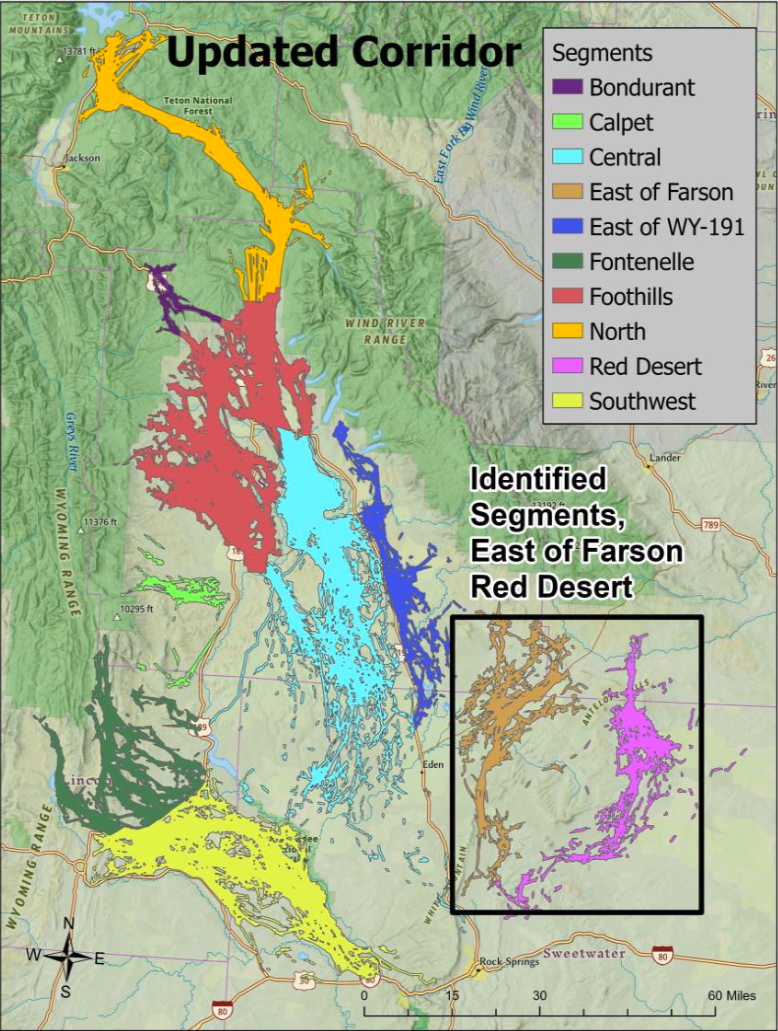
Game and Fish revived efforts to protect the migration in late 2023 and early 2024. Biologists pulled together one of North America’s most comprehensive migration datasets, benefiting from approximately two decades of GPS collar information collected from more than 400 pronghorn.
Some controversy followed the process until near the end. There was a debate about whether to designate the migration’s two easternmost segments, in the Red Desert and east of Farson. The Game and Fish Department proposed excluding the routes, but was overridden by its commission. Then Gordon upended that decision, excluding the two segments.
Vetting the migration corridor through a Gordon-appointed working group was the second-to-last step in the designation process.
“Today’s designation demonstrates that voluntary, locally driven conservation works,” said Robb Slaughter, who chaired the group, during the commemoration at Trapper’s Point.
Time will tell if that’s the case. Wyoming’s migration policy is, by design, permissive of development. Private land is exempt from protections, and designation is not an assurance that new stressors won’t be added to the landscape.

“Today is not the end of the process,” Slaughter said. “It’s the beginning of the next chapter. Continued monitoring, adaptive management, research, and cooperation will ensure these recommendations remain effective as conditions change.”
But Friday was the end of the migration designation process. The governor’s informal OK — no signature was needed — was the last step, said Sara DiRienzo, the governor’s deputy policy advisor.
Wildlife advocates celebrated the moment.
“This is historical,” Bruce said. It’s the first effort to protect the full length of a pronghorn migration corridor in the nation, she said.
-

 Maryland5 minutes ago
Parents of former Maryland athlete killed in 2024 car crash start foundation in his honor
-

 Michigan12 minutes ago
Michigan State hockey breaks program record with nine NHL Draft picks
-

 Massachusetts15 minutes ago
Off-duty Massachusetts State Trooper seen on video punching another trooper at bar
-

 Minnesota27 minutes ago
How Minnesotans are coming together to support Venezuela after deadly earthquakes
-

 Mississippi30 minutes ago
McRae: Mississippi Firsts
-

 Missouri35 minutes ago
Children receive custom playhouses at Habitat for Humanity’s first-ever playhouse build event
-

 Montana42 minutes ago
Iron (MN) HS ATH Isaiah Asuma Commits to Montana State
-

 Nebraska45 minutes ago
These high school athletes defined the state of Nebraska — who’s the greatest?

