Wyoming
A Long-Delayed BLM Resource Management Plan in Southwest Wyoming Pits Conservation Against Resource Extraction – Inside Climate News


For the last 16 years, Joy Bannon has been leading tours of the land near Rock Springs, Wyoming. Usually, Bannon and her cohort mosey through Wyoming’s southwest landscape—home to the sandstone badlands and slithering dunes of the Northern Red Desert, and the Big Sandy Foothills, a sea of sagebrush bordering the Wind River range—in vehicles, chattering over walkie talkies. At a particularly stunning vista, they set out on foot or take to the skies. Flyovers cover more ground, and better showcase the area’s topographical diversity.
Bannon, the executive director of the Wyoming Wildlife Federation, a nonprofit that advocates for policies that preserve Wyoming’s wildlife, landscapes and strong recreation heritage, leads the tours to help county, state and federal officials along with other nonprofits, all of them involved in Bureau of Land Management’s Rock Springs Resource Management Plan, better understand the region’s natural contours.
“When a decision maker is more familiar with an area, they’re going to have more ownership,” she said. “They’re going to be more interested, they’re going to be able to make decisions with a better understanding of what they’re making a decision on.”
For over a decade—an unprecedented amount of time—the Bureau of Land Management (BLM) has been working to finalize a Resource Management Plan for its Rock Springs field office, which manages 3.6 million acres of land in the area. This week, the process inched closer to completion after the BLM concluded its public comment period. While Bannon’s tours may have helped increase interest in conservation of the land she loves, there’s still staunch disagreement about how it should be managed.
We’re hiring!
Please take a look at the new openings in our newsroom.
See jobs
Resource management plans establish long-term policies for how the BLM juggles dozens of competing interests—oil and gas extraction, mining for coal and trona (the main mineral in baking soda), renewable energy development, livestock grazing allotments, animal migration corridors and recreational opportunities, to name a few. Without a new plan, the agency operates under the old one, in this case a relic from 1997.
Last August, the BLM announced its draft plan and preferred alternative, a non-binding step it is legally required to take. The agency chose its Alternative B, which “conserves the most land area for physical, biological, and cultural resources” while implementing the most restrictions on resource extraction, the Bureau said.
State politicians, public officials and members of Wyoming’s oil and gas industry, which, under Alternative B, would be prevented from bidding on over half of the land under management, did not mince words in response to the BLM’s plan, calling it a national disaster and a death knell to the state’s economy.
But conservationists have countered that the oil and gas industry hasn’t shown interest in much of the land under the BLM Rock Springs Office’s jurisdiction, justifying more stringent leasing restrictions by the agency. The presence of culturally sacred sites for Indigenous Nations, valuable recreation areas, indispensable habitats and wildlife migration corridors make future oil and gas leases undesirable, leaving conservation as the right management tool for the job, they contend.
BLM director Tracy Stone-Manning defended the agency’s selection of Alternative B in a statement to Inside Climate News, saying the alternative strikes “a balance with conservation and multiple uses.” Nonetheless, she said the agency has valued Wyomingites’ feedback throughout the comment process. “Our experience is that the more a public discussion goes into the details, science and intention of a proposed plan, the more the heated rhetoric dissipates and the better the final product will be.”
Members of the Petroleum Association of Wyoming, a trade group that represents the industry’s interest in the state, declined to comment for this story after multiple requests.
The backlash and fierce public debate have illuminated the contours of a wider struggle in Wyoming: preserving some of the Cowboy State’s spectacular and sacred scenery in the face of its economic reliance on fossil fuel extraction.
In November, Wyoming Gov. Mark Gordon convened a task force of representatives from energy, conservation, agriculture and recreation organizations to come up with consensus-driven recommendations for the BLM. On January 10, the task force submitted its recommendations to the agency; a week later the public comment period for the BLM’s proposed plan, already once extended, ended.
Now, the agency returns to the drawing board with thousands of lines of texts from Wyomigites detailing changes they’d like to see in the agency’s management approach.
“We’re excited to see the BLM making a shift to acknowledging that multiple use mandates require equal balancing of conservation,” and resource extraction, said Julia Stuble, the Wyoming state director of the Wilderness Society, describing her initial reaction to the agency’s preferred alternative.
Stuble, born in southern Wyoming and now a Lander resident, built her career advocating for broad environmental and public land issues. Even after decades of work in the field, seeing a BLM preferred alternative so devoted to conservation came as “such a surprise,” she said.
Part of her shock stemmed from BLM’s proposal to cordon off 61 percent of the land from future oil and gas leasing, a figure the industry has seized on.
“We have significant concerns about the current [preferred] plan as it stands,” Ryan McConnaughey, Petroleum Association of Wyoming vice president and director of communications, told Wyofile, a state news outlet. McConnaughey added that technological advancements in hydraulic fracturing have allowed producers to access rock formations with fewer surface level disturbances.
“Their preferred alternative, from their own admission, would cut economic output in the field office by over half,” he said.
In comments submitted to the BLM, the Petroleum Association of Wyoming and Western Energy Alliance, a trade group representing oil and gas interests in nine Western states, argued that the BLM had made a “hard left turn” by selecting Alternative B. The two organizations asserted that making more acreage available for future leases would be an “environmentally protective outcome” as it would prevent oil and gas projects (and their emissions) from being transferred to other areas of the U.S., or overseas.
Local county officials have expressed concerns about what a decrease in oil and gas leases would mean for the region’s economy. “This Alternative B—if they actually got this whole thing through—would destroy our county,” said Mary Thoman, a Sweetwater County commissioner who was a local government cooperator, helping the BLM craft alternatives for the plan over the past 12 years. Reducing the number of future oil and gas leases would “affect the senior citizen centers, really impact the schools, the county infrastructure—it would be totally devastating,” Thoman said. “It’d be like shutting our county down, basically.”
But the oil and gas industry has shown little interest in the lands under BLM management in Rock Springs, and in a recent revenue estimate forecast, Wyoming acknowledged that its natural gas production has declined by nearly 50 percent since 2009.
“When you dig into where the potential oil and gas for future development is, it’s low,” Stuble said. What’s more, closures from Alternative B wouldn’t affect “existing production and future production of existing leases,” she said.
In 2023, the oil and gas industry bid on public lands available for oil and gas leasing, including acreage in the Rock Springs management plant. From quarters two through four, 3.5 percent of the acreage up for sale across the entire state yielded nearly 85 percent of the revenue, according to an analysis by the Center for Western Priorities, an environmental nonprofit that advocates for conservation of America’s Western landscapes. Over three quarters of the acres up for sale didn’t sell at all or sold for the $10 minimum.
Aaron Weiss, deputy director of the Center For Western Priorities, did not buy the argument that today’s low-potential lands could be tomorrow’s booming oil reserves. “The oil and gas industry has basically been in charge of the leasing process for the last hundred years,” he said. “Almost any parcel of land in the West that has produced oil or will ever produce oil is already under lease.”
Even low-potential leases sitting untouched for years could be a waste of state and federal resources, said Alec Underwood, program director of the Wyoming Outdoor Council, a state-based conservation organization. Undeveloped leases come “at the cost of agency resources, at the cost typically of taxpayers. It can also preclude, you know, other use of those lands, like restoration,” he said.
The fight to preserve some of the conservation priorities the BLM outlined in Alternative B in the agency’s final draft, the next step in the plan process, involves more than disagreement over the sprawl of oil and gas leases. For some, culturally significant sites and the majesty of the lands and animals under the BLM’s jurisdiction are reason enough to ensure they remain pristine for decades to come.
The White Mountain Petroglyphs, designs carved by hand into pale sandstone cliffs more than 200 years ago, sit in the Red Desert, the heart of the land under the BLM’s jurisdiction. The site is “culturally important to four Native American tribes,” the BLM states. But despite the site’s significance and proximity to several expired oil and gas permits and abandoned wells, no representative from Native Nations were included on Gov. Gordon’s task force.
Rock Springs is also home to a state-recognized mule deer migration corridor—the species’ longest on earth—and the ranges where the deer seek food during Wyoming’s brutal winter, said Josh Coursey, co-founder and president of the Muley Fanatic Foundation.
Coursey, who was appointed by Gov. Gordon to represent hunters’ interests on the resource management plan task force, believes a balanced approach to conservation and resource extraction will be crucial for the prospects of mule deer in Wyoming.
Mule deer have declined 40 percent over the last three decades, he said, for a variety of reasons.
“Habitat fragmentation, that certainly has been a big culprit,” he said. There may be no “silver bullet” to save the mule deer, but “wide open spaces,” like those under BLM jurisdiction in Rock Springs “would certainly be valuable for the health of deer populations.”
This story is funded by readers like you.
Our nonprofit newsroom provides award-winning climate coverage free of charge and advertising. We rely on donations from readers like you to keep going. Please donate now to support our work.
Donate Now
And, for the people living on these lands, the Northern Red Desert and Big Sandy Foothills—also called the “Golden Triangle” for the triangular shape highways 181 and 91 mark around the land yawning toward the Wind River mountains—represent some of the best recreation and hunting opportunities in the state, said Underwood. These lands are “a true iconic landscape of the American West,” he said. “It’s a place worthy of protection.”
Coursey and Underwood, both members of Gov. Gordon’s task force, viewed the deliberations largely as a success; the group was able to come to consensus on a range of issues, including those raised by the state’s powerful ranching industry. They each noted that 45 days spanning two major holidays was hardly enough time to flesh out all the concerns from every stakeholder at the table.
For instance, the group could not come to an agreement around oil and gas leases in the Northern Red Desert and Big Sandy Foothills, Underwood said. “We’re still pushing and hoping that the BLM will implement some of the added protections” in the final draft, he said.
Coursey expects that task force’s feedback to help usher in a “mosaic and hybrid approach” to managing the lands that will meet a range of priorities across all the stakeholders on the task force.
That final document may still be a ways off. Now that the BLM has public feedback, the agency will begin evaluating and revising its draft plan. Then, it will submit a final plan and Environmental Impact Statement, which are subject to simultaneous 30-day protest periods for the public and a 60-day review period by the governor.
In the meantime, Wyoming Attorney General Bridget Hill and the state’s general assembly have explored taking legal and legislative actions against the BLM for its draft proposal.

Jake Bolster
Contributor
Jake Bolster is a freelance multimedia journalist who covers climate and the environment across the United States.

Wyoming
Wyoming Cultural Trust Fund awards $529K in grants, including several Fremont County projects


CHEYENNE, Wyo. — Wyoming is a state known for cowboys, rodeos, and beautiful plains, but is also known for being the first territory to grant women the right to vote, something historian Jennifer Helton explored in her Suffrage Stories presentation.
Helton was invited to highlight Wyoming’s remarkable role in the fight for women’s suffrage as part of the museum’s special America 250 Discover & Discuss series on Jun 18, but the recorded version was just released. This is a part of Cheyenne Frontier Days Old West Museum’s goal of exploring Cheyenne and the greater state of Wyoming’s history.
Helton’s presentation not only celebrates Wyoming’s role in suffrage, but also how the state’s pioneering women helped shape the future of voting rights across the nation.
Born and raised in Wyoming, Jennifer Helton left the state at age 18 to attend college, “which left a giant, Wyoming-sized hole in my heart,” Helton said, “and the way that I fill that hole is by conducting research on women’s suffrage.”
Upon realizing that most people outside of the state of Wyoming did not know the West’s progressive role in suffrage, she became obsessed with bridging this knowledge gap and researching the history of suffrage.
“My kids would tell you it’s an obsession, not just an interest or a hobby,” Helton said. “They always joke that I have three kids, the two of them and then Esther Morris.”
During her presentation, Helton’s admiration for Esther Morris was apparent due to her trailblazing nature as suffragist, her courage to stand up to torch-bearing mobs, and abolitionist activities.
Interestingly enough, her sons were also instrumental in shaping Wyoming’s history. E.A. Slack is known as the “Father of Frontier Days” and citizens of Wyoming can thank Robert C. Morris for Cheyenne’s public library, as he brought the Carnegie Public Library System to Wyoming.
.
” data-large-file=”https://i0.wp.com/capcity.news/wp-content/uploads/2026/06/image-2.png?fit=780%2C863&ssl=1″ alt=”” class=”wp-image-170117″ style=”aspect-ratio:0.90332473687879;width:464px;height:auto” srcset=”https://i0.wp.com/capcity.news/wp-content/uploads/2026/06/image-2.png?resize=925%2C1024&ssl=1 925w, https://i0.wp.com/capcity.news/wp-content/uploads/2026/06/image-2.png?resize=271%2C300&ssl=1 271w, https://i0.wp.com/capcity.news/wp-content/uploads/2026/06/image-2.png?resize=768%2C850&ssl=1 768w, https://i0.wp.com/capcity.news/wp-content/uploads/2026/06/image-2.png?resize=780%2C864&ssl=1 780w, https://i0.wp.com/capcity.news/wp-content/uploads/2026/06/image-2.png?resize=400%2C443&ssl=1 400w, https://i0.wp.com/capcity.news/wp-content/uploads/2026/06/image-2.png?resize=706%2C782&ssl=1 706w, https://i0.wp.com/capcity.news/wp-content/uploads/2026/06/image-2.png?w=960&ssl=1 960w, https://i0.wp.com/capcity.news/wp-content/uploads/2026/06/image-2-925×1024.png?w=370&ssl=1 370w” sizes=”auto, (max-width: 780px) 100vw, 780px”/><figcaption class=) Photo of Esther Morris, the first female justice of the peace (Cheyenne Frontier Days Old West Museum). Credit: Cheyenne Frontier Days Old West Museum (Jennifer Helton Presentation) / Cheyenne Frontier Days Old West Museum
Photo of Esther Morris, the first female justice of the peace (Cheyenne Frontier Days Old West Museum). Credit: Cheyenne Frontier Days Old West Museum (Jennifer Helton Presentation) / Cheyenne Frontier Days Old West Museum
Throughout the course of her presentation, Helton revealed the results of her research by tracing the course of American history in order to highlight the intersection between Wyoming, women, and winning the right to vote.
The talk also highlighted incredible Black women such as Lucy Phillips and Nancy Phillips, some of the first Black women to vote.
As America celebrates its 250th anniversary, the museum invites visitors to explore the stories of trailblazers like the nation’s first woman justice of the peace Esther Morris, the first woman governor, the first Black women to vote, and many other extraordinary leaders who made history.
The museum is hosting its special America 250 exhibit and allows visitors to discover the stories, artifacts, and moments that connect the community to the nation’s history. The exhibit even features six U.S. presidents who visited Cheyenne or Cheyenne Frontier Days, and is currently running at the museum. For those who cannot attend, lectures such as this are filmed and provided online.
As Helton closed her lecture, she read the words of Esther Morris, “I say do all the good you can while you do live.”
“Because women like Esther Morris, like Theresa Jenkins, had the courage to stand up and do all the good that they could in their lives we are all able to live the lives that we are living today,” Helton said.
“So, we should be grateful to them, and I think we should also be asking ourselves what is it that we need to be doing so that future generations can preserve the same opportunities we have, and perhaps more.”
Watch Jennifer Helton’s full presentation at the link provided here.
To learn more about historian Jennifer Helton visit jenniferhelton.org.
.
” data-large-file=”https://i0.wp.com/capcity.news/wp-content/uploads/2026/06/image-3.png?fit=780%2C519&ssl=1″ alt=”” class=”wp-image-170141″ srcset=”https://i0.wp.com/capcity.news/wp-content/uploads/2026/06/image-3.png?resize=1024%2C681&ssl=1 1024w, https://i0.wp.com/capcity.news/wp-content/uploads/2026/06/image-3.png?resize=300%2C200&ssl=1 300w, https://i0.wp.com/capcity.news/wp-content/uploads/2026/06/image-3.png?resize=768%2C511&ssl=1 768w, https://i0.wp.com/capcity.news/wp-content/uploads/2026/06/image-3.png?resize=1536%2C1022&ssl=1 1536w, https://i0.wp.com/capcity.news/wp-content/uploads/2026/06/image-3.png?resize=1200%2C799&ssl=1 1200w, https://i0.wp.com/capcity.news/wp-content/uploads/2026/06/image-3.png?resize=780%2C519&ssl=1 780w, https://i0.wp.com/capcity.news/wp-content/uploads/2026/06/image-3.png?resize=400%2C266&ssl=1 400w, https://i0.wp.com/capcity.news/wp-content/uploads/2026/06/image-3.png?resize=706%2C470&ssl=1 706w, https://i0.wp.com/capcity.news/wp-content/uploads/2026/06/image-3.png?w=1605&ssl=1 1605w, https://i0.wp.com/capcity.news/wp-content/uploads/2026/06/image-3-1024×681.png?w=370&ssl=1 370w” sizes=”auto, (max-width: 780px) 100vw, 780px”/><figcaption class=) Jennifer Helton’s information (Cheyenne Frontier Days Old West Museum).
Jennifer Helton’s information (Cheyenne Frontier Days Old West Museum).
Related
Wyoming
At 6,000-year-old crossing, Gov. Gordon OKs Wyoming’s first-ever designated pronghorn migration route – WyoFile

SUBLETTE COUNTY—Gov. Mark Gordon heralded Wyoming’s first-ever designation to protect a pronghorn migration corridor — a more than 2 million-acre web of habitat — at Trapper’s Point, which he called a “wonderful passageway.”
“How incredibly valuable it is that you are standing here today,” Gordon told the crowd, “to witness this remarkable moment.”
Gordon commemorated the moment with his feet planted on the narrow bulge of high country that splits the Green and New Fork rivers. Thousands of years ago, the site was a well-used hunting ground for Native Americans — it’s the earliest known killing and processing site for pronghorn in North America. Now it boasts a wildlife overpass.
No pronghorn were to be seen during the especially windy Friday afternoon gathering, which attracted 75 attendees from nearby Pinedale and other western Wyoming communities.
Now Trapper’s Point is officially classified as a “bottleneck” for the Sublette Pronghorn Herd — one of 13 such bottlenecks. That classification is supposed to prevent any surface-disturbing activity, with the intent that pronghorn can keep passing through Trapper’s Point for generations to come.

Protecting the ability of the fleet-footed, tawny-and-white ungulates to migrate is a “key factor” in sustaining their population, Wyoming Game and Fish Director Angi Bruce said.
“This becomes even more important in severe winters or extreme droughts,” Bruce said. “Pronghorn are long overdue for recognition.”
Pronghorn in Sublette, Teton, Sweetwater and Lincoln counties travel a long road — some migrate more than 200 miles to escape harsh winters, trekking south into the lower Green River Basin, a semi-arid sweep of sagebrush steppe between Pinedale and Rock Springs. Then in the spring, they retrace those paths, returning to summer ranges, lush with verdant vegetation, even going as far as Grand Teton National Park.
There was also a long road of bureaucracy to get to this point.
Nearly three decades of effort preceded the formal designation of the migration routes used by the Sublette Pronghorn Herd, which is the farthest-traveling and among the largest pronghorn herds in the West.
Jackson Hole biologists long knew that the valley’s pronghorn left in the winter. But details were hazy on where they went and how they got there until around the turn of the century. Using data from tracking collars, biologists like Joel Berger, Steve Cain, Hall Sawyer and Doug Brimeyer helped delineate the route.

In 2008, a Bridger-Teton National Forest plan amendment established a portion of the path as the nation’s first designated wildlife migration corridor.
Popularized by its branding as the “Path of the Pronghorn,” the route has received press in national publications like High Country News and the New York Times.
But the southern reaches of the migration through the energy-rich Green River Basin have faced major political opposition since the early 2000s. Wyoming first attempted to protect those travel corridors in 2019, under a policy administered by the Wyoming Game and Fish Department. That effort was halted after a coalition of industry trade groups and counties protested.
Then, in early 2020, Gordon revamped the migration policy with an executive order. Still, the Sublette Pronghorn Herd proposal gathered dust, even as development threatened the route.
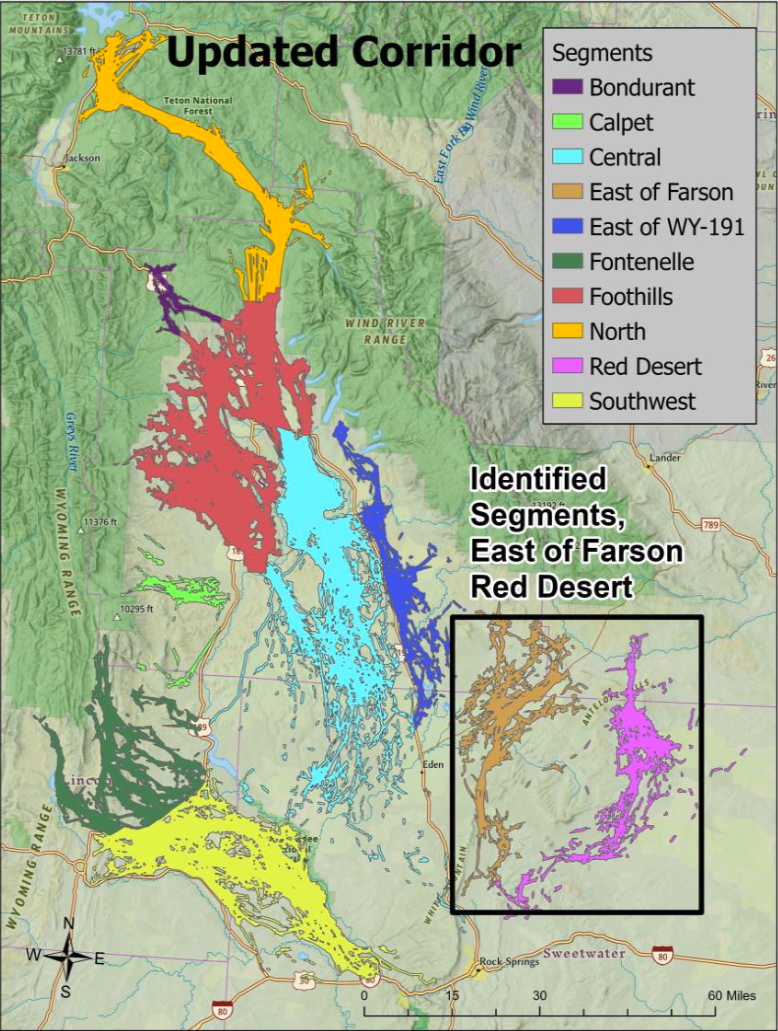
Game and Fish revived efforts to protect the migration in late 2023 and early 2024. Biologists pulled together one of North America’s most comprehensive migration datasets, benefiting from approximately two decades of GPS collar information collected from more than 400 pronghorn.
Some controversy followed the process until near the end. There was a debate about whether to designate the migration’s two easternmost segments, in the Red Desert and east of Farson. The Game and Fish Department proposed excluding the routes, but was overridden by its commission. Then Gordon upended that decision, excluding the two segments.
Vetting the migration corridor through a Gordon-appointed working group was the second-to-last step in the designation process.
“Today’s designation demonstrates that voluntary, locally driven conservation works,” said Robb Slaughter, who chaired the group, during the commemoration at Trapper’s Point.
Time will tell if that’s the case. Wyoming’s migration policy is, by design, permissive of development. Private land is exempt from protections, and designation is not an assurance that new stressors won’t be added to the landscape.

“Today is not the end of the process,” Slaughter said. “It’s the beginning of the next chapter. Continued monitoring, adaptive management, research, and cooperation will ensure these recommendations remain effective as conditions change.”
But Friday was the end of the migration designation process. The governor’s informal OK — no signature was needed — was the last step, said Sara DiRienzo, the governor’s deputy policy advisor.
Wildlife advocates celebrated the moment.
“This is historical,” Bruce said. It’s the first effort to protect the full length of a pronghorn migration corridor in the nation, she said.
-

 Alabama1 minute ago
Two ejected after boat crash on Alabama lake
-

 Alaska7 minutes ago
Alaska Sen. Dan Sullivan’s primary challenger who has the same name is eligible for ballot, judge rules
-

 Arizona13 minutes ago
Where People Are Moving To In Arizona In 2026
-

 Arkansas16 minutes ago
Fourth of July 2026: Where to celebrate across Northwest Arkansas | Northwest Arkansas Democrat-Gazette
-

 California17 minutes ago
Long Beach officials confirm first California case of human West Nile virus in 2026
-

 Colorado29 minutes ago
Colorado State Patrol investigating after pedestrian struck on Highway 36
-

 Connecticut31 minutes ago
2026 Connecticut Little League softball state tournaments
-

 Delaware36 minutes ago
Severe thunderstorm to bring 60-mph winds, hail to Sussex County

