West
WATCH: Trump-appointed judge chides colleagues' ignorance on guns in unique video dissent
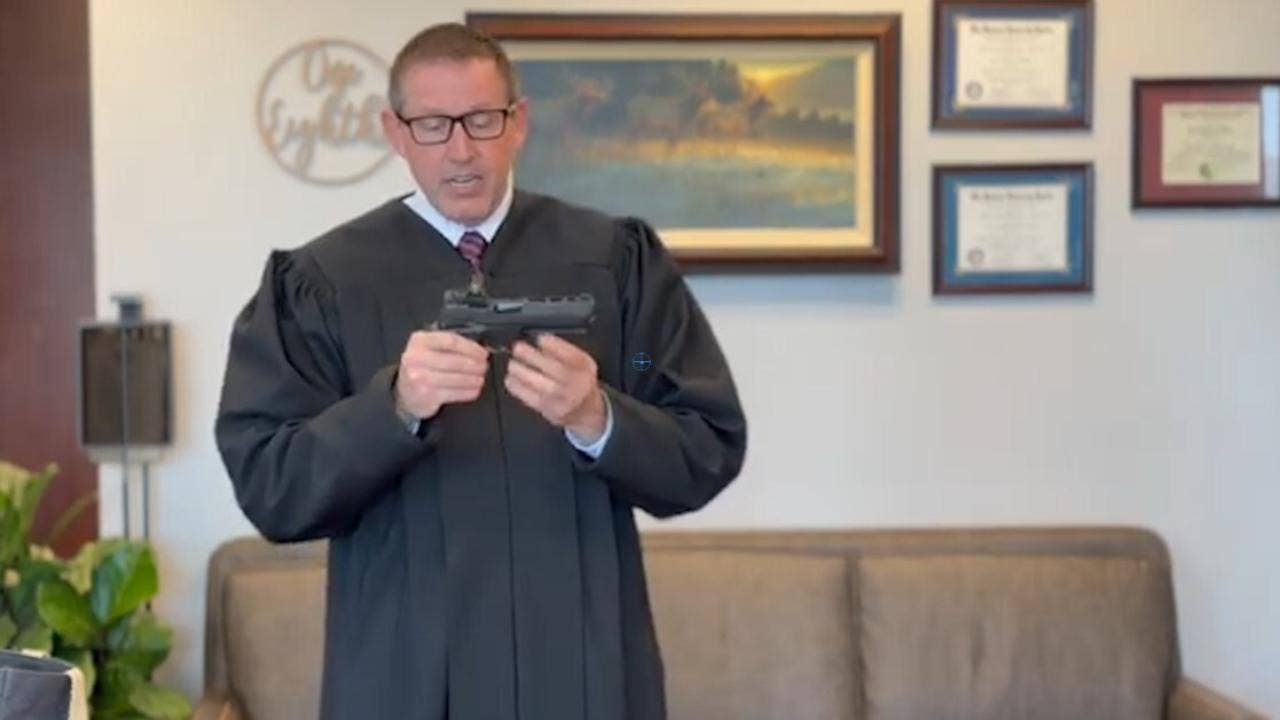
Judge Lawrence VanDyke of the U.S. Court of Appeals for the Ninth Circuit, appointed by President Donald Trump during his first term, issued a unique dissenting-opinion video when his colleagues voted to uphold a California ban on magazines that hold more than 10 rounds of ammunition.
In an 18-minute video uploaded to the Ninth Circuit’s YouTube channel, VanDyke argued that the other judges on the appellate court lacked “the basic familiarity with firearms to understand the inherent shortcomings and obvious inadmissibility of the test that California was proposing” when they voted by a 7-4 margin Thursday to uphold the ban.
Dressed in his judicial robes, VanDyke went on to show the mechanics of his personal firearms for several minutes.
SCHOOL CHOICE ACTIVISTS WARN PARENTS ABOUT BLUE STATE’S HOMESCHOOL BILL WITH JAIL-TIME PROVISION
Dissent video in 23-55805 Duncan v. Bonta: Judge Lawrence VanDyke of the U.S. Court of Appeals for the Ninth Circuit criticized his colleagues’ “basic misunderstanding of how firearms work” after they voted to uphold magazine restrictions.
“As an appellate body, it’s obviously not our role to make factual determinations,” VanDyke said in the video. “So I share this not to supplement the factual record that we’re using to decide this case. Instead, I share this because a rudimentary understanding of how guns are made, sold, used and commonly modified makes obvious why California’s proposed tests and the one my colleagues are adopting today simply does not work.”
VanDyke went on to say he could “explain all this in writing” but that it is “much more effective to simply show” what he means through demonstrating it. He also said he had “rendered inoperable all the guns and gun parts” for the video demonstration for safety purposes.
In his discussion, VanDyke challenged California’s argument that a magazine holding more than 10 rounds of ammunition is merely an accessory, not an arm protected by the Second Amendment, saying this argument is inconsistent with the facts of how a gun works, as a magazine plays an essential role in the function of a firearm, just like the firearm itself.
PUBLIC SCHOOL STUDENTS IN THIS STATE COULD SOON BE REQUIRED TO TAKE GUN SAFETY COURSES
Assault weapons and handguns are seen for sale at Capitol City Arms Supply on Jan. 16, 2013, in Springfield, Ill. (AP Photo/Seth Perlman, File)
VanDyke asked California’s counsel whether the reasoning that was used to justify banning these types of magazines could also be applied to semi-automatic firearms, which hold more rounds than older weapons, like muskets. He argued that the logic behind banning magazines could extend to banning semi-automatics altogether, which he suggested would be a broader and more extreme infringement of Second Amendment rights.
“I don’t think that we could ban all semi-automatic weapons,” California’s attorney for the case said in the discussion. “The point I was just making is, with respect to accessories, I think we have a difference of opinion.”
“That’s important, because your argument turns on whether you can characterize accessories,” Van Dyke responded. “So, you would say that the revolver versus semi-automatic is not an accessory, but that, but that a magazine is an accessory. So, what would you think about like a red dot sight? You know, electro optics, which are, which many, many firearms are going to, electronic optics nowadays? They’re obviously an accessory, because you could have iron sights. Could you ban those?”
“Your Honor, I’m not intimately familiar with that,” the counsel responded. “And I do want to answer this question and make sure that I save time for rebuttal.” The state’s attorney went on to say that at issue is whether, as an accessory, it is essential to exercising the right to self-defense.
TRUMP SURROGATE CORRIN RANKIN PICKED TO LEAD BLUE STATE’S GOP: ‘MAKE CALIFORNIA GREAT AGAIN’
AR-15 style rifles are displayed for sale at a gun store. (REUTERS/Bing Guan) (Reuters/Bing Guan)
In her majority opinion, Clinton appointee Judge Marsha Berzon wrote that VanDyke’s video was “wildly improper” and that he “in essence appointed himself as an expert witness in this case.”
In 2016, the California legislature passed Senate Bill 1446, which banned the possession of so-called “large-capacity” magazines, or those that hold more than 10 rounds, starting July 1, 2017. The bill also imposed fines for those who failed to comply with this ban.
Later in 2016, Proposition 63 was approved by California voters, which incorporated the provisions of Senate Bill 1446 but also added a criminal penalty for the unlawful possession of large-capacity magazines after the July 1, 2017, deadline.
Read the full article from Here
Wyoming
Statewide candidates split on Wyoming GOP’s plans to defy state law and make endorsements
by Maggie Mullen, WyoFile
After the Wyoming GOP voted to defy a state law prohibiting the party from backing one Republican over another before the primary election, statewide candidates are split on whether they would accept such an endorsement.
Some told WyoFile they agree with the party’s decision and will seek out an endorsement, while others said they oppose a political party breaking election law. A few said they were taking a wait-and-see approach.
“Jury’s still out on this one for me,” Wyoming State Auditor Kristi Racines said Wednesday.
For years, the Wyoming Republican Party has argued that because it is a private organization, state laws that govern its organizational structure and prohibit it from endorsing or financially backing candidates in opposed primary election races are unconstitutional.
At its convention in Douglas last weekend, the party took things into its own hands, voting to adopt bylaws establishing a process for vetting, endorsing and spending money to support candidates ahead of the primary.
Supporters of the new bylaws point to a U.S. Supreme Court ruling from 1989, which struck down California’s ban on political party endorsements, ruling that the law violated the First Amendment’s guarantees of free speech and association. Opponents, meanwhile, raised concerns at the convention about the bylaws breaking the law, litigation costs and unintended consequences.
The new bylaws are widely expected to spark lawsuits, while the Wyoming Republican Party has said it plans to file its own legal challenge against the state.
In the meantime, the new bylaws lay out a process for evaluating candidates based on “commitment to the Wyoming Republican Party Platform, demonstrated loyalty to the Party’s principles, legal eligibility to hold office, and for incumbents, their voting record.”
The state party will consider candidates running for Wyoming’s state-elected officials — including governor, secretary of state, superintendent of public instruction, treasurer and auditor — as well as congressional candidates. Otherwise, county parties “may vet all other races on their respective County Ballots,” according to the new bylaws.
The state party, as well as each county party, “shall each create and oversee a Candidate Vetting Committee empowered to review and recommend approval or disapproval of candidates based on established criteria,” the bylaw states. “The Committee shall provide candidates an opportunity to respond to concerns prior to issuing a recommendation.”
Candidates
Brent Bien, who is running for governor, told WyoFile the bylaw changes are “a long time coming,” pointing back to the 1989 ruling.
“I think we just got to make sure we get those folks that truly believe on the Republican side of the equation, who truly believe in the platform and what Wyoming stands for,” Bien said. “And I just don’t think there’s been any enforcement mechanism to do that.”
At the convention, Bien was a clear favorite among many attendees who wore his campaign buttons and t-shirts. Still, Bien said he wouldn’t be surprised if he didn’t get the party’s endorsement.
“I didn’t get Trump’s endorsement,” Bien said. “And some of these legislators around the state, you know, they haven’t endorsed me.”
Bien’s take isn’t shared by all the gubernatorial candidates.
“Contested primaries should be decided by voters,” Gillette Sen. Eric Barlow wrote in a statement. “The role of the state party is to unite Republicans around shared values and help grow the party, not decide elections before voters have had their say.”
“Under current law, the state party should not choose sides in Republican primaries, and I will not ask them to start now,” he wrote. “My job,” running for governor, “is to earn the trust of Wyoming voters directly.”
At the convention, supporters of the bylaws said the party had tried to get the Legislature to change state statute. Barlow directly pushed back on that argument.

“As a legislator for the past 14 years, this issue has never come before us,” Barlow said. “If it had, it would have ensured all Wyomingites could weigh in and decisions would have been made openly and transparently — not in the courts and not a few months before an election.”
Secretary of State Chuck Gray, who is running for U.S. House, told WyoFile he supports the new bylaws.
“I will participate in the Party’s vetting process and will seek their support because I’m the only candidate in this race with a proven record of standing up for conservative principles — even when it wasn’t popular with the media and the insiders,” he wrote in a statement.
As secretary of state, Gray is Wyoming’s chief election officer and oversees statewide election administration. Asked if he wanted to comment in his official capacity on the Wyoming Republican Party’s decision to defy state law, Gray did not respond by publishing time.
U.S. House candidate David Giralt took a more cautious approach when asked for his opinion on the new bylaws.
“I trust Wyoming Republicans to make good decisions for our party, and I’ll let the process play out,” Giralt said. “I’m focused on getting in front of as many Wyoming voters as possible and making the case for why I’m the right person to represent this state in Congress.”
Kevin Christensen, another U.S. House candidate, said he wanted to see how fair, transparent and consistent the process played out before weighing in.
“The Wyoming people are the ones that make the determination in the primary, not the party,” he said. “That being said, if this is about supporting candidates and determining who is really a Republican and who’s just putting an ‘R’ next to their name, that seems like that would be consistent with being the Republican Party.”
Jillian Balow, yet another candidate for U.S. House and former superintendent of public instruction, said she “would be honored to accept an endorsement and money from the state party only if it is in accordance with Wyoming and federal law.”
“The contingency of our party at the convention knew the changes they made defied state law and they curtailed delegate discussion to pass new by-laws anyway,” Balow wrote in a statement. “Some delegates were appalled, some were gleeful, and many were silent, because they were silenced. This is not the way Wyoming does business.”
U.S. House candidate Reid Rasner also pushed back on the new bylaws.
“As a pro-Trump conservative, I always expected the political establishment to try and stop our campaign,” he wrote in a statement. “But, after making over 200 stops across our communities, one thing is clear: people are tired of the political games.”

Sheridan Republican Rep. Tom Kelly, who is running for superintendent, said while he opposes “the idea of parties having the power to disallow anyone from running under their banner,” he thinks “parties should be able to express publicly which people they would like to represent them.”
Though he’s not actively seeking endorsements, Kelly said he would accept support from the state party.
“Financial backing? Absolutely,” Kelly said. “Contrary to a popular false narrative, I have no wealthy D.C. donors bankrolling me.”
And if the party endorsed one of his opponents, Kelly said he would tell them, “Congrats. I should have done a better job presenting myself.”
WyoFile reached out to other statewide Republican candidates, including those running for governor, secretary of state, superintendent, U.S. House and U.S. Senate. They did not respond by publishing time.
This article was originally published by WyoFile and is republished here with permission. WyoFile is an independent nonprofit news organization focused on Wyoming people, places and policy.
Related
San Francisco, CA
Contributor: May we never grow inured to homelessness
Most Saturday mornings, I stroll half a mile downhill from my tiny apartment in a bosky part of San Francisco to a farmers market. My usual reverie of anticipation (about carrots with their tops attached, about the price of berries) was interrupted recently by the sight of three bodies.
That is, I thought of them as bodies; it was not evident whether they were alive or dead. All lay splayed on the sidewalk, one a couple blocks from my home, the other two, blocks apart, closer to the market, itself located in a neighborhood where need is evident. (Food stamps are often the tender for buying produce.) The bodies belonged to shabbily but fully dressed men — except one man, who was missing a shoe. Maybe the men are sleeping, I thought, or unconscious from drink or drugs. Or maybe they are dead. Nobody walking by — including me — slowed down to pay attention to them, beyond a glance.
For decades, encountering such a scene, I used to stop, then wait to see a leg twitch, a chest rise. I rarely do even that anymore. In high school, I had read with shock that poor people in India, people with no home, slept on the sidewalk, while others just walked by. How awful of those others, I remember thinking. How could they live with themselves? The reproach has come home. We’ve gotten used to homelessness — the homelessness of others.
I guessed the three men on that recent Saturday had no homes, but from many years interviewing a formerly homeless man who is now a civic leader in San Francisco, I learned not to rush to conclusions. Del Seymour, today known locally as the mayor of the Tenderloin, taught me that a man lying with his eyes closed on a sidewalk may have a home, but perhaps was interrupted by temptation or a medical situation on his way there. I also learned from Del, to my initial shock, that some homeless people work full-time jobs. I’ve learned a lot about homelessness, mostly from him, but also from my daily Google alert for the word in the news.
Because those alerts are so rarely encouraging, one seeming spark of good news recently stood out. In Los Angeles County, according to newly released statistics about 2024, the number of deaths among the homeless population decreased from 2023. Yay! I thought. The myriad programs are working! Whether naloxone intervention or tiny houses or new shelters or other efforts (free job training like Del initiated in San Francisco?) are to praise, I felt a surge of hope. Then I read more closely.
Deaths among unhoused individuals in L.A. County had fallen in 2024 not to 100 or so, as I naively hoped, but to 2,208. A trend in the right direction, yes. A cause for celebration, no.
Far too many people know firsthand the emotional and physical grind of homelessness. Virtually all other Californians know it secondhand and have probably asked themselves the same question: What is a (presumably well-meaning) housed person to do in response to the sight of an unhoused person, not to mention many unhoused people? I know of a nurse in San Francisco who screeches her car to a stop when she spots a person in bodily distress and administers CPR if appropriate. I admire her action, but doubt I could replicate it.
Granted, my own main and stubborn response, to spend nearly a decade writing a book about the subject in the hope it will have a helpful impact, is not a route available or attractive to many. And shorter term efforts, such as volunteering at local nonprofits, certainly have more immediate results. One common impulse, in which I take part, if insufficiently and awkwardly, is to give someone food or money, or call 911 when someone clearly needs help.
Yet any pedestrian, especially any female pedestrian, will attest that the impulse to help someone on the sidewalk becomes more challenging if that someone is awake, and male. Will an offering lead to a spit, a scream, a chase? Should we avoid eye contact and walk on? Not necessarily.
What I’ve learned from Del is to offer something that may mean more than a dollar or a sandwich: Say hello.
Acknowledge the person whose face is several feet below your own. This individual is part of a family, “somebody’s son, somebody’s auntie,” Del’s litany goes, and remains a human being. Remind yourself of that. More importantly, remind them. Del adds: Don’t stop if the person seems “nuts,” his enjoyed foray into politically incorrect phrasing. Otherwise, slow down for a few seconds, maybe longer. At some point, over time, and the same route, you might recognize one another and actually have a conversation. Meanwhile, keep it basic, but say something.
I obey. Often, just “Hi.”
Almost always comes an incalculably generous reward: a smile and a greeting returned. Humbled, I move on, again resolved not to let our unhoused neighbors feel invisible, nor to forget that homelessness is, among other adjectives, abnormal.
Alison Owings is the author of “Mayor of the Tenderloin: Del Seymour’s Journey From Living on the Streets to Fighting Homelessness in San Francisco.”
Denver, CO
Denver welcomes national Democrats for 2028 convention site visit, starting with a trip on the A-Line
Denver will welcome representatives from the Democratic National Committee on Tuesday for a three-day show-and-tell highlighting the city as Mayor Mike Johnston tries to woo the party’s leaders into hosting their 2028 convention in the West.
If he’s successful, it will mean 50,000 people will pour into Denver for four days in August of that year.
“It’s kind of like four Super Bowls in a row,” Johnston said in an interview with Denver Post journalists in advance of the delegation’s site visit.
Throughout the visit, much of which could happen during a spring snowstorm, Denver city leaders will attempt to demonstrate the city’s logistical, financial and merriment potential.
Denver is the only one of five finalist cities that is located west of the Mississippi River. The other options are Atlanta, Boston, Philadelphia and Chicago. DNC leaders, including chair Ken Martin, have already visited Atlanta and Philadelphia.
The competition between the rival cities has already begun.
Atlanta’s mayor recently called out most of the other bidding cities, saying, “Boston is history. Philadelphia is played out. Denver is nostalgia. Atlanta is now,” according to the Atlanta Journal-Constitution.
Johnston responded to that, saying: “Of all the disses, I thought ours was actually the best.” It refers to the city’s much-lauded hosting of the 2008 Democratic National Convention, where then-Sen. Barack Obama accepted his party’s nomination on his way to becoming the nation’s first Black president.
Denver’s plan is to focus on what the city has to offer instead of attacking the others, Johnston added. He did take a few jabs throughout the conversation, though.
“(Denver) is cool in the summertime and it’s not 110 degrees in August, like it is in some other places that I won’t name,” he said.
Talking about some of the criteria the DNC will consider in the decision, he said: “It’s very much like, you either have a 20,000-person arena or you don’t. Atlanta does not.”
The visit plan
During the site visit, Johnston and other city leaders will try to infuse “little moments of joy” while also showing off the city’s infrastructure. That will include visits to some of the city’s best restaurants and bars, along with a tour of Rockmount Ranch Wear in Lower Downtown.
If Denver wins the bid, the city plans to host excursions for the delegates in two years. While they’re in the city, visitors are likely to have downtime to explore the region. For their entertainment, Denver will offer things like craft beer tours, history courses on neighborhoods like Five Points and a trip to the city’s mountain parks, Johnston said.
Different bars would be dedicated to delegates from each state — including miniature versions of Denver’s big blue bear in front of each, with a painted flag from their state.
This week’s site visit won’t all be about bid leaders’ ideas for fun, though.
Johnston’s team will also have to show that hosting the convention in Denver will make things easier on the event planners.
After the representatives land at Denver International Airport, Denver officials will show them how to use the A-Line train to travel into the heart of the city — an option that didn’t exist in 2008. Once there, they will lead them on a short walk to some of the nearby hotels.
Johnston said that when he’s spoken to other delegates about past conventions, their biggest complaints have been mostly logistical, such as long commutes between venues. Ball Arena’s easy proximity to downtown is a strong suit of the bid.
Beyond logistical concerns, Denver’s bid team will talk about the city’s hotel offerings, space available for the convention, security options and parking spots. The city’s recent expansion of the Colorado Convention Center is also a major selling point, he said.
Another important focus will be the city’s fundraising capabilities, though officials haven’t cited a specific dollar figure they’re aiming for or disclosed their progress in securing commitments.
“I actually feel very confident about our path. … We are ahead of our projection for what we can raise,” Johnston said.
Stay up-to-date with Colorado Politics by signing up for our weekly newsletter, The Spot.
-
West Virginia2 minutes ago
Verizon outage reported in West Virginia
-
Wyoming8 minutes agoStatewide candidates split on Wyoming GOP’s plans to defy state law and make endorsements
-
Crypto14 minutes agoTriple Win for Bitcoin ETFs With $532M Inflow While Ethereum Adds $61M
-
Finance20 minutes ago
Over 60? These 4 financial moves might offer your best ‘return’ on investment
-
Fitness26 minutes agoAre Upright Rows Bad for Shoulders? How to Build Bigger Delts Without Injury – Muscle & Fitness
-
Movie Reviews38 minutes agoBrian Miller Movie Review: Apex
-
World50 minutes agoCitigroup to announce new profit targets at investor day, CEO says
-
News56 minutes agoVideo: U.S. and Iran Make Competing Claims Over Strait of Hormuz